

OEKO-TEX and GOTS answer two different questions. OEKO-TEX STANDARD 100 asks whether the finished textile is free from harmful substances. GOTS asks whether the fibre is organic and whether the whole supply chain, from farm to factory, meets environmental and social rules. Neither is “better” in general. The right one depends on whether your priority is chemical safety against your baby’s skin, organic content, or both.
If you are choosing a nursing pillow, a bassinet sheet or a muslin, this guide shows you how to read each label, where the common mix-ups are, and how to check a claim before you pay.
TL;DR
- OEKO-TEX STANDARD 100 is about the finished product: it is free from harmful substances, but it does not mean organic.
- GOTS is about the supply chain: organic fibre plus environmental and social criteria from fibre to finished product.
- Choose GOTS when organic content matters most, OEKO-TEX when chemical safety is your main worry, and look for both when you want the widest coverage.
- You can verify both labels online with the certificate or licence number, so you never have to rely on a logo alone.
- Material matters as much as the badge: breathability, washability and how a fabric behaves against skin all affect comfort.
Table of Contents
- What each label actually certifies
- Does either label mean “organic”?
- What GOTS adds that OEKO-TEX doesn’t
- What OEKO-TEX adds that GOTS doesn’t
- Can a product carry both?
- How to check a label in Australia
- Which should you choose for a baby product?
- Fabric still matters as much as the badge
- Our perspective
- Choosing a nursing pillow with comfort in mind
- FAQ
- Sources
What each label actually certifies
The easiest way to separate them: one certifies a result, the other certifies a process.
OEKO-TEX STANDARD 100 is a product-safety label. Textiles carrying it are free from harmful substances. Testing covers the finished item and its components, such as the fabric, thread, zips and trims, and the limits are tighter for products made for babies and young children. That is why you see it on baby bedding, clothing and feeding accessories.
GOTS (the Global Organic Textile Standard) is a processing standard for organic fibres. According to Choice, it sets environmental and social criteria across the entire supply chain. The organisation behind it describes GOTS-certified material as meeting organic, environmental and social criteria through its whole production process, including chemical input restrictions, wastewater treatment and human rights requirements for workers.

A third label sometimes confuses people: OEKO-TEX MADE IN GREEN. It indicates that a product was made under sustainable and socially responsible conditions, so it sits closer to the supply-chain side than the plain STANDARD 100 label does.
Side by side
| OEKO-TEX STANDARD 100 | GOTS | |
|---|---|---|
| Main question | Is the finished product free from harmful substances? | Is the fibre organic, and was it made responsibly? |
| Focus | The end product | The whole supply chain |
| Organic fibre required? | No | Yes, at least 70% |
| Applies to | Conventional, synthetic or organic textiles | Textiles made from organic fibres |
| Social criteria | Not part of STANDARD 100 | Yes, human rights and worker protections |
| How to verify | Label Check with the certificate number | GOTS public database search |
The organic-fibre row is the one that trips people up. A polyester sheet can carry an OEKO-TEX label and a pure organic cotton sheet can fail to carry any label at all. The badge tells you what was assessed, not how “natural” the product feels.
Does either label mean “organic”?
Only GOTS does.
To carry a GOTS label, a product needs organic fibre content at a set minimum. The standard requires at least 70% certified organic fibre. There are two label grades: products with at least 95% organic fibre can be labelled “organic”, while products with 70% to 94% carry a “made with X% organic materials” label. The organic fibre itself must be grown to a recognised organic standard, for example EU or USDA NOP rules, before it enters the GOTS processing chain.
OEKO-TEX STANDARD 100 has no organic requirement. It certifies that the end product has passed its consumer-safety test and that residues sit within its limits. That is a useful assurance, but it is a different one. If a seller says “OEKO-TEX organic”, treat that as a prompt to look closer at what exactly is certified.

Does organic mean softer or better quality?
Not automatically. A textile expert quoted by Wirecutter says it is a myth that organic cotton gives softer, higher-quality fabric. Organic describes how the fibre was grown and processed. Softness, durability and breathability depend on the fibre type, the weave, the finishing and how the item is used and washed. For a baby product, those practical qualities deserve as much attention as the certification.
What GOTS adds that OEKO-TEX doesn’t
Three things set GOTS apart.
- Independent audits along the chain. GOTS requires third-party audits of facilities in the supply chain, including annual on-site inspections and transaction-based verification, so the claim follows the product from raw fibre to finished item.
- Social criteria. Worker safety, fair treatment and human rights requirements apply to the facilities involved, which STANDARD 100 does not cover.
- Environmental processing rules. Chemical input restrictions and wastewater treatment apply during manufacture, not only to the final product.
A parent who cares where and how a product was made, and not only what is left in it, will find GOTS speaks to that more directly.
What OEKO-TEX adds that GOTS doesn’t
OEKO-TEX works on any fibre. That matters because plenty of good baby products are not made from cotton at all, and because a product can be conventionally grown yet still tested clean. It is also the label most likely to appear on items that are not fully organic, such as blended fabrics, trims and zips, foam or fill materials.
If your main worry is what sits against your baby’s skin hour after hour, a tested-for-harmful-substances label speaks to that worry directly. That is also why the two labels are often seen together on the same product: they cover different ground.
Can a product carry both?
Yes. They do not conflict, and one does not replace the other. Some retailers point out that no single label covers everything and that combining certifications gives broader assurance. A simple rule of thumb:
- Organic is your priority: look for GOTS.
- Chemical safety is your priority: look for OEKO-TEX STANDARD 100, and the baby-appropriate product class where it is stated.
- You want both: look for a product carrying both, or one with a clear explanation of what is certified and what isn’t.
For a product with several parts, such as a pillow with a cover, filling, stitching and a zip, ask which components each label covers. A certified cover does not automatically describe the filling inside.
How to check a label in Australia
A logo on a hang tag is not proof on its own. The good news is that checking takes a couple of minutes.
- Find the number. OEKO-TEX labels carry a certificate number. GOTS labels should show the label grade, the certifier’s name and a licence number.
- Look it up. Choice notes that shoppers can use the GOTS online search tool and the OEKO-TEX label-number checker. OEKO-TEX’s Label Check asks for the specific certificate number from the tag.
- Match the scope. Confirm the certificate covers the product type you are buying, not just a different item from the same brand.
- Read the wording. “Made with organic cotton” is not the same as “GOTS certified”, and “tested to OEKO-TEX standards” is not the same as holding a certificate.
The Australian consumer regulator is clear about the principle. The ACCC says products do not need a particular standard or certification to be labelled organic, but a business making an organic claim, including a certification claim, must be able to prove it, and requirements vary between private certifying bodies.
The certifiers police this themselves too. In its 2024 annual report, the Global Standard organisation reported 154 complaints about potential misuse of GOTS signs worldwide, leading to investigations, corrective actions or legal measures. The takeaway for shoppers: the labels are worth looking for, and the lookup tools exist so you can confirm them.
Which should you choose for a baby product?
Think about what you are trying to protect.
If it touches skin for hours
Nursing pillow covers, bassinet sheets, swaddles and muslins spend long stretches against a baby’s skin and your own. Here a chemical-safety label and a breathable, easy-to-wash fabric are the first things to weigh. Our guides to breathable fabric for newborns and whether linen is safe for newborn skin walk through what to look for in the fabric itself.
If sustainability drives your buying
When the environmental and social side matters, GOTS is the label that speaks to it, and the same goes for fillings. Our piece on sustainable pillow filling covers what to ask about what is inside, and the sustainable baby products guide for Australia brings the wider picture together.
If you are on a budget
The cheapest route is not to chase every badge. Decide which one matters to you, verify it with the number, and then weigh the fabric, how often you will wash it, and how long the product will last. A well-made item you can wash repeatedly without it losing shape gives you more use per dollar than a heavily badged one that you replace.
Common mix-ups to avoid
- “OEKO-TEX means organic.” It does not. It is about harmful substances in the finished product.
- “GOTS means it is tested like OEKO-TEX.” GOTS has its own chemical restrictions, but it is a different system with a different scope.
- “Natural means certified.” A natural fibre such as linen or cotton can be a lovely choice without carrying either label. The label is a separate layer of proof.
- “A logo on the website covers the whole product.” Scope can be limited to the fabric, or one component, or one product line.
Fabric still matters as much as the badge
A label certifies something specific. It does not tell you how a fabric feels at 3am, how it handles milk spills, or whether it survives forty washes. Those depend on the material.
That is why we pay so much attention to cover fabric in a nursing pillow. Linen is breathable, durable and softens with washing, which is why we wrote about why linen is better than polyester for babies and five nursing pillow cover checks. If you are weighing natural fibres against synthetic ones, the guide to antibacterial natural fabrics for babies is a good next read, and how fabric choice shapes comfort and safety applies the same thinking to nursing pillows. Washing matters too: our note on washing linen at 30 to 40°C explains how to keep it soft and avoid shrinkage.
Our perspective
We talk to tired mums every day, and the question under “OEKO-TEX or GOTS?” is nearly always the same: “Is this safe for my baby, and will it actually help me?”
Our view is that a certification tells you about one layer of a product, and the rest comes from design and materials. A nursing pillow is a good example. Most pillows that fail mums fail on shape, not on paperwork: they collapse under a baby’s weight, so you end up hunching over to feed. That is why we built ours with an 18cm lift that brings baby to you, a compression-resistant fill designed to hold its shape, and a stable design that is meant to cut down on repositioning.
We chose a hypoallergenic French flax linen cover because it is breathable and durable, with machine washable components, so that daily laundry is realistic when you are sleep-deprived. Look at what a label covers, check it with the number, and then ask whether the product suits the way you will use it every day.
Marietjie
Choosing a nursing pillow with comfort in mind
If you are comparing nursing pillows, our Nursing Pillow is made for ergonomic feeding. It has an 18cm lift to bring baby up to you, a compression-resistant fill designed to keep its shape, and a stable design to reduce repositioning. It also works for tummy time and general support.
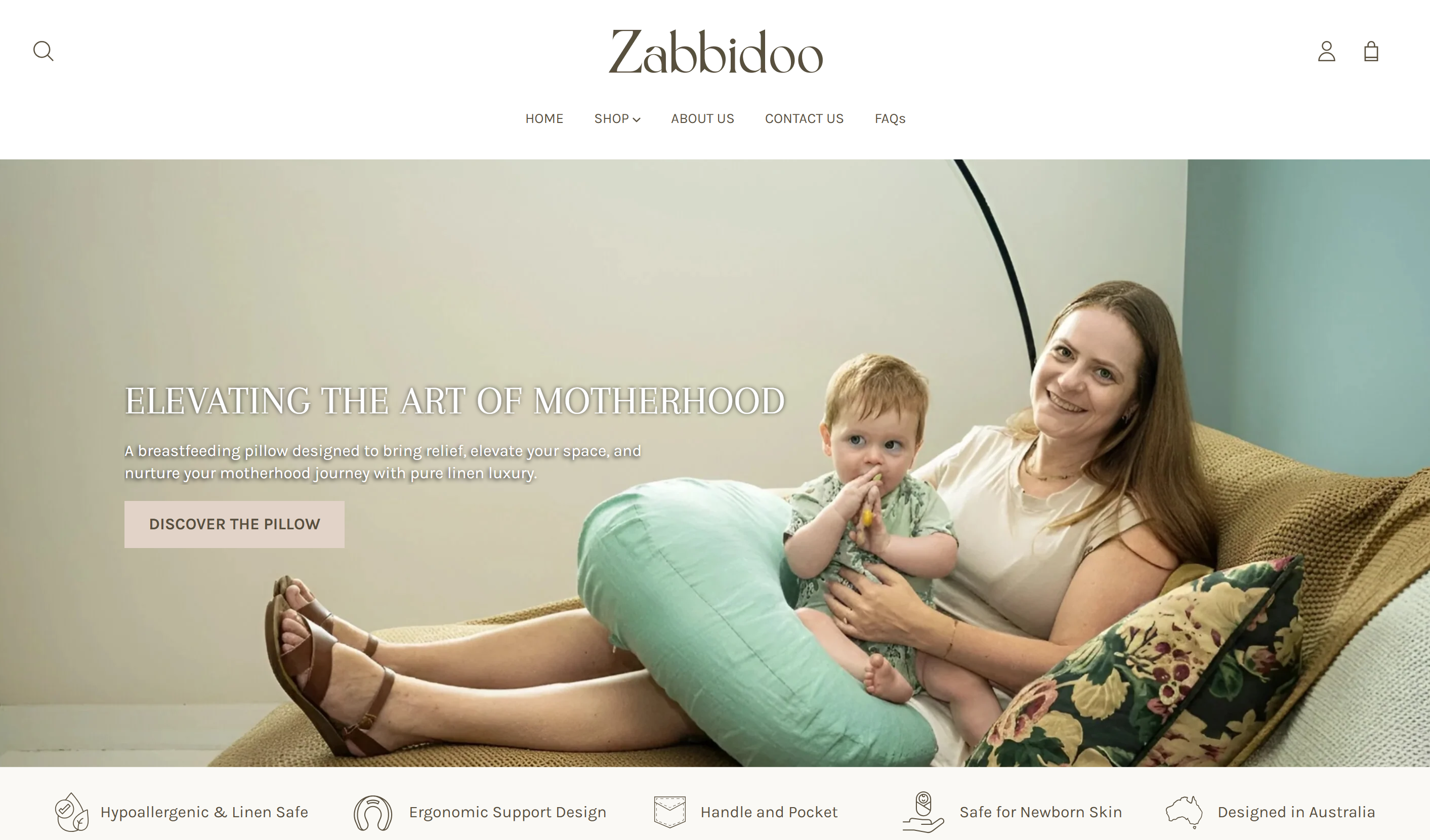
The cover is hypoallergenic French flax linen, the components are machine washable, and there is a built-in pocket and a portable handle for moving between rooms. It is $249, one-off. You can see the details on the Nursing Pillow page.
FAQ
Is OEKO-TEX or GOTS better?
Neither is better across the board, because they certify different things. GOTS is the stronger signal if you want organic fibre and responsible production across the supply chain. OEKO-TEX STANDARD 100 is the one to look for if your main concern is harmful substances in the finished product.
Is OEKO-TEX organic?
No. OEKO-TEX STANDARD 100 has no organic fibre requirement and can apply to conventional, synthetic or organic textiles. Only GOTS sets organic content minimums, at least 70% certified organic fibre.
How do I check a GOTS or OEKO-TEX claim in Australia?
Use the online tools run by the certifiers. Search the GOTS database for the licence holder, and enter the certificate number from the tag into OEKO-TEX’s Label Check, as Choice recommends. Then confirm the certificate covers the type of product you are buying.
Does a product need certification to be called organic in Australia?
Not by law, according to the ACCC. However, any business making an organic claim must be able to prove it, so certification from a recognised body is one of the clearest ways to back it up.
Is organic cotton better quality than regular cotton?
Not necessarily. Organic describes how the cotton was grown and processed, not how soft or long-lasting it is. A textile expert quoted by Wirecutter calls the idea that it is always softer and higher quality a myth.
Sources
- Eco and sustainability labels you can trust, Choice
- GOTS key features, Global Standard
- GOTS: how the system works, Global Standard
- Global Organic Textile Standard v8.0
- Requirements for GOTS labels and transaction certificates
- Organic claims, ACCC
- GOTS Annual Report 2024
- Sustainable apparel certifications: your 2026 guide
- Is organic cotton really better? Wirecutter