

The safest default for washing most linen is 30 to 40 degrees Celsius. Choose 30°C for coloured, delicate or shrinkage-sensitive pieces, and move to 40°C when bedding or heavier soiling calls for it. Reserve 60°C for rare cases, such as sanitizing pure white linen, and only when the care label explicitly allows it.
TL;DR:
- Washing most linen at 30°C on a gentle cycle is safest for coloured, delicate, or freshly purchased items to prevent fading and shrinkage.
- Reserve 40°C for heavily soiled bedding or towels when the care label permits, and only use 60°C for white linen that explicitly allows it and requires sanitizing.
- The care label is the most reliable guide, with symbols indicating maximum safe temperatures, and should override general advice for specific fabric blends or finishes.
- Proper washing involves sorting, gentle cycles, mild detergent, avoiding bleach and softeners, and limiting drying heat to maintain dimensional stability and prevent long-term damage.
- For handwashing or sensitive pieces, use cool to lukewarm water around 20-30°C and avoid prolonged soaking or twisting to protect fibers and shape.
Table of Contents
- At-a-glance temperature quick reference
- How to choose the right temperature for different linen items
- Washing process and machine settings to protect linen
- Drying, shrinkage and dimensional stability
- Handwashing linen: safe temperature and technique
- Special cases: stains, whites and sanitising (when 60°C is acceptable)
- Expert nuance and the care-label rule: evidence and brand guidance
- Colour-care guidance for dyed and printed linen
- Author’s perspective: practical rule-of-thumb and maintenance rhythm
- A practical note on washable linen covers for nursing pillows
- Sources
- FAQ
At-a-glance temperature quick reference
Different linen items carry different risks, so the right temperature depends on what you’re washing and why.
- Delicate clothing (blouses, dresses): a low temperature around 30°C, gentle cycle, to protect dye and shape.
- Coloured linen: lower temperatures near 30°C to help guard against fading and bleeding.
- Bed sheets and pillowcases: a cool to warm range suitable for household soiling, often up to moderate temperatures.
- Towels and heavily used textiles: moderate temperature settings help clean effectively without excess wear.
- White table linen: higher temperature washes may be acceptable when the label permits and for genuine stain removal.
A first wash on a brand-new item is a good moment to stay conservative and use 30°C, since fresh dye and finishes are the least stable. Heavy stains are better handled with pre-treatment than with hotter water. Very hot water accelerates fibre breakdown and shrinkage in linen because heat relaxes and then re-sets the weave structure, so the temperature you choose has lasting effects on both size and texture.
How to choose the right temperature for different linen items
The care label is the definitive guide for any linen item, and it overrides general advice whenever the two disagree. Manufacturers factor in the specific dye, finish and blend used in that item, and Marimekko’s care guidance treats the label as the authoritative instruction because those variables change what temperature is genuinely safe.
Reading the label is simple once you know the shorthand. A washtub symbol with a number shows the maximum temperature. A hand inside the tub means handwash only, and a crossed-out tub means do not machine wash at all. Dots inside an iron symbol indicate heat tolerance for pressing.
Beyond the label, a few practical rules help:
- Use a lower temperature around 30°C for coloured, delicate or newly purchased linen, since colour loss and shrinkage risk are usually highest early on.
- Employ a moderately warm temperature for heavily soiled bedding or towels when the label indicates it is suitable, to balance cleaning effectiveness and fabric care.
- Test an unfamiliar or vintage linen piece by washing a hidden seam first, checking for colour change or puckering before committing the whole item.
- Treat linen blends and special finishes (such as stone-washed or coated linen) as needing their own lower temperature, since added fibres or coatings often tolerate less heat than pure linen.
Marimekko’s guidance also notes that washing too cold can fail to clean properly, so the decision isn’t simply “colder is always safer”: soil level and fabric condition both belong in the decision.
Washing process and machine settings to protect linen
Temperature only does part of the work. The cycle, detergent and load size you choose all interact with heat to determine how much wear your linen takes.
- Sort and prep: separate colours, close zips and buttons, and turn garments inside out to protect the outer surface.
- Select a gentle or delicate cycle: this reduces the tumbling action that, combined with heat, causes most shrinkage and fibre stress.
- Choose a modest spin speed, generally under 800 RPM, since fast spinning creases linen fibres and can distort the weave.
- Avoid overloading the machine: linen needs room to move freely for the water and detergent to rinse out properly.
- Use a mild liquid detergent formulated for delicates, and skip products with optical brighteners on coloured linen, since brighteners are designed for whites and can dull or discolour dyed fabric.
- Skip bleach unless the care label specifically allows it, and avoid fabric softener, which coats linen fibres and reduces the fabric’s natural breathability.
Pro Tip: Wash linen inside out and skip the softener; the fibres soften naturally with repeated washing, and a coating from softener only masks that process rather than helping it.
Wash duration matters as much as the number on the dial. A long, hot cycle with a full spin puts far more stress on linen than a short, cool cycle, even if both technically sit within the “safe” temperature range. Mechanical action and heat compound each other, so a gentle setting is what makes a 40°C wash safe rather than risky.
Drying, shrinkage and dimensional stability
Shrinkage is rarely just about the wash temperature. It’s usually decided in the dryer.
- Air-dry linen whenever possible, laid flat or hung, to reduce heat exposure.
- If using a tumble dryer, use a low heat setting and remove items while still somewhat damp.
- Reshape items while damp, smoothing seams and edges by hand before drying fully.
- Prewashed linen tends to be more stable, but remains sensitive to shrinkage from repeated high-heat drying cycles.
Dimensional-stability testing shows that wash temperature and drying heat act as separate shrinkage drivers, meaning a moderate 40°C wash can still shrink noticeably if it’s followed by high dryer heat, according to research modelling linen’s dimensional stability. That distinction is worth remembering: a careful wash can be undone by an aggressive dry cycle, so the two decisions deserve equal attention.
If linen comes out of the wash tighter than expected, don’t panic and don’t reach for high heat to “loosen” it. A light steam while the fabric is slightly damp, combined with gentle stretching by hand, usually restores most of the original shape. Repeating this over a couple of wears is more effective than one aggressive attempt.

Handwashing linen: safe temperature and technique
Handwashing suits delicate finishes, embellished pieces, or anything labelled “hand wash only,” and it gives you far more control than a machine cycle.
- Fill a basin with cool to lukewarm water, around 20 to 30°C, and add a small amount of mild detergent.
- Submerge the item and soak for no more than 15 to 20 minutes, since prolonged soaking can weaken fibres.
- Agitate gently with your hands rather than scrubbing or twisting, which can distort the weave.
- Rinse thoroughly until the water runs clear, removing all detergent residue.
- Press out excess water by rolling the item in a dry towel rather than wringing it.
Choose this method whenever a garment has delicate trims, hand-stitched details or a care label that specifically calls for it. It takes longer than a machine cycle, but for the right pieces it’s the safer route.
Special cases: stains, whites and sanitising (when 60°C is acceptable)
Sixty degrees is the exception, not a fallback for a tough wash day. It applies mainly to uncoloured or white linen, and only when the care label explicitly allows it for sanitizing purposes.
Manufacturer product-care guidance is consistent on this point: LinenMe’s care instructions recommend staying at or below 40°C for routine washing, treating higher temperatures as an occasional measure for whites or specific stain removal rather than a standard setting.
- Pre-treat stains first with an enzyme-based stain remover or a soak, rather than reaching straight for hotter water.
- Reserve 60°C for genuine sanitising needs, such as after illness, and only on labelled-safe white linen.
- Avoid repeating hot cycles, since each one adds cumulative fibre wear and increases shrinkage risk over the life of the item.
- Combine chemical treatment with lower-temperature mechanical cleaning instead of relying on heat alone: a good pre-treat plus a 30 to 40°C wash often outperforms a single hot cycle on stubborn marks.
Repeated exposure to high heat is what causes most of the long-term damage people associate with linen “wearing out,” more than any single wash.
Expert nuance and the care-label rule: evidence and brand guidance
Care labels exist because no single temperature rule covers every linen product. Dye batches, finishing treatments and fibre blends all shift what’s genuinely safe, which is why Marimekko’s guidance treats the label, not a general rule, as the final word for any specific item.
The dimensional-stability research referenced earlier reinforces why this nuance matters. Testing separates wash temperature from drying heat as distinct variables affecting shrinkage, which means a fabric can pass a moderate wash test and still shrink under aggressive drying, or vice versa. That’s a more precise picture than the common shorthand of “wash cold to avoid shrinkage,” and it’s worth remembering whenever you’re deciding how to dry something you’ve just washed carefully.
Dye, finish and blend composition can each independently change the temperature a linen item can safely tolerate.
Some nursing pillow covers use premium French flax linen chosen for breathability, and the science behind how linen softens with washing explains why repeated gentle washing, rather than one hot cycle, is what actually improves texture over time.
Colour-care guidance for dyed and printed linen
Colour behaves differently from white linen in the wash, and the first few washes matter most. New dyed or printed linen is at its most unstable early on, before excess dye has fully released, so washing separately from lighter fabrics for the first two or three washes avoids surprises.
Dark and bright colours are more prone to fading under heat and agitation than pastel or muted tones, which is another reason 30°C suits most coloured linen rather than 40°C. Skip optical brighteners entirely on dyed items, since they’re formulated to make whites appear whiter and can leave coloured fabric looking dull or slightly grey over time.
Turning garments inside out before washing protects the visible surface from friction against zips, buttons or other items in the load. Washing similar colours together, rather than mixing darks with lights or brights with pastels, reduces the risk of dye transfer even at lower temperatures.

Over time, even correctly washed coloured linen will soften and mellow slightly in tone, which is a normal part of how the fibre behaves rather than a sign of poor care. Choosing a gentle detergent without harsh optical additives is one of the simplest ways to keep colour looking close to its original depth for longer.
Author’s perspective: practical rule-of-thumb and maintenance rhythm
My routine is simple: 30°C on a gentle cycle for most weekly washes, 40°C when things are visibly grubbier than usual, and 60°C only for white linen with a label that explicitly says it’s fine, which in my house is rare. Rotating bedding between two sets reduces how often anything needs a hot wash at all. I skip fabric softener entirely and reshape damp linen by hand rather than fighting wrinkles later. For more on how linen actually behaves over repeated washes, Zabbidoo’s linen science articles go deeper than most product pages bother to.
— Marietjie
A practical note on washable linen covers for nursing pillows
If you’re already thinking about wash temperatures for your own linen, a nursing pillow with a removable cover saves you from hand-scrubbing spit-up at midnight. Some nursing pillows use a hypoallergenic linen cover that’s machine washable, often paired with a design to reduce strain and a compression-resistant fill that holds its shape wash after wash.
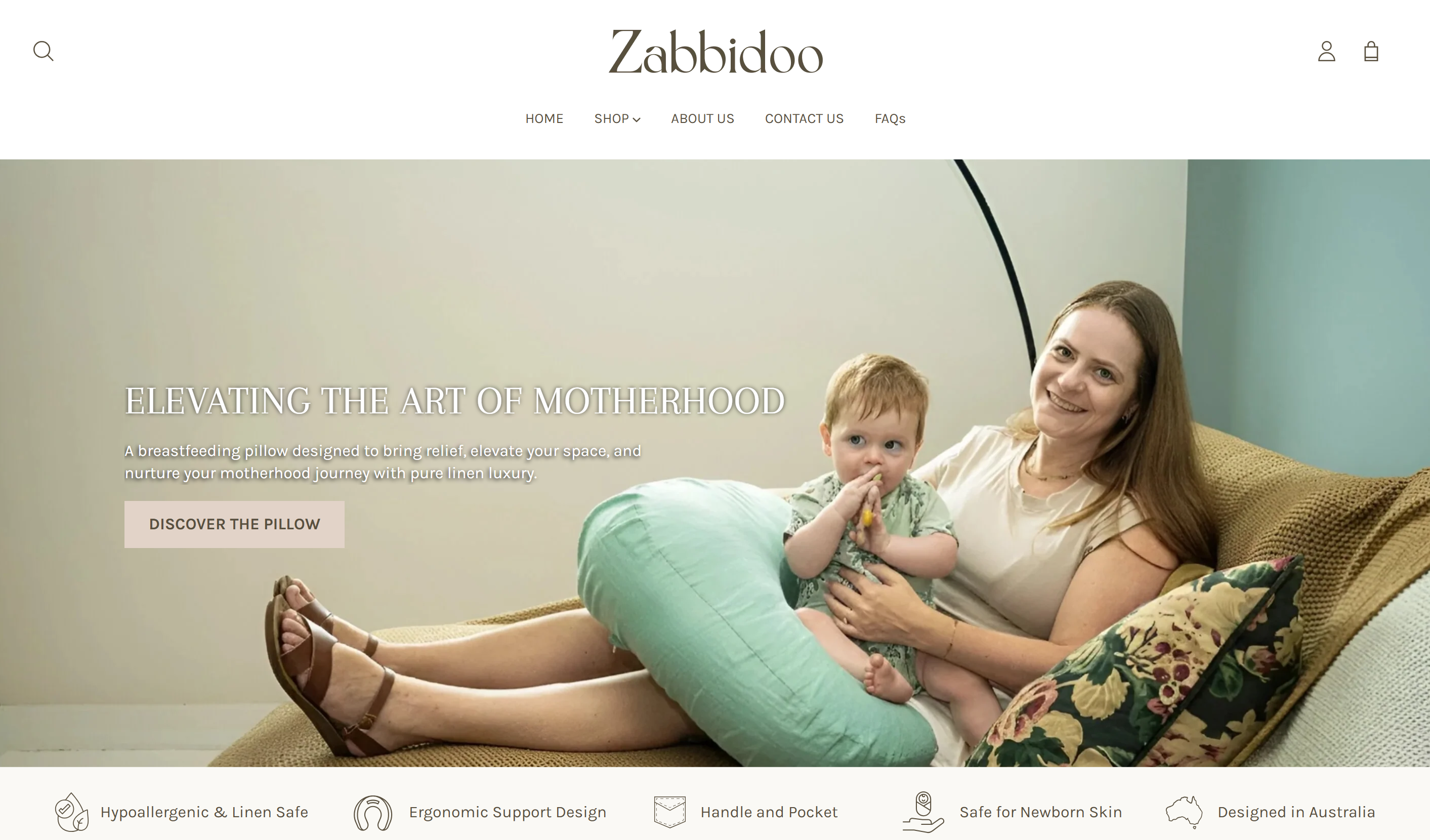
The same rules in this guide apply directly: follow the care label on the cover, wash it at the temperature it specifies, and skip the fabric softener. If you want a nursing pillow built around a cover you can actually keep clean without fuss, the Zabbidoo nursing pillow is worth a look, and our pillow hygiene guide covers the specifics for nursing pillow care.
Sources
- Marimekko care guidance
- LinenMe product care page
- Modeling the dimensional stability of linen fabrics
FAQ
Should I wash linen on 30 or 40?
Wash coloured, delicate or new linen at 30°C, and move to 40°C for bedding or towels with heavier soiling when the care label permits it. Thirty degrees is the safer default for most items, especially in the first few washes.
What temperature should I wash 100% linen?
Most 100% linen washes safely between 30 and 40°C on a gentle cycle, according to Marimekko’s care guidance. Reserve higher temperatures like 60°C only for white linen where the label specifically allows it.
Should bedding be washed at 40 or 60?
Everyday bedding generally only needs 40°C, which cleans effectively without the fibre wear that comes from repeated hot washes. Sixty degrees is worth using only occasionally, mainly for sanitising white linen after illness, and only when the care label allows it.
Does 100% linen shrink after washing?
Linen can shrink, and the risk comes from both wash temperature and drying heat rather than washing alone. Dimensional-stability testing shows drying conditions interact strongly with wash conditions, so low tumble-dryer heat or air-drying matters as much as the temperature you wash at.