

Choosing a nursing pillow feels simple until you realise the one you picked makes feeding harder, not easier. Many new mums reach for the softest, squishiest option available, assuming comfort means cushiony. But firm support at nipple level is what actually prevents you from hunching over during 20 to 30 minute feeds and protects your back, neck, shoulders, and wrists from cumulative strain. This guide breaks down exactly what separates a genuinely high-performance nursing pillow from the ones that look great in a nursery but fail you on the couch at 3am.
Table of Contents
- Why firmness and support matter most
- The role of ergonomic shapes and securing features
- Hygiene, safety and everyday usability
- Real-life benefits: posture, pain relief and successful feeding
- The truth most new mums miss about high-performance pillows
- Explore pillow solutions designed for real comfort
- Frequently asked questions
Key Takeaways
| Point | Details |
|---|---|
| Firmness beats softness | Firm pillows give consistent height and support, making breastfeeding easier and less painful. |
| Shape and security | C-, U-, and V-shaped pillows with straps or buckles prevent slipping and keep latches deep and effective. |
| Easy hygiene matters | Removable, washable covers and hypoallergenic materials ensure a safe and practical feeding environment. |
| Real pain relief | Empirical data proves high-performance pillows help mums feed longer and more comfortably, day or night. |
Why firmness and support matter most
Softness feels appealing when you are exhausted and sore. A pillow that gives easily under your hand seems like it will be gentle on your body. The problem is that “gives easily” is precisely what causes trouble during a feed.
When a pillow compresses under baby’s weight, your baby sinks. That means their mouth drops below your nipple, and instinctively you lean down to meet them. Do that 8 to 12 times a day across weeks of newborn feeding and your lower back, neck, and wrists pay the price. It is not your posture failing you. It is your equipment.
Feeding pillow firmness is now a central factor recommended by lactation consultants worldwide, and for good reason. A firmer surface keeps baby elevated and stable throughout the entire feed, not just at the start before compression kicks in. Your spine stays neutral, your shoulders stay down, and your wrists stop bearing the extra load of compensating for a sinking pillow.
Lactation consultants prioritise firm, flat surfaces for the tummy-to-tummy latch position because soft pillows allow babies to slide or shift, resulting in shallow latches. A shallow latch is uncomfortable for mum, inefficient for baby, and one of the most common reasons new mums experience nipple pain in the early weeks. Firmness is not about comfort versus function. It is what delivers both at once.
Firmness comparison at a glance
| Feature | Soft pillow | High-performance firm pillow |
|---|---|---|
| Compression under baby’s weight | Significant, fast | Minimal, sustained |
| Latch depth consistency | Poor, varies per feed | Consistent, stable |
| Mum’s posture during feed | Hunched forward | Upright, neutral spine |
| Reshaping needed mid-feed | Frequently | Rarely |
| Long-term back and neck strain | High risk | Significantly reduced |
“A pillow that holds its shape for the full length of a feed is doing more than supporting your baby. It is protecting your body from cumulative strain that builds invisibly across hundreds of feeds.” — Feeding posture research
Pro Tip: Press your fist firmly into a nursing pillow before buying. A high-performance pillow should resist compression and spring back. If your fist sinks easily, so will your baby. Pillow design trends for 2026 show manufacturers are finally moving toward higher-density fills as standard.
The role of ergonomic shapes and securing features
Support is not just about what is inside the pillow. The shape on the outside and the way the pillow stays in place matter just as much. This is where many otherwise decent pillows fall short.
C-shaped, U-shaped, and V-shaped nursing pillows each solve different problems. A C-shape wraps around the front of the body, cradling baby across mum’s lap and reducing the gap between torso and baby. A U-shape provides bilateral support, useful for twin feeding or mothers who switch sides frequently. A V-shape offers angled elevation, which works well for side-lying feeding positions or mums recovering from caesarean sections. Understanding which shape suits your feeding style is as important as choosing the right firmness.
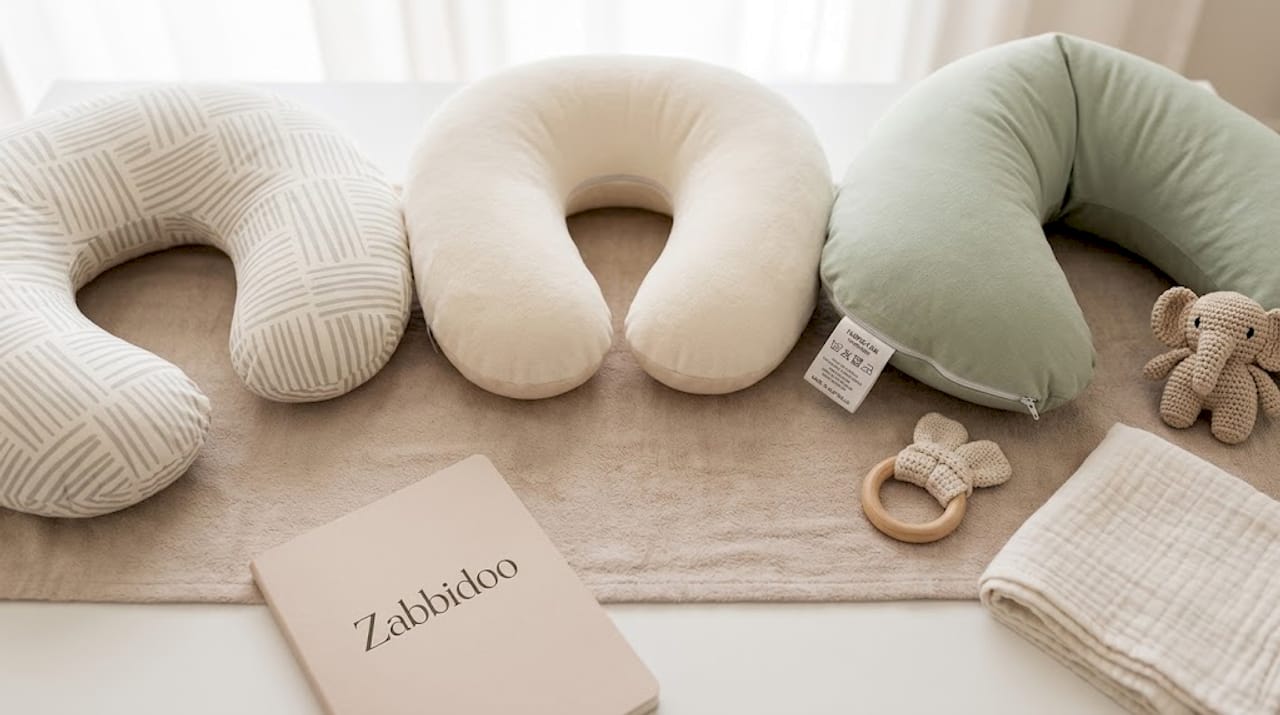
Ergonomic shapes combined with securing mechanisms like waist straps, buckles, or stretch panels are what transform a pillow from a passive cushion into an active feeding tool. Without a securing feature, even the firmest pillow will drift during a long feed. You shift, baby shifts, and suddenly you are 15 minutes into a feed re-latching for the third time while running on four hours of sleep.
Consider what securing mechanisms actually do in practice. A waist strap keeps the pillow anchored when you reposition your body. A stretch panel like the Boppy’s Miracle Middle accommodates postpartum body changes while maintaining contact. My Brest Friend uses a wraparound strap and built-in backrest, which is why it became the standard in many hospitals. These are not gimmicks. They solve the specific problem of a pillow that shifts at the worst possible moment, like during a drowsy overnight feed.
Shape comparison for different feeding needs
| Pillow shape | Best suited for | Key advantage |
|---|---|---|
| C-shape | Most feeding positions | Close body contact, stable front support |
| U-shape | Twin feeding, frequent side-switching | Symmetrical bilateral support |
| V-shape | Post-caesarean, side-lying feeds | Angled elevation, pressure-free tummy |
| Flat panel with strap | Tummy-to-tummy latch positions | Maximum latch depth and stability |
- C-shaped pillows work well for cradle hold and cross-cradle positions
- U-shaped pillows give consistent support when switching between left and right side
- V-shaped pillows reduce abdominal pressure, ideal in the first weeks post-birth
- Pillows with backrests give mums support from behind, reducing shoulder fatigue
- Securing straps reduce the number of repositioning interruptions per feed
Pro Tip: Use the ergonomic nursing pillow workflow technique: position the pillow before picking up your baby, fasten any strap while standing, then sit and settle. This one habit alone reduces mid-feed adjustments significantly. Your nursing pillow setup guide can walk you through positioning step by step.
Hygiene, safety and everyday usability
You can have the best-designed pillow in the world, and it still needs to survive real life. Real life involves spills, leaks, and the kind of messes that happen at the most inconvenient times. A high-performance nursing pillow must be as practical to maintain as it is effective to use.
Removable, machine-washable, hypoallergenic covers are not a luxury feature. They are a baseline requirement for any nursing pillow used daily. Breast milk, formula, and spit-up create an environment where bacteria and allergens build quickly without regular washing. If removing the cover requires effort or the cover cannot go in the washing machine, it will simply not get cleaned as often as it should be.
Hypoallergenic covers matter particularly for newborns, whose skin and respiratory systems are still developing. A cover treated with harsh dyes or made from synthetic fibres that trap heat creates unnecessary exposure risk. Premium materials like breathable natural linen allow airflow, regulate temperature, and tend to soften with washing rather than degrade.
Steps to assess a pillow’s everyday usability:
- Check whether the cover zips off fully without awkward closures or difficult seams
- Confirm the cover is machine-washable at 40 degrees or higher for effective sanitisation
- Verify the fill material inside is labelled hypoallergenic and resistant to moisture migration
- Look for a spare cover option from the manufacturer, so you always have a clean one while the other dries
- Test whether the pillow retains its shape after the cover is removed and replaced, since some pillows rely on their cover for structural integrity
Safety is where performance pillows draw a firm line. 2025 CPSC standards now mandate firmer designs and explicitly prohibit nursing pillows from being used as sleep surfaces for babies. This distinction matters enormously. A pillow that is soft enough for a baby to sleep on is, by definition, a safety hazard. Firmness and safety are directly connected.
Never leave a baby unsupervised on a nursing pillow, regardless of how it is designed. Nursing pillows are supervised feeding tools, not sleep aids.
When assessing any pillow for caring for your nursing pillow long-term, look at how the fill behaves over time. Pillows that flatten within the first month offer no protection against the posture problems you were trying to avoid. Compression resistance should be a durability feature, not just an initial selling point.
Real-life benefits: posture, pain relief and successful feeding
This is where the design details translate into something you actually feel in your body every day. The difference between a standard nursing pillow and a high-performance one is not abstract. It is the difference between finishing a feed feeling okay and finishing one feeling like your neck is locked in place.
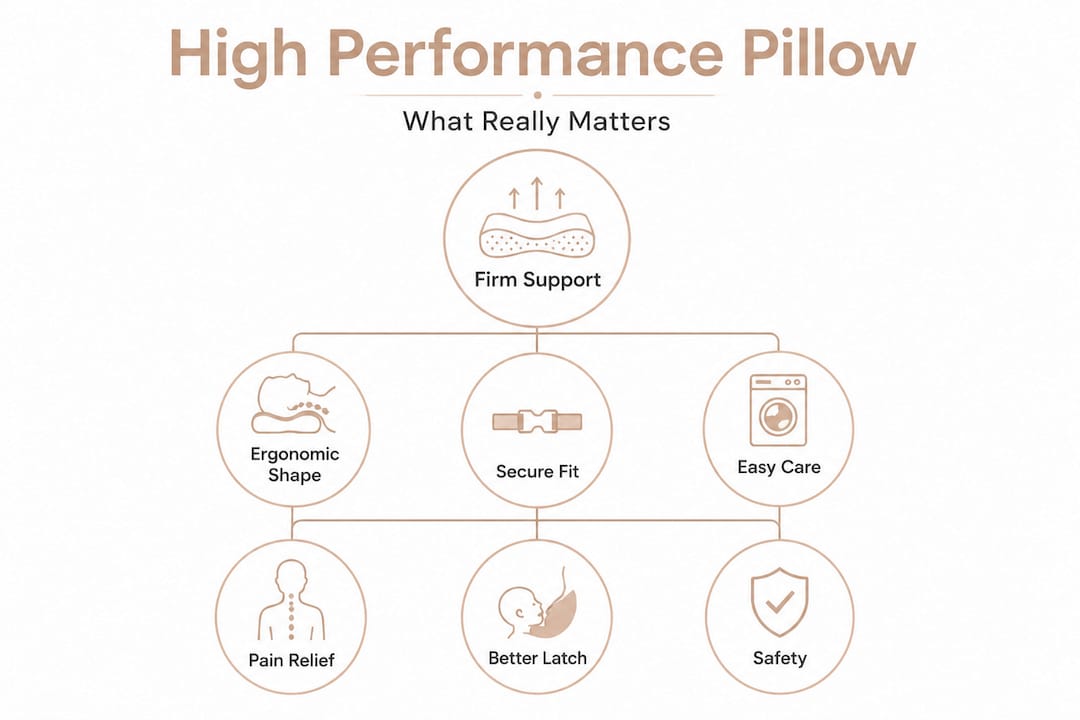
84% of breastfeeding mothers report monthly back pain directly linked to feeding posture. That is not a minor complaint shared by a sensitive minority. It is the overwhelming majority of nursing mums carrying unnecessary physical strain, often without realising that their equipment is contributing to the problem.
The benefits that multi-use nursing pillows deliver go beyond a single feed:
- Back pain relief: Keeping baby elevated eliminates the forward lean that strains the lumbar spine and thoracic muscles
- Neck tension reduction: When your shoulders stay down and back, your neck stops compensating for the weight of hunching forward
- Wrist strain prevention: A stable, elevated baby means your arms are not holding extra weight for 20 to 30 minutes at a time, reducing wrist and forearm fatigue
- Deep latch consistency: Baby at the correct height reaches the nipple without pulling or twisting, which directly reduces nipple soreness
- Longer, calmer feeding sessions: When mum is physically comfortable, sessions are less likely to be cut short due to discomfort, which supports milk supply and baby’s intake
“The most consistent finding across nursing posture studies is that when mums are positioned correctly, they nurse longer and report significantly higher satisfaction with their breastfeeding experience.”
Longer sessions are important because fully draining the breast during a feed supports both supply and baby’s access to calorie-rich hindmilk. Pain and discomfort are among the leading reasons mums reduce feeding frequency earlier than they intended. A pillow that eliminates unnecessary strain keeps more mums feeding for longer.
Safer, more comfortable feeding outcomes in 2026 show that purpose-designed pillows are closing the gap between what mums experience and what is possible with the right support. That gap is worth closing.
The truth most new mums miss about high-performance pillows
Here is something most guides will not say plainly: the reason so many mums struggle with breastfeeding comfort is not their technique. It is their pillow.
Mums are instinctive. When something is soft, it feels safe and comforting. When a pillow looks plush and inviting, it seems like the right environment for a newborn. That instinct is completely understandable, and it is also leading a huge number of mums directly into postural pain and latch problems that they then spend weeks troubleshooting.
The irony is that lactation consultants prioritise firm surfaces precisely because soft pillows undermine everything mums are trying to achieve. Hospitals do not stock soft, marshmallow-style pillows. They stock firm, structured ones because outcome data supports the choice. When a new mum goes home and reaches for the fluffy option from her baby shower, she is often unknowingly stepping backwards.
Switching to a purpose-designed, firm ergonomic pillow does not just improve comfort. It frequently resolves feeding issues that mums had started to accept as inevitable. Pain during feeding. Constant re-latching. Feeling exhausted after every session even before factoring in sleep deprivation. These are not fixed character traits of the breastfeeding experience. They are often symptoms of inadequate support.
The biggest shift we see is confidence. When the physical setup works, mums stop second-guessing themselves. The feed goes smoothly, baby settles, and mum’s body does not feel like it went through a workout. That is not a luxury outcome. It is what pillow features favoured by professionals are designed to deliver every single time.
If you have been telling yourself that breastfeeding discomfort is just something to push through, it is worth asking whether your pillow is actually the problem. Because more often than not, it is.
Explore pillow solutions designed for real comfort
Understanding what a high-performance nursing pillow should do is half the equation. The other half is finding one that actually delivers on every point covered here, without compromise.
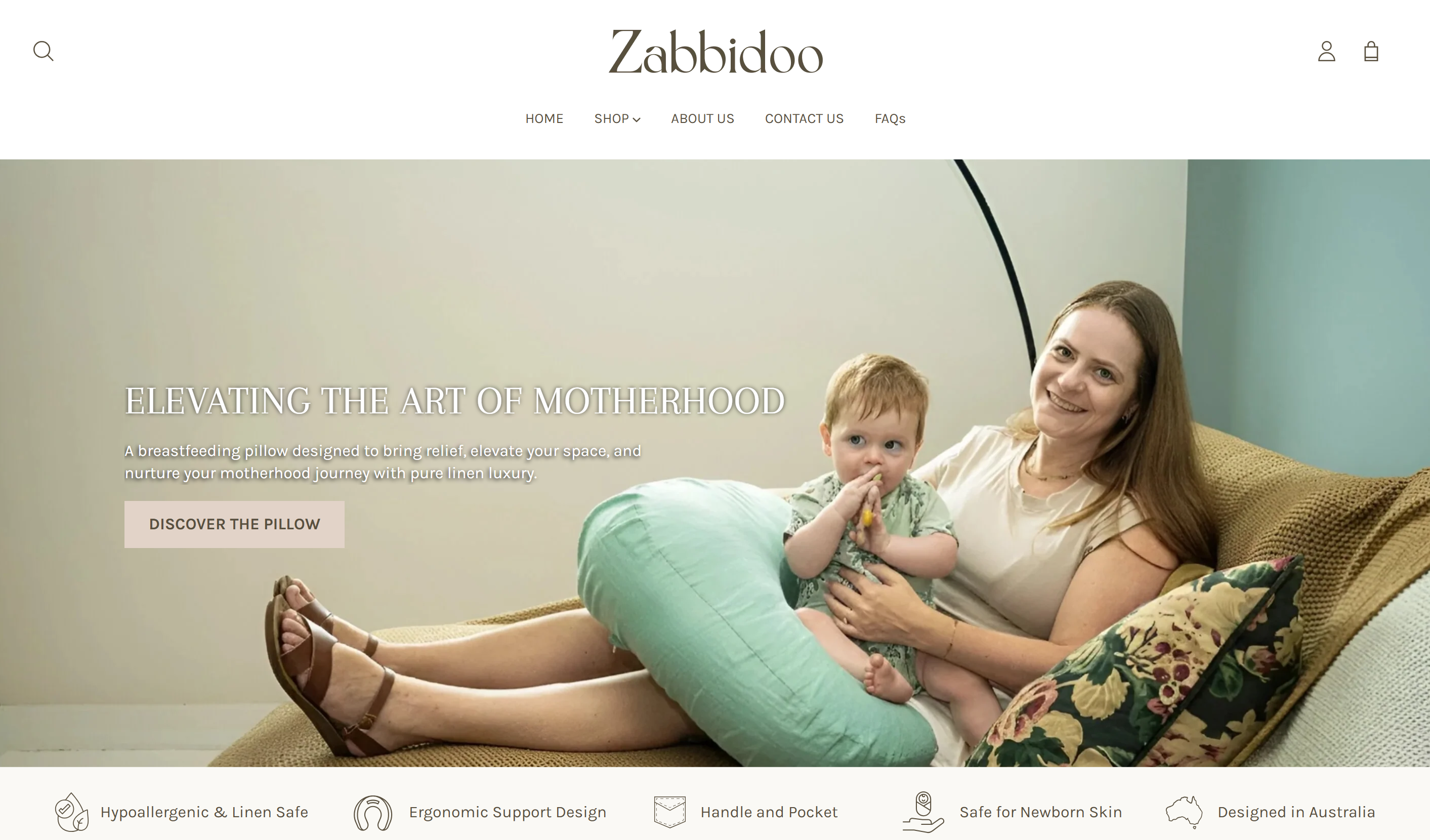
Zabbidoo’s ergonomic nursing pillow is built around the principles discussed throughout this guide: 18cm of firm, compression-resistant lift that brings baby to mum instead of forcing mum to hunch down, French flax linen covers that are breathable and machine-washable, and a stability-focused design that stays put throughout feeds. While you are setting up your feeding station, you can also grab a free pacifier clip chain to keep your routine simple and within reach. Your feeding experience deserves equipment that performs as hard as you do.
Frequently asked questions
Why are firm nursing pillows better than soft ones?
Firm pillows maintain baby’s height at nipple level throughout a full feed, preventing the sinking and slouching that cause back, neck, shoulder, and wrist strain in nursing mums.
Can I use a standard pillow instead of a specialised nursing pillow?
Standard pillows lack the firm structure and ergonomic shaping needed for consistent support. Soft pillows cause sliding and shallow latches, making feeding uncomfortable and less effective than with a purpose-designed option.
How often should I clean my nursing pillow cover?
Wash the cover after every significant leak or spill, and at minimum weekly. Machine-washable, hypoallergenic covers make this routine easy and help prevent allergen build-up around your newborn.
What safety features should I look for in a high-performance pillow?
Prioritise firm density, anti-slip securing mechanisms, and compliance with current safety guidelines. CPSC standards mandate firmer designs and explicitly prohibit nursing pillows from being used as sleep surfaces for babies.
Do ergonomic pillows really reduce pain during breastfeeding?
Yes. Research shows 84% of breastfeeding mums experience monthly back pain, and ergonomic, elevated pillow designs demonstrably reduce back, neck, and wrist strain across feeds.