

Nursing is one of the most physically demanding things your body does after birth. The neck ache, the hunched shoulders, the wrist fatigue from holding a baby at the wrong height for hours each day — these are not small inconveniences. They compound fast. A multi-use nursing pillow, used with a deliberate workflow, can change that picture entirely. This article walks you through everything you need: safety prerequisites, a step-by-step setup for multiple use cases, common mistakes to fix, and how to maintain comfort as your baby grows. By the end, you will have a practical system, not just a pillow.
Table of Contents
- What you need to know before starting
- Step-by-step workflow for multi-use nursing pillow setup
- Common pitfalls and troubleshooting tips
- Verifying and maintaining long-term comfort and safety
- Why workflow — not just pillow choice — changes everything
- Explore ergonomic solutions for your nursing journey
- Frequently asked questions
Key Takeaways
| Point | Details |
|---|---|
| Safety comes first | Use nursing pillows only under direct supervision to prevent health risks. |
| Workflow trumps product | Consistent pillow workflow and alignment reduce strain more than product choice alone. |
| Multi-use boosts value | Adapting the pillow to different tasks maximises comfort and convenience for both mum and baby. |
| Regular checks needed | Inspect, clean, and maintain your pillow regularly for ongoing safety and performance. |
What you need to know before starting
Before you place a pillow under your baby, there are non-negotiable safety basics and some smart preparation steps that will shape every session that follows. Getting this foundation right means fewer adjustments, less frustration, and a safer experience from day one.
Safety first: what the current standards say
The 2025 Consumer Product Safety Commission (CPSC) standards are clear. Nursing pillows are supervised feeding tools only — never for unsupervised sleep, lounging, or propping. Between 2010 and 2022, 154 infant deaths were linked to nursing pillow misuse, and 64 injuries were recorded in the same period. The updated 2025 standards require firmer fill, wider adult-fit openings, no infant straps, and mandatory suffocation warnings on packaging. If your pillow predates these standards, check the label.
“A nursing pillow is a feeding aid, not a sleep surface. The moment your baby falls asleep on it, the session is over.”
Choosing the right fill for your body
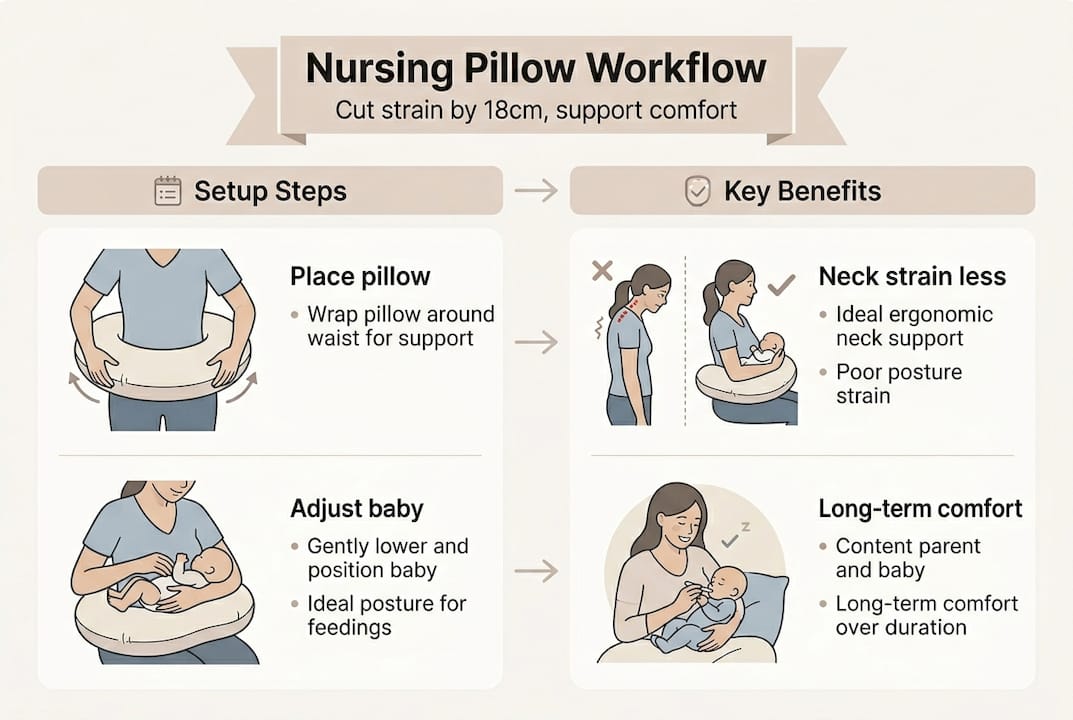
Fill type matters more than most mums realise. Firmer memory foam holds its shape under pressure, which is critical for mums recovering from a C-section who cannot afford to hunch forward to compensate for a collapsing pillow. Fibre-fill is softer and more adaptable, but compresses quickly under a heavier baby. For ergonomic relief for nursing, the pillow must resist compression throughout the full feed, not just at the start. Lumbar support has been shown in clinical trials to reduce postpartum back pain significantly, and the same principle applies to your nursing pillow: the firmer and more stable, the better.
For nursing pillow durability over months of daily use, look for compression-resistant fill and a removable, washable cover. Height-adjustable pillow options are worth considering if you are petite, tall, or recovering from surgery.
Your readiness checklist
Before every session, run through this quick check:
- Pillow cover is clean and securely fitted
- Fill feels firm with no flat spots or lumps
- Pillow fits snugly around your waist or torso
- You have read the manufacturer’s positioning guide
- Baby is awake and you are present for the entire session
| Feature | What to look for | Why it matters |
|---|---|---|
| Fill firmness | High-density foam or firm fibre | Prevents collapse mid-feed |
| Height | At least 18cm lift | Brings baby up to breast |
| Cover material | Breathable, removable | Hygiene and temperature control |
| Shape | Curved or contoured | Supports natural arm position |
Pro Tip: If you are recovering from a C-section, place a folded towel between the pillow and your incision site for the first few weeks to reduce direct pressure.
Step-by-step workflow for multi-use nursing pillow setup
Once your pillow passes the readiness check, you are ready to build a repeatable routine. The goal is not perfection on day one. It is a system you can run on three hours of sleep without thinking too hard.
Setting up for breastfeeding
- Sit upright in a chair or against a firm surface. Avoid soft couches that tilt your pelvis backward.
- Place the pillow around your waist, curved side facing inward, level with your lap.
- Lay baby on the pillow surface so their mouth is at nipple height without you leaning forward.
- Check your shoulders. They should be relaxed and down, not raised toward your ears.
- Adjust the pillow height with a folded muslin or wedge if needed.
Research on neck muscle strain during feeding confirms that no single hold position eliminates neck strain. What matters is consistent spinal alignment and alternating sides across feeds. A firm pillow that holds baby at the correct height reduces the need to compensate with your neck and shoulders.
Setting up for bottle feeding, tummy time, and propping
For bottle feeding, the same height principle applies. Baby should come to you, not the other way around. For tummy time, lay baby across the pillow’s curved surface so their chest is elevated and arms are free. This is a setup guide for feeding comfort that also doubles as developmental support.

| Use case | Pillow position | Key benefit |
|---|---|---|
| Breastfeeding | Around waist, curved inward | Reduces arm and shoulder strain |
| Bottle feeding | Flat on lap, baby reclined | Frees both hands |
| Tummy time | Flat on floor, baby draped over curve | Supports chest, frees arms |
| Parental lumbar support | Behind lower back in chair | Relieves postpartum back ache |
For special circumstances setup such as twins or plus-size bodies, a wider pillow or two pillows positioned side by side can provide the coverage needed without straining one arm more than the other.
Pro Tip: Test pillow stability before each feed by pressing down firmly with your forearm. If it compresses more than two centimetres, add a folded blanket underneath to restore height. You can also review testing pillow stability for a more detailed method.
Common pitfalls and troubleshooting tips
Even with the right pillow and good intentions, small errors creep in. Most mums do not notice them until the pain does.
The most common mistakes
- Using the pillow as a sleep surface. This is the single most dangerous misuse. 154 deaths and 64 injuries have been linked to exactly this.
- Choosing a pillow that is too soft for your body weight. A pillow that collapses forces you to hunch, which defeats the entire purpose.
- Ignoring the pillow’s position relative to your body. If it sits too low on your hips, baby drops below nipple height and you lean forward to compensate.
- Skipping side alternation. Feeding from the same side repeatedly creates asymmetrical muscle strain in your neck and shoulders.
Quick fixes for common issues
- Pillow slipping: Use a non-slip mat underneath or tighten the waist strap if your pillow has one.
- Baby rolling off: Reposition so the curved edge supports baby’s back, not their side.
- Back strain persisting: Check your chair. A firm, upright surface makes more difference than most mums expect.
- Pillow losing shape mid-feed: This is a fill quality issue. Review nursing pillow cleaning advice to rule out fill clumping from improper washing.
“User reviews consistently report less arm and back fatigue when lumbar-style support is used correctly. The pillow is not magic — the workflow is.”
Clinical data backs this up. Studies show lumbar support reduces pain with an effect size of Cohen d=3.97, which is considered very large in research terms. That kind of result does not come from the product alone. It comes from consistent, correct use.
Pro Tip: Set a phone reminder to switch feeding sides each session. Alternating sides every feed is one of the simplest ways to prevent the cumulative neck and shoulder strain that builds over weeks of nursing.
Verifying and maintaining long-term comfort and safety
Your nursing pillow workflow is not a one-time setup. As your baby grows, their weight and positioning needs change, and your pillow needs to keep up.
How to know if your pillow is still doing its job
Check these signs weekly:
- Fill still feels firm and even with no flat patches
- Baby sits at nipple height without you adjusting your posture
- Cover shows no signs of wear, tearing, or staining that cannot be washed out
- No unusual odours suggesting moisture trapped in the fill
- Pillow holds its shape after a full 20-minute feed without you repositioning
Weekly and monthly maintenance
Wash pillow covers weekly in warm water. Spot-clean the inner fill as needed and air-dry thoroughly before use. Moisture trapped in fill creates bacteria and breaks down the material faster. Memory foam is firmer but less soft; fibre-fill is more versatile but compresses sooner. Both are safe when they meet current CPSC standards compliance. Replace your pillow when the fill no longer returns to its original shape after use. For detailed guidance, the pillow durability insights guide covers when to replace versus when to restore.
Adapting as your baby grows
| Baby stage | Pillow adjustment | Reason |
|---|---|---|
| Newborn (0-3 months) | Full wrap-around support | Head and neck control needed |
| 3-6 months | Slight height reduction | Baby gaining head control |
| 6+ months | Transition to tummy time focus | Developmental milestone support |
A pillow that suited a 3kg newborn may not provide enough lift for a 7kg baby. Reassess height and firmness every few weeks, not just when something feels wrong.
Why workflow — not just pillow choice — changes everything
Most mums spend hours researching pillow features and minutes thinking about how they actually use it. That is the wrong ratio. The research is clear that consistent ergonomic habits produce better outcomes than product choice alone.
Here is the uncomfortable truth: a premium pillow used carelessly will underperform a mid-range pillow used with intention. The mums who report the least pain at six months postpartum are not necessarily the ones with the most expensive equipment. They are the ones who check their posture at the start of every feed, alternate sides, and adjust their setup as their baby grows.
The workflow mindset means treating each feed as a brief, repeatable process rather than a chaotic scramble. It means revisiting your setup weekly, not just when something hurts. Most strain builds silently over days before it becomes pain. A five-second posture check at the start of each session catches problems before they compound. That is where the real gains are.
Explore ergonomic solutions for your nursing journey
Now that you have a clear workflow, the right pillow makes every step easier to execute consistently.

Zabbidoo’s nursing pillow is designed specifically for the kind of workflow you have just built. At 18cm of firm, compression-resistant lift, it brings baby to you rather than forcing you to hunch down. The French flax linen cover is breathable, removable, and built to handle weekly washing without losing its shape. For added convenience during feeds, the pacifier clip accessory keeps essentials within reach so you are not breaking your posture mid-session. Browse the full range and find the setup that fits your body and your routine.
Frequently asked questions
Are multi-use nursing pillows safe for all infants?
When used as per CPSC guidelines — supervised, during awake feedings only — they are safe across ages and sizes. Never use a nursing pillow as a sleep surface or leave baby unattended on one.
What makes a workflow better than occasional use?
A consistent workflow ensures proper alignment at every feed, reducing cumulative fatigue over time. Regular lumbar support use has been shown in clinical trials to significantly reduce postpartum pain and disability compared to occasional or inconsistent use.
How do I clean and maintain my nursing pillow?
Wash pillow covers weekly, spot-clean inner portions, and inspect fill for lumping or flattening after each use. Detailed care steps are covered in the nursing pillow durability guide to help you extend the life of your pillow safely.
Can I use the nursing pillow for tummy time and bottle feeding too?
Yes, multi-use nursing pillows work well for tummy time, bottle feeding, and parental lumbar support, provided you always supervise your baby and follow the positioning steps for each use case.
What features should I prioritise for ergonomic relief?
Firm, height-appropriate pillows with compression resistance are most effective. Lumbar-style support has shown the strongest clinical results for reducing postpartum back and pelvic pain during feeding sessions.