

Most new mums instinctively reach for the softest nursing pillow they can find. It feels gentle, cosy, and kind. The problem? That instinct can work against both you and your baby. Firmness in a feeding pillow is not about comfort for comfort’s sake. It directly affects how well your baby latches, how long your back can hold up through a feed, and critically, how safe your baby is when resting against it. This guide breaks down what feeding pillow firmness actually means, why it matters more than most people realise, and how to choose and maintain the right level of support for your feeding journey.
Table of Contents
- What is feeding pillow firmness?
- Why firmness matters for mum and baby
- How to choose the right firmness for feeding pillows
- Maintaining pillow firmness for lasting comfort
- Why most mums misunderstand pillow firmness
- Find your perfect feeding pillow solution
- Frequently asked questions
Key Takeaways
| Point | Details |
|---|---|
| Firmness ensures safety | Proper firmness prevents suffocation risks and supports infants effectively during feeding. |
| Comfort improves with firmness | A firm pillow supports mum’s posture and reduces neck and back strain throughout nursing sessions. |
| Regulations matter | Choosing a pillow that meets post-2025 standards guarantees safety and ergonomic benefits for both mum and bub. |
| Maintenance is key | Regular care and replacement keep feeding pillows firm, supportive, and comfortable over time. |
What is feeding pillow firmness?
Firmness in a nursing pillow refers to how well the filling resists compression under your baby’s weight and body. Think of it less like a bed pillow and more like a supportive platform. A firm pillow holds its shape. A soft one sinks, shifts, and slowly loses the very height and stability that made it useful in the first place.
Most mums aren’t thinking about compression resistance when they’re shopping. They’re thinking about texture, cover softness, and how the pillow looks. But the interior fill and how it performs under repeated pressure is what determines whether a pillow actually supports your baby or simply cradles them in a way that compromises safety and posture.
Here’s a simple breakdown of what separates soft from firm in a nursing context:
| Feature | Soft pillow | Firm pillow |
|---|---|---|
| Shape retention | Collapses under weight | Holds form throughout feed |
| Baby elevation | Inconsistent, drops over time | Stable and consistent height |
| Latch support | Requires constant repositioning | Keeps baby at optimal height |
| Safety | Higher conforming risk | Lower conforming risk |
| Mum’s posture | Encourages hunching | Supports upright position |
Post-2025 CPSC regulations mandate sufficient firmness to prevent suffocation by not conforming to an infant’s face, alongside flatter designs and wider openings. This is not a minor update. It fundamentally shifts what a “safe” nursing pillow looks like, and softness is no longer an acceptable trade-off.
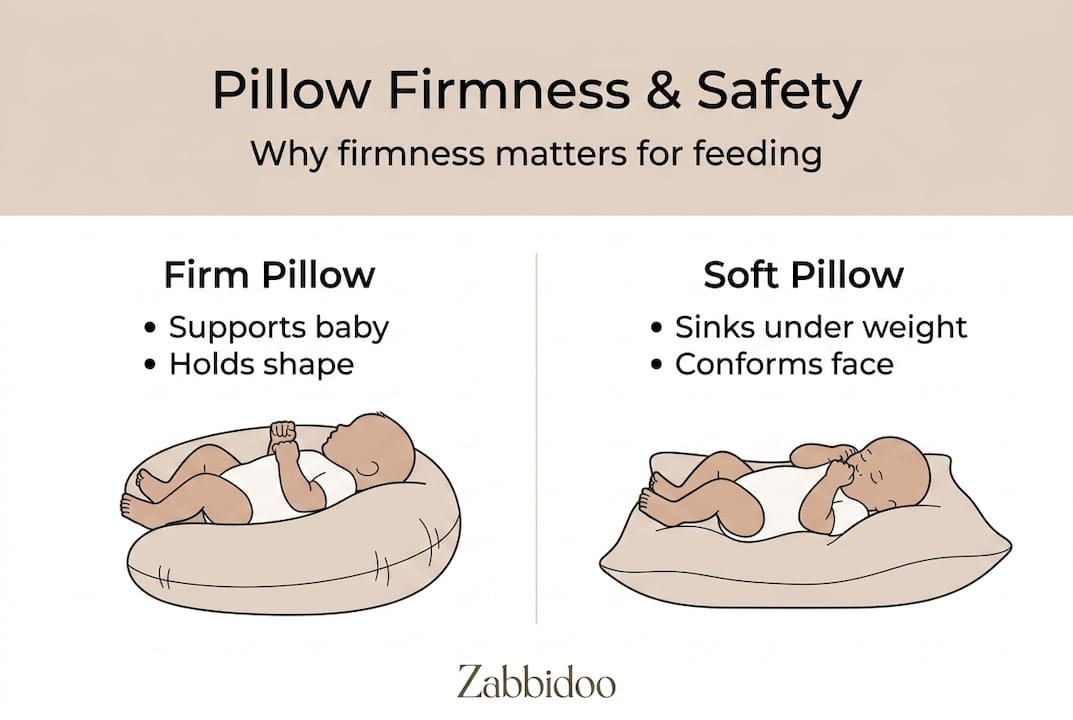
Beyond safety, firmness also affects latch. When a pillow sinks, your baby sinks with it. You end up leaning forward, dropping your shoulders, and craning your neck to compensate. Over a 20 to 30 minute feed, that adds up fast. We explore safe support for mums in detail elsewhere, and it’s worth understanding how structure and firmness interact before making any purchase. You should also consider nursing pillow durability because a pillow that starts firm and becomes soft within weeks offers no lasting value.
Key characteristics of a firm, high-quality nursing pillow include:
- Consistent compression resistance under a baby’s weight across multiple feeds per day
- Shape retention that doesn’t degrade noticeably within the first few months
- Flat or near-flat sleeping surface to reduce conforming risks to baby’s face
- Adequate height so baby reaches nipple level without mum hunching down
Pro Tip: A quick squeeze test before buying is not enough. Press down firmly with your full palm and hold for five seconds. A quality firm pillow should recover almost immediately, with minimal visible indent. If it bounces back slowly or stays compressed, it won’t hold up under your baby’s weight over a full feed.
Why firmness matters for mum and baby
Understanding firmness starts with knowing its impact. Here’s why it’s critical for both mums and babies during feeding.
The most overlooked benefit of a firm nursing pillow is what it does for you. When a pillow holds its height, it brings your baby up to your nipple level rather than forcing you to hunch down to meet them. That distinction sounds simple, but it changes everything about your posture during a feed.
Proper firmness elevates baby to nipple level, aligns the ear, shoulder, and hip, and reduces back and neck strain during those 20 to 30 minute sessions. Poor firmness, on the other hand, causes hunching and a poor latch. For a mum who is feeding eight to twelve times a day in the early weeks, a pillow that forces even a slight forward lean creates cumulative strain that can result in serious neck and back discomfort over time.
“The difference between a pillow that supports you and one that merely cushions you is the difference between a comfortable feeding journey and one that leaves you in pain every single day.”
From a baby’s perspective, firmness matters for two reasons: safety and latch quality. A pillow that conforms too readily to the shape of a baby’s face poses a genuine suffocation risk, particularly in moments when a new mum is exhausted and might drift off. Firmness prevents that conforming. A flatter, firmer surface also keeps baby in the correct feeding position, which supports a deeper, more effective latch and reduces feeding frustration for both of you.

Here’s a comparison of what happens at either extreme:
| Scenario | Too soft | Too firm |
|---|---|---|
| Baby’s position | Sinks, tilts, loses alignment | Elevated but may need cover padding for comfort |
| Mum’s posture | Hunches to compensate | Can remain upright |
| Latch quality | Often shallow or inconsistent | Supported and stable |
| Safety risk | Higher face-conforming risk | Lower risk |
| Longevity | Compresses quickly | Maintains height longer |
Testing pillow stability before committing to a pillow is a practical step that pays off. And if you’re exploring options that account for mum’s body variation, height-adjustable pillows offer an extra layer of personalisation that flat-fill pillows cannot.
The risks of getting firmness wrong cut both ways. Too soft and you compromise safety and posture. Too firm with no breathability or cover comfort and baby can be uncomfortable at the contact points. The sweet spot is a pillow that is genuinely firm in its core while using breathable, skin-friendly materials on its surface. That combination is what separates a well-designed nursing pillow from one that simply looks good in a flat-lay photo.
How to choose the right firmness for feeding pillows
Knowing why firmness matters, let’s look at practical ways to choose the best pillow for your needs.
Choosing a nursing pillow based on firmness alone still requires a structured approach. Many pillows on the market are marketed with vague terms like “supportive” or “ergonomic” without any meaningful specification. Knowing what to look for and how to test it gives you a real advantage.
Here’s a step-by-step process for evaluating firmness before you buy:
- Press and hold test. Press the pillow firmly for five to ten seconds and release. A firm pillow should return to its original shape within one to two seconds. Delayed recovery signals poor compression resistance.
- Weight simulation. If possible, hold the pillow on your lap and apply a load similar to your baby’s weight. Note whether the height changes significantly. A quality pillow loses minimal height under load.
- Edge test. Press along the edges, not just the centre. Pillows that feel firm in the middle but collapse at the edges won’t keep baby stable during repositioning.
- Cover breathability check. A firm fill means nothing if the cover traps heat. Run the fabric through your hands and check whether air flows through it easily. Linen or open-weave materials are generally superior.
- Flat surface check. Look for a relatively flat top surface with a consistent profile. Pillows that are heavily contoured or very curved force baby into a C-shape position that can compromise airway safety.
Post-2025 CPSC regulations mandate sufficient firmness to prevent suffocation by not conforming to an infant’s face, alongside flatter designs and wider openings. Buying a pillow that meets these standards isn’t just smart. It’s a baseline.
When you’re comparing features, prioritise these in order:
- Compression resistance rated for repeated daily use, not just initial feel
- Flat or semi-flat design to reduce conforming to baby’s face
- Stable base that doesn’t shift on your lap or a chair arm
- Washable cover in breathable, durable material
- Adequate lift height ideally 15cm or more to genuinely bring baby up to you
Pro Tip: Look for whether a pillow lists its fill material specifically. Vague terms like “premium foam” without density information are a red flag. High-density foam or a quality EPS fill should be named clearly. A brand that doesn’t specify what’s inside often has something to hide about long-term performance.
A stat worth knowing: a pillow that loses 20% of its height after 30 days of regular use will provide measurably less support and may no longer meet the safety threshold it achieved when new. Knowing how to set up comfortable feeding from the start makes a real difference, as does understanding how to care for your pillow so it doesn’t degrade prematurely.
Maintaining pillow firmness for lasting comfort
Once you’ve chosen the right pillow, keeping it firm and supportive is essential for ongoing comfort.
Maintenance is the part of the nursing pillow conversation that gets almost no attention. Mums spend considerable time researching the right pillow and almost none understanding how to preserve what made it good in the first place. Yet a well-maintained firm pillow can serve you reliably for a full feeding journey. A neglected one can lose its integrity in weeks.
The biggest causes of firmness loss are:
- Compression without recovery time. Leaving a pillow compressed under weight for extended periods, particularly overnight, degrades fill faster than regular feeding use.
- Improper washing. High heat shrinks or clumps fill material. Machine washing on a hot cycle is one of the fastest ways to ruin a foam or EPS fill.
- Moisture exposure. Milk, sweat, and damp covers that aren’t dried properly cause the fill to break down from the inside. This is why breathable outer materials matter so much.
- Storing under other items. Storing a nursing pillow under heavy objects, even in a cupboard, causes slow compression that accumulates invisibly.
Regular pillow care extends useful life significantly, and the habits are simple once you build them in. And if you’re using your pillow beyond feeding, exploring multi-use workflow tips can help you understand how tummy time and supported sitting positions affect fill over time.
To maintain your pillow’s firmness:
- Wash covers separately on a cold or warm gentle cycle. Never put a cover back on while it’s damp.
- Air the fill regularly. Even once a week, take the inner pillow out and let it breathe for an hour. This helps the fill recover and reduces moisture build-up.
- Store upright or flat, never under weight. A hook on the back of a door or a dedicated shelf is ideal.
- Check the shape monthly. Lay the pillow on a flat surface and look at it from the side. If the height has dropped visibly or the top is uneven, the fill is degrading.
Pro Tip: The most reliable sign that your pillow has lost its firmness is not how it looks but how you feel after feeding. If you notice yourself starting to lean forward again during feeds, or if your neck and shoulders ache in ways they didn’t earlier, the pillow’s support has degraded. Don’t wait for visible collapse. Your body will tell you first.
A well-designed nursing pillow that aligns ear, shoulder, and hip keeps back and neck strain minimal. Once a pillow can no longer deliver that alignment consistently, it’s time to replace it regardless of how it looks from the outside.
Why most mums misunderstand pillow firmness
The conversation about nursing pillows has been dominated for years by aesthetics and softness. Brands market with words like “cloud-like” and “ultra-plush” because those words feel safe and nurturing. But softness is not safety. And cushioning is not support.
The real trap is this: a pillow that feels wonderful when you press it in the shop is often the first one to fail at home. Low-density fill feels soft and welcoming but has almost no compression resistance. Within weeks, it collapses to a fraction of its original height. At that point, you’re essentially feeding on a decorative ring with no meaningful lift.
What most discussions also miss is the regulatory shift. Post-2025, firmness is no longer just an ergonomic preference. It’s a safety specification. Any pillow that doesn’t meet those standards is genuinely not appropriate for use with a newborn, regardless of how well it sells.
The multi-use pillow benefits conversation is also worth having here. A firm pillow used correctly for feeding, tummy time, and supported sitting retains its value far longer than a soft pillow that struggles to survive feeding alone. Firmness isn’t a compromise. It’s the foundation.
Find your perfect feeding pillow solution
If navigating pillow firmness still feels overwhelming, Zabbidoo takes the guesswork out of it. Every detail of the Zabbidoo ergonomic nursing pillow has been designed around the things most pillows get wrong: not enough height, fill that compresses too quickly, and designs that force mums to hunch rather than sit tall. The 18cm lift brings baby to you. The compression-resistant fill holds that height through every feed. French flax linen keeps things breathable and durable.

And because the feeding routine involves more than just the pillow, the free pacifier clip chain is a small but genuinely useful addition to keep your setup organised and your hands free. Explore the full range at Zabbidoo and find what works for your body, your baby, and your feeding goals.
Frequently asked questions
What makes a feeding pillow ‘firm’?
A feeding pillow is considered firm when it doesn’t conform to an infant’s face, supports their weight without sinking, and keeps its shape consistently throughout a feed. Firmness is determined by the density and quality of the fill material inside.
How do I test my pillow’s firmness at home?
Press down firmly on the pillow and release. If it recovers quickly and shows minimal indent, it has good compression resistance. Slow or incomplete recovery means the fill is too soft and won’t maintain safe, supportive height during feeds.
How does pillow firmness affect breastfeeding?
Proper firmness elevates baby to nipple height, supports a deeper latch, and keeps your posture aligned so your back, neck, and shoulders aren’t compensating throughout the feed. Poor firmness leads to hunching and a shallower, more frustrating latch.
When should I replace my feeding pillow?
Replace your pillow when it no longer holds its original height, feels uneven, or when you notice postural strain returning during feeds. Visual sagging or lumpiness in the fill is also a clear sign that support has been compromised and the pillow is no longer doing its job safely.