

Nursing a newborn is one of the most demanding physical tasks a new mum faces, often multiple times a day, every single day. Yet most of the conversation around breastfeeding focuses on latch technique, milk supply, and feeding frequency. Rarely does anyone mention that the position you feed in, and the support beneath your arms, can be the difference between a comfortable feed and 20 minutes of hunching over your baby while your neck quietly screams. The right support pillow changes everything, and this guide will show you exactly how.
Table of Contents
- Why support pillows matter for nursing comfort
- Key features to look for in a quality support pillow
- How to use a support pillow for optimal nursing alignment
- Beyond feeding: Multi-use value and ongoing care
- What most guides miss about support pillows
- Find your ideal support pillow
- Frequently asked questions
Key Takeaways
| Point | Details |
|---|---|
| Proper positioning reduces strain | Support pillows help keep mum and baby comfortable and aligned during feeding. |
| Features impact effectiveness | Choosing the right shape, firmness, and materials maximises support and ease of use. |
| Versatility adds long-term value | Multi-use support pillows prove helpful beyond feeding, lasting through multiple parenting stages. |
| Care sustains comfort | Looking after your support pillow ensures safer, more comfortable sessions for months to come. |
Why support pillows matter for nursing comfort
Let’s start with the basics. When you nurse without proper support, your body compensates. You lean forward. You drop your shoulder. You crane your neck to see your baby’s face. Do that six to eight times a day for weeks, and you will feel it in your upper back, your wrists, and your lower spine.
Support pillows exist to break that cycle. They work by lifting your baby up to breast height, so your arms don’t have to carry the full weight of your baby’s body during every feed. This one change, bringing baby up to you instead of you hunching down to baby, reduces the mechanical load on your neck, shoulders, and wrists in a way that no amount of post-feed stretching can fully undo.
As nursing pillow research notes, nursing pillows are intended to stabilise positioning so the baby does not slide and feeding stays at a consistent latch angle and height. That consistency is crucial. When your baby is at the right height and stays there, you spend less energy repositioning, and your latch stays more reliable.
Here is what a quality support pillow does for you during every feed:
- Raises baby to the correct height so your arms and shoulders stay relaxed
- Keeps your baby steady so they are less likely to slide or shift mid-feed
- Supports your forearms, reducing wrist fatigue that builds up over weeks of nursing
- Encourages a more upright seated posture for you, reducing spinal load
- Creates a hands-free moment where you can drink water, check your phone, or simply breathe
Support pillows are not just for breastfeeding either. Bottle-feeding parents and co-carers benefit from the same ergonomic lift. Babies with reflux or tongue tie, who need careful positioning, especially benefit from the consistent angle a good pillow provides.
“The best nursing pillow is one that holds your baby at the right height and stays there, so you can focus on feeding instead of constantly readjusting.” This idea is at the heart of good pillow design, and it applies to every feeding style.
If you want a deeper understanding of how pillow design has evolved to meet these needs, it is worth reading about feeding pillow design trends and what modern ergonomic thinking looks like in practice.
Key features to look for in a quality support pillow
Now that we have covered why support pillows are essential, let us explore how to choose one that truly meets your needs. Not all pillows are created equal. Some collapse after a few weeks of use. Others are the wrong shape for your body. Knowing what to look for before you buy saves you money and frustration.
Here are the four core features that matter most:
- Firmness and compression resistance. This is the number one differentiator between a great pillow and a disappointing one. A pillow that compresses under your baby’s weight defeats the entire purpose. Look for dense foam or high-loft fill that holds its shape session after session.
- Height. Standard pillows often sit too low. A lift of around 18cm brings your baby to breast height for most seated adults. If a pillow sits flat on your lap, you will still end up leaning.
- Cover material. Breathable, washable covers are non-negotiable. Your baby will spend hours against this surface. French flax linen, for example, is naturally breathable and temperature-regulating, which keeps both you and your baby more comfortable.
- Shape and fit. C-shaped pillows wrap around your midsection and work well for most body types. Wraparound designs offer more adjustability. Multi-use pillows that convert for tummy time or infant support add long-term value.
As nursing pillow comparisons show, different designs reduce the guesswork around positioning and maintain more consistent support throughout the feed. That reduced guesswork translates directly into less frustration at 2am when you are exhausted and your baby is hungry.
| Feature | Standard pillow | Quality ergonomic pillow |
|---|---|---|
| Height lift | Low (under 10cm) | 15 to 18cm or more |
| Compression resistance | Collapses with use | Holds firm under weight |
| Cover material | Synthetic, non-breathable | Natural, breathable, washable |
| Shape options | Mostly C-shaped | C-shaped, wraparound, multi-use |
| Multi-use capability | Feeding only | Feeding, tummy time, toddler support |
| Washing ease | Often hand wash only | Machine washable cover |
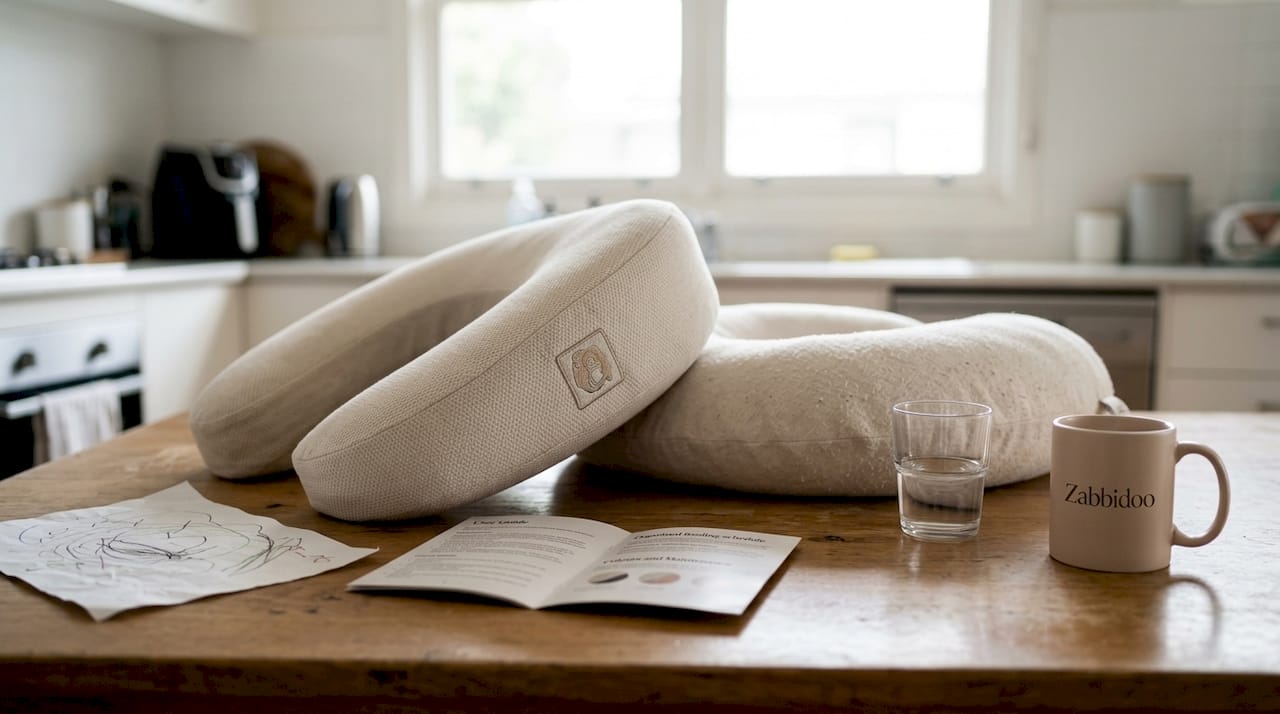
You can explore a detailed pillow shape guide to match the right design to your body type and feeding style. And if you want to see how real-world testing nursing pillows plays out, there is practical guidance on what to look for when you try before you buy.
Pro Tip: If you can, try the pillow in a feeding position before purchasing. Sit in your usual nursing chair, place the pillow on your lap, and check whether your arms feel naturally supported. Your elbows should rest comfortably, and you should not feel the urge to lean forward at all.
How to use a support pillow for optimal nursing alignment
Knowing which pillows to choose, let us guide you step by step through using a support pillow safely and effectively. Even the best pillow delivers poor results if it is set up incorrectly. The good news is that getting it right takes less than two minutes once you know what you are doing.
- Set up your environment first. Choose a chair with a firm seat and armrests at roughly elbow height. Dim lighting is gentler on your eyes during night feeds. Have your water bottle and phone within reach before you sit down.
- Position the pillow on your lap. Place the pillow so it wraps snugly around your waist. It should feel secure, not sliding toward your knees. If it sits too low, place a folded blanket underneath to raise it.
- Bring baby to breast height. Lay your baby on the pillow with their head at your breast level. Their body should be turned toward you, tummy to tummy. Their head, neck, and hips should be in a straight line.
- Check the latch and head support. Your baby’s head should be level with your breast without you needing to tilt your body. Their chin should be touching your breast, and their mouth should open wide. If you are straining to reach, the pillow needs adjusting.
- Check in with your own body. Are your shoulders relaxed? Is your neck neutral, not craned forward? Are your wrists carrying unnecessary load? Adjust the pillow height or your seating position until everything feels effortless.
- For bottle feeding, use the same setup. The pillow works identically for bottle feeding. The key is that your baby’s head should always be higher than their stomach during a feed to support healthy digestion.
Research consistently shows that pillows help maintain consistent latch angle and keep baby steady during feeding sessions, which is especially valuable in the early weeks when both you and your baby are still learning.
Statistic spotlight: Studies on ergonomic support during nursing indicate that mums who use a properly positioned nursing pillow report significantly reduced neck and back discomfort compared to those feeding without support. The difference is most pronounced after the first two weeks of consistent use.
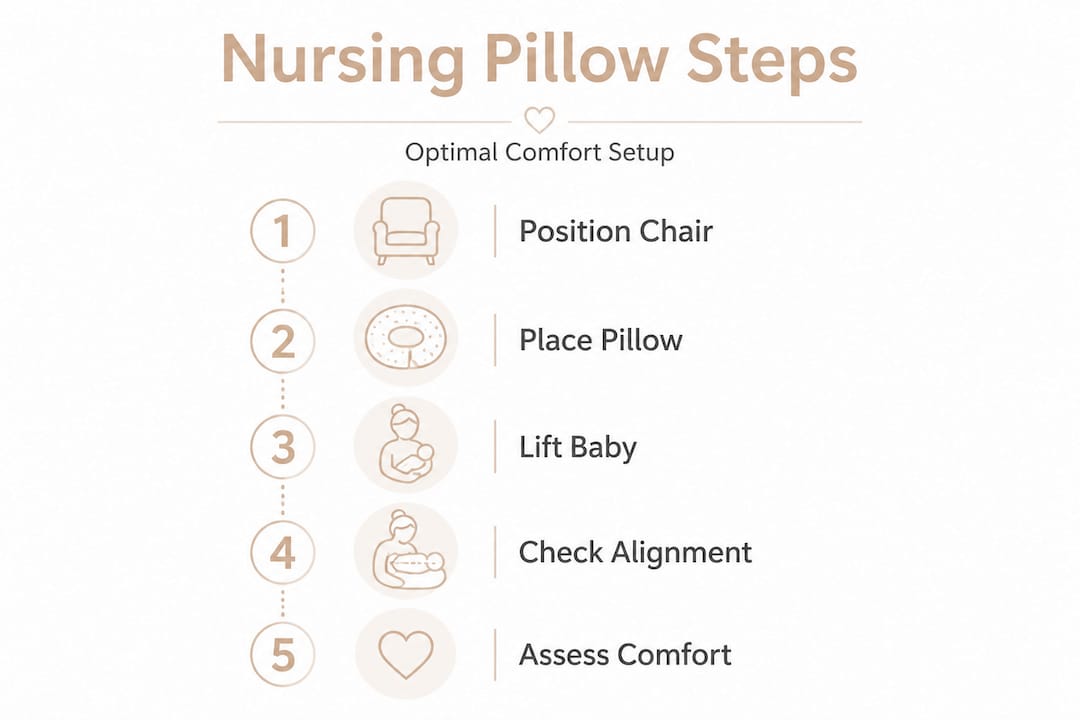
For a visual walkthrough, the nursing pillow setup steps guide walks you through each stage with practical detail.
Pro Tip: After each feeding session, take five seconds to assess how your body felt. Was anything tight or sore? That feedback tells you exactly what to adjust next time. Nursing is a skill, and so is using your pillow well.
Beyond feeding: Multi-use value and ongoing care
With your support pillow now part of your routine, let us look at how you can get even more value from it, and keep it in top condition for months to come.
One of the most overlooked advantages of a quality nursing pillow is how far beyond feeding it reaches. Support pillows can aid in reducing strain, facilitate a variety of tasks, and improve maternal and infant health during and beyond feeding sessions. Here is what that looks like in practice:
- Tummy time support. Lay your baby over the pillow so their chest rests on it during tummy time. This gentle incline takes pressure off their arms and makes the position more sustainable for longer stretches.
- Sitting support for older babies. As your baby grows, the pillow can be placed in a ring shape around them to cushion minor wobbles as they learn to sit independently.
- Comfortable positioning during bottle preparation. Pop baby on the pillow while you prepare a bottle or settle yourself. It gives them a safe, supported rest position.
- Comfort for mum during recovery. In the early postpartum period, some mums use their nursing pillow as a support cushion for their lower back when sitting up in bed.
| Use | Age range | Frequency of use | Care tip |
|---|---|---|---|
| Breastfeeding or bottle feeding | Newborn to 12 months | Multiple times daily | Spot clean after each use |
| Tummy time support | 6 weeks to 6 months | Once or twice daily | Air out regularly |
| Sitting support | 4 to 9 months | As needed | Check stitching monthly |
| General infant cushioning | Birth to 12 months | As needed | Full wash every 1 to 2 weeks |
For washing, always follow the care label. Most quality nursing pillows have removable, machine-washable covers. The inner filling usually needs a gentle hand wash or a delicate machine cycle with a mild detergent. Never tumble-dry foam fillings at high heat, as this degrades the structure and reduces the firmness you depend on.
You can find detailed guidance in the multi-use nursing pillow benefits article, and thorough washing and maintenance advice in the nursing pillow care tips guide.
What most guides miss about support pillows
Here is the insight you will not find printed on any product label. Most buying guides treat nursing pillow selection as a one-time decision: buy the right pillow, problem solved. But the reality is that using a support pillow well is an ongoing practice, not a single purchase.
Every mother and baby pair is genuinely different. Your torso length, your chair height, your baby’s weight, your breast size, all of these affect how a pillow needs to sit to work for you. A pillow that is perfect for your friend at five weeks postpartum may need a completely different setup for you at week eight, after your baby has gained two kilograms.
The mums who get the most relief from their nursing pillows are not necessarily the ones with the most expensive model. They are the ones who treat their pillow setup as something that gets refined over time. They fold a small towel under one side to create a slight angle. They shift the pillow two centimetres higher toward their waist. They try a different chair and suddenly everything clicks.
This is not a sign that you bought the wrong pillow. It is a sign that you are listening to your body and responding. That kind of active tuning makes a measurable difference in strain reduction. Research into nursing pillow workflow tips consistently shows that small setup changes, not product upgrades, produce the biggest comfort improvements.
The uncomfortable truth is that no pillow works perfectly straight out of the box for every mum. What separates a great nursing experience from a painful one is your willingness to experiment, adjust, and pay attention. Give yourself permission to do that, and your pillow, whatever model you choose, will serve you far better.
Find your ideal support pillow
You now have everything you need to make a genuinely informed decision about nursing support. You understand the mechanics, the features that matter, the setup steps, and the ongoing care that keeps your pillow performing.

The next step is finding a pillow that actually delivers on all of those criteria. At Zabbidoo, we designed our nursing pillow specifically to address the gap between what standard pillows promise and what they actually provide. The 18cm lift, the compression-resistant fill, the breathable French flax linen cover, each detail exists to solve a real problem that mums told us about. And because we know the small things matter too, you can also grab a free pacifier clip chain to make your feeding setup even more streamlined. Because easier feeds mean more rest for everyone.
Frequently asked questions
How does a support pillow improve nursing posture?
A support pillow keeps your baby at a consistent height and angle, so you never need to hunch forward or drop your shoulders to reach them. As nursing pillows are designed to stabilise positioning so baby does not slide, the result is a more natural, upright posture for mum throughout the feed.
Are support pillows only for breastfeeding?
Not at all. Support pillows aid a variety of tasks beyond breastfeeding, including bottle feeding, tummy time, and providing a cushioned support structure for babies learning to sit.
How often should I wash my support pillow?
Most nursing pillows benefit from a full cover wash every one to two weeks, with spot cleaning after any spills. Always check your specific care label, as fill materials vary and some require gentler treatment than others.
What makes a pillow ergonomic for new mums?
An ergonomic pillow provides firm, height-appropriate support and holds its shape under your baby’s weight. As positioning and posture sustainability are core requirements for any nursing pillow, a truly ergonomic design keeps both mum and baby aligned with minimal effort or adjustment.
Can a regular pillow work as a nursing support pillow?
Regular pillows lack the specific shape, height, and compression resistance required for safe, ergonomic nursing. As different specialist designs reduce guesswork and maintain consistent support, the structural difference between a household pillow and a dedicated nursing pillow is significant and worth taking seriously.