

Wrist pillows work. Used correctly, they keep your wrists in a neutral position during typing, mousing, and recovery, which reduces strain on the tendons and soft tissue that take the most punishment from repetitive movement. The key word is “correctly.” A wrist pillow placed under an actively typing wrist does more harm than good. Place it under the base of your palms during rest breaks, keep your wrists hovering while you work, and the support should be at least 3.8 cm deep, soft, and rounded to spread pressure evenly.
Here is what you need to know upfront:
- A wrist pillow is a palm support, not a wrist rest. Contact during active typing creates pressure on the tendons underneath your wrist.
- The minimum recommended depth for a wrist support is at least 3.8 cm, with a soft, rounded surface.
- Benefits include reduced muscular tension in the neck, shoulders, and arms, improved circulation, and cushioning of pressure points.
- Wrist pillows work best as part of a fully adjusted workstation, not as a standalone fix.
- Elevating your arm slightly on a pillow during recovery or sleep can reduce swelling and improve circulation.
What a wrist pillow actually does for your wrists
The term “wrist rest” is a bit misleading. According to the Canadian Centre for Occupational Health and Safety (CCOHS), the real distinction is between a wrist rest and a palm support. A wrist rest contacts the wrist directly. A palm support contacts the base of the palm, keeping pressure away from the tendons that run along the underside of the wrist. Used as a palm support, these devices genuinely reduce strain. Used as a wrist rest during active typing, they can cause pressure injuries and contribute to conditions like carpal tunnel syndrome (CTS) and tenosynovitis.
The benefits, when the device is used properly, are real. CCOHS notes that even minimal forearm and wrist support can reduce muscular tension in the neck, shoulders, and arms without creating unnecessary pressure elsewhere. For people recovering from injury or managing arthritis, elevating the arm on a pillow can improve circulation and reduce swelling during flare-ups. The Cleveland Clinic recommends this approach specifically for post-injury recovery and arthritis management.
Key benefits of using wrist pillows correctly:
- Cushions pressure points at the base of the palm during rest breaks
- Promotes a neutral wrist position, reducing repetitive strain injury risk
- Reduces muscular tension in the neck, shoulders, and arms
- Supports recovery by improving circulation when the arm is elevated
- Provides a softer surface than a desk edge for people who rest their wrists between tasks
What types and materials are available in Australia?
The Australian market has a solid range of wrist support options, from basic foam pads to gel-filled ergonomic products and multi-use nursing pillows repurposed for wrist elevation.
Memory foam is the most common material. It conforms to the shape of your palm, distributes pressure evenly, and holds its shape reasonably well over time. The main drawback is heat retention, which can be uncomfortable during long sessions in warm weather.
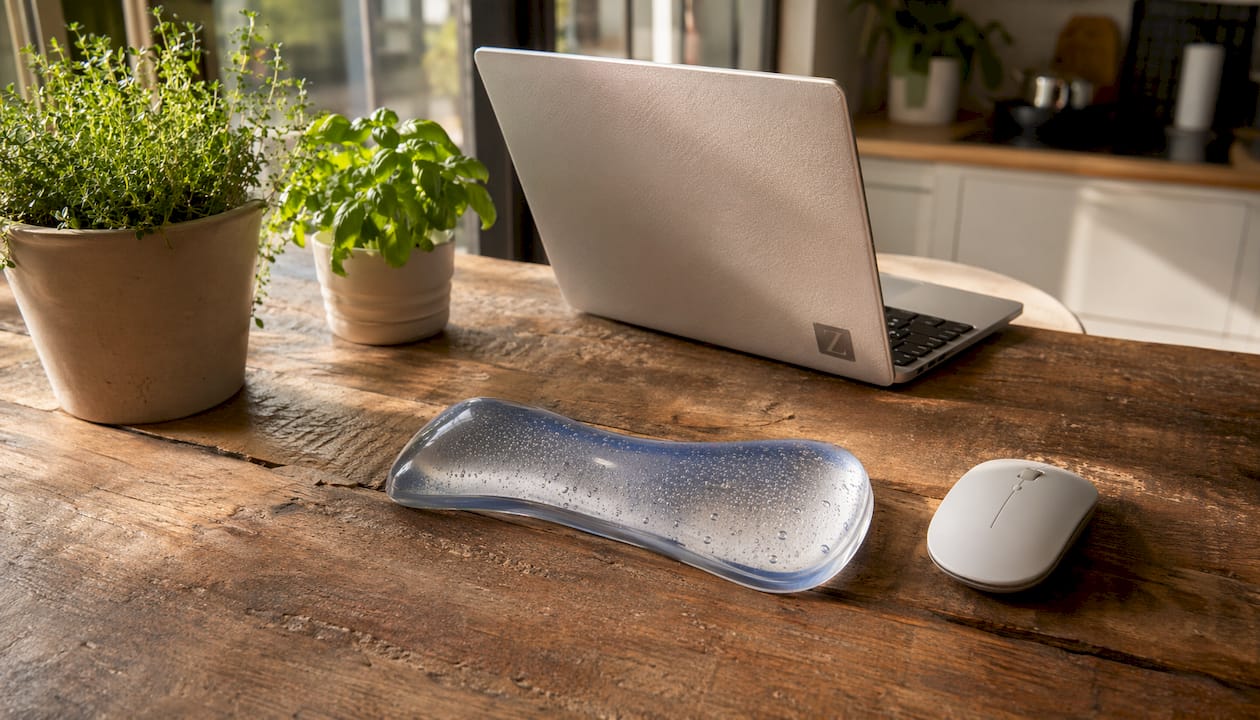
Gel-filled supports are popular for desk use because gel conforms to the hand’s natural curve and stays cooler than foam. The Fellowes Crystal Ergonomic Mouse Pad & Wrist Rest (Gel) is a widely available example in Australia, combining a firm mouse pad surface with a gel wrist cushion. The Fellowes Crystal Flex Rest Wrist Rest is a companion product designed for keyboard use, with a similar gel construction and a non-skid base. Both are designed to keep the wrist in a neutral position during rest breaks, not during active typing.
Fabric-covered foam options, like the Kensington Wrist Pillow range, use a soft fabric layer over a secondary foam support. The fabric conforms to the wrist without restricting movement, and the non-skid base keeps the pad in place during use.
Nursing pillows are worth mentioning here because they serve a genuinely different purpose. The Zabbidoo nursing pillow, with its 18 cm lift, is designed to bring the baby up to the mother rather than forcing the mother to hunch down. That same elevation principle applies to wrist and arm support during recovery, where raising the forearm reduces fluid retention and eases discomfort.
Material considerations at a glance:
- Gel: Conforms well, stays cool, good pressure distribution
- Memory foam: Soft and moulding, but retains heat
- Fabric-covered foam: Breathable surface, good for all-day use
- Firm foam with linen cover (e.g. Zabbidoo): Durable, breathable, compression-resistant
Pro Tip: Match the depth of your wrist support to the front edge height of your keyboard. If the support is too thick or too thin, your wrists will angle up or down, defeating the purpose entirely.
How to use wrist pillows properly for maximum benefit
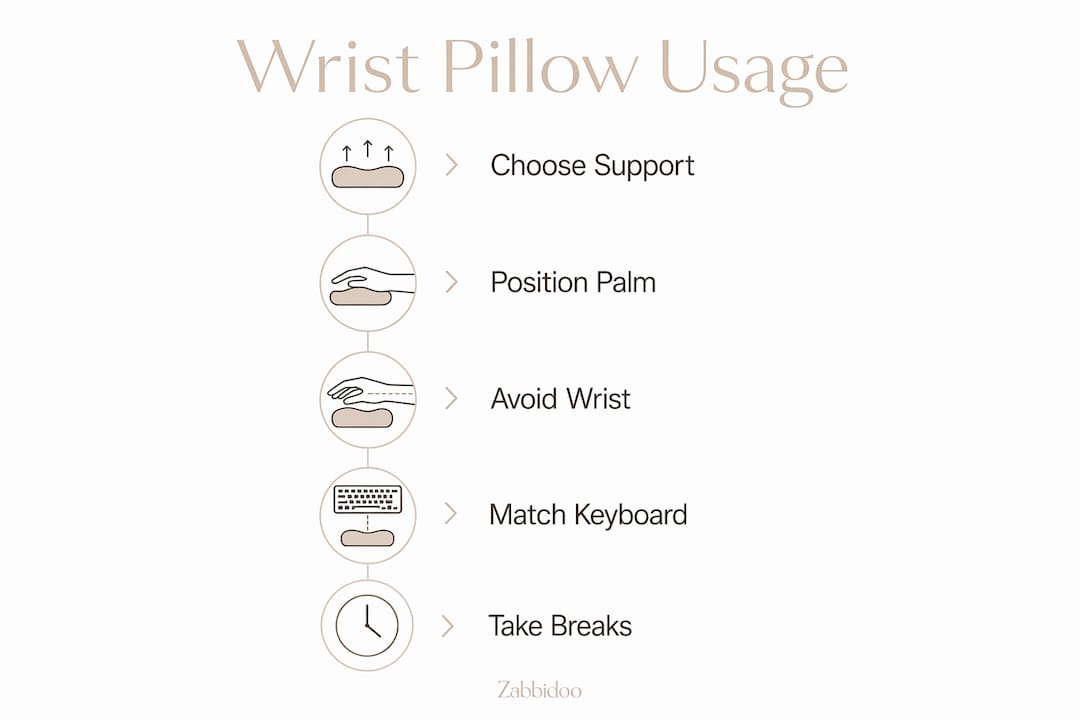
The single most common mistake is resting your wrists on the pad while actively typing. That contact compresses the tendons on the underside of the wrist and can worsen the very conditions you are trying to prevent. The correct technique, as outlined by both the Cleveland Clinic and CCOHS, is to keep your hands elevated above the support while typing, making contact only during pauses.
Position the pillow so it supports the heel or base of your palm, not the wrist joint itself. Your forearms and wrists should be roughly level, neither angled up nor bent down. If the pillow forces your wrists into an upward angle, it is too thick. If your wrists drop below the keyboard, it is too thin or positioned too far back.

For nighttime use, the guidance is different. Avoid tucking your hands under your pillow or head during sleep, as this bends the wrist into a non-neutral position and can cause or worsen pain. A small, firm pillow placed under the forearm keeps the wrist straight and, if elevated slightly, helps reduce overnight swelling. This approach is particularly useful after surgery or during arthritis flare-ups, where fluid management matters.
Proper use checklist:
- Hands hover above the support during active typing or mousing
- Contact occurs at the heel or base of the palm, not the wrist joint
- Wrists and forearms are neutral, neither tilted up nor down
- The support matches the width and height of the keyboard’s front edge
- During sleep, avoid bent wrist positions; use a small pillow under the forearm instead
Pro Tip: If you wake up with wrist pain or numbness, check whether you are sleeping with your wrist bent under your body or head. A rolled towel placed along the forearm can break this habit quickly.
Common mistakes to avoid:
- Resting wrists on the pad during active typing (increases tendon pressure)
- Using a support that is too thick, forcing wrists into upward extension
- Placing the pad too far from the keyboard, causing wrists to reach forward
- Tucking wrists under the head or pillow during sleep
- Relying on a wrist pillow without adjusting the rest of the workstation
How wrist pillows fit into a full ergonomic workstation
A wrist pillow cannot fix a poorly set-up workstation. The Cleveland Clinic is direct on this point: proper posture and ergonomic setup are the foundation, and wrist supports work within that foundation, not instead of it. A worker with a well-adjusted chair and desk may need only minimal wrist support, if any.
Start with the chair. Your feet should sit flat on the floor, your knees at roughly a right angle, and your elbows close to your body at desk height. If the desk is too high, your shoulders rise to compensate, which creates tension that no wrist pillow can address. Once the chair and desk are right, set the keyboard so your forearms are roughly parallel to the floor and your wrists can stay straight.
Ergonomic workstation principles that support wrist health:
- Chair height adjusted so elbows align with desk surface
- Keyboard positioned so forearms are parallel to the floor
- Monitor at eye level to prevent forward head posture
- Mouse close to the keyboard to avoid reaching
- Armrests set to lightly support the forearms without raising the shoulders
- Keyboard tray used where needed to bring the keyboard below desk height
Switching between sitting and standing during the day also helps. The Cleveland Clinic notes that alternating positions loosens joints and strengthens tendons over time. Regular movement breaks, even brief ones, reduce the cumulative load on wrists and forearms far more than any single product can.
For people managing repetitive strain injuries or tendinitis, the workstation setup is not optional. It is the primary intervention, with wrist supports playing a secondary, complementary role.
What does correct wrist and arm posture look like with a wrist pillow?
Neutral is the goal. Your wrist should be in line with your forearm, neither bent up (extension) nor bent down (flexion), and not rotated to either side. When you look at your arm from the side while typing, the line from your elbow to your knuckles should be roughly straight.
The forearm position matters as much as the wrist. If your elbow is lower than your wrist, your hand tilts upward into extension, which strains the extensor tendons. If your elbow is higher, your hand drops into flexion, compressing the carpal tunnel. The wrist pillow’s job is to fill the gap between the desk surface and the natural resting height of your palm, so the wrist does not have to hold itself up during breaks.
Arm posture points to check:
- Elbows bent at roughly 90 degrees, close to the body
- Forearms roughly parallel to the floor or angled slightly downward
- Wrists straight, not bent up or down, not rotated
- Shoulders relaxed, not raised or pulled forward
- Fingers relaxed on the keys, not gripping or pressing hard
One detail people often miss: the angle of the keyboard itself. A flat or slightly negative tilt (front edge higher than back) suits most people better than a positive tilt (back edge raised), because it keeps the wrists in a more neutral position. If your keyboard has fold-out legs that raise the back, try folding them flat and see whether your wrist comfort improves.
How do wrist pillows compare to other wrist support options?
Wrist pillows are one tool among several. Each option has a different use case, and the right choice depends on what you are doing and when.
Wrist braces hold the wrist in a fixed neutral position. They are useful during sleep for people with carpal tunnel syndrome, where the wrist tends to flex involuntarily. During the day, rigid braces can restrict the natural movement needed for typing and may shift strain to other joints. Softer, flexible braces offer a middle ground for people who need some support without full immobilisation.
Compression gloves apply even pressure across the hand and wrist, which can reduce swelling and improve proprioception (your sense of where your hand is in space). They are popular among people managing arthritis and are available widely in Australia through pharmacies and medical suppliers.
Ergonomic keyboards and mice address the root cause of wrist strain more directly than any cushion can. Split keyboards keep the wrists in a more natural position, and vertical mice reduce forearm rotation. These are higher-cost options but worth considering for people who type for several hours daily.
Wrist pillows and palm supports sit in the middle of this range. They are low-cost, easy to use, and effective for reducing pressure during rest breaks. They do not immobilise the wrist, which is an advantage during work hours. For recovery and elevation during sleep, a standard pillow or rolled towel under the forearm works just as well as a dedicated product.
The multi-use potential of nursing pillows is worth noting here. A firm, elevated nursing pillow like the Zabbidoo can support the forearm during seated rest or recovery in a way that a thin keyboard pad cannot, simply because of the height and compression resistance it offers.
| Support type | Best use | Limitation |
|---|---|---|
| Wrist pillow / palm support | Desk use, rest breaks | Not for active typing contact |
| Wrist brace | Sleep, CTS management | Restricts movement during work |
| Compression glove | Arthritis, swelling | Less effective for desk positioning |
| Ergonomic keyboard/mouse | Long-term strain prevention | Higher cost, learning curve |
| Nursing pillow (elevated) | Forearm elevation, recovery | Bulkier than desk-specific pads |
The Zabbidoo nursing pillow: ergonomic support that goes further
Most wrist pillows are thin. They fill the gap between your palm and the desk, and that is about it. The Zabbidoo nursing pillow does something different: its 18 cm lift is designed to bring the baby up to the mother during feeding, reducing the hunching and wrist strain that comes from leaning down. That same principle, elevating the forearm to a comfortable height rather than forcing the body to compensate, applies directly to wrist comfort during rest and recovery.

The pillow uses premium French flax linen, which is breathable and durable, and the foam core is compression-resistant, meaning it holds its shape under sustained pressure rather than collapsing flat. For nursing mothers dealing with wrist fatigue from feeding sessions, or anyone using a pillow to elevate an arm during recovery, that compression resistance is the difference between genuine support and a cushion that bottoms out within minutes.
Zabbidoo’s design is also stability-focused. The pillow does not shift or require constant repositioning, which matters when you are trying to keep a wrist or forearm in a consistent, neutral position. If you are looking for a high-performance nursing pillow that doubles as a genuine ergonomic support for wrist comfort and recovery, Zabbidoo is worth a close look. You can explore the full range, including the free pacifier clip chain, at zabbidoo.com.
Key takeaways
Using pillows for wrist comfort works when the support is at least 3.8 cm deep, contacts the palm not the wrist joint, and forms part of a properly adjusted workstation rather than substituting for one.
| Point | Details |
|---|---|
| Correct contact point | Support should contact the heel or base of the palm, not the wrist joint, during rest breaks only. |
| Minimum depth standard | Wrist supports should be at least 3.8 cm deep, soft, and rounded to distribute pressure evenly. |
| Workstation first | Adjust chair, desk, and keyboard height before relying on a wrist pillow; supports complement a good setup, not replace it. |
| Nighttime positioning | Avoid tucking wrists under your head or pillow; elevate the forearm on a small, firm pillow to reduce swelling. |
| Zabbidoo nursing pillow | Offers 18 cm of compression-resistant lift, making it a practical option for forearm elevation during nursing and recovery. |