

Why elasticity matters for breastfeeding posture and strain
Elasticity in a nursing pillow is its ability to compress under load and return to its original shape. That single property determines whether a pillow holds your baby at a consistent height throughout a feed, or slowly sinks until you’re hunching forward to compensate.
According to Harley Street Orthopaedics, pillows with good elasticity and firmness provide consistent, stable height, allowing the body to reduce subconscious muscular effort. When a pillow collapses, your muscles take over. During a 20-minute feed, that adds up fast.
The role of elasticity in pillows is not just about feel. It’s about whether your neck, shoulders, and upper back stay relaxed or stay switched on.
Key effects of pillow elasticity on breastfeeding posture:
- Consistent height keeps your baby at breast level, reducing forward lean
- Shape retention prevents gradual postural drift mid-feed
- Stable support reduces the need for constant repositioning
- Adequate rebound resilience means the pillow recovers between feeds, not just during them
Pro Tip: When testing a nursing pillow, press your forearm into it firmly for 10 seconds, then release. A pillow with appropriate elasticity should return to its original height within 2–3 seconds. Slow recovery signals poor rebound resilience.
Table of Contents
- 1. How elasticity affects your neck, shoulders, and upper back
- 2. What’s the optimal elasticity and firmness for a nursing pillow?
- 3. How pillow materials determine elasticity and durability
- 4. Softness is not the same as support
- 5. Why compression resistance is what actually keeps you upright
- 6. How elasticity affects pressure distribution and blood flow
- 7. How elasticity determines how long your pillow lasts
- 8. Choosing the right elasticity for your body type and feeding position
- Zabbidoo: built around what most nursing pillows get wrong
- Key takeaways
1. How elasticity affects your neck, shoulders, and upper back
The muscles of the neck and upper back are postural muscles. They work constantly, but they work hardest when your spine is out of alignment. A nursing pillow that lacks adequate elasticity forces those muscles into sustained low-level contraction, which is exactly the kind of load that produces fatigue and soreness over days and weeks of feeding.

When a pillow compresses unevenly, one side drops before the other. Your body responds with micro-adjustments, tiny shifts in shoulder height and neck angle that you barely notice in the moment. Over a full day of feeds, those micro-adjustments accumulate.
Strain causes linked to poor pillow elasticity:
- Uneven compression creates lateral postural tilt
- Gradual height loss forces forward head posture
- Unstable surfaces engage stabilising muscles unnecessarily
- Repeated repositioning adds cumulative load to the wrists and lower back
Posture supported by an elastic pillow: Baby held at breast height, shoulders relaxed, spine neutral, arms resting without gripping. Posture on a collapsed pillow: Mum leaning forward, chin jutting, shoulders raised, wrists bearing weight to compensate for lost height.
The difference between those two positions, sustained across six to twelve feeds a day, is the difference between manageable and genuinely painful.
2. What’s the optimal elasticity and firmness for a nursing pillow?
Moderate elasticity is the target. Too soft and the pillow compresses fully under infant weight, offering no real support. Too firm and it becomes rigid, creating pressure points and reducing comfort for both mum and baby.
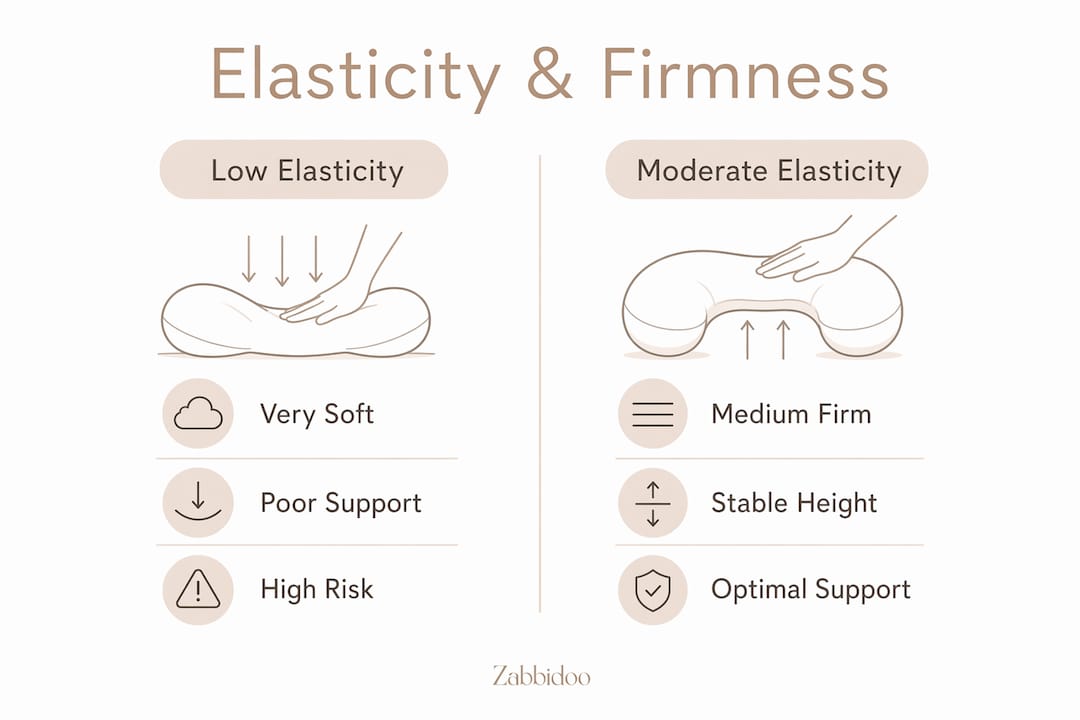
Standardised hardness tests classify pillows from soft to hard using objective compression measurements, giving a more reliable guide than the subjective “feels comfortable in the shop” test.
| Elasticity level | Firmness feel | Posture support | Risk |
|---|---|---|---|
| Low elasticity | Very soft | Poor, collapses under load | Hunching, muscle fatigue |
| Moderate elasticity | Medium firm | Consistent height, stable support | Minimal when well-designed |
| High elasticity (uncontrolled) | Bouncy | Unstable, causes micro-shifts | Constant muscle engagement |
| Low resilience (memory foam) | Slow-recovery firm | Good pressure distribution, slow rebound | May not recover between feeds |
For most feeding positions, a medium-firm pillow with controlled, moderate elasticity gives you the best of both: enough give to feel comfortable, enough resistance to stay at height. The pillow height and loft directly determines whether you’re feeding in a neutral spine position or compensating with your posture.
3. How pillow materials determine elasticity and durability
The material inside a nursing pillow is what actually creates its elastic behaviour. Two pillows can feel similar in a shop and perform completely differently after a week of use.
Natural rubber latex foam has a rebound resilience of approximately 74% and a hysteresis loss ratio of 0.19, meaning it recovers quickly after compression. Memory foam, by contrast, has a rebound resilience of around 9%, dissipating energy slowly. That slow recovery can feel supportive initially but means the pillow doesn’t fully reset between feeds.
Research published in the ULBEC journal Q1 2025 found that natural rubber latex foam maintains cervical curvature with rapid recovery and significantly reduces neck pain, while polyurethane and memory foams vary considerably in energy dissipation and recovery speed.
Material comparison for elasticity and support:
- Natural latex: High rebound resilience, rapid shape recovery, good pressure distribution, tends to run warmer
- Memory foam: Slow recovery, excellent initial pressure relief, poor rebound between uses
- Polyurethane foam: Mid-range resilience, widely available, variable quality
- Fibre fill: Inconsistent elasticity, compresses permanently over time, low durability
Design matters as much as material. Research on personalised pillow shapes found that smart pillows with adjustable height outperformed both latex and polyester fibre pillows in maintaining natural cervical curvature. Structured foam or pneumatic designs that preserve specific dimensions under weight consistently outperform soft-fill alternatives for ergonomic support.
Zabbidoo’s nursing pillow uses French flax linen as its outer cover, a breathable, durable material that holds its structure wash after wash. The internal construction prioritises compression resistance and an 18cm lift height, bringing the baby up to breast level rather than requiring the mother to lean down.
4. Softness is not the same as support
This is the most common mistake mothers make when choosing a nursing pillow. A pillow that feels wonderfully soft in your hands can be the worst option for a 45-minute feed.
Harley Street Orthopaedics is direct on this point: softness is the initial tactile impression of a pillow, but support depends on its resistance to collapse and its ability to maintain shape over time during use. A pillow that feels soft and fails to hold its height forces muscles to overcompensate, leading to fatigue and poor posture.
Pillows with excessive elasticity cause subtle but constant micro-shifts during feeding, engaging stabilising muscles unnecessarily and contributing to discomfort over time.
Common misconceptions about pillow softness:
- “Softer means more comfortable” — comfort during feeding depends on sustained height, not initial softness
- “A plush feel means good cushioning” — high loft without compression resistance collapses under infant weight
- “Firm pillows are uncomfortable” — medium-firm pillows with good elasticity feel supportive, not hard
- “Any nursing pillow will do the job” — pillow shape, height, and material all affect feeding posture significantly
Clinicians advocate for standardised compression testing rather than subjective softness claims when evaluating pillow suitability. The pillow shape and feeding comfort connection is well-documented, yet softness remains the primary purchase driver for most buyers.
5. Why compression resistance is what actually keeps you upright
Elasticity gets a pillow back to its original shape. Compression resistance is what stops it from collapsing in the first place. You need both.
A pillow’s ability to maintain height under load prevents hunching and reduces neck and back strain during prolonged feeding. Without adequate compression resistance, even a highly elastic pillow will bottom out under the combined weight of a growing baby and the mother’s arms.
Benefits of good compression resistance:
- Maintains consistent baby height across the full duration of a feed
- Reduces the frequency of repositioning, which is a significant source of wrist and shoulder strain
- Prevents the gradual forward lean that develops when pillow height drops
- Supports different body types without requiring constant adjustment
Consequences of poor compression resistance:
- Pillow flattens within minutes under load
- Mum compensates by gripping, leaning, or tensing
- Feeding sessions become progressively more uncomfortable
Pro Tip: After a full day of use, place your nursing pillow on a flat surface and measure its height. If it’s noticeably shorter than when new, compression resistance is failing. A well-constructed pillow should retain close to its original height after regular use.
Chiropractic guidance on pillow support and spinal health consistently emphasises that structural integrity under load is the defining factor in whether a pillow actually reduces musculoskeletal strain.
6. How elasticity affects pressure distribution and blood flow
When a pillow distributes pressure evenly, it reduces localised load on any single point of contact. For a breastfeeding mother, that means less concentrated pressure on the forearms and wrists, and better circulation throughout a feed.
Research on pillow material and pressure distribution found that polyurethane water pillows and low-resilience elastic urethane pillows support the weight of the head and neck over a wider contact area, reducing strain on the neck and shoulders compared to softer polyester alternatives. The principle applies directly to nursing pillows: a material with appropriate elasticity spreads the load rather than concentrating it.
Poor pressure distribution from a collapsed or overly rigid pillow restricts blood flow to the forearms during extended holds. That pins-and-needles sensation many mothers notice mid-feed is often a pressure distribution problem, not just fatigue.
7. How elasticity determines how long your pillow lasts
A nursing pillow that loses its elasticity after three months is not a bargain at any price. Rebound resilience is the key durability indicator: materials that recover quickly under repeated compression retain their support properties far longer than those that gradually compact.
Fibre-fill pillows are the worst offenders. The fibres mat together with use, permanently reducing loft and elasticity. Latex and structured foam hold their elastic properties significantly longer under repeated compression cycles. Research on lyocell and synthetic fibre pillow fillings found that filling height and form stability after repeated compression cycles varied substantially by material, with coarser synthetic components retaining height better over 500 compression cycles.
For a nursing pillow used six to twelve times daily, that compression cycling adds up quickly. A pillow that maintains its elasticity and height over months of daily use is the one that continues to protect your posture, not just on day one.
8. Choosing the right elasticity for your body type and feeding position
There is no single elasticity level that suits every mother. Body weight, arm length, and preferred feeding position all affect how much compression a nursing pillow experiences and how much rebound resilience it needs.
Larger body frames or mothers feeding twins place more load on the pillow, requiring higher compression resistance alongside moderate elasticity. Petite frames may find that a very firm pillow creates pressure points rather than distributing load comfortably.
Feeding position matters too. The cradle hold places load centrally, while the football hold concentrates weight on one side. A pillow with uneven elasticity will tilt under asymmetric load, creating exactly the postural instability you’re trying to avoid.
Expert advice on choosing the right pillow for musculoskeletal health recommends prioritising consistent height retention and even compression resistance over softness, regardless of body type. The pillow should meet you where you are, not require you to adapt your posture to it.
Zabbidoo: built around what most nursing pillows get wrong
Most nursing pillows are designed to feel soft in the packet. Zabbidoo is designed to hold its shape during the feed.

The Zabbidoo nursing pillow features a lift height designed to bring your baby up to breast level so you’re not rounding your shoulders to close the gap. Its internal construction prioritises compression resistance, so the pillow stays at height under infant weight rather than compressing down within the first few minutes. The French flax linen cover is breathable and durable, and the design supports multiple feeding positions without requiring constant repositioning.
If you’ve been feeding on a pillow that leaves your neck aching by the end of the day, the issue is almost certainly elasticity and compression resistance, not your technique. A pillow that holds its structure changes the experience entirely.
See the Zabbidoo nursing pillow and find out whether it suits your feeding setup.
Key takeaways
Elasticity in a nursing pillow directly determines whether it maintains the height and structure needed to support neutral feeding posture and reduce muscle strain throughout each feed.
| Point | Details |
|---|---|
| Elasticity sustains height | A pillow with good rebound resilience holds consistent height, reducing forward lean and muscle compensation. |
| Moderate elasticity is optimal | Too soft collapses under load; too bouncy causes constant micro-shifts; medium-firm with controlled elasticity is the target. |
| Material drives performance | Natural latex foam has approximately 74% rebound resilience, recovering quickly; memory foam at approximately 9% dissipates energy slowly and resets poorly between feeds. |
| Compression resistance is non-negotiable | Elasticity alone is insufficient; a pillow must resist compression under load to prevent postural collapse during a full feed. |
| Zabbidoo addresses the core problem | With an 18cm lift and compression-resistant construction, Zabbidoo maintains height and structure where most nursing pillows gradually fail. |