

Pillow height is defined as the vertical lift a pillow provides between a surface and the body it supports, and during breastfeeding it determines whether your neck and spine stay in neutral alignment or collapse into strain. Feeding eight to twelve times daily creates cumulative load on the neck and shoulders that most mothers never anticipate. An Inglesina survey of 2,259 mothers found 80% reported physical discomfort during breastfeeding, with 25% considering stopping because of pain. The right pillow height does not just make feeding more comfortable. It protects your body across hundreds of sessions.
Why does pillow height matter for breastfeeding posture?
Pillow height matters because it controls the angle of your neck during feeding, and even a few centimetres of difference shifts your muscles from resting to working hard. National Geographic’s 2025 sleep science reporting confirms that too much height causes excessive forward bending, while too little causes the neck to drop backward, both of which strain muscles and trigger pain signals. During breastfeeding, this problem is amplified because you are not lying still. You are actively holding a baby, adjusting a latch, and sustaining that position for ten to forty minutes at a stretch.

The clinical term for what happens when pillow height is wrong during feeding is head-forward posture, a condition where the head shifts in front of the shoulders rather than sitting directly above them. HNJ Clinic describes this as a geometric problem of sustained muscle loading: the further your head moves forward, the heavier it effectively becomes for the muscles supporting it. A head that weighs roughly five kilograms at neutral alignment can place the equivalent of twenty or more kilograms of force on the cervical spine when tilted forward by just thirty degrees.
The most common posture mistakes linked to incorrect pillow height during breastfeeding include:
- Holding the baby too low and hunching forward to meet them at chest level
- Using a flat or collapsed pillow that forces the arms to bear the baby’s full weight
- Sitting in a deep, soft sofa that lowers the effective height of any pillow placed on the lap
- Leaning the head to one side to check the latch repeatedly without repositioning the whole body
- Feeding without elbow support, which transfers load directly to the neck and upper back
Pro Tip: Position your baby so their mouth is level with your nipple before you latch. If you need to tilt your chin down more than a few degrees to see what is happening, your pillow is too low. Raise the baby, not your neck.
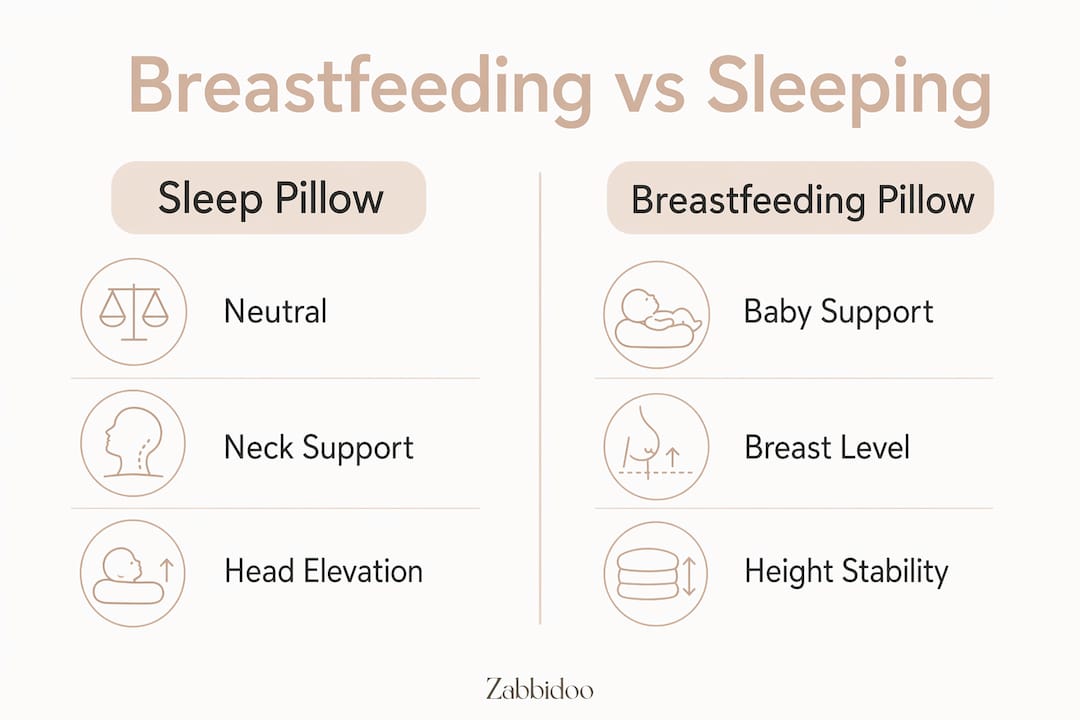
Breastfeeding vs sleeping: how pillow height needs differ
Sleep science provides a useful starting point for understanding pillow height, but breastfeeding creates a different set of demands that sleeping research does not fully address. Research summarised by Mattress Miracle from a 2016 Applied Ergonomics study confirms that pillow height is the single most significant factor for cervical spine alignment during sleep, with side sleepers needing four to six inches of loft depending on shoulder width. That principle transfers directly to breastfeeding, but the application changes significantly.
| Factor | Sleep pillow height | Breastfeeding pillow height |
|---|---|---|
| Primary goal | Neutral cervical alignment during rest | Baby at breast level, neutral spine during active feeding |
| Height range | 4 to 6 inches for side sleepers | Varies by torso length, chair height, and baby size |
| Surface effect | Mattress firmness alters effective loft | Chair or sofa depth changes effective baby height |
| Duration | 6 to 8 hours, mostly static | 10 to 40 minutes, repeated 8 to 12 times daily |
| Adjustment frequency | Set once per sleep position | Reassessed each feeding session and location |
The key difference is that a sleep pillow supports your head. A breastfeeding pillow supports your baby, and through that, your arms, shoulders, and neck. Getting the baby to breast height removes the need to hunch. It is a fundamentally different ergonomic goal, which is why a standard bed pillow almost never works well for feeding.
Surface sink is a factor that most mothers overlook entirely. The same pillow loft produces different neck angles depending on how much the seating surface compresses under body weight. A firm dining chair raises your lap relative to your torso, meaning a pillow of a given height will position the baby higher than the same pillow used on a deep, soft couch. This is not a minor variation. It can mean the difference between a comfortable feed and twenty minutes of neck strain.
Pro Tip: Test your pillow height in every location where you regularly feed, including the bed, the couch, and any nursing chair. What works in one spot may not work in another. Keep a folded blanket nearby to add height when needed.
How to choose and adjust the right breastfeeding pillow height
The correct breastfeeding pillow height brings your baby’s mouth level with your nipple without you needing to lean forward or tilt your head down. Raising the baby to breast level reduces neck flexion and supports a better latch, because you are not compensating with your body for a pillow that is not doing its job. A useful starting point is to sit upright in your usual feeding chair, rest your forearm across your lap, and note where your elbow naturally sits. Your pillow should bring the baby to roughly that height.
Pillow firmness matters as much as starting height. A pillow that compresses under a baby’s weight loses effective height mid-feed, which means you gradually hunch without realising it. Zabbidoo’s nursing pillow is designed with an 18cm lift and compression-resistant fill specifically to address this. The pillow holds its shape under load, so the height you set at the start of a feed is the height you have at the end. This is the practical difference between a pillow that supports and one that merely cushions.
Elbow support is the detail most mothers miss when thinking about pillow height effects. If your elbows are unsupported and your arms are bearing the baby’s weight, your shoulders will rise and your neck will tighten regardless of how well your pillow is positioned. The pillow height should be sufficient to let your arms rest, not grip.
Watch for these warning signs that your pillow height is wrong:
- Neck or shoulder ache that begins during or immediately after a feed
- A tendency to lean forward or slide down in your seat as the feed progresses
- Wrist fatigue from holding the baby up rather than resting them on the pillow
- Needing to crane your neck sideways to check the latch
- Upper back tightness that builds across the day with each feed
What to do when discomfort persists despite adjustments
Persistent neck or shoulder pain after adjusting your pillow height is a signal worth taking seriously. Wrong pillow height can cause neck pain syndromes with symptoms including stiffness, headaches, and numbness in the arms or hands, all of which result from sustained muscle guarding rather than a single acute injury. If these symptoms continue beyond a few days of correct positioning, the issue may have moved from postural to structural, and simple cushioning will not resolve it.
Here is a practical sequence for addressing persistent discomfort:
- Book a session with a physiotherapist who has experience in postnatal musculoskeletal care. They can assess whether your pain is postural, joint-related, or nerve-referred, and give you targeted treatment rather than generic advice.
- Consult a lactation consultant if pain is affecting your feeding confidence or duration. They can observe your positioning in real time and identify height or latch issues that are difficult to self-diagnose.
- Add targeted stretches to your daily routine. Chin tucks, shoulder rolls, and doorway chest stretches address the specific muscle groups most loaded during breastfeeding. Ten minutes twice a day makes a measurable difference over two weeks.
- Take movement breaks between feeds. Standing up, walking briefly, and resetting your posture between sessions reduces the cumulative load that builds across a full day of nursing.
- Review your feeding furniture. A chair with armrests at the right height, combined with a correctly sized nursing pillow setup, removes the need for your body to compensate for inadequate support.
Hydration also affects muscle recovery. Breastfeeding increases fluid demands significantly, and dehydrated muscles fatigue faster and recover more slowly. Keeping water within reach during every feed is a small habit with a real physiological benefit.
Key takeaways
Pillow height during breastfeeding is a biomechanical variable, not a comfort preference, and getting it right reduces neck strain, supports latch quality, and protects mothers across hundreds of feeding sessions.
| Point | Details |
|---|---|
| Height determines posture | Incorrect pillow height causes head-forward posture, loading the cervical spine with disproportionate force. |
| Baby height is the real goal | The pillow must bring the baby to breast level, not just cushion the lap or support the head. |
| Surface sink changes everything | Chair or mattress firmness alters effective pillow height; test your setup in every feeding location. |
| Compression resistance matters | A pillow that collapses mid-feed loses height gradually, causing unnoticed hunching and strain. |
| Persistent pain needs professional input | Ongoing discomfort despite correct positioning warrants physiotherapy or lactation consultant review. |
The thing nobody tells you about nursing pillows
I have spoken with many mothers who bought a nursing pillow, found it uncomfortable after a week, and assumed they were using it wrong. In most cases, they were not using it wrong. They had a pillow that was simply too low, or one that compressed under their baby’s weight within minutes of sitting down.
The conversation around breastfeeding support focuses almost entirely on latch technique and milk supply. Pillow height barely gets a mention in most antenatal classes, and yet it is the physical variable that determines whether a mother can sustain feeding without pain. A poor latch can be corrected in a single session with a lactation consultant. Chronic neck and shoulder strain from months of hunching takes considerably longer to resolve.
What I find most telling is the Inglesina survey data: 25% of mothers considered stopping breastfeeding because of physical pain. That is not a feeding problem. That is an ergonomics problem. And ergonomics problems have engineering solutions. The right pillow height, held consistently by a pillow that does not collapse, removes a significant portion of that pain before it accumulates.
My honest advice is to treat pillow height as a non-negotiable setup step, not an afterthought. Experiment with it deliberately in the first week postpartum, before patterns of compensation become habits. Your neck will thank you at the six-month mark.
— Marietjie
How Zabbidoo supports better breastfeeding posture

Zabbidoo’s nursing pillow is built around the one thing most nursing pillows get wrong: height that holds. At 18cm of lift, it brings your baby to breast level without you needing to hunch, and its compression-resistant fill means that height stays consistent from the first minute of a feed to the last. The cover is made from French flax linen, which is breathable and durable through repeated washing. Whether you are feeding on the couch, in bed, or in a nursing chair, Zabbidoo is designed to keep your spine neutral and your arms rested. If you are ready to stop compensating with your body and start feeding with proper support, explore the Zabbidoo nursing pillow and see the difference that height-focused design makes.
FAQ
Why does pillow height matter more during breastfeeding than sleeping?
During breastfeeding, the pillow must raise the baby to breast level rather than simply support your head, making height a direct determinant of neck angle and feeding posture. Feeding eight to twelve times daily means any height mismatch compounds into significant cumulative strain.
What is the optimal pillow height for breastfeeding?
The optimal height brings your baby’s mouth level with your nipple while you sit upright, without you needing to tilt your head forward or raise your shoulders. This varies by torso length, chair height, and baby size, so individual testing in your usual feeding spots is the most reliable method.
Can the wrong pillow height cause neck pain?
Yes. Sustained incorrect neck angles from a pillow that is too low or too high cause muscle guarding, stiffness, headaches, and in some cases arm numbness. These symptoms often develop gradually rather than appearing after a single session.
Does pillow height affect breastfeeding comfort on different furniture?
The same pillow produces different effective heights on different surfaces because chair or mattress firmness changes how much the body sinks. A pillow that works well on a firm dining chair may be too low on a deep sofa, so height should be reassessed in each feeding location.
How do I know if my breastfeeding pillow is the right height?
If you are leaning forward, your neck aches during or after feeds, or your wrists are bearing the baby’s weight rather than resting, your pillow is likely too low. A correctly sized pillow lets your arms rest fully, keeps your chin level, and holds the baby at breast height without any compensatory posture from you.