

Most parents assume any nursing pillow will do the job. You prop the baby up, latch on, and get through the feed. But explaining pillow lift properly means understanding that how high your baby sits during feeding changes everything. The lift itself is the active ingredient. Without enough height, you hunch forward. Your neck strains, your shoulders round, and your wrists absorb weight they should never carry. By the end of this article, you will know exactly what a pillow lift is, why it matters for your body and your baby’s latch, and how to use it correctly from day one.
Table of Contents
- Key takeaways
- Explaining pillow lift: what it actually means
- How pillow lift supports latch and posture at every stage
- Pillow lifts vs wedge pillows vs standard nursing pillows
- How to use pillow lift correctly during feeding
- My honest take on pillow lifts after working with nursing mums
- Why Zabbidoo was designed around lift from the start
- FAQ
Key takeaways
| Point | Details |
|---|---|
| Lift height is the key variable | A pillow that raises baby to breast level prevents mum from hunching, reducing neck and back strain. |
| Growth-zoned designs save effort | Pillows with different padding densities adapt to baby’s size without constant manual re-adjustment. |
| Torso support beats head-only elevation | Supporting shoulders and upper back maintains spinal alignment far better than lifting the head alone. |
| Wedge pillows serve a different purpose | Wedges work best for sleep elevation, not the multi-positional support needed for feeding holds. |
| Compression resistance matters | A pillow that holds its shape under baby’s weight keeps posture consistent across every feed. |
Explaining pillow lift: what it actually means
A pillow lift is not a product category. It is a function. It describes the measurable height a nursing pillow raises your baby toward your breast, reducing the distance your body needs to travel downward to meet them. Most standard nursing pillows offer somewhere between 8 and 12 centimetres of lift once compressed under a baby’s weight. That gap matters enormously.
The ergonomic principle is straightforward. When baby comes up to mum, mum stays upright. When baby stays low, mum folds down. That folding motion is where neck and shoulder strain originates for most new parents. It is not a single dramatic injury. It is hundreds of small compressions per day across weeks and months.
There are a few design approaches worth knowing:
- Flat nursing pillows wrap around the waist and offer minimal height. They are widely available and inexpensive, but their low profile means most caregivers end up leaning forward anyway.
- Contoured nursing pillows use shaped foam or layered fill to create specific zones of support, with higher lift at the baby-facing surface.
- Wedge-style supports angle the baby’s body rather than lifting horizontally. They work differently from a pillow lift and are better suited to reflux positioning than active feeding.
- Growth-zoned pillows use different padding densities across the surface to adapt as baby grows, maintaining consistent lift without manual re-adjustment.
The defining feature of a genuine pillow lift is compression resistance. A pillow that collapses under baby’s weight gives you zero lift within minutes of sitting down. Regular pillows shift and compress, losing their supportive alignment quickly, which is precisely why specialised nursing pillows exist.
Pro Tip: Press down firmly on your nursing pillow before purchasing. If it compresses more than two centimetres under light hand pressure, it will compress significantly more under your baby’s full weight during a feed.
How pillow lift supports latch and posture at every stage
The connection between pillow lift and latch quality is more direct than most parents realise. When baby is lifted to breast level, their head, neck, and torso align naturally. That alignment is what allows a deep latch without the baby craning upward or the mum angling downward to compensate.

Growth-zoned nursing pillows address this by offering different padding densities on each side. One side supports newborns from 0 to 3 months, where a firmer, higher surface is needed for a smaller, lighter baby. The flip side accommodates babies from 3 months onward, where slightly more give suits a heavier, more active feeder. The practical benefit is that different densities aligned to baby age stages minimise constant manual pillow tuning across the feeding journey.
Here is how posture works across the three most common feeding holds when pillow lift is correctly applied:
- Cradle hold. Baby lies across your body, head in the crook of your arm. The pillow lift supports the full length of baby’s body, keeping their head at breast height without your arm bearing the entire load. Your shoulders stay back and level.
- Cross-cradle hold. You support baby’s head with the opposite hand. The pillow lift takes the weight of baby’s torso, freeing your wrist from load-bearing entirely. This is particularly useful in the early weeks.
- Rugby hold. Baby tucks under your arm beside you. The pillow lift here supports your forearm and baby’s body simultaneously. Without adequate height, this hold places enormous strain on the elbow and shoulder joint.
Across all three, ergonomic nursing pillows support cradle, cross-cradle, and rugby holds to relieve shoulder and back tension by keeping the caregiver’s spine in a neutral position. Research suggests that growth-zoned pillow designs can reduce mother’s muscle fatigue by up to 90% compared to unsupported feeding. That figure reflects what many parents feel but rarely attribute directly to pillow height.
A critical nuance that most pillow lift explanations skip: it is not enough to lift the baby’s head. Elevating shoulders and upper back maintains better spinal alignment than lifting the head alone, both for the caregiver and for positioning the baby in reflux-sensitive situations. Think of support as full-torso, not just a prop under the neck.
Pillow lifts vs wedge pillows vs standard nursing pillows
Understanding the pillow lift explanation fully means knowing what it is not. Wedge pillows are triangular, designed primarily for sleep elevation, and work by angling the entire upper body at 30 to 45 degrees. They are excellent for acid reflux management during sleep. But wedge pillow stability depends on orientation and entire torso support, and placing a wedge incorrectly under the neck rather than starting at the shoulders can cause significant neck strain and increase abdominal pressure.
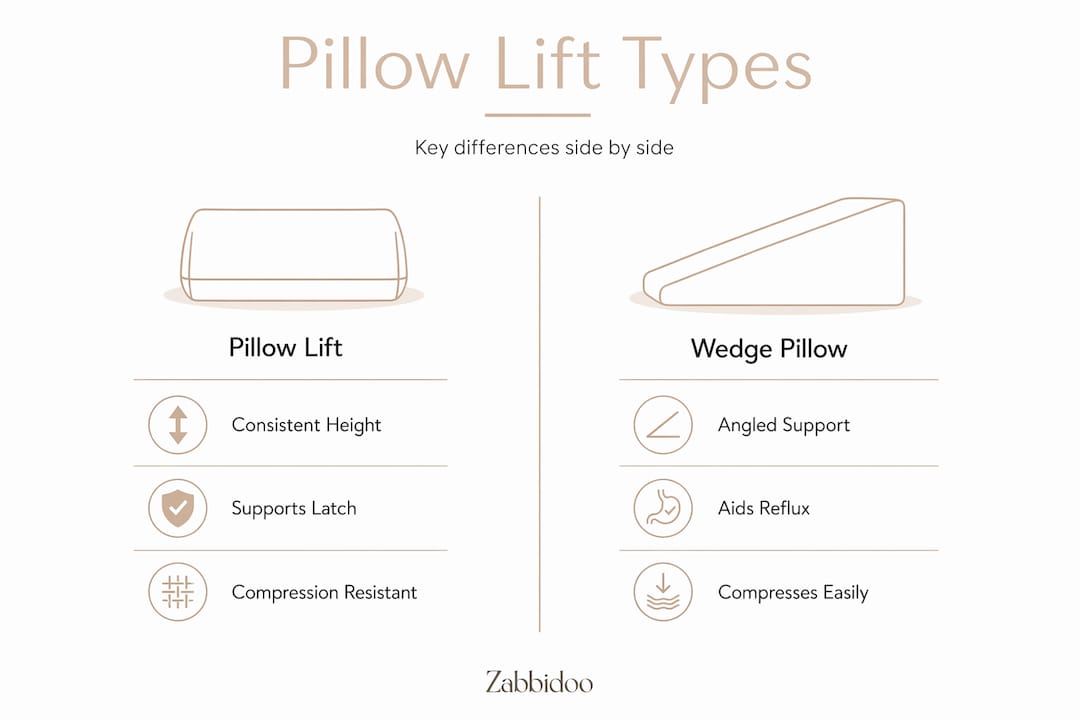
Here is a direct comparison of the main product types:
| Support type | Primary function | Lift height | Best use case | Compression resistance |
|---|---|---|---|---|
| Nursing pillow (standard) | Baby support during feeding | Low (6-10cm) | Short feeds, supplementary support | Low to medium |
| Growth-zoned nursing pillow | Ergonomic feeding across stages | Medium to high (12-18cm) | Full feeding journey, multiple holds | High |
| Wedge pillow | Sleep and reflux elevation | Fixed angle | Sleep positioning, post-feed settling | Medium |
| Bolster pillow | Positional support | Variable | Side-lying nursing, body support | Medium |
The clearest takeaway from this comparison is that wedge pillows and nursing pillows solve different problems. A wedge is not a nursing pillow, and a nursing pillow used as a sleep wedge creates safety risks. The pillow shape affects feeding comfort and posture in ways that go beyond simple height. Surface contour, edge firmness, and centre channel design all influence how well baby stays positioned across a full feed.
Pro Tip: If you are tempted to stack two standard pillows for more height, know that stacking normal pillows is ineffective for therapeutic positioning because they shift and compress independently. You end up with an unstable, uneven surface that creates more strain, not less.
How to use pillow lift correctly during feeding
Getting the pillow lift technique right takes a few deliberate steps, particularly in the first weeks when both you and baby are still finding your rhythm. The nursing pillow setup for comfortable feeding process is more nuanced than simply placing a pillow on your lap.
- Sit upright before placing the pillow. Your back should be supported by the chair or couch behind you. Feet flat on the floor. Do not start by leaning forward to find baby. Start upright and let the pillow bring baby to you.
- Position the pillow at waist height, not lap height. If the pillow sits too far down your thighs, the effective lift is reduced. Slide it up until the surface is level with your lower ribcage.
- Place baby on the pillow before latching. Get baby settled and supported first, then adjust your position. Most parents do this in reverse, which means they are already leaning by the time the latch happens.
- Check your shoulders. They should be relaxed and level, not raised toward your ears. Raised shoulders almost always indicate the pillow is too low or too compressed to provide adequate lift.
- Adjust for the hold. For rugby hold, bring the pillow further to the side rather than centred. For cross-cradle, make sure the pillow extends far enough to support baby’s full body weight, not just their lower half.
For babies in the 3 to 6 month range who are growing quickly, the height question becomes relevant again. A pillow with good compression resistance will maintain its lift far longer than a lower-density product. The ideal pillow height varies depending on the caregiver’s body and the baby’s weight, but the benchmark for effective nursing support sits at a minimum of 12 centimetres of consistent, uncompressed lift.
Common mistakes worth avoiding include letting the pillow drift away from your body mid-feed (which forces you to reach forward to maintain contact), and relying on the pillow for baby’s head support without also supporting their lower body. The baby should be fully on the pillow surface, not partially suspended.
Pro Tip: Use a rolled hand towel to fill any gap between the pillow and your abdomen. This prevents the pillow from sliding outward during longer feeds and keeps baby’s position stable without you physically holding it in place.
My honest take on pillow lifts after working with nursing mums
From where I sit, the single most underestimated aspect of infant feeding is what it does to the caregiver’s body over time. I have spoken with many mums who attributed neck pain, shoulder tightness, and wrist strain to “just being a new parent.” They normalised it. What I have found is that in almost every case, the physical strain traced directly back to feeding position, and feeding position traced back to a pillow that did not lift enough.
What surprises caregivers when they finally use a pillow with real, consistent lift is not the comfort. It is how much less effort feeding takes. When baby is at the right height, you stop bracing. You stop compensating. Your arms genuinely rest instead of holding a position.
The other thing I would say honestly: the conversation around pillow lifts tends to focus on baby’s latch, and that matters. But the caregiver’s posture is equally worth protecting. You are going to feed this baby eight to twelve times a day for months. The cumulative strain on your neck, shoulders, and lower back across that period is not trivial. A pillow that provides real, sustained lift is not a luxury purchase. It is the difference between feeding being sustainable and feeding being something you endure.
Do not settle for a pillow that compresses flat within the first few minutes. That is not lift. That is just padding.
— Marietjie
Why Zabbidoo was designed around lift from the start

Zabbidoo built its nursing pillow specifically around the problem that most nursing pillows get wrong. The pillow provides 18 centimetres of consistent lift, which means baby comes up to mum rather than mum folding down to baby. The fill is engineered to resist compression, so the lift you feel in the first feed is the lift you still have three months later. The French flax linen cover keeps the surface breathable across long feeds.
For parents who want to go deeper on feeding pillow design trends and what to look for in 2026, Zabbidoo’s resource library covers the full picture. And if you are building out your feeding kit, the free pacifier clip chain is a practical addition to complement your nursing routine.
Average pillows collapse. Zabbidoo supports.
FAQ
What is a pillow lift in nursing?
A pillow lift refers to the height a nursing pillow raises your baby toward breast level during feeding, reducing the need for the caregiver to lean or hunch forward. The goal is to bring baby to mum, not the other way around.
How does pillow lift help with neck pain?
By raising baby to the correct height, a pillow lift keeps the caregiver’s spine in a neutral position throughout the feed. Elevating shoulders and upper back rather than only the baby’s head prevents the forward neck strain that accumulates across multiple daily feeds.
Is a wedge pillow the same as a nursing pillow lift?
No. Wedge pillows are designed for sleep elevation at a fixed angle and work best for reflux positioning, not active feeding holds. A nursing pillow lift provides height and surface support across multiple positions including cradle, cross-cradle, and rugby holds.
How much lift does a nursing pillow need?
A minimum of 12 centimetres of consistent, uncompressed lift is the practical benchmark for effective nursing support. Zabbidoo’s pillow offers 18 centimetres of lift, which brings baby to breast height for most seated caregivers without requiring forward lean.
Can I use a regular pillow instead of a nursing pillow?
Regular pillows compress and shift under baby’s weight, losing their supportive alignment almost immediately. Stacking standard pillows creates an unstable, uneven surface that increases rather than reduces physical strain during feeding.