

Pillow stability is defined as a pillow’s ability to maintain consistent loft and firmness throughout an entire nursing session, without collapsing, shifting, or losing shape under the weight of you and your baby. When a nursing pillow fails to hold its position, your neck drops forward, your shoulders round, and the muscles along your upper back begin compensating within minutes. The importance of pillow stability goes well beyond initial comfort. It determines whether your spine stays in neutral alignment or spends 20 to 40 minutes per feed locked in a strained position. For mothers nursing multiple times a day, that strain compounds quickly.
Why pillow stability matters for neck and spine alignment
The biomechanical term for what a stable nursing pillow achieves is neutral cervical alignment. This means your head sits directly above your shoulders, with no forward tilt or backward extension. Incorrect pillow height or firmness forces the neck into strained positions, causing muscle and joint strain that fragments comfort and, over time, contributes to chronic tension. For nursing mothers, this happens not just at night but across every feed throughout the day.
Each nursing hold creates a different postural demand on your neck and upper back.
- Cradle hold: Your baby lies across your forearm with their head at your elbow. Without adequate loft under the arm, your shoulder lifts and your neck tilts to compensate.
- Cross-cradle hold: Your opposite hand supports the baby’s head, which means your wrist and forearm carry more load. A pillow that collapses shifts that load directly onto your neck and shoulder.
- Football hold: The baby is tucked under your arm along your side. This hold often requires less pillow height but demands lateral stability so the baby does not slide downward during the feed.
Adjustable-height nursing pillows should be tailored to each specific hold and then rechecked for neutral chin and head posture, according to practitioners who work with breastfeeding mothers. A pillow that works perfectly for the cradle hold may leave you hunching forward during a football hold if the loft is not adjusted.
Pro Tip: After settling into your nursing position, check that your chin is level, not tucked toward your chest or lifted upward. If either is happening, your pillow loft needs adjusting before the feed continues.

How do loft and firmness affect nursing pillow stability?
Pillow support differs from softness. Loft refers to the height of the pillow. Firmness refers to how much the material resists compression under load. Support only emerges when loft and firmness interact correctly with your anatomy and the surface beneath you. A pillow can feel wonderfully soft in the first minute and still fail you by minute ten if the fill material compresses too easily.
Matching loft to your body dimensions is the starting point. Broader shoulders require higher loft to fill the gap between your arm and your torso. Petite frames need less. Side sleepers require a thicker, firmer pillow to fill the shoulder-to-head gap for proper alignment, and the same principle applies to nursing. If your arm is elevated on a pillow that sits too low, your shoulder rises and your neck tilts. If the pillow is too high, your neck extends backward.
The table below compares common fill materials by their stability characteristics during nursing use.
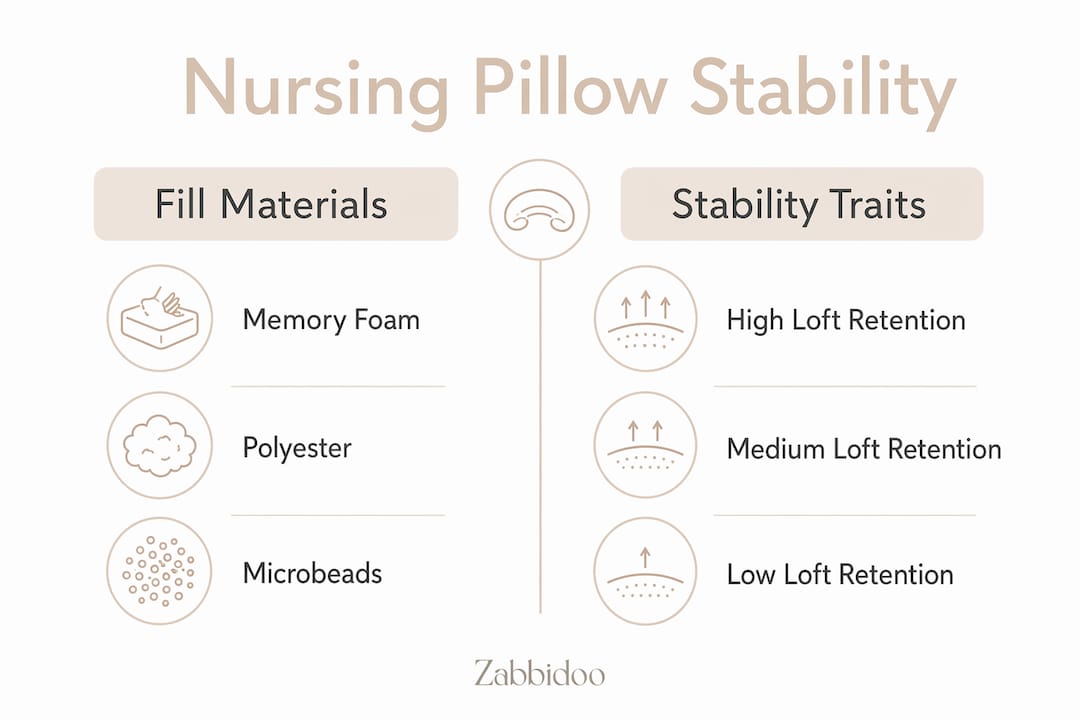
| Fill material | Loft stability | Firmness under load | Nursing suitability |
|---|---|---|---|
| Memory foam (solid) | High | Moderate to firm | Good for consistent support; heat retention is a consideration |
| Latex (natural) | Very high | Firm and responsive | Excellent stability; resists compression well over long sessions |
| Down and feather | Low | Soft; compresses quickly | Poor stability; requires frequent repositioning |
| Polyester fibrefill | Low to moderate | Soft; loses shape over time | Common in budget pillows; not recommended for extended nursing |
| Dual-density foam | Very high | Firm base, softer surface | Best for nursing; maintains loft while cushioning baby’s weight |
Matching pillow loft to body dimensions and nursing position reduces alignment drift by maintaining stable support throughout the session. Zabbidoo’s nursing pillow is built at 18 centimetres of lift specifically because most standard nursing pillows sit too low, forcing mothers to hunch down toward the baby rather than bringing the baby up to them.
Pro Tip: When testing a new nursing pillow, sit in your usual nursing position and press down firmly with your forearm for 30 seconds. If the pillow drops more than two centimetres and does not recover, the fill material lacks the compression resistance needed for extended feeds.
How to test and maintain nursing pillow stability
The most common mistake mothers make is judging a nursing pillow by how it feels in the first moments of use. Pillow instability often reveals itself after 10 to 15 minutes, when gradual compression causes sustained neck flexion or extension. By that point, the damage to your posture is already underway.
Here is a practical method for evaluating and maintaining your nursing pillow’s stability over time.
-
Conduct a timed loft test. Place your forearm on the pillow in your nursing position and hold it there for 15 minutes. Measure or estimate the pillow height at the start and again at the end. A stable pillow loses minimal height. A pillow that compresses by more than two centimetres is not providing consistent support.
-
Check your posture mid-feed. At the five-minute mark of a nursing session, pause and assess your head position. Is your chin level? Are your shoulders relaxed? If you have drifted forward or your shoulder has lifted, the pillow has shifted or compressed and needs repositioning.
-
Refit for each hold. Do not assume the same pillow position works across different holds. Re-fitting for cradle, cross-cradle, and football holds maintains alignment specific to each position. Spend 30 seconds adjusting before each feed rather than correcting your posture throughout it.
-
Inspect the fill regularly. Every four to six weeks, remove the cover and press the pillow evenly across its surface. Uneven compression, flat spots, or areas that do not spring back indicate fill breakdown. This is the point at which the pillow is no longer providing reliable support.
-
Replace when stability fails. A nursing pillow that no longer holds its loft is not just uncomfortable. It actively works against your posture. Most polyester-filled pillows need replacing within six to twelve months of regular use. Latex and high-density foam options last considerably longer.
For a detailed walkthrough of testing pillow stability during actual feeding sessions, Zabbidoo’s practical guide covers the process step by step.
What design features make a nursing pillow more stable?
Not all nursing pillows are built with stability as the primary goal. Many prioritise softness, aesthetics, or price point, which means the features that actually maintain support are often absent. Understanding what to look for helps you choose a pillow that holds up across months of daily use.
The most effective design feature for stability is dual-density padding. Specialty nursing pillows with dual-density padding promote correct posture and reduce muscle fatigue significantly by using a firm base layer that resists compression and a softer surface layer that cushions without collapsing. This combination means the pillow holds its height under load while still feeling comfortable against the baby’s body.
Key design features that contribute to nursing pillow stability include:
- High compression resistance: The fill or foam must resist deformation under the combined weight of your arm and your baby. Pillows that compress easily create the gradual loft loss that causes postural drift.
- Defined shape retention: C-shaped and U-shaped nursing pillows with structured foam maintain their form across different holds better than loosely filled wraparound styles.
- Adjustable loft layers: Some pillows allow you to add or remove fill to customise height. This is particularly useful as your baby grows and the required loft changes.
- Non-slip base: A pillow that slides on the chair or sofa surface forces you to reposition constantly, which interrupts the feed and strains your posture in the process.
- Breathable, durable cover materials: Covers made from natural fibres like French flax linen regulate temperature and withstand repeated washing without degrading the structural integrity of the pillow beneath.
Pillow height matters for breastfeeding mums in ways that go beyond comfort. The right height directly influences latch quality, because a baby positioned at the correct height requires less neck and jaw effort to feed effectively. A pillow that collapses mid-feed changes that height and disrupts the latch.
The RZ Puff Pillow from Guestly Sleep offers a useful reference point for understanding how dual-sided foam construction maintains consistent loft for side sleepers, which translates directly to the principles of nursing pillow support. The same logic applies: a pillow that holds its shape under sustained lateral pressure is a pillow that supports rather than just cushions.
Key takeaways
A nursing pillow’s stability, not its softness, determines whether it protects your neck and spine across every feed.
| Point | Details |
|---|---|
| Stability over softness | A pillow that holds its loft under load protects posture; one that compresses quickly causes strain. |
| Match loft to your body | Shoulder width and nursing hold determine the correct pillow height for neutral alignment. |
| Test after 15 minutes | Initial comfort is misleading; check loft and posture mid-feed to detect gradual collapse. |
| Refit for each hold | Cradle, cross-cradle, and football holds each require distinct loft adjustments for correct alignment. |
| Replace when loft fails | Flat spots and uneven compression signal the pillow is no longer providing reliable support. |
Why softness is the wrong thing to shop for
I have spoken with dozens of mothers who bought the softest nursing pillow they could find and spent the first three months of breastfeeding with persistent neck and shoulder pain. They assumed the pain was just part of new motherhood. It was not. It was the pillow.
The instinct to choose softness makes complete sense. You are sleep-deprived, your body is recovering, and something soft feels like relief. But softness and support are not the same thing. A soft pillow compresses under load. A supportive pillow holds its position. The distinction matters enormously when you are nursing for 30 minutes at a time, six to eight times a day.
What I find most mothers do not realise is that the discomfort they feel at the end of a feed, that ache across the upper back and the tightness in the base of the neck, is not caused by the nursing itself. It is caused by the gradual postural drift that happens when the pillow loses its loft and the body compensates without the mother noticing. Regularly reassessing pillow fit during nursing prevents this from becoming a chronic pattern.
The emotional dimension of this matters too. When nursing is physically comfortable, it is easier to be present. When every feed involves managing pain or constantly readjusting, the experience becomes something to endure rather than something to enjoy. Getting the pillow right is not a luxury. It is the foundation of a sustainable nursing routine.
— Marietjie
Find a nursing pillow that actually holds its shape

Zabbidoo’s nursing pillow is built around one principle: the pillow should come to you, not the other way around. At 18 centimetres of lift, it brings your baby to the correct feeding height without requiring you to hunch forward. The high-density foam core resists compression across extended feeds, so the loft you start with is the loft you finish with. The French flax linen cover is breathable, washable, and built to last well beyond the newborn stage. If you have been nursing through discomfort and assuming that is simply how it feels, Zabbidoo was designed to show you it does not have to be.
FAQ
What is pillow stability and why does it matter for nursing?
Pillow stability refers to a pillow’s ability to maintain its height and firmness under sustained load without collapsing or shifting. For nursing mothers, it determines whether the neck stays in neutral alignment throughout a feed or drifts into a strained position.
How does pillow loft affect breastfeeding posture?
Pillow loft sets the height at which you hold your baby during nursing. Too low and your shoulder lifts or you hunch forward; too high and your neck extends backward. Matching loft to your shoulder width and nursing hold keeps your spine aligned and reduces muscle fatigue.
How often should I replace my nursing pillow?
Polyester-filled nursing pillows typically need replacing within six to twelve months of regular use once flat spots or uneven compression appear. High-density foam and latex options last considerably longer but should still be tested every four to six weeks for loft consistency.
Can a nursing pillow help with neck pain?
Yes. Maintaining neutral head and neck posture with a stable pillow reduces strain and can improve comfort even for mothers with persistent nursing-related discomfort. The key is choosing a pillow that holds its loft rather than one that simply feels soft initially.
What fill material is best for nursing pillow stability?
Latex and dual-density foam offer the highest compression resistance and are the most reliable for maintaining consistent loft across long nursing sessions. Down and polyester fibrefill compress quickly and require frequent repositioning, making them poor choices for extended feeds.