

Your nursing pillow is one of the most frequently used items in those early months, often pressed against your skin and your baby’s face multiple times a day. Yet most mums rarely think about what’s building up inside it between washes. Neglected pillows can harbour over a million fungal spores, dust mites, and bacteria, which is a real concern when you’re feeding a newborn with sensitive skin and an immature immune system. This guide walks you through exactly how to clean your nursing pillow properly, what materials require special care, and how consistent hygiene supports both comfort and safe feeding.
Table of Contents
- Why pillow hygiene matters for mums and babies
- What you need for effective pillow cleaning
- Step-by-step pillow hygiene process for every pillow type
- Verifying cleaning success and avoiding common mistakes
- Expert perspective: Why pillow hygiene is more than a cleaning task
- Discover ergonomic nursing solutions with Zabbidoo
- Frequently asked questions
Key Takeaways
| Point | Details |
|---|---|
| Weekly cover washes | Washing pillow covers weekly minimises skin and allergy issues for mum and baby. |
| Adapt cleaning to materials | Always check care tags—memory foam and latex require special handling, while synthetic or down may be machine washed. |
| Never use for sleep | Nursing pillows are for feeding only and must not be used for unsupervised sleep due to safety risks. |
| Sunlight reduces allergens | Airing pillows outdoors helps decrease fungal spores and dust mites more effectively than machine washing alone. |
| Inspect after cleaning | Check for lingering stains, odours, or moisture to confirm proper cleaning and maintenance. |
Why pillow hygiene matters for mums and babies
Every feed leaves something behind. Sweat from your arms and torso, lanolin from nipple creams, milk spills, dead skin cells, and oils from both your skin and your baby’s all work their way into the pillow cover and insert over time. It sounds unpleasant because it is. But the bigger concern is what those residues attract and grow.
“Pillows that aren’t cleaned regularly can harbour over a million fungal spores, dust mites, and bacteria. Regular cleaning significantly reduces allergen load and keeps sleep and feeding environments safer.”
For mums, this matters for skin health. A pillow cover sitting against your forearms and torso during multiple daily feeds can trigger acne flare-ups, rashes, and irritation if it’s not washed frequently. For babies, the stakes are even higher. Infants have delicate, permeable skin and underdeveloped immune systems, making them more reactive to allergens and microbes than older children.
Weekly cover washes align with standard pillowcase hygiene benchmarks and help minimise skin irritation for both mum and baby. Think of the cover like a pillowcase on your bed pillow. You wouldn’t go weeks without washing that, and your nursing pillow deserves the same attention.
There are a few key hygiene risks to stay on top of:
- Dust mite accumulation is one of the most common allergen triggers in home textiles
- Mould and mildew can develop inside damp inserts, especially after spills that weren’t fully dried
- Bacterial growth from skin-to-fabric contact during feeding sessions
- Milk residue soaking through covers into inserts, creating persistent odour and microbial activity
- Skin cell build-up, which feeds dust mites and contributes to that “stale” smell over time
There’s also an ergonomic dimension to pillow hygiene that often gets overlooked. A pillow that’s compressed, waterlogged from improper drying, or structurally compromised from neglect will no longer support your baby at the correct height. You’ll unconsciously hunch forward to compensate, loading your neck, shoulders, and wrists. Clean, well-maintained pillows hold their shape and keep safer feeding with baby pillows as the default, not something you have to work for.
One more non-negotiable: nursing pillows are for supervised feeding only. They are never safe for infant sleep, which we’ll return to shortly.
Having set the stakes for hygiene, let’s look at what you need to begin the cleaning process.
What you need for effective pillow cleaning
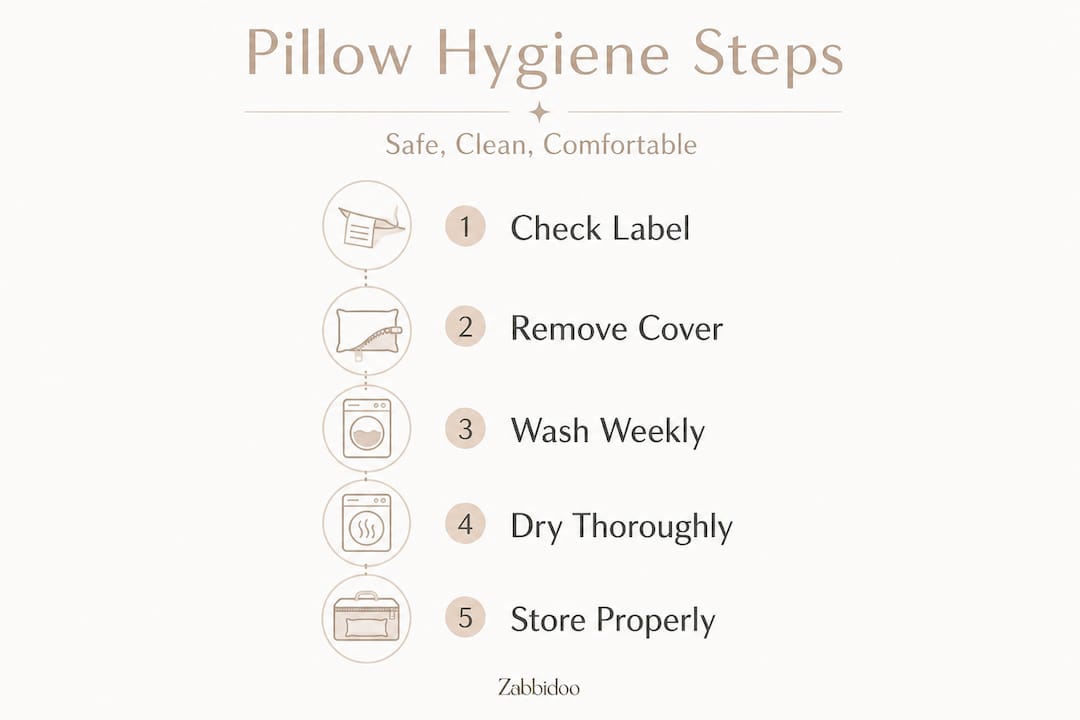
Before you start, check the care label on both your cover and your insert. This step saves a lot of trouble. A care label will tell you the maximum wash temperature, whether machine washing is permitted, and whether tumble drying is safe. If the label has faded or been removed, default to the gentlest method available for that material type.
Here’s a quick comparison of pillow types and their corresponding care requirements:
| Pillow type | Machine washable? | Recommended method | Drying method |
|---|---|---|---|
| Synthetic fibre insert | Yes (if label allows) | Gentle cycle, warm water | Low heat tumble or air dry |
| Down or feather insert | Yes (if label allows) | Gentle cycle, cool water | Low heat tumble with dryer balls |
| Memory foam insert | No | Spot clean or hand wash only | Air dry flat, away from direct heat |
| Latex insert | No | Spot clean or hand wash only | Air dry flat in ventilated space |
| Removable cover (cotton/linen) | Yes | Gentle cycle, cool to warm water | Tumble or line dry |
Covers should be washed weekly or after any spills, using a gentle cycle with cool to warm water. For inserts, a wash every three to six months is a reasonable baseline, though you may need to increase this frequency if you live in a humid climate, if allergies are a concern, or if there’s been a significant milk spill.
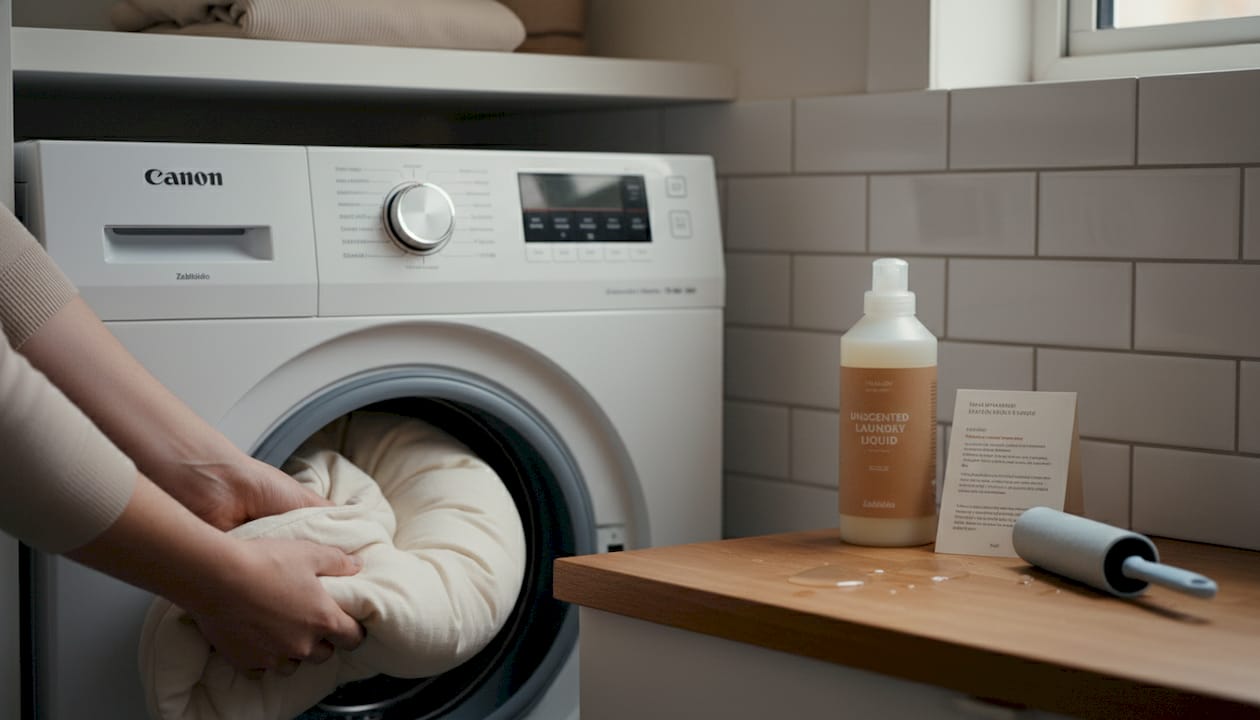
Memory foam and latex inserts require hand washing or spot cleaning only and must be air dried completely before reassembly. Machine washing these materials breaks down their cellular structure, causing them to crumble internally even when they look intact from the outside. You won’t necessarily notice the damage immediately, but the pillow will lose its compression resistance faster than it should.
What you’ll need before you start:
- Mild, fragrance-free laundry detergent (important for babies with sensitive skin)
- Non-chlorine bleach or white vinegar for stubborn stains (check label first)
- A clean sponge or soft cloth for spot cleaning
- Access to a washing machine with a gentle cycle setting
- A well-ventilated drying area or a tumble dryer with a low-heat setting
- Dryer balls if tumble drying down or synthetic inserts (they help prevent clumping)
Pro Tip: If you’re caring for a nursing pillow with a French flax linen cover, wash it separately from other laundry to prevent lint transfer. Linen softens beautifully with each wash when treated correctly. Learn more about caring for your nursing pillow and nursing pillow durability for material-specific guidance.
With your materials in hand, let’s walk through each cleaning method for safer feeding.
Step-by-step pillow hygiene process for every pillow type
Getting the method right the first time protects your pillow’s structure and ensures it continues to support you and your baby properly at every feed. Here’s how to approach each cleaning task, broken down by pillow component.
Cleaning the removable cover:
- Remove the cover completely from the insert before washing
- Pre-treat any stains with a small amount of mild detergent or a diluted white vinegar solution, allowing it to sit for five to ten minutes
- Wash on a gentle cycle with cool to warm water (roughly 18 to 29°C)
- Avoid fabric softeners, which can reduce breathability and irritate sensitive skin
- Tumble dry on low heat or line dry in a ventilated space, avoiding direct prolonged sunlight on coloured covers to prevent fading
- Ensure the cover is completely dry before placing it back on the insert
Cleaning synthetic or down inserts:
- Check the care label first. If machine washing is permitted, use a gentle or delicate cycle
- Balance the load with two pillows or add a couple of towels to prevent the machine from becoming unbalanced during spinning
- Use a small amount of mild detergent. Too much creates excess residue that’s difficult to rinse out fully
- Run an additional rinse cycle to remove all detergent traces
- Tumble dry on low heat with dryer balls to restore loft and prevent clumping, or lay flat to air dry in a warm, ventilated area
Cleaning memory foam or latex inserts:
- Remove the cover and inspect the insert for stains or odour
- For spot cleaning: dampen a clean cloth with cool water and a tiny amount of mild detergent, then blot (don’t rub) the affected area
- For a more thorough hand wash: submerge gently in a bath or large sink of cool water with a small amount of detergent, and squeeze water through without wringing or twisting
- Rinse thoroughly until no detergent remains
- Press out excess water gently with a clean towel, then lay flat to air dry completely before reassembly. This can take 24 to 48 hours. Never rush drying with high heat.
Here’s a quick reference summary:
| Task | Frequency | Method |
|---|---|---|
| Cover wash | Weekly or after spills | Gentle machine wash |
| Insert wash (synthetic/down) | Every 3 to 6 months | Gentle machine wash if label allows |
| Insert clean (foam/latex) | Every 3 to 6 months | Hand wash or spot clean only |
| Air out pillow | Monthly minimum | Outdoor ventilation, indirect sunlight |
| Full inspection | Monthly | Check for stains, odour, shape retention |
Pro Tip: Outdoor drying in indirect sunlight is genuinely effective for reducing microbial load on the insert itself, even if machine washing isn’t practical for your pillow type. UV exposure helps neutralise bacteria and freshen the material without chemical intervention.
“Safety comes first in every feed. The CDC identifies nursing pillows as a SUID risk when used for infant sleep. Nursing pillows must only be used during supervised feeding sessions, never as a sleep surface.”
This safety point sits alongside hygiene as a non-negotiable practice. A clean pillow used incorrectly still poses risk. A well-designed nursing pillow setup positions your baby correctly for feeding and is removed the moment the feed is done. If you’d like to explore what a well-engineered pillow actually looks like in practice, the Zabbidoo ergonomic nursing pillow is designed with this exact use-case in mind.
Once you’ve completed cleaning, monitor outcomes and avoid common errors for ongoing hygiene.
Verifying cleaning success and avoiding common mistakes
After cleaning, there are a few checks worth doing before you put the pillow back into rotation. These take less than two minutes and will save you from discovering a mildew problem weeks later.
Signs your pillow has been cleaned effectively:
- No residual odour, either from milk, sweat, or detergent build-up
- Cover feels clean and soft against the skin, not stiff or soapy
- Insert feels consistently firm or responsive across its entire surface (no soggy patches)
- No visible staining on the cover or insert surface
- The pillow returns to its original shape when you press and release
Common mistakes to avoid:
- Putting the insert away damp. This is the single most common cause of mildew in nursing pillows. If it feels even slightly cool or heavy, it needs more drying time.
- Using too much detergent. Residue left in the insert attracts more dirt faster and can irritate baby’s skin.
- Machine washing memory foam or latex inserts. Even a single machine wash can permanently compromise the structure.
- Tumble drying on high heat. This degrades synthetic fibres and can melt the adhesive in foam inserts.
- Skipping the cover wash because it “looks clean.” Bacteria and dust mites aren’t visible. Weekly washing is important regardless of visible soiling.
Wash covers every week, or more frequently if you have acne-prone skin or your baby has eczema. In humid climates or allergy-heavy households, washing inserts more frequently than the standard three to six months is a reasonable adjustment. The investment in regular care pays off in the pillow’s lifespan and your daily comfort.
Pro Tip: Store your nursing pillow in a breathable cotton bag rather than a plastic tub when it’s not in regular use. Plastic traps moisture and promotes mildew, even in pillows that were dry when stored.
For mums who use their nursing pillow for multiple purposes, such as tummy time or baby support, check out this guide on multi-use pillow hygiene to keep all use cases clean and safe.
Expert perspective: Why pillow hygiene is more than a cleaning task
Here’s something that rarely gets discussed in cleaning guides: the physical condition of your nursing pillow directly affects your posture during every single feed. When a pillow loses its loft or structural integrity because it’s been neglected or improperly washed, you compensate physically. You hunch. You twist. You hold tension in your wrists to support your baby’s weight that the pillow should be absorbing. Over weeks of multiple daily feeds, that compensation causes real strain.
Pillow hygiene isn’t just about eliminating bacteria. It’s about preserving the very properties that make a good nursing pillow worth using. A clean, well-maintained insert holds its shape. A compromised one doesn’t, and no amount of repositioning fixes a pillow that’s fundamentally collapsed.
We’ve also noticed that mums who establish a weekly cover wash routine report feeling more in control during an otherwise overwhelming period. There’s something grounding about a small, consistent habit. Knowing your pillow is clean reduces background anxiety during feeds, which matters when you’re already navigating sleep deprivation and learning a new skill.
Weekly cover washes are also your first line of defence against the skin irritation that builds up quietly over repeated feeds. Most mums don’t connect a rash on their forearm or a breakout on their chest to their nursing pillow. But contact dermatitis from unwashed textiles is genuinely common and easily prevented.
The safety reminder bears repeating one more time: a nursing pillow belongs in one context only, which is an awake, supervised feed with an adult present. Understanding what makes a nursing pillow high performance will help you see why structure, material quality, and consistent care are all part of the same equation.
Discover ergonomic nursing solutions with Zabbidoo
If maintaining your current pillow has highlighted its limitations, or if you’re setting up for a new baby and want to get it right from the start, Zabbidoo was built to address exactly what average nursing pillows get wrong.

The Zabbidoo nursing pillow lifts your baby 18cm toward you, so you stop hunching down to meet them. The compression-resistant fill holds its shape through feeds, tummy time, and the months of daily use to follow. The French flax linen cover is breathable, machine washable, and designed to make weekly care genuinely effortless. Pair it with a free pacifier clip chain as a thoughtful addition, or make it a meaningful gift with Zabbidoo’s gift wrapping service for a new mum in your life.
Frequently asked questions
How often should nursing pillow covers be washed?
Covers should be washed weekly or after spills on a gentle cycle to keep allergens and skin irritants at bay. More frequent washing is advisable if you or your baby have sensitive skin.
Are all pillow inserts machine washable?
No. Memory foam and latex inserts must be hand washed or spot cleaned only and air dried flat. Synthetic and down inserts may be machine washed on a gentle cycle if the care label permits.
Is it safe for babies to sleep on nursing pillows?
No. Nursing pillows pose a SUID risk when used as a sleep surface. They are designed for supervised feeding sessions only and should always be removed once the feed is complete.
How can I reduce allergens in nursing pillows between washes?
Frequent cover washing and airing the insert outdoors in indirect sunlight both help reduce dust mite and mould activity. Regular cleaning removes the oils and dead skin cells that allergens feed on, significantly lowering the microbial load between full washes.
Does over-washing reduce pillow durability?
Yes. Washing inserts too frequently, or using the wrong method for the material, shortens their lifespan noticeably. Follow care label instructions, use the gentlest effective method, and aim for the three to six month benchmark for full insert cleans to maintain both comfort and structural integrity.