

Most mums assume that any nursing pillow will do the job. You grab something soft, prop your baby up, and hope for the best. But the thickness and firmness of your nursing pillow directly affects your feeding posture, your baby’s latch, and even their safety. A pillow that’s too thin forces you to hunch forward, straining your neck and back with every single feed. One that’s too soft lets your baby sink, making a good latch almost impossible. This article walks you through the evidence on ideal nursing pillow thickness so you can feed comfortably, safely, and without the guesswork.
Table of Contents
- Why nursing pillow thickness matters
- Finding the ideal thickness: Evidence from experts
- Comparison: Thin vs thick pillows — real impacts
- Applying the knowledge: Choosing the right pillow for you
- What most guides miss about nursing pillow thickness
- Explore safe, ergonomic nursing pillow solutions
- Frequently asked questions
Key Takeaways
| Point | Details |
|---|---|
| Correct thickness matters | Using a pillow around 3–4 inches thick ensures safe alignment for mum and baby. |
| Firmness is safety-critical | Pillows must be firm and flat to minimise suffocation risk and maintain stable feeding posture. |
| Test before purchase | Always check pillow height and firmness at breast level to avoid discomfort and poor latch. |
| Avoid thin pillows | Pillows under 2 inches thick nearly always cause mum hunching and feeding strain. |
Why nursing pillow thickness matters
Let’s start with why pillow thickness is more than just a comfort preference.
When you sit down to feed, your body needs to remain upright and relaxed. The pillow beneath your baby acts as a bridge, lifting them to breast height so you don’t have to lean down. If that bridge is too low, too soft, or too unstable, your posture collapses. You compensate by hunching, twisting, or holding your baby’s weight with your wrists and arms. Do that eight to twelve times a day, and the cumulative strain becomes genuinely painful.
Thickness also plays a direct role in infant safety. Regulatory bodies and consumer safety organisations now pay close attention to how nursing pillows are built, because a surface that’s too soft can become a suffocation hazard if a newborn’s face presses into it.
“Firmness is critical per new nursing pillow safety standards to prevent suffocation; firm, flat designs support optimal alignment and stability at breast height.”
This is why modern pillow designs increasingly favour structured, firm fills over plush, cushiony ones. The goal is a surface that holds its shape under your baby’s weight and keeps them stable, not one that feels luxurious but collapses mid-feed.
The durability of nursing pillows is closely tied to this. A pillow that starts firm but loses its shape after a few weeks is effectively becoming thinner and softer over time, which means the support it offered on day one won’t be there at week six when you still need it.
Here’s what a pillow with the right thickness actually does for you:
- Keeps your baby level with your breast without you bending forward
- Reduces the load on your wrists, arms, and shoulders
- Provides a stable, non-rolling surface for consistent positioning
- Maintains safe alignment so your baby’s airway stays clear
- Supports a proper latch by keeping your baby at the right angle
When you’re testing pillow safety before buying, these are the outcomes you want to verify, not just how plush it feels in the shop.
Finding the ideal thickness: Evidence from experts
Now that we know thickness is critical, let’s explore what the evidence says about the best dimensions.
The sweet spot for nursing pillow thickness sits between 7.5 and 10 centimetres (roughly 3 to 4 inches). Within this range, the pillow lifts your baby high enough to reduce maternal strain while keeping the surface firm enough to prevent sinking. Go below this, and you start running into problems fast.
Too thin a pillow forces hunching or holding the pillow up, increasing back strain; too soft causes baby to sink, leading to poor latch. That’s not a minor inconvenience. Hunching during feeds loads the lumbar spine and upper back in ways that build up to real injury over weeks and months.
Firmness and thickness work together. A pillow that is 4 inches thick but made from a soft, compressible fill will collapse under your baby’s weight, effectively becoming a 2 inch pillow the moment pressure is applied. This is why firmness is just as important as the measured height.
Lactation consultants recommend firm pillows for a flat, stable surface that prevents rolling and slumping, particularly in the early postpartum weeks when newborns are still learning to latch.
Here’s a quick summary of how thickness ranges perform in practice:
| Thickness | Performance | Risk |
|---|---|---|
| Under 5 cm (2 in) | Low lift, poor posture support | High back and neck strain |
| 7.5 to 10 cm (3 to 4 in) | Optimal breast height, firm surface | Minimal if fill is firm |
| Over 12 cm (5 in) | Too elevated for most mums | Awkward angle, shoulder tension |
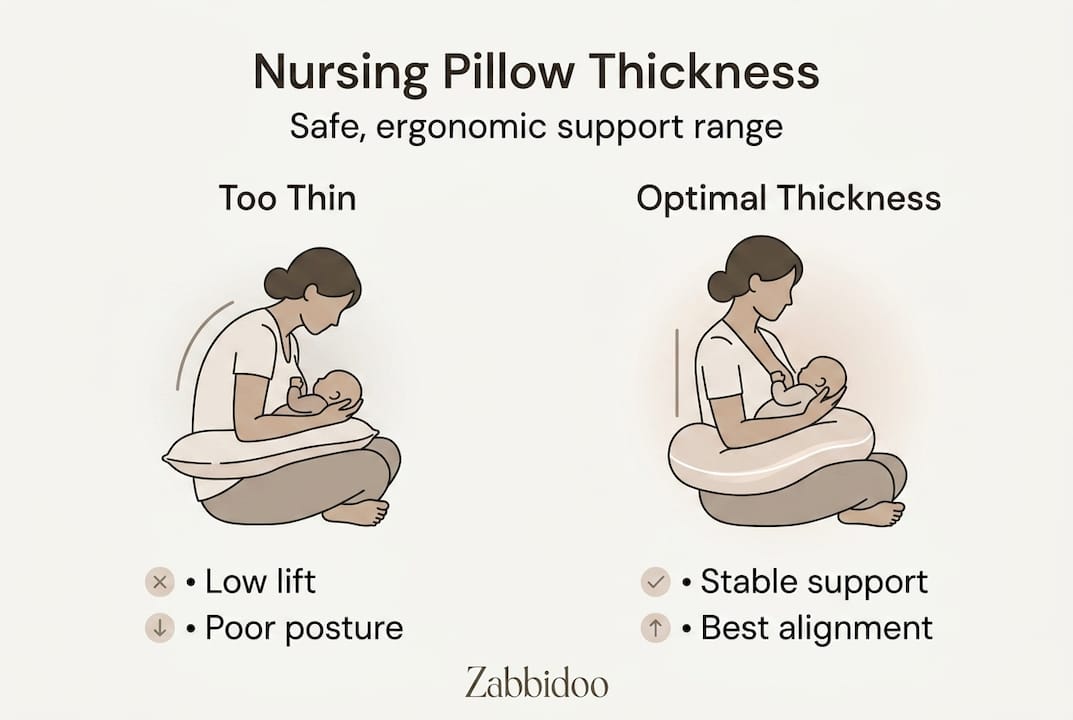
The height-adjustable nursing pillows on the market attempt to bridge individual variation, which is worth considering if you’re between sizes or unsure where you fall.
Pro Tip: Before you commit to a pillow, sit in your usual feeding position and hold a folded blanket at breast height. Note the thickness that brings your baby level without you leaning. That measurement is your personal target thickness.
When setting up nursing pillows correctly, even a well-made pillow can underperform if it’s positioned too far forward or worn too loosely around your body.
Comparison: Thin vs thick pillows — real impacts
Understanding the recommended thickness is helpful, but how do thin versus thick pillows actually affect feeding in real life?
Imagine two scenarios. In the first, a mum uses a 5 cm (2 inch) soft pillow. Within minutes, the fill compresses under her baby’s weight. She finds herself leaning forward to bring her baby to breast level, her shoulders rounding, her wrists bearing the extra load. By the end of the feed, her upper back aches. Her baby’s latch is inconsistent because the unstable surface keeps shifting.
In the second scenario, the same mum uses a firm 10 cm (4 inch) pillow. Her baby rests at breast height without her adjusting her posture. The surface doesn’t compress. Her shoulders stay relaxed. The baby latches well because the position is stable and consistent from start to finish.

The difference isn’t subtle. It plays out across every single feed, dozens of times a week.
Here’s a side-by-side comparison of how pillow thickness affects key outcomes:
| Feature | Thin pillow (under 5 cm) | Optimal pillow (7.5 to 10 cm) | Very thick pillow (over 12 cm) |
|---|---|---|---|
| Breast height support | Poor | Excellent | Variable |
| Posture impact | Causes hunching | Maintains upright posture | Can cause shoulder elevation |
| Latch quality | Inconsistent | Consistent | Depends on mum’s height |
| Safety | Higher risk if soft | Safe if firm | Manageable |
| Comfort over time | Declines quickly | Sustained | May cause tension |
The step-by-step impact on feeding posture looks like this:
- Pillow placed around your waist. The thickness determines immediately whether your baby rests at breast height or below it.
- Baby settled on the surface. A firm pillow holds position; a soft or thin one compresses, dropping your baby lower.
- You either adjust or hunch. With inadequate thickness, your body compensates automatically and unconsciously.
- Latch is attempted. Poor positioning makes a deep latch harder to achieve, which increases nipple discomfort.
- Feed continues. Every minute in a compromised posture adds cumulative strain to your neck, shoulders, and lower back.
Using a multi-use pillow for less strain also means the right thickness works across multiple functions, from feeding to tummy time, without you needing to swap between products.
For pillow safety and effectiveness, the evidence consistently points to firm, structured fills in the 3 to 4 inch range as the safest and most effective option for the majority of mums.
Applying the knowledge: Choosing the right pillow for you
So, how can you use all this information to select the best pillow for your unique situation?
The right thickness for you isn’t purely about the number. It’s influenced by your body, your feeding style, and how old your baby is. A taller mum with a longer torso may find a slightly thicker pillow more useful. A mum who feeds in a recliner versus an upright chair will have different needs. A newborn versus a four-month-old sitting up slightly will also change the equation.
Before you buy, ask yourself:
- How tall am I? Taller mums often need more lift to avoid leaning.
- What chair do I feed in? Low, soft sofas change how the pillow sits against your body.
- How old is my baby? Newborns need more height support; older babies may manage with slightly less.
- Do I plan to use the pillow for other purposes? Multi-use pillows need to hold their shape under varied pressure.
- What is the fill material? Memory foam and high-density foam hold firm better than polyester fibrefill.
The safe pillow guidelines consistently highlight firmness as the most important safety criterion, ahead of shape or size. A firm, flat design at the right height is the standard to match.
Avoid these common mistakes:
- Choosing a pillow because it looks soft and comfortable in packaging
- Assuming a crescent shape means it will support your back (it won’t, that’s not what it’s designed for)
- Buying the cheapest option without checking fill density
- Skipping a feeding pillow stability test before using it for extended feeds
Pro Tip: Press your palm firmly into the centre of the pillow and hold for five seconds. A good pillow should spring back almost completely. If it stays compressed, the fill density is too low and it will let your baby sink during feeds.
Good nursing pillow care tips also matter here. Even the best pillow will lose its firmness faster if the cover isn’t washable or if the fill gets damp and compressed over time.
What most guides miss about nursing pillow thickness
Most guides focus on shape, cover material, or which celebrity uses which brand. Very few talk honestly about the engineering behind thickness and why it matters so much more than aesthetics.
The real issue is this: marketing has trained mums to associate softness with comfort. A pillow that feels plush in the shop feels like it will be kind to your body. But softness and support are not the same thing. In fact, a pillow that feels wonderful to touch is often the worst choice for feeding posture because it compresses the moment weight is applied.
Thickness without firmness is meaningless. A 4 inch pillow filled with loose polyester fibrefill will behave like a 2 inch pillow within seconds of your baby settling on it. The number on the label means nothing if the fill doesn’t hold.
We think mums deserve advice based on physics and posture science, not on which pillow photographs well. When you focus on reducing feeding discomfort from the start, you protect yourself from the kind of cumulative back and neck strain that makes those early months far harder than they need to be. Test real alignment. Test real stability. That’s what actually matters.
Explore safe, ergonomic nursing pillow solutions
If you’re ready to put this knowledge into practice, here are trusted solutions designed for mum and baby comfort.
At Zabbidoo, every pillow is built around the principles you’ve just read about. That means firm, compression-resistant fill that maintains its shape feed after feed. It means an 18 cm lift that genuinely brings your baby to breast height. And it means materials like French flax linen that stay breathable and durable through the full newborn stage and beyond.

You shouldn’t have to choose between safety and comfort, and with the right pillow, you don’t have to. Browse ergonomic nursing pillows that meet modern safety standards and are designed specifically for Australian mums. Visit Zabbidoo to find your match.
Frequently asked questions
What is the safest nursing pillow thickness?
Firm pillows around 7.5 to 10 centimetres (3 to 4 inches) thick provide optimal breast height support and help prevent suffocation, according to current safety standards. The key is that the fill must stay firm under pressure, not just measure tall when unloaded.
Can a thin pillow cause feeding issues?
Yes, pillows under 5 cm often force mums to hunch or hold their baby’s weight manually, causing significant back strain and making a consistent latch much harder to achieve.
How can I test if my pillow’s thickness is suitable?
Place the pillow at your breast height while seated and settle your baby onto the surface. Your posture should remain upright without leaning, and your baby should rest level and stable without sinking or rolling.
Does pillow firmness matter as much as thickness?
Absolutely. Firmness is vital to prevent your baby sinking into the surface, which addresses both safety and latch quality. A thick but soft pillow will compress under load and effectively become too thin within seconds.