

Breastfeeding up to 8 to 12 times a day takes a serious toll on your body, especially when you’ve been around the block before and know just how exhausting those early weeks can be. Second-time mums often assume it’ll be easier, but the physical strain of frequent feeds, awkward positions, and poor support still catches many by surprise. The good news is that back pain from poor positioning is largely preventable. This guide walks you through everything: the right tools, the best positions, latch technique, posture adjustments, and when to call in a professional.
Table of Contents
- What you need for comfortable breastfeeding
- Master the key breastfeeding positions
- Achieving a deep and pain-free latch
- Posture and support: setting up your body for relief
- When to ask for professional lactation help
- Why comfort is more than just pillows and positioning
- Support your comfort journey with the right products
- Frequently asked questions
Key Takeaways
| Point | Details |
|---|---|
| Set up your space | Prepare your seat, support tools, and essentials before each feed to prevent discomfort. |
| Learn comfortable positions | Master several breastfeeding holds and vary them throughout the day to minimise physical strain. |
| Focus on latch quality | A deep, pain-free latch is crucial for both baby’s nutrition and relieving pain for mums. |
| Prioritise posture | Use ergonomic supports and check your alignment to avoid back and shoulder pain. |
| Seek help early | Reach out to a lactation consultant for persistent pain or complex feeding issues. |
What you need for comfortable breastfeeding
Having your environment set up before your baby signals hunger is one of the most underrated strategies for comfortable feeding. When you’re scrambling for a cushion mid-feed, you’re already compromising your posture. Getting your space right means you can settle in quickly, feed well, and get on with your day.
Here are the essentials every breastfeeding mum should have within arm’s reach:
- A supportive chair with armrests to keep your arms from bearing the full weight of your baby
- A footstool or ottoman to keep your feet flat and knees at a comfortable angle
- A quality nursing pillow to lift baby to breast height rather than hunching down to meet them
- A lumbar support cushion to protect your lower back during extended feeds
- A water bottle because hydration drops fast during letdowns
- A small side table for your phone, snacks, burp cloths, and anything else you need
- Burp cloths within easy reach to avoid sudden stretching movements
The following table shows how each tool targets a specific source of physical strain:
| Tool | Purpose | Benefit |
|---|---|---|
| Nursing pillow | Lifts baby to breast height | Reduces neck and shoulder hunching |
| Footstool | Keeps knees at 90 degrees | Relieves lower back and hip tension |
| Lumbar cushion | Supports the curve of your spine | Prevents lower back fatigue |
| Chair with armrests | Supports arm weight | Reduces wrist and elbow strain |
| Side table | Holds essentials at reach | Avoids mid-feed twisting and stretching |
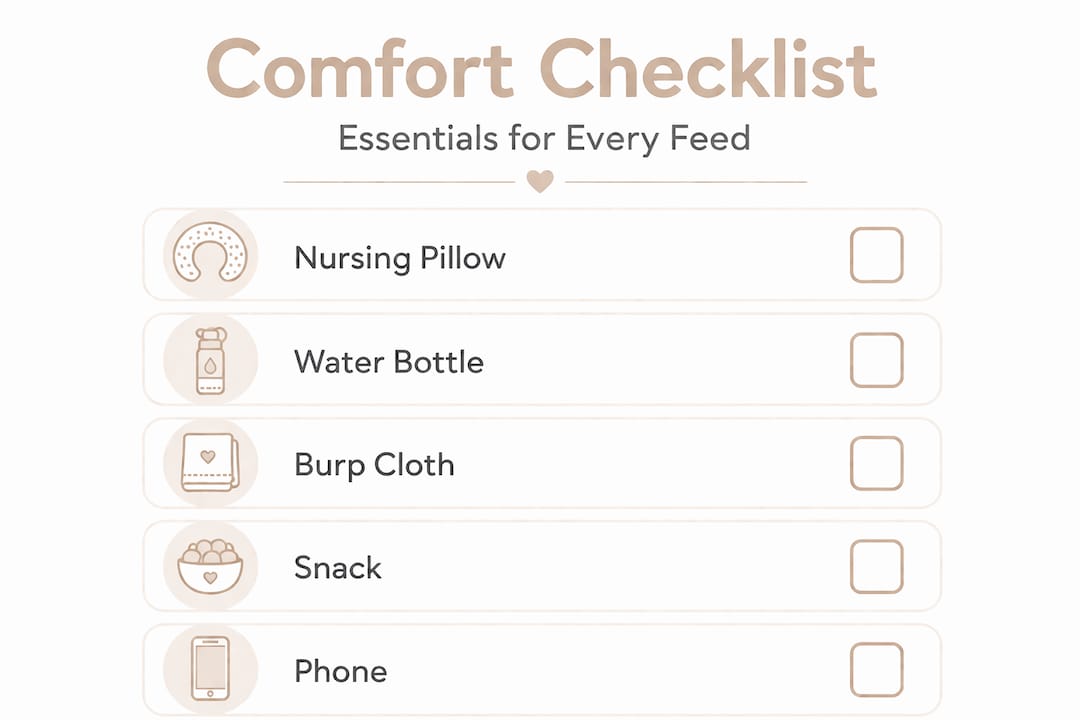
Setting up a proper nursing pillow setup before feeds begin saves you from making small but damaging adjustments every session. Ergonomic positions like the cradle hold, cross-cradle, football hold, laid-back, and side-lying all become far easier when baby pillows for feeding bring your baby to the right height from the start. Using a footstool to maintain a 90-degree knee angle alongside a lumbar support pillow in a chair with armrests makes a measurable difference to how your back and shoulders feel by the end of a long day.
Pro Tip: Before your baby starts feeding, do a quick sweep of your space. Water, phone, burp cloth, and snack all within reach. You’ll spend less time fidgeting and more time feeding comfortably.
Master the key breastfeeding positions
With your environment ready, it’s time to focus on how you hold yourself and bub during feeds. There’s no single “correct” position. What works brilliantly at 2am may not suit a daytime feed in your nursing chair. Knowing your options gives you flexibility.
Here are the five most effective positions and how to use them:
- Cradle hold: Baby lies across your body, head resting in the crook of your arm, facing your breast. Best for daytime feeds when you’re alert and upright.
- Cross-cradle hold: Your opposite arm supports baby’s head, giving you more control over positioning. Great for newborns or when working on latch in the early weeks.
- Football hold: Baby is tucked under your arm like a footy, body running along your side. Ideal after a caesarean, for large breasts, or when feeding twins.
- Laid-back (biological nurturing): You recline at roughly 45 degrees and baby lies tummy-down on your chest. Uses gravity and baby’s natural feeding reflexes beautifully.
- Side-lying: Both you and baby lie facing each other in bed. The go-to for overnight feeds, post-birth recovery, and anyone with lower back or pelvic pain.
| Position | Best use | Key benefit |
|---|---|---|
| Cradle hold | Daytime, alert feeding | Classic comfort for experienced mums |
| Cross-cradle | Newborns, latch training | Extra control over baby’s head |
| Football hold | Post-caesarean, large breasts | No pressure on abdomen |
| Laid-back | Reflux, strong letdown | Gravity supports latch |
| Side-lying | Night feeds, recovery | Back and pelvis rest fully |
Rotating through these feeding positions for newborns matters more than most mums realise. Varying positions frequently prevents muscle strain from prolonged holding by distributing pressure across different muscle groups. Using the same hold every single feed is a bit like carrying a heavy shopping bag in one hand all day. Switching is what saves you.
Pro Tip: At night, try the side-lying position. Your back gets a proper rest, you’re less likely to tense your shoulders, and both you and bub can settle more quickly after the feed.

Achieving a deep and pain-free latch
Positions set the stage, but latch is the foundation of pain-free feeding. A shallow latch is the number one reason mums experience nipple pain, and it’s also the most fixable. Getting this right early protects you from cracking, bleeding, and the kind of dread that builds before each feed.
Follow these steps for a deep, comfortable latch every time:
- Hold your baby so their nose is level with your nipple, not their mouth.
- Wait for a wide, open yawn-like mouth before bringing baby to breast.
- Lead with baby’s chin, not their mouth, aiming their bottom lip well below the nipple.
- Guide the nipple toward the roof of baby’s mouth as they take the breast.
- Check that both lips are flanged outward, like a fish mouth.
Signs that the latch is correct include lips that are turned out, easy swallowing sounds, no pain after the first few seconds of the feed, and baby’s chin touching your breast. If it still hurts after 10 to 15 seconds, gently break the suction with your little finger and try again.
Common latch mistakes to watch for:
- Baby latching onto the nipple only rather than taking a good portion of the areola
- Asymmetric latch where baby’s top lip is pulled in rather than flanged
- Pulling baby away without breaking suction first, which damages nipple tissue
- Feeding before baby’s mouth is fully open, leading to a shallow, pinching latch
- Mum leaning forward to meet baby instead of bringing baby up to the breast
If you’re noticing ongoing breastfeeding discomfort despite adjusting latch technique, it’s worth reading up on causes and solutions to see if something structural like tongue-tie might be a factor.
Important: Most latch pain is a positioning problem, not a permanent condition. A simple adjustment to baby’s head angle or your breast support can completely change the feed within seconds.
Posture and support: setting up your body for relief
With proper latch skills, it’s just as crucial to address your own body’s support and alignment. You can have the best feeding position in the world and still walk away sore if your chair, pillow height, or foot position isn’t right.
Here’s how a properly supported sitting position should look:
| Body part | Ideal position |
|---|---|
| Feet | Flat on floor or footstool |
| Knees | Bent at 90 degrees |
| Back | Fully supported, no slouching |
| Arms | Resting on armrests or pillow |
| Shoulders | Relaxed, not raised or pulled forward |
| Neck | Neutral, not craning forward or down |
Micro-adjustments that make a real difference during every feed:
- Sit all the way back in your chair rather than perching on the edge
- Use a nursing pillow to bring baby to your breast, not your back to your baby
- Tuck a small rolled towel behind your lower back if your chair lacks lumbar support
- Release jaw and shoulder tension every few minutes by consciously softening them
- Swap sides each feed to balance muscle use across both sides of your body
The multi-use nursing pillow comfort approach is key here. A pillow that holds its shape under the weight of a growing baby does the work your arms and back would otherwise absorb. Flat, collapsed pillows force you to compensate by lifting your arms or dropping your chin. Current feeding pillow design trends show that height and compression resistance are the two most important features for sustained posture support across multiple daily feeds.
Maintaining a 90-degree knee angle with lumbar support in a chair with armrests has a direct impact on how your spine manages the repeated load of feeding throughout the day.
“Ergonomic posture during breastfeeding isn’t a luxury. It’s what makes sustained feeding physically possible for mums who feed frequently across months, not just days.”
Pro Tip: Set a quiet phone reminder every 10 minutes during long feeds to check your posture. It sounds excessive, but your body adapts to bad positions quickly, and a brief posture check is all it takes to course correct.
When to ask for professional lactation help
Even with ergonomic tools and great technique, sometimes a bit more help is needed. Knowing when to ask is a strength, not a shortcoming. Waiting too long to see a professional can turn a manageable issue into a bigger one.
Reach out to a lactation consultant (IBCLC, or International Board Certified Lactation Consultant) if you experience any of the following:
- Persistent nipple pain or damage that doesn’t improve after adjusting latch and position
- Baby not gaining weight as expected
- Ongoing shallow latch despite multiple attempts at correction
- Concerns about tongue-tie or lip-tie
- Feeding multiples or premature babies with different needs
- Blocked ducts or early signs of mastitis
- Feelings of anxiety or overwhelm around feeding sessions
Early IBCLC intervention prevents downstream complications like mastitis, low supply, and early weaning driven by pain rather than choice. An IBCLC can observe a full feed, assess baby’s oral anatomy, and give you personalised guidance that no article can fully replicate.
“Seeing a lactation consultant early doesn’t mean you’ve failed. It means you’re problem-solving like someone who wants to keep going.”
The mums who get the most out of breastfeeding are rarely the ones who suffer in silence. They’re the ones who ask questions, try new approaches, and call in expert backup when something isn’t working.
Why comfort is more than just pillows and positioning
Let’s step back from the practical steps and look at comfort from a mum’s lived experience. Here’s a perspective that doesn’t get said often enough: the tools and techniques in this guide matter enormously, but they only work if you’re actually tuned in to what your own body is telling you.
Second-time mums sometimes fall into the trap of thinking they should already have this figured out. So when it hurts, they push through. When their back aches, they assume that’s just feeding. When baby seems unsettled at the breast, they blame supply instead of checking the latch and positioning first.
Real, lasting comfort comes from flexibility. Not just physical flexibility in trying different holds, but the mental willingness to say “this isn’t working, let me try something else.” The mums who find feeding genuinely manageable long-term are usually the ones who experiment across the first few weeks, find their two or three go-to positions, and then stay curious about why any given feed feels harder than usual.
The nursing pillow workflow tips we recommend aren’t just about product use. They reflect a broader truth: when your setup is intentional, you spend less mental energy compensating and more time actually connecting during feeds.
Self-kindness is not soft advice. It’s practical. A tense, exhausted mum with a sore back will struggle to maintain the relaxed shoulders and neutral neck that a pain-free feed requires. Comfort is circular. When you feel supported, your body positions better, your milk lets down more easily, and your baby feeds more effectively.
Pro Tip: If you notice yourself feeling uncomfortable during a feed, don’t wait until it’s over. Pause, break the latch gently, reposition, and start again. Your baby won’t mind. Your body will thank you.
Support your comfort journey with the right products
You deserve lasting comfort, and the right support tools can make a big difference to how feeding feels from week one through to the months that follow.

At Zabbidoo, we built our nursing pillow around the exact problems described in this guide. Most pillows collapse under the weight of a growing baby, forcing mums to hunch, compensate, and absorb the strain in their neck and shoulders. Our pillow sits at 18cm high, holds its shape under pressure, and brings your baby to the right height so your back stays neutral and your arms stay relaxed. Made with breathable French flax linen, it’s designed for the long haul, not just the first fortnight. Browse the full range of ergonomic feeding solutions at Zabbidoo and find the support that suits your feeding style.
Frequently asked questions
How often should I switch breastfeeding positions to prevent strain?
Switch sides and positions every feed or at least several times per day. Varying positions daily reduces muscle fatigue and supports even milk flow across both breasts.
What’s the best breastfeeding position for nighttime comfort?
The side-lying position is the most recommended for overnight feeds. It allows you to rest while feeding and reduces pelvic and lower back strain significantly compared to sitting upright.
How can I tell if my baby has a good latch?
A good latch features a wide open mouth, lips flanged outward, and no pain after initial seconds with audible swallowing sounds throughout the feed.
When should I see a lactation consultant?
Seek professional help if you have ongoing pain, persistent latch problems, or special concerns. Early IBCLC support prevents complications like mastitis and supply issues before they escalate.