

Many mums reach a point where the nursing pillow feels more like a crutch than a comfort, yet making the switch feels daunting. You might notice yourself hunching forward, constantly readjusting, or feeling uncertain about whether your baby is ready to feed without that familiar foam ring. The stakes are real: nursing pillows linked to over 150 infant deaths mean safety must drive your decision as much as convenience. This guide gives you a clear, practical roadmap for moving away from the pillow at the right pace for you and your baby.
Table of Contents
- Why and when to transition off the nursing pillow
- What you’ll need: Preparing for a smooth transition
- Step-by-step: How to transition off your nursing pillow
- Troubleshooting: Common challenges and solutions
- How to know you’ve succeeded: Signs your transition is complete
- What most mums aren’t told about transitioning off the nursing pillow
- Help for your feeding journey: Next steps and resources
- Frequently asked questions
Key Takeaways
| Point | Details |
|---|---|
| Prioritise safety | Never let your baby sleep on a nursing pillow and always supervise use during feeds. |
| Transition at your pace | Most mums transition between 4 and 8 weeks, but go with what feels right for you and your baby. |
| Use safe alternatives | Rolled towels or standard pillows can help support you and your baby during feeds. |
| Watch for readiness | If your baby latches comfortably without extra support, you’re on the right track. |
| Seek help if needed | Don’t hesitate to ask a lactation consultant or GP for support during the transition. |
Why and when to transition off the nursing pillow
Understanding the “why” makes the whole process feel less like a chore and more like a confident, informed choice. There are two main reasons to make the switch: safety and posture.
Safety first. The U.S. Consumer Product Safety Commission (CPSC) now recommends supervised use only for nursing pillows, strictly during awake feeding sessions. Leaving a baby unattended on a nursing pillow, or allowing them to fall asleep on one, creates a genuine suffocation risk. The curved shape that makes these pillows so handy for feeding is also what makes them dangerous when a baby rolls or shifts position unattended.
Posture matters too. Many standard nursing pillows sit low, which encourages mums to hunch down to meet the baby rather than bringing the baby up to breast height. Over weeks and months, that subtle lean forward adds up to real neck, shoulder, and wrist strain. When you start feeding in positions that rely on your own body mechanics rather than a foam prop, you often discover your posture is naturally better.
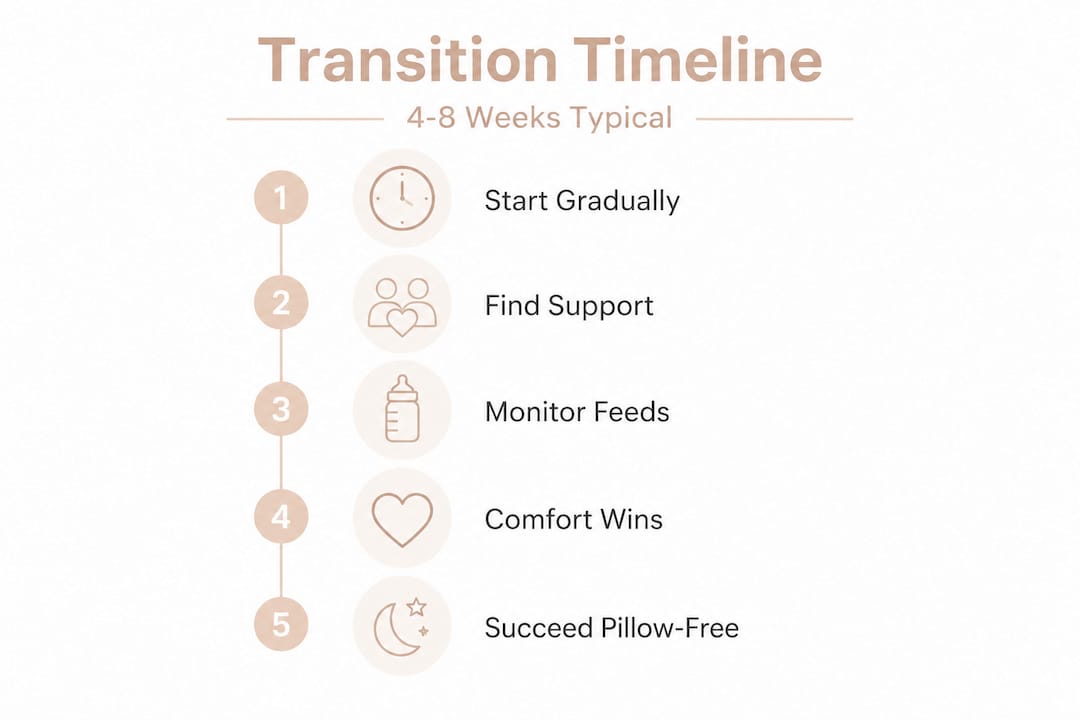
Typical transition timelines
Most mums stop using their nursing pillow between four and eight weeks postpartum, typically when the baby can latch confidently in a side-lying position or sitting upright with minimal support. Some mums make the switch earlier; others take longer. Both are completely normal.
| Stage | Baby’s ability | Pillow need |
|---|---|---|
| 0 to 2 weeks | Still learning to latch | High |
| 2 to 4 weeks | Improving head control | Moderate |
| 4 to 8 weeks | Stronger neck, consistent latch | Reducing |
| 8 weeks and beyond | Good latch in multiple positions | Low to none |
Signs your baby may be ready:
- Consistent, strong latch without needing height adjustment
- Reasonable head and neck control
- Settles quickly at the breast in different positions
- Feeds are calm with fewer repositioning breaks
You can also explore safer feeding recommendations to understand the broader picture of what safe, supported feeding looks like at each stage.
Statistic to note: Nursing pillows have been linked to over 150 infant deaths in the United States, prompting updated CPSC guidance on supervised use only. The transition off the pillow is not just about convenience. It is a genuine safety step.
What you’ll need: Preparing for a smooth transition
You don’t need to throw the nursing pillow out on day one. A gradual approach works far better, and having the right alternatives in place makes an enormous difference to your comfort and confidence.
Safer alternatives to a nursing pillow
The great news is that most households already contain what you need. The key is knowing how to use everyday items effectively. Check out these nursing pillow alternatives for a deeper look at setup options that keep both you and bub comfortable.
| Alternative support | How it helps | Best for |
|---|---|---|
| Rolled towel or blanket | Adjustable height under arm or elbow | Cradle hold without a dedicated pillow |
| Regular bed pillow | Broad support across lap | Taller mums or older babies |
| Feeding armchair with wide armrests | Full arm support, reduces wrist strain | Long feeding sessions |
| Folded throw rug | Adds gentle lift under forearm | Newborn phase with supervised use |
If you’re exploring multi-use pillow options beyond the classic nursing ring, there are ergonomic designs that double as tummy time props, which can keep your pillow in rotation safely even after feeding-specific use decreases.
Setting up your feeding space
Your environment has a bigger impact on comfort than most mums realise. Consider these adjustments before you begin the transition:
- Chair height. Your feet should be flat on the floor. If they’re dangling, add a footstool. This one change reduces lower back strain dramatically.
- Back support. A firm cushion placed in the small of your back keeps you sitting tall instead of slumping. Slumping pulls your shoulders forward and puts pressure on your wrists as you compensate.
- Water and supplies within reach. You’re far more likely to maintain good posture when you’re not reaching and twisting every few minutes to grab your phone or water bottle.
- Baby’s clothing. Dressing your baby in easy-to-manage layers means less fumbling and repositioning at the start of each feed.
Pro Tip: Before your very first pillow-free feed, do a dry run. Sit in your usual feeding chair, hold a cushion where your baby would be, and notice where your arms and back feel strained. Adjust your setup before bub arrives hungry and impatient.
Step-by-step: How to transition off your nursing pillow
A phased approach is far more sustainable than going cold turkey. Gradual changes let both you and your baby adapt without unnecessary stress.
-
Start with one feed per day without the pillow. Choose the feed where your baby is typically most calm and cooperative, usually the morning feed after a good sleep. Keep all other feeds on the pillow as usual.
-
Reduce the pillow’s height gradually. Instead of removing it entirely in those first pillow-free sessions, try folding the pillow slightly or placing less underneath it so the lift is lower. This trains your arms to do more of the work incrementally.
-
Introduce alternative arm support. Swap the nursing pillow for a rolled blanket or regular cushion under your elbow. This keeps your arm from fatiguing while you build the muscle memory for a new hold.
-
Experiment with the cradle hold and cross-cradle hold. These positions work well without a pillow once your baby has reasonable head control. The cross-cradle hold, where your opposite hand supports the baby’s head, gives you excellent control of latch depth and angle.
-
Try side-lying feeding. Side-lying is the position most mums find easiest to transition to without a nursing pillow, because your body naturally supports the baby. It’s also deeply restful for night feeds.
-
Increase pillow-free feeds by one per day each week. By week two, aim for half your feeds without the pillow. By week three or four, most feeds should feel natural without it.
-
Observe your baby’s cues throughout. A baby who is fussing, pulling off repeatedly, or struggling to latch may need a small readjustment rather than a full return to the pillow. Try shifting their position slightly, ensuring their ear, shoulder, and hip are in line, and check that their chin is pressing gently into the breast.
Most mums find the four to eight week window is the natural sweet spot because baby’s neck strength has improved enough to make arm-only holds feel manageable. That said, your timeline is yours. Trust the process.
Pro Tip: Keep a quick mental note of which feeds feel easiest without the pillow. You’ll likely notice a pattern, perhaps morning feeds or post-bath feeds, when your baby is calm and your positioning feels natural. Build out from those anchor feeds.
Troubleshooting: Common challenges and solutions
Even with the best preparation, some feeds will feel awkward during the transition. That’s not failure. It’s adjustment.
Baby seems unsettled without the pillow. This is the most common concern. Before assuming the position is the problem, check the basics: Is baby’s nose clear? Are they getting a deep enough latch? Sometimes the issue is simply that you’re slightly more tense during a pillow-free feed, and babies pick up on that tension. Take a breath, relax your shoulders, and try again.
Your arms fatigue quickly. This is normal, especially in the first week. Your arms are doing work the pillow used to do. Build up gradually and use interim supports like rolled towels. Regular pillows work well for this too.
Back or shoulder pain. Immediately check your posture. You should be sitting tall with your back supported, shoulders down and relaxed, and baby brought up to you rather than you leaning down to baby. If you find yourself constantly rounding forward, your chair setup likely needs adjustment.
You keep reaching for the pillow out of habit. This is completely normal. Habit is powerful. Move the nursing pillow to another room for a few days. Out of sight, out of reach.
“You’re not failing the transition just because some feeds still need the pillow. It’s a gradual process, not a switch you flip overnight.”
Understanding what makes a good support system is important too. Reading up on caring for your nursing pillow can also help you decide whether to repurpose it or retire it as you move forward. For a deeper look at how support tools are evaluated for safety, the safe nursing supports guide is worth bookmarking.
When to seek help. If feeds remain consistently painful, your baby is not gaining weight well, or latch problems persist beyond a week of adjustment, contact a lactation consultant or your GP. These are not things to push through alone.
New CPSC guidelines emphasise that alternatives like rolled blankets are considered safer for long-term use than dedicated nursing pillows left unsupervised, which reinforces why working through any challenges is worth the effort.
How to know you’ve succeeded: Signs your transition is complete
Progress in breastfeeding doesn’t always announce itself loudly. Here’s how to recognise that you and your baby have genuinely made the shift.
| Sign | What it means |
|---|---|
| Baby latches well in at least two positions without the pillow | You have feeding flexibility |
| Feeds are calm and comfortable most of the time | No compensatory hunching or strain |
| You reach for the pillow only occasionally | Habit has shifted, not just intention |
| Feeding sessions feel shorter (or the same) | Baby is feeding efficiently |
| You can feed in different locations comfortably | You’re no longer dependent on a specific setup |
Other signs worth celebrating:
- You no longer dread pillow-free night feeds
- Your wrists and neck feel noticeably less sore
- You feel confident adjusting your baby’s position mid-feed without panicking
- Your baby latches well when sitting up or in a side-lying position without any additional props
Most mums find that by eight weeks, pillow-free feeding is the default rather than the exception. If you’re there earlier, excellent. If it takes a bit longer, that’s fine too.
Once the transition is complete, think about what to do with your nursing pillow. Supervised tummy time is a great repurposing option. Placing your baby tummy-down over the pillow for short, watched sessions helps build upper body strength. It’s a great way to get continued value from the pillow without the feeding-related safety concerns. For more on reducing feeding strain throughout the day, there are some clever positioning strategies worth exploring as your baby grows.
What most mums aren’t told about transitioning off the nursing pillow
Here’s the honest truth that most transition guides skip: the hardest part is rarely the feeding technique. It’s the mental weight of wondering whether you’re doing it right.
Mums are surrounded by timelines. “Most babies do X by week Y.” Those averages are useful reference points, but they can quietly turn into measuring sticks for self-worth. When the transition doesn’t go smoothly at week four, it’s easy to feel like you’ve failed rather than recognising that your baby and your body are simply on their own curve.
There’s also an overlooked aspect of posture that most articles don’t address plainly: if you’ve been hunching over a low nursing pillow for weeks, your body has adapted to that position. Muscles have tightened. Habits have formed. The transition off the pillow isn’t just a baby adjustment. It’s a physical recalibration for you too. That takes time, and it’s worth acknowledging.
The real mum insights from mums who’ve been through this transition show one theme consistently: the mums who felt best about the process were the ones who gave themselves permission to go at their own pace without guilt. Some took two weeks. Some took ten. Both outcomes were valid.
There’s also no shame in reverting temporarily to the pillow during a difficult feed, an illness, or a growth spurt. The goal is a gradual, sustainable shift, not a dramatic overnight change. If you need a reset, reset. Then try again.
Posture and comfort are not luxuries in breastfeeding. They are foundations. When you feel physically supported, you feed with more ease, confidence, and patience. That transfers directly to your baby’s feeding experience.
Help for your feeding journey: Next steps and resources
If you’re not quite ready to let go of your nursing pillow entirely, that’s completely understandable.

Zabbidoo’s nursing pillow options are built differently from standard designs. With an 18cm lift that brings baby up to you rather than pulling you down, and a compression-resistant fill that holds its shape through every feed, it’s designed to support your posture rather than compromise it. Whether you’re in the thick of the early weeks or gently reducing your reliance on a pillow, having the right support underneath you makes every session easier. And while you’re there, grab a free pacifier clip chain to make your whole feeding setup a little more manageable. Small things add up.
Frequently asked questions
Is it safe to let my baby sleep on a nursing pillow?
No, you should never let your baby sleep on a nursing pillow. Nursing pillows linked to over 150 infant deaths highlight the serious suffocation risk when babies are left unattended or allowed to fall asleep on them.
When do most mums stop using a nursing pillow?
Most mums stop between four and eight weeks, once their baby can latch well in a side-lying or upright position without needing the added height.
What alternatives can I use if I stop using a nursing pillow?
Rolled towels, regular bed pillows, and supportive armrests are all effective options. CPSC guidelines note that alternatives like rolled blankets are considered safer for ongoing use than leaving a dedicated nursing pillow unsupervised.
How do I know my baby is ready to feed without a pillow?
Your baby is ready when they latch consistently and settle comfortably in at least a couple of different positions without needing extra height. Mums report this typically happens when the baby develops stronger neck and core control, usually from around four weeks onward.