

Multi-purpose pillows are ergonomic cushions designed to serve several functions beyond basic head support during sleep. Rather than buying separate pillows for lumbar relief, leg elevation, travel comfort, and nursing, one well-designed multi-purpose pillow handles all of these. The core idea is consolidation: fewer items, better support, less clutter.
Here is what a quality multi-purpose pillow typically does:
- Supports the head and neck across different sleep positions (side, back, and combination)
- Provides lumbar relief when placed behind the lower back during sitting or driving
- Elevates the legs to improve circulation or reduce swelling
- Acts as a nursing aid, bringing baby up to the right height for feeding
- Cushions the neck and back during travel
- Supports the body while reading, watching television, or resting upright
The difference from a standard pillow is not just shape. It is the combination of ergonomic design, adaptive fill, and construction that lets the same pillow shift roles without losing its effectiveness.
What shapes and types of multi-purpose pillows are there?
Shape is the first thing that determines how a pillow performs across different uses. Most multi-purpose pillows fall into a handful of recognisable categories, each suited to a different set of tasks.
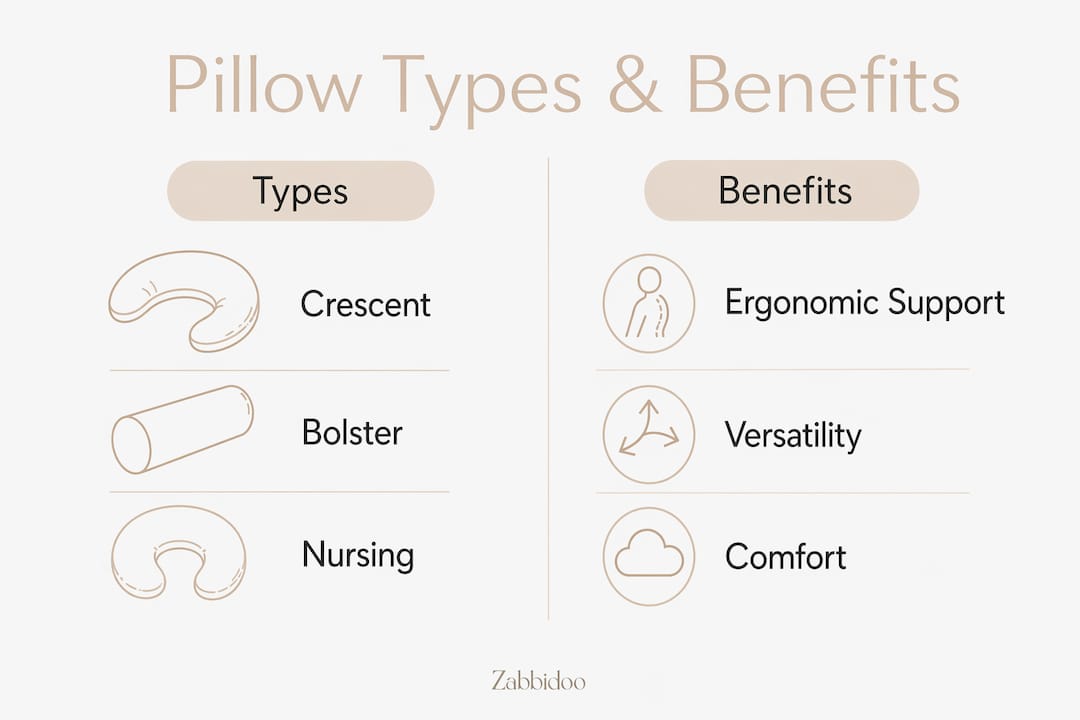
Crescent or half-moon pillows curve to follow the body’s natural contours. Placed under the neck, they cradle the cervical spine. Flipped under the knees, they reduce lower back pressure. The curved profile makes them particularly effective for side sleepers who need something between their knees for hip alignment.

Bolster or roll pillows are cylindrical and firm. They work well under the knees, ankles, or lower back, and they hold their shape under sustained pressure better than softer alternatives. Many physiotherapists recommend them for leg elevation after long periods of standing.
Modular or adjustable pillows let you add or remove fill to change the loft and firmness. Adjustable fill types include shredded memory foam, shredded latex, buckwheat hulls, down alternatives, and microfibre blends. Each material behaves differently: shredded latex runs cooler and bouncier, buckwheat hulls are firm and exceptionally breathable, and shredded memory foam conforms closely but retains more heat.
Ergonomic contoured pillows are moulded to a specific profile, often with a raised section for the neck and a lower section for the head. They suit back sleepers particularly well and are frequently recommended for people managing neck pain.
Nursing or feeding pillows are shaped to wrap around the body, creating a stable platform that brings the baby up to breast or bottle height. The best ones are firm enough to resist compression under the baby’s weight throughout a feed.

Wedge pillows tilt the upper body at an angle, which helps with acid reflux, snoring, and post-surgery recovery. Some designs flip into multiple positions, functioning as both a sleep aid and an upright reading support.
Pro Tip: If you are unsure which shape to start with, a crescent or half-moon pillow covers the widest range of everyday uses, from neck support to knee alignment to lumbar relief, without requiring any adjustment.
How do multi-purpose pillows improve sleep and comfort?
The benefits of multi-purpose pillows go well beyond convenience. Used correctly, they address real physical problems that accumulate from poor posture, inadequate support, and the wrong pillow for a given sleep position.
Spinal alignment is the most cited benefit. When the spine stays neutral from the base of the skull through the neck and into the mid-back, muscles can relax fully during sleep. A pillow that is too flat or too high forces the neck into a bent position for hours, which leads to morning stiffness and, over time, chronic tension.
Pressure relief matters most for side sleepers, who concentrate body weight onto the shoulder and hip. Placing a crescent pillow between the knees distributes that load more evenly and takes strain off the lower spine.
Travel comfort is an area where multi-purpose designs genuinely outperform single-use options. Ergonomic memory foam travel pillows reduce neck pain on long trips compared to traditional options. That is a meaningful difference on a red-eye flight or a long drive.
Stable head and neck alignment during sedentary activities also prevents muscle tension before sleep even begins. Prevention Australia notes that pillows providing this kind of support during desk work or travel help avoid the tension that would otherwise carry into the night.
The practical benefits stack up quickly:
- One pillow replaces several specialised cushions, saving storage space
- Reduced cost over time compared to buying separate sleep, travel, lumbar, and nursing pillows
- Easier care when the pillow has a single removable, washable cover
- Consistent support across different activities without needing to swap between items
For nursing mothers specifically, the right multi-purpose pillow reduces strain on the neck, back, and wrists by bringing the baby up rather than forcing the mother to hunch down. That distinction has real consequences across multiple feeds a day, every day.
How does your sleep position affect which pillow you should choose?
Sleep position is the single biggest variable in pillow selection, and it is where most people go wrong. A pillow that works perfectly for a side sleeper will likely cause neck pain for a back sleeper, and vice versa.
Side sleepers need higher loft to fill the gap between the shoulder and the head. The wider the shoulders, the more loft is needed to keep the spine horizontal. Modular or adjustable pillows solve this by letting you dial in the exact height rather than guessing from a product description.
Back sleepers need medium loft. Too much height pushes the chin toward the chest; too little lets the head fall back. A contoured ergonomic pillow with a raised neck section and a lower head cradle tends to work well here.
Stomach sleepers have the narrowest range of suitable options. They need very low loft, and most multi-purpose pillows remain too thick even when adjusted to their minimum. This is a genuine limitation worth acknowledging.
Personal factors beyond sleep position also matter:
- Shoulder width: broader shoulders require more loft for side sleeping to maintain neutral alignment
- Mattress firmness: a softer mattress lets you sink further, reducing the loft you need by roughly 0.5–1 inch
- Body size: heavier sleepers compress fill more quickly and may need a higher starting loft
- Neck length: a longer neck generally needs more support height to prevent the head from dropping
One more consideration that often gets overlooked: sharing a modular pillow with a partner rarely works because each person’s shoulder width and loft requirements tend to differ.
Pro Tip: Stand with your back and head against a wall in your usual sleep posture. The distance between your head and the wall gives you a reliable estimate of the loft you need. Most people fall somewhere between 3 and 5 inches.
What materials and quality features should you look for?
The fill inside a multi-purpose pillow determines how it feels, how long it lasts, and how well it holds up across different uses. Getting this right matters more than most buyers realise.
Adjustable fill options each have distinct trade-offs:
- Shredded memory foam: conforms closely, hypoallergenic, holds adjusted loft well, but retains heat and may off-gas when new
- Shredded latex: bouncier and more responsive than foam, naturally antimicrobial, sleeps cooler, slightly heavier
- Buckwheat hulls: very firm, outstanding airflow, durable over many years, but noisy when repositioning
- Down alternatives and microfibre blends: soft and lightweight, good for stomach sleepers needing low loft, less precise in adjustment
Compression resistance is the quality feature that separates a good multi-purpose pillow from a mediocre one. A pillow that collapses under sustained pressure stops doing its job mid-feed, mid-flight, or mid-night. Look for fills and construction that maintain their shape under load.
Breathability matters across all uses. A pillow that traps heat becomes uncomfortable quickly, particularly for nursing mothers who are already warm. Natural covers like French flax linen wick moisture and allow airflow in a way that synthetic covers typically do not.
Washability is non-negotiable for a pillow used across multiple activities. A cover that cannot be removed and machine-washed will accumulate oils, dust, and bacteria faster than a standard sleep pillow. Removable, machine-washable covers are a baseline requirement, not a premium feature. You can find more detail on pillow hygiene for nursing and why it matters more than most people expect.
For durability, look for covers with reinforced seams, zippers that do not catch or break after repeated washing, and fills that are certified hypoallergenic. A pillow used for nursing, travel, and desk support needs to withstand far more handling than one that simply sits on a bed.
How does the Zabbidoo nursing pillow apply these principles?
Zabbidoo is an Australian brand built around one specific problem: most nursing pillows are too flat, too soft, and too unstable to actually help a mother feed comfortably. The result is that mothers hunch down to the baby rather than the pillow bringing the baby up to them. Over dozens of feeds a day, that posture causes real strain.
Le coussin d’allaitement Zabbidoo offre un rehaussement de 18 cm, ce qui est nettement supérieur à celui des coussins d’allaitement standard. Cette hauteur permet de placer le bébé à la bonne position pour la tétée sans que la mère ait à se pencher. Sa conception met aussi l’accent sur la résistance à la compression, garantissant que le coussin maintient sa forme pendant toute la durée de la tétée.
| Caractéristique | Coussin d’allaitement Zabbidoo | Coussin standard |
|---|---|---|
| Rehaussement | 18 cm | Inférieur à 18 cm |
| Résistance à la compression | Forte, conserve sa forme | Souvent aplati sous le poids |
| Matière du housse | Lin français | Synthétique |
| Respirabilité | Élevée (lin naturel) | Moyenne |
| Polyvalence | Allaitement, temps sur le ventre, soutien | Principalement allaitement |
The French flax linen cover is not a cosmetic choice. Linen is naturally breathable and moisture-wicking, which matters during feeding when both mother and baby generate heat. It also holds up to repeated washing without pilling or losing its texture, which is relevant for a cover that needs to be cleaned frequently.
Beyond feeding, the Zabbidoo pillow functions as a tummy time surface for the baby and a general support cushion for the mother. That multi-use design reflects the broader principle behind ergonomic nursing pillows: one well-made item should handle several real needs rather than doing one thing adequately.
Key benefits for nursing mothers:
- Correct feeding height reduces neck and back strain across multiple daily feeds
- Stable surface means less repositioning, which reduces frustration and interruption
- Improved latch support through consistent height and firmness
- Breathable cover keeps both mother and baby comfortable during longer feeds
- Durable construction maintains performance over months of daily use
Pro Tip: For pain-free nursing posture, the pillow should bring the baby to nipple height when you are sitting upright. If you are leaning forward to meet the baby, the pillow is too low.
How do multi-purpose pillows compare to single-purpose ones?
Single-purpose pillows do one thing well. A standard sleep pillow supports the head. A lumbar cushion supports the lower back. A dedicated travel pillow cradles the neck on a plane. Each is optimised for its specific task, and within that task, a well-made single-purpose pillow can be excellent.
The problem is accumulation. A household that addresses every support need with a dedicated pillow ends up with a collection that takes up space, requires separate care, and still leaves gaps when needs change. A nursing mother who also travels frequently and works at a desk would theoretically need three or four different cushions to cover all her situations.
Multi-purpose pillows consolidate those functions. The trade-off is that they rarely match the absolute peak performance of a purpose-built specialist option. A dedicated orthopaedic neck pillow moulded precisely for cervical support will outperform a general-purpose crescent pillow for someone managing a specific neck condition. That is an honest limitation.
Where multi-purpose designs win is in everyday versatility, cost over time, and the ability to adapt as needs change. An adjustable pillow that lets you modify loft and firmness can follow you through pregnancy, postpartum recovery, a return to desk work, and travel, without needing replacement at each stage. That adaptability is what makes them worth considering seriously.
For most people, the right answer is not one or the other. A high-quality multi-purpose pillow covers the majority of daily support needs, with a specialist option reserved for a specific medical or therapeutic requirement.
Common mistakes people make with multi-purpose pillows
The biggest mistake is treating a multi-purpose pillow as a set-and-forget purchase. These pillows require some adjustment to work properly, and most people skip that step entirely.
Using the wrong loft for your sleep position is the most common error. Buying an adjustable pillow and never removing or adding fill means you are using it at the manufacturer’s default, which may not suit your shoulder width, mattress, or sleep position at all. Take the time to adjust it over the first week and test the result each morning.
Assuming one pillow suits two people is the second most frequent mistake. As noted earlier, different shoulder widths require different loft settings. A couple sharing one adjustable pillow will usually find that one person sleeps well and the other does not.
Neglecting hygiene is underestimated for multi-purpose pillows specifically. A pillow used for nursing, travel, and desk support is exposed to far more oils, sweat, and contact than a standard sleep pillow. Without a removable, washable cover, that build-up happens quickly. Check the care requirements before buying, not after.
Expecting a multi-purpose pillow to replace a medical device is a misunderstanding worth addressing directly. These pillows improve comfort and support for healthy adults. They are not a treatment for diagnosed conditions like herniated discs, severe sleep apnoea, or post-surgical recovery, where a clinician should be guiding the choice of support.
Buying based on softness alone leads to pillows that feel good in the shop and collapse within weeks. Compression resistance matters far more than initial softness, particularly for nursing and travel use. A pillow that feels slightly firmer than expected is usually the better long-term choice. You can explore what high-performance pillow construction actually involves to understand what to look for before you buy.
Finally, stomach sleepers sometimes buy multi-purpose pillows hoping the adjustability will solve their loft problem. For most modular designs, even at minimum fill, the pillow remains too thick for comfortable stomach sleeping. If stomach sleeping is your primary position, a dedicated ultra-low-loft pillow is likely a better fit than a multi-purpose model.
Key takeaways
Multi-purpose pillows deliver genuine ergonomic benefit when matched to the right sleep position, fill type, and use case, with the Zabbidoo nursing pillow demonstrating how a purpose-driven design can solve a specific comfort problem without sacrificing versatility.
| Point | Details |
|---|---|
| Shape determines function | Crescent pillows suit neck and knee support; bolsters work for leg elevation; modular designs adapt to multiple uses. |
| Loft must match your body | Side sleepers need higher loft; back sleepers need medium; stomach sleepers rarely suit modular designs. |
| Compression resistance matters | A pillow that collapses under load fails at nursing, travel, and sustained lumbar support. |
| Washable covers are non-negotiable | Multi-purpose pillows contact more surfaces and need machine-washable covers to stay hygienic. |
| Rehaussement de 18 cm Zabbidoo | Le coussin d’allaitement Zabbidoo élève le bébé à la bonne hauteur, réduisant la fatigue du cou et du dos de la mère lors des tétées quotidiennes. |
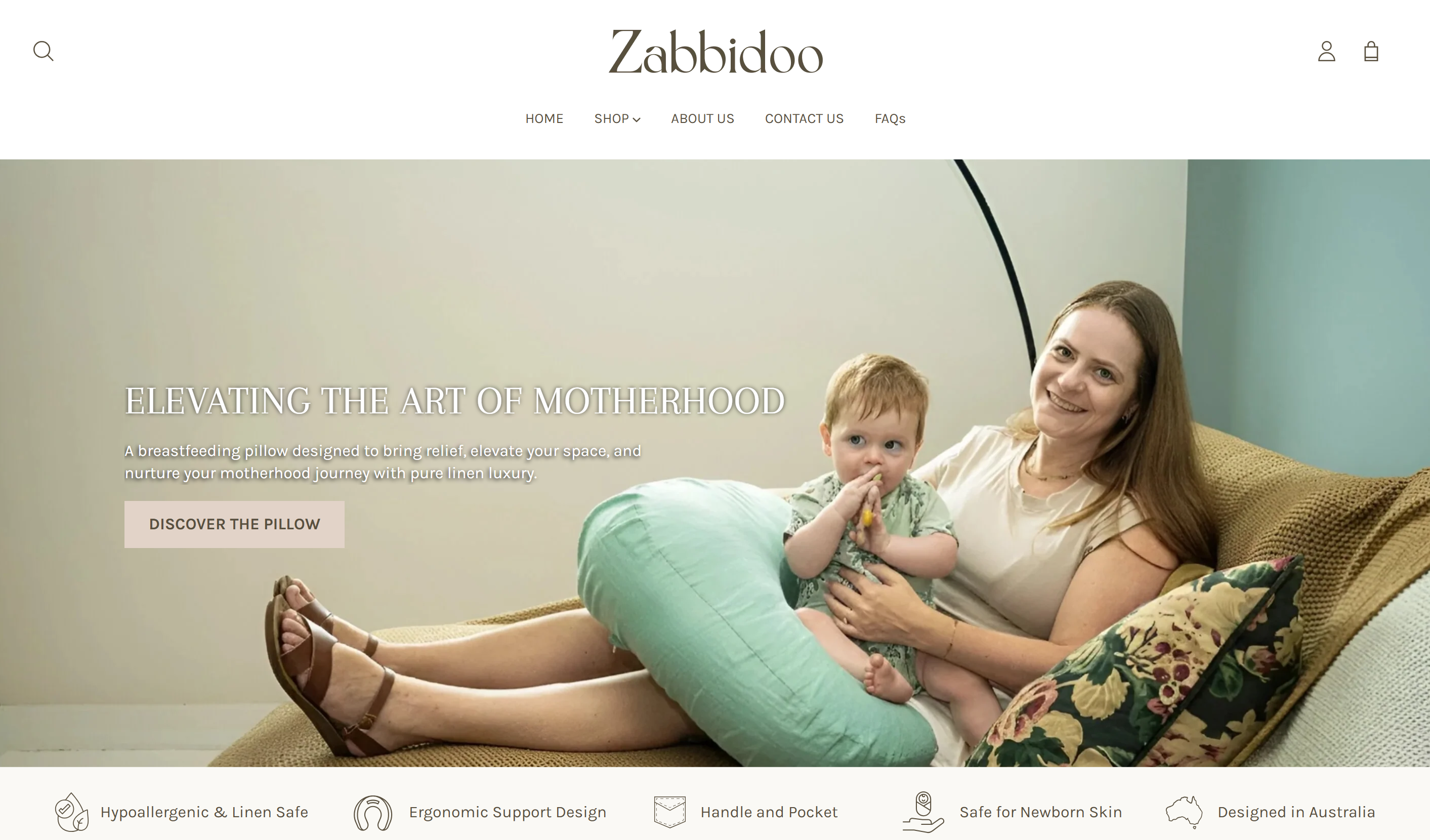
Zabbidoo was built specifically for nursing mothers who are tired of pillows that look the right shape but collapse the moment they matter. The Zabbidoo nursing pillow combines an 18 cm lift, compression-resistant construction, and a breathable French flax linen cover into one pillow that works from the first feed to the last. If you are ready for a pillow that actually holds its position, it is worth a look.