

A nursing pillow is a practical feeding tool for new mothers, not a sleep device. Use it for supervised feeding only, keep your baby awake and within arm’s reach the entire time, and move baby to a flat, firm sleep surface the moment feeding ends. Never leave a baby unattended on any positioning pillow for infants, and never use one as an infant sleeping pillow or overnight support.
Safety first: The CDC’s Georgia SUID data found nursing pillows present in the sleep space in 84 out of 1,685 infant deaths over a decade, with 86% of those babies under four months old and 56% occurring during bed sharing. The risk is real, and it is avoidable.
Table of Contents
- What does ‘baby positioner pillow’ actually mean, and why does it matter?
- How a well-designed nursing pillow helps your posture and your baby’s latch
- What to look for when buying a nursing pillow in Australia
- How to use a nursing pillow safely, step by step
- Keeping your nursing pillow clean and shape-stable
- When to stop using the pillow and what to use instead
- Key takeaways
- The case for getting the ergonomics right from the start
- The Zabbidoo nursing pillow: built for what actually matters
- Useful sources and further reading
What does ‘baby positioner pillow’ actually mean, and why does it matter?
The term covers two very different products, and mixing them up carries serious consequences.
A sleep positioner (sometimes called an infant support cushion or sleep wedge) is designed to hold a baby in a fixed position during sleep. These are the products that prompted the CPSC’s 2025 federal safety standard after 79 infant deaths and 124 injuries were linked to them between 2010 and 2022. The CPSC and AAP both warn that sleep positioners have no proven benefit and a documented death toll.
A nursing or feeding pillow is an entirely different object. It sits around the carer’s waist during a feed, lifts the baby to breast height, and supports the mother’s arms. Its job is ergonomic support for the adult, not sleep positioning for the baby.
| Product type | Intended use | Safe for unsupervised sleep? |
|---|---|---|
| Sleep positioner / wedge | Hold baby in a fixed sleep posture | No — linked to infant deaths |
| Nursing / feeding pillow | Lift baby during supervised feeds | No — remove immediately after feeding |
| Tummy-time mat | Supervised awake-time floor play | No — always supervised |
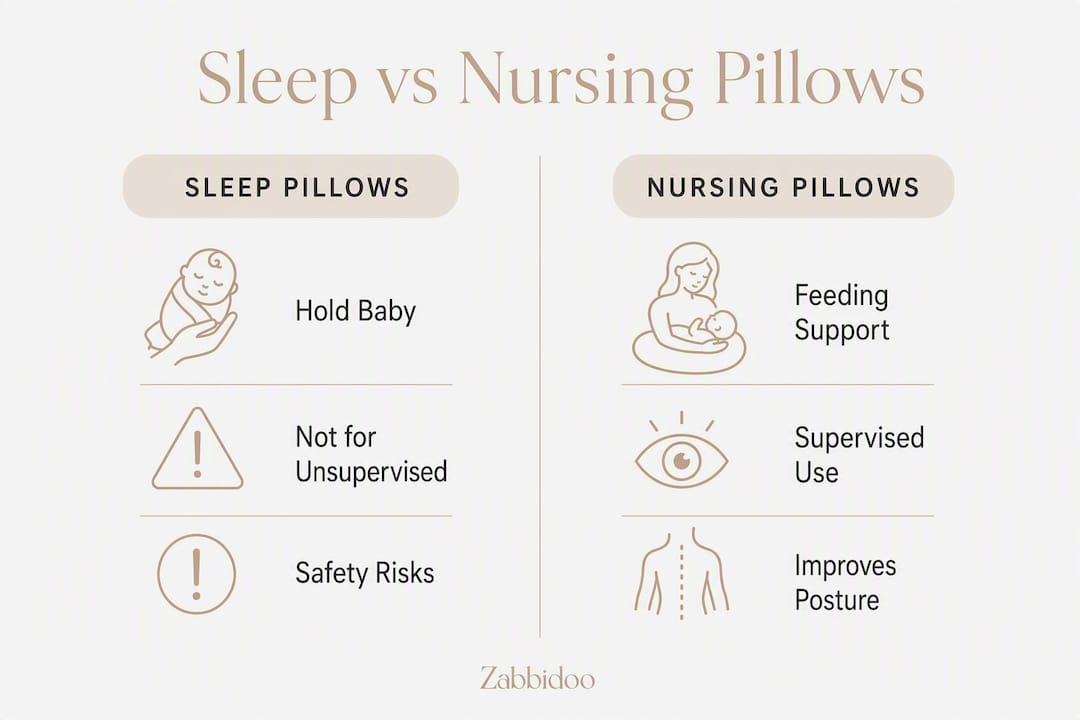
Marketing claims like “anti-reflux” or “prevents flat head” do not change this. The CPSC explicitly cautions against accepting medical-sounding claims as justification to place any positioning product in a baby’s sleep space.
How a well-designed nursing pillow helps your posture and your baby’s latch
Most feeding discomfort for new mothers comes from one thing: hunching down to meet the baby. A pillow with genuine lift, around 18cm, brings the baby up to the breast rather than forcing the mother’s neck and shoulders forward. That single design difference reduces strain on the neck, upper back, and wrists across multiple daily feeds.

Compression resistance matters just as much as height. A pillow that flattens under the baby’s weight within minutes forces constant repositioning, which breaks the latch and adds frustration to an already demanding task. A non-collapsing core holds its shape through a full feed, keeping the baby at a consistent height and angle.
Pro Tip: For cradle and cross-cradle holds, position the pillow so the baby’s ear, shoulder, and hip form a straight line. For the football hold, tuck the pillow further to the side so the baby’s body runs parallel to yours rather than angling across your lap. A stable pillow base makes all three positions easier to hold without gripping.
Public health data supports the breastfeeding case too: some programmes find nursing pillows help with breastfeeding uptake, provided the product is used only during supervised feeds and never left in the sleep space.
What to look for when buying a nursing pillow in Australia
Height and firmness are the two specs that separate a genuinely useful pillow from one that looks good in a photo. Everything else is secondary.
- Lift height: Aim for a lift height that raises the baby adequately to avoid most mothers hunching forward.
- Compression resistance: Squeeze the pillow firmly. It should spring back fully. If it compresses more than a third of its depth and stays there, it will flatten under a baby’s weight within weeks.
- Base stability: A non-slip underside stops the pillow shifting mid-feed, which is the most common cause of latch breaks.
- Cover material: Breathable fabrics like French flax linen wick moisture and stay cooler against a baby’s face than synthetic covers. Hypoallergenic fill matters for sensitive skin.
- Washability: The cover should be fully removable and machine-washable. Milk residue builds up fast; a cover you can only spot-clean is a hygiene problem.
- On-product safety labelling: Since April 2025, CPSC labelling rules require conspicuous warnings against sleep use on infant support cushions. Look for explicit warnings on the product itself, not just the packaging.
- Portability: A handle makes moving the pillow between rooms practical, which matters when you are feeding six to eight times a day.
- Warranty: A pillow that loses its shape within months is not worth buying twice.
Australian nursing pillows range roughly from $60 to $200 depending on materials and construction. A mid-range pillow with a washable linen cover and a high-density core sits around $120–$160 and tends to outlast cheaper options by a significant margin.
How to use a nursing pillow safely, step by step
Start every feed the same way: sit upright in a supportive chair, place the pillow around your waist, and bring the baby to the pillow rather than leaning into the baby.
- Sit with your back supported. Avoid feeding on a sofa with deep cushions, which tilts your pelvis and increases lower-back strain.
- Place the pillow snugly against your body so there is no gap between the pillow and your abdomen.
- Lay the baby on the pillow with their ear, shoulder, and hip aligned. The baby’s nose should be level with your nipple before latching, not below it.
- Watch for chin tucking, slumped shoulders, or the baby’s face pressing into the pillow surface. Any of these signals a repositioning is needed.
- Keep the baby awake and supervised throughout. Never step away, even briefly.
- The moment feeding ends, move the baby to a flat, firm sleep surface on their back.
Never use the pillow for naps, overnight sleep, or unsupervised placement on a bed, sofa, or any raised surface. Do not add blankets or soft items around the baby while they are on the pillow. Safe-sleep guidance is consistent: the sleep surface must be flat, firm, and bare.
Keeping your nursing pillow clean and shape-stable
A pillow used six to eight times a day needs a proper cleaning routine, not just occasional spot-wiping.
- Remove and machine-wash the cover every two to three days, or immediately after any significant spill. Use a gentle, fragrance-free detergent.
- Air-dry the cover flat or on a rack. Tumble drying on high heat can shrink linen covers and degrade elastic.
- For the inner fill, check the care label. Most high-density foam or fibre cores should not be machine-washed; spot-clean with a damp cloth and mild soap, then air-dry completely before replacing the cover.
- Every few weeks, press firmly across the entire pillow surface to check for soft spots or uneven compression. A pillow that has lost firmness in one area will tilt the baby and compromise the latch.
- Store the pillow in a dry, ventilated spot. Avoid compressing it under other items in storage, which permanently deforms the fill.
A pillow hygiene routine also reduces the risk of mould in the inner core, which can develop unnoticed in humid Australian summers.
When to stop using the pillow and what to use instead
Most mothers naturally phase out the nursing pillow as the baby grows and feeding becomes more efficient. A few clear signals suggest it is time:
- The baby can roll independently, which makes any elevated surface a fall risk.
- The baby can sit unsupported and no longer needs the height assist for latching.
- The baby consistently shows discomfort, arching away or fussing when placed on the pillow.
For continued support after stopping pillow use, a firm ergonomic chair with armrests often replaces the pillow’s function adequately. For tummy time, a flat, firm mat on the floor under direct supervision is the safer option. Rolled towels placed under the chest (never under the head) can provide short-term shaping support during supervised awake time. The multi-use case for nursing pillows during tummy time is legitimate, but only with the baby awake and a carer present throughout.
Key takeaways
A nursing pillow is a supervised feeding tool only: use it to bring baby to breast height, then move baby to a flat, firm sleep surface the moment feeding ends.
| Point | Details |
|---|---|
| Never use for sleep | Nursing pillows in sleep spaces were present in 84 out of 1,685 infant deaths in Georgia SUID investigations; always transfer baby to a flat, firm surface after feeding. |
| Height and firmness matter most | Look for an 18cm lift and a compression-resistant core that springs back fully under pressure. |
| Check safety labelling | Since April 2025, CPSC rules require explicit sleep-risk warnings on infant support cushions; look for this on the product itself. |
| Clean the cover regularly | Machine-wash the removable cover every two to three days; check the inner fill for soft spots monthly. |
| Zabbidoo nursing pillow | Designed with an 18cm lift, high compression resistance, and a washable French flax linen cover to meet the ergonomic and hygiene criteria above. |
The case for getting the ergonomics right from the start
Most nursing pillow advice focuses on the baby’s comfort. The mother’s body barely gets a mention, which is a gap worth addressing directly.
Postpartum musculoskeletal strain is common and largely preventable. The repetitive forward-lean of feeding without adequate lift loads the cervical spine and upper trapezius in a way that accumulates quickly across dozens of daily feeds in the first weeks. A pillow that collapses under the baby’s weight does not solve this; it just adds the frustration of constant repositioning to the physical strain.
The 18cm lift figure is not arbitrary. It reflects the approximate height difference between a seated mother’s lap and the optimal feeding position for most newborns. A pillow that delivers that height consistently, without compressing, removes the need to hunch. That is the whole ergonomic argument in one sentence.
Safety and ergonomics are not competing priorities here. A stable, height-appropriate pillow that keeps the baby well-positioned also makes it easier to monitor the baby’s airway, face, and posture throughout the feed. Good design serves both at once.
The Zabbidoo nursing pillow: built for what actually matters
Most nursing pillows are designed to look good in a nursery flat-lay. Zabbidoo’s nursing pillow is designed around the one thing that actually matters at 3am: keeping your baby at the right height without you having to hunch, grip, or readjust every two minutes.

The 18cm lift brings your baby to breast height rather than forcing your neck and shoulders down to meet them. The high-compression-resistance core holds that height through a full feed, not just the first five minutes. A stability-focused base stops the pillow shifting mid-latch, and the hypoallergenic French flax linen cover stays breathable and machine-washable for the long haul. A built-in pocket keeps a phone or nipple cream within reach, and the carry handle makes moving between rooms genuinely easy.
See the full specs and order the Zabbidoo nursing pillow directly. Follow the safe-use instructions on the product label, and consult your maternal and child health nurse for personalised feeding advice.
Useful sources and further reading
This article draws on the following authoritative sources. All are worth bookmarking for ongoing reference.
- CDC MMWR: Nursing Pillows and SUID, Georgia 2013–2022 — the primary data source on nursing-pillow-associated infant deaths; essential reading for understanding the sleep-use risk.
- CPSC: New Federal Safety Standard for Infant Support Cushions (2025) — the regulatory standard that now governs labelling and performance requirements for these products.
- AAP / HealthyChildren.org: Baby Products to Avoid — clinical guidance from the American Academy of Pediatrics on sleep positioners and nursing pillows.
- Mary Bridge Children’s: Nursing Pillow Dangers — clear, parent-facing explanation of the airway risks when nursing pillows are used in sleep spaces.
- Red Nose Australia (rednose.org.au) — Australia’s leading authority on infant safe sleep. No single page is linked here because their guidance updates regularly; visit the site directly for current Australian recommendations on safe sleep surfaces, room-sharing, and soft-object risks.
- Breastfeeding positions guide — practical descriptions and visuals for cradle, cross-cradle, football, and side-lying holds.
This article provides general information only, not professional medical advice. Confirm current safe-sleep guidelines with Red Nose Australia or your maternal and child health nurse for advice specific to your baby’s age and circumstances.