

Holding a baby comfortably means supporting their head, neck, and body in a position that keeps them safe, calm, and close to you. Most new parents feel nervous the first time they pick up a newborn, and that nervousness is completely normal. The key is technique, not strength. Once you understand the core holds and why head and neck support matters until about four months, everything else falls into place. This guide walks you through the best ways to hold a baby, feed comfortably, and soothe your little one with confidence.
How to hold baby comfortably: the essential positions
The most critical rule in baby holding is this: always support your baby’s head. Newborns lack the neck muscle strength to hold their own head up, and most babies cannot do so independently until around four months. That single fact shapes every hold you will use in the early weeks.
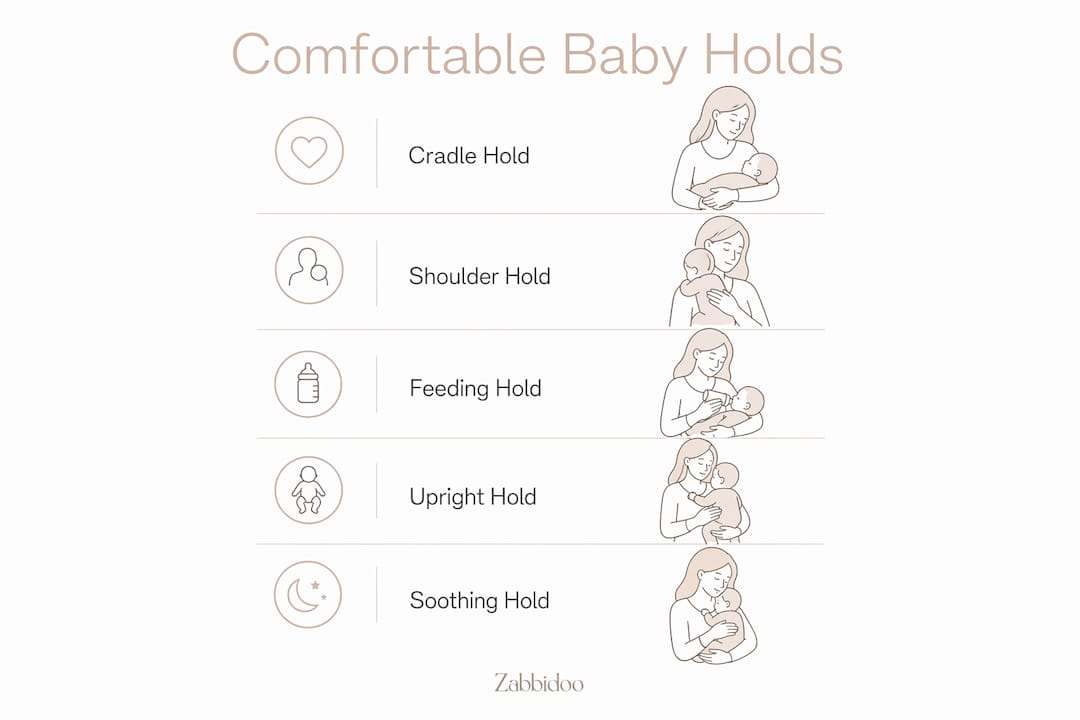
The cradle hold
The cradle hold is the most natural starting position for new parents. Lay your baby along your forearm with their head resting in the crook of your elbow. Your other hand supports their bottom and lower back. This position brings your baby’s face level with yours, which promotes bonding through eye contact and early communication. Keep your baby’s spine gently curved, not flat, to mimic the position they held in the womb.

The shoulder hold
The shoulder hold is ideal after feeding when you need to burp your baby. Hold your baby upright against your chest with their chin resting on your shoulder. One hand supports their bottom, and the other rests firmly across their upper back and neck. This position also gives your baby a new visual perspective, which many find calming. The upright angle helps move trapped wind and reduces the chance of spitting up.
Common mistakes to avoid:
- Letting the head fall back without support, even for a second.
- Holding the baby too loosely, which creates a sense of insecurity.
- Gripping too tightly around the ribs, which restricts breathing.
- Switching holds mid-movement without maintaining head control throughout.
Pro Tip: When you first pick up your baby, slide one hand under their head before lifting their body. This two-step approach prevents the sudden head drop that startles both of you.
What are the best holds for feeding your baby?
Feeding is the moment when comfortable baby carrying techniques matter most. A poor position strains your back, tires your arms, and makes it harder for your baby to latch or swallow safely.
For bottle-feeding, cradle your baby in a semi-upright position with the bottle held nearly horizontal. A fully flat position increases the risk of choking because milk flows too fast. The semi-upright angle lets your baby control the flow and breathe between swallows.
For breastfeeding, the best breastfeeding positions share one thing in common: baby comes to breast, not breast to baby. When you hunch forward to meet your baby, you load your neck and upper back with strain that compounds over dozens of feeds a day.
Key feeding positions at a glance:
- Cradle hold: Baby lies across your body, head at breast or bottle level, supported by your forearm.
- Football hold: Baby tucks under your arm like a footy, facing up, with their legs behind you. Useful after a caesarean.
- Side-lying hold: Both you and baby lie on your sides facing each other. Good for night feeds when you need to rest.
- Upright koala hold: Baby sits straddled on your thigh, facing you. Helpful for babies with reflux.
| Position | Best for | Key support point |
|---|---|---|
| Cradle hold | General feeding | Forearm under baby’s back |
| Football hold | Post-caesarean, large bust | Hand supports baby’s head |
| Side-lying | Night feeds | Pillow behind your back |
| Upright koala | Reflux-prone babies | Baby’s back and neck |
Holding baby upright after feeding is especially useful for gassy or reflux-prone babies. Even five minutes in the shoulder hold after a feed reduces spitting up noticeably.
Pro Tip: A firm nursing pillow lifts your baby to the right height so your arms rest rather than strain. Check the feeding positions guide on Zabbidoo for position-by-position pillow placement tips.
What are the best ways to soothe a baby through holding?
Soothing a crying baby is one of the most stressful parts of early parenthood. The good news is that holding technique plays a direct role in how quickly your baby settles.
Dr Harvey Karp’s 5 S’s method is the most widely recognised framework for soothing newborns. The 5 S’s are swaddling, side or stomach position, shushing, swinging, and sucking. Each step builds on the last, recreating the sensory environment of the womb. The method works because babies miss the constant, gentle movement they experienced before birth. Small, rhythmic motions help them adjust to life outside the womb.
“Babies are calmed by the sensations that remind them of the womb. The key is recreating that environment through gentle, rhythmic movement and sound. The 5 S’s work together as a system, not as individual tricks.” Dr Harvey Karp, paediatrician and author of The Happiest Baby on the Block
When you combine swaddling with a side-lying hold and a gentle rocking motion, you activate the calming reflex in most newborns within minutes. The motion matters more than the speed. Gentle, small movements of about one inch back and forth, always with head and neck supported, are far more effective than large bouncing movements.
Safety note on soothing motions:
- Never shake your baby, even gently. Shaking causes serious brain injury.
- The “Jell-O head jiggle” technique means the head wobbles slightly with the movement, not that you are shaking the head deliberately.
- Stop swaddling once your baby begins to roll over, as it becomes a suffocation risk at that stage.
- Always check for hunger, cold, or discomfort before assuming your baby needs motion. Identifying the root cause first reduces both your baby’s crying and your own stress.
For a detailed walkthrough of calming holds during feeds, the soothing newborns during feeds guide on Zabbidoo covers the 5 S’s in a feeding context.
What mistakes do parents make when holding their baby?
Most holding errors come from anxiety, not carelessness. When you are nervous, you either grip too tight or hold too loosely. Both create problems.
- Insufficient head support. This is the most common and most dangerous mistake. Most babies cannot control their head until about four months, so every hold requires one hand dedicated to head and neck support.
- Feeding in a flat position. Laying your baby fully horizontal during bottle-feeding increases choking risk. The semi-upright feeding posture with a nearly horizontal bottle is the correct approach.
- Ignoring your baby’s cues. Babies signal discomfort through arching their back, turning their head, or stiffening their body. When you see these cues, adjust your hold before the crying starts.
- Pushing through pain. If your arms, neck, or back ache during feeding, your position is wrong. Pain is a signal to adjust, not to endure.
Pro Tip: If you feel overwhelmed, put your baby down safely in their cot and take two minutes to reset. A calm parent holds a baby better than an exhausted one. Seeking support when you need it is part of good parenting, not a sign of failure.
Key takeaways
Comfortable, safe baby holding requires consistent head and neck support, the right position for each situation, and attention to your own posture as well as your baby’s cues.
| Point | Details |
|---|---|
| Head support is non-negotiable | Support your baby’s head and neck at all times until about four months of age. |
| Semi-upright feeding prevents choking | Hold baby at an angle during feeds to control milk flow and aid safe swallowing. |
| The 5 S’s calm most newborns | Swaddling, side position, shushing, swinging, and sucking work together as a system. |
| Your posture matters too | Hunching to reach your baby causes neck and back strain across dozens of feeds a day. |
| Read your baby’s cues | Arching, stiffening, or turning away signals discomfort. Adjust your hold before crying starts. |
What I have learned about holding babies with confidence
By Marietjie
New parents often tell me they are terrified of “doing it wrong.” I understand that completely. The first time you hold a newborn, they feel impossibly fragile, and every tiny movement feels like a risk. What I have found, though, is that the fear fades faster than most people expect. Once you feel how your baby responds to a secure hold, your hands start to remember what to do.
The thing most articles do not say clearly enough is this: your baby is giving you feedback constantly. When they relax into your arms, you are doing it right. When they stiffen or arch, something needs to change. Learning to read those signals is the real skill, and it develops quickly with practice.
The muscle development timeline also matters more than people realise. That four-month window for head control is not just a safety guideline. It is a reminder that your baby is changing fast. The hold that works at two weeks will feel different at eight weeks, and different again at three months. Stay curious about what your baby needs rather than locking yourself into one approach.
My honest advice: do not wait until you feel confident to enjoy the cuddles. The confidence comes from the cuddles.
— Marietjie
Why your nursing pillow changes everything
Holding your baby well is far easier when your body is properly supported. Most of the strain parents feel during feeds comes from reaching down to meet their baby rather than having their baby brought up to them.

The Zabbidoo nursing pillow sits 18cm high, which is meaningfully taller than standard nursing pillows. That height brings your baby to you, so your arms rest on the pillow rather than holding your baby’s full weight. The pillow holds its shape under pressure, which means you are not constantly repositioning as the fill compresses. Made with French flax linen, it stays breathable during long feeds. The Zabbidoo nursing pillow works for breastfeeding, bottle-feeding, tummy time, and general support, so it earns its place well beyond the newborn stage.
FAQ
How do I support a newborn’s head when picking them up?
Slide one hand under your baby’s head and neck before lifting their body with your other hand. Newborns cannot support their own head until around four months, so this two-hand approach is the safest way to lift them.
What is the safest position to hold a baby during bottle-feeding?
Hold your baby in a semi-upright position with the bottle nearly horizontal. A fully flat position increases choking risk by letting milk flow too quickly for your baby to manage.
How do I soothe a crying baby through holding?
Use the 5 S’s: swaddle your baby, hold them on their side or stomach, make a shushing sound, swing them with small rhythmic movements, and offer sucking. These steps together recreate the womb environment and activate the calming reflex in most newborns.
When can I stop supporting my baby’s head during holds?
Most babies develop enough neck muscle strength to hold their head independently at around four months. Until then, every hold requires deliberate head and neck support from your hand or forearm.
Can a nursing pillow help with comfortable baby holding?
Yes. A firm, high-lift nursing pillow raises your baby to the correct feeding height, reducing the strain on your arms, neck, and back. It also stabilises your baby’s position so you can focus on feeding rather than repositioning.