

A guide to infant feeding positions is a practical framework for ensuring both mother and baby are comfortable, well-supported, and feeding effectively from the very first session. The holds you use directly affect latch quality, milk transfer, and how long you can sustain breastfeeding without pain. Whether you are feeding a newborn for the first time or adjusting your approach as your baby grows, understanding the core positions, the principles behind them, and the tools that support them gives you real confidence. This guide covers breastfeeding holds, bottle-feeding techniques, and the ergonomic adjustments that make feeding sustainable.
What are the key principles of safe infant feeding positions?
Every effective feeding position, whether breastfeeding or bottle-feeding, rests on the same foundational principles. Get these right and most positioning problems solve themselves.
The most critical alignment rule is that baby’s ear, shoulder, and hip should form a straight line, with the baby’s tummy facing the mother’s tummy. This single principle governs milk transfer efficiency and prevents the neck twisting that causes a shallow, painful latch. When the body is twisted, swallowing becomes harder for the baby and the latch suffers.

The second principle is bringing baby to breast, not breast to baby. Holding baby close and avoiding leaning forward prevents neck and back strain and promotes an effective latch. Leaning down to meet your baby shifts your centre of gravity, loads your neck and shoulders, and is one of the most common causes of upper back pain in new mothers.
Here are the core principles to apply to every feed:
- Keep baby’s head, neck, and spine in a straight line
- Position baby’s tummy against your tummy, not facing the ceiling
- Support baby’s head and neck without forcing the head forward
- Use your free hand to shape the breast in a C-hold if needed
- Bring baby to nipple height with a pillow or cushion rather than hunching down
- Sit on your sit-bones, not your tailbone, to maintain a stable base and reduce arm strain
Pro Tip: If you find yourself hunching within two minutes of starting a feed, your baby is too low. Raise them with a firm pillow before latching, not after.
What are the most common breastfeeding positions and when to use them?
There is no single best breastfeeding hold. Each position suits different body types, birth experiences, and stages of infant development. Knowing when to use each one is what separates struggling through feeds from genuinely comfortable ones.
Cradle and cross-cradle holds
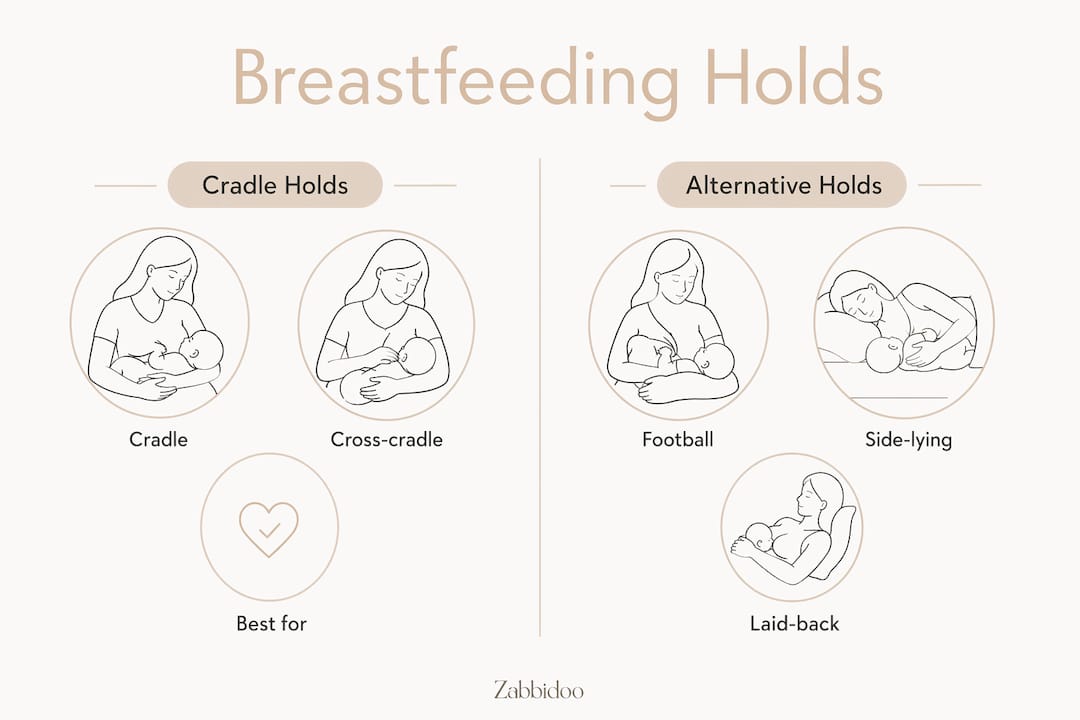
The cradle hold is the most recognised position. Baby lies across your body with their head resting in the crook of your arm on the same side as the breast being used. It works well once breastfeeding is established and your baby has reasonable head control. The cross-cradle hold is the better choice for newborns. You support the baby with the opposite arm, which gives you far more control over head positioning and latch. This extra control is particularly useful in the first two to four weeks when you and your baby are still learning together.
One detail most guides miss: sitting on your sit-bones rather than your tailbone changes the angle of your lap and reduces the arm strain that comes with the cradle hold. La Leche League GB highlights this as a small adjustment with a significant impact on comfort.
Football (clutch) hold
In the football hold, baby is tucked under your arm like a footy, with their body running along your side and their legs pointing behind you. This position is recommended for mothers recovering from C-section because it keeps baby’s weight off the abdominal incision. It also suits mothers with large breasts, flat or inverted nipples, or twins. Placing extra cushions behind you helps maintain a forward posture and creates space for baby’s length, reducing the tendency to hunch.
Side-lying position
Side-lying is the position most mothers discover out of desperation at 3am and then wonder why no one told them about it sooner. Both you and baby lie on your sides facing each other, with baby’s mouth at nipple level. It is ideal for night feeds, post-birth recovery, and any time you need to rest. When visual checks are limited in this position, a rhythmic pull sensation confirms an effective latch. A rolled blanket behind baby’s back adds stability and prevents rolling.
Laid-back (biological nurturing) position
The laid-back position involves reclining at roughly 45 degrees with baby lying tummy-down on your chest. It is one of the most underused positions in early breastfeeding. Laid-back feeding reduces pressure on the nipple, supports natural self-attachment reflexes, and is particularly effective for reducing nipple pain in the first weeks. Gravity does much of the work, which means baby uses less effort to stay latched.
Koala (upright/straddle) hold
In the koala hold, baby sits upright and straddles your thigh, facing the breast. This position becomes practical once baby has reasonable head and neck control, usually from around three to four months. It is especially useful for babies with reflux or a fast letdown, as the upright angle reduces the chance of milk pooling at the back of the throat.
| Position | Best for | Key advantage |
|---|---|---|
| Cross-cradle | Newborns, latch difficulties | Maximum head control |
| Football hold | Post-C-section, large breasts | No pressure on abdomen |
| Side-lying | Night feeds, recovery | Rest for mother |
| Laid-back | Nipple pain, early weeks | Activates self-attachment reflexes |
| Koala hold | Reflux, older babies | Upright reduces overflow |
Pro Tip: Rotate through at least two different holds per day. Varying the position changes the angle of the latch and drains different areas of the breast, which helps prevent blocked ducts.
How to adapt feeding positions as your baby grows
The hold that works beautifully for a two-week-old will often feel awkward and ineffective by three months. Positions effective at the newborn stage frequently need changing over the first year as the infant develops. This is not a sign that something has gone wrong. It is a normal part of the feeding relationship.
As your baby gains head and neck control, the cross-cradle hold becomes less necessary. You can transition to the standard cradle hold or introduce the koala position, which many babies prefer once they can sit with support. Bigger, more active babies often resist being cradled and feed better when they have more freedom of movement.
Watch for these signals that a position needs adjusting:
- Baby pulls off the breast repeatedly during a feed
- You notice increased nipple soreness after a period of comfortable feeding
- Baby seems frustrated or arches their back during feeds
- Your arms or back ache within the first few minutes
- Baby’s latch has become shallower without an obvious cause
Switching sides and alternating holds also prevents one-sided soreness and keeps milk supply balanced. As baby grows heavier, a firm nursing pillow becomes less of a comfort item and more of a physical necessity for maintaining good posture without arm fatigue.
What are safe bottle-feeding positions and techniques?
Bottle-feeding positions follow the same core principles as breastfeeding holds, with a few important additions. Baby should be held semi-upright, with their head supported and slightly elevated above their body. This angle controls milk flow and reduces the risk of milk pooling in the ear canal.
Propping a bottle or leaving a baby to feed unattended increases the risk of choking, ear infections, and tooth decay. This is not a minor inconvenience. It is a genuine safety issue that CDC guidance addresses directly. Always hold both the baby and the bottle throughout the feed.
Paced bottle-feeding is the technique that most closely mimics breastfeeding. Hold the bottle horizontally rather than tipping it steeply downward. This slows the milk flow, encourages baby to work for the feed, and reduces the risk of overfeeding. Paced feeding also makes it easier to switch between breast and bottle without causing nipple confusion.
Key bottle-feeding position tips:
- Hold baby at roughly a 45-degree angle, never flat on their back
- Keep the bottle horizontal so the teat is only partially filled with milk
- Pause every few minutes to allow baby to rest and signal fullness
- Alternate which arm you hold baby in across feeds to support visual development
- Never leave baby alone with a propped bottle, regardless of age
What tools and support methods improve feeding comfort?
The right support tools do not replace good positioning. They make good positioning sustainable across multiple feeds per day, every day, for months.
A nursing pillow is the most practical single investment for feeding comfort. Nursing pillows raise baby to nipple level, reduce arm strain, and allow proper support across multiple holds including the cradle, football, and side-lying positions. The critical detail most mothers learn too late is that pillow firmness matters enormously. A pillow that compresses under baby’s weight forces you to hunch down to compensate, which defeats the purpose entirely.
Here is how to build a complete support setup for comfortable feeds:
- Nursing pillow: Place it around your waist to bring baby to breast height without arm strain. Choose one with compression resistance, not just soft foam.
- Lumbar support cushion: Position it at the small of your back when sitting in a chair or on a sofa. This maintains the natural curve of your spine and prevents the forward slump that causes lower back pain.
- Rolled blanket or small pillow: Use behind baby’s back in the side-lying position or under baby’s bottom in the football hold for added stability.
- Footstool: Raising your feet slightly tilts your pelvis forward and reduces the gap between your lap and your baby, which means less work for your arms.
- Lactation consultant: If positioning feels consistently uncomfortable or latch problems persist beyond the first two weeks, an International Board Certified Lactation Consultant (IBCLC) can assess your specific anatomy and baby’s oral function and recommend personalised adjustments that no article can replicate.
Support pillows that bring baby closer prevent maternal neck and back strain and enable longer, more comfortable feeding sessions. This directly affects how long mothers continue breastfeeding. Discomfort is one of the most cited reasons for early breastfeeding cessation, and much of that discomfort is positional and preventable.
Pro Tip: Set up your feeding station before your baby arrives. Have your pillow, water bottle, phone charger, and a small snack within arm’s reach. Once you are latched and comfortable, you do not want to move.
Key takeaways
Mastering infant feeding positions requires consistent alignment, the right support tools, and a willingness to adapt holds as your baby grows and your body changes.
| Point | Details |
|---|---|
| Alignment is the foundation | Keep baby’s ear, shoulder, and hip in a straight line with tummy facing yours on every feed. |
| Match the hold to the situation | Use cross-cradle for newborns, football post-C-section, and koala for reflux or older babies. |
| Adapt as baby develops | Positions that work at two weeks will likely need adjusting by three to four months. |
| Bottle-feeding needs the same care | Hold baby semi-upright, use paced feeding, and never prop the bottle unattended. |
| Support tools prevent early quitting | A firm nursing pillow and lumbar support reduce the physical strain that causes mothers to stop breastfeeding early. |
What I have learned about feeding positions after working with hundreds of mums
Most mothers come to feeding positions looking for the one correct hold. What I have found, working with new and experienced mothers alike, is that the question is almost never “which position is right?” It is “which position is right for this feed, with this baby, on this day?”
The conventional advice to pick a position and stick with it is well-intentioned but often counterproductive. Babies change fast. A baby who fed beautifully in the cross-cradle hold at two weeks may actively resist it at eight weeks because they want to see the room. A mother who had a straightforward birth may find the cradle hold comfortable from day one, while a mother recovering from a C-section needs the football hold for weeks before anything else feels manageable.
What I advocate for, and what the evidence from HSE breastfeeding guidance supports, is treating feeding as a skill that you and your baby develop together. That means experimenting, adjusting, and not interpreting a position change as failure. It also means getting help early. A single session with an IBCLC in the first two weeks can prevent months of pain and frustration. Most mothers wait far too long to ask for that support.
The other thing I want to say plainly: your comfort matters as much as your baby’s. A mother in pain will not feed for long, and that is not a moral failing. It is physiology. If feeding hurts consistently, something in the position needs to change. Start with alignment, check your support setup, and if the problem persists, get professional eyes on it. You deserve to find feeding comfortable. That is not a luxury. It is the foundation of a sustainable feeding relationship.
— Marietjie
How Zabbidoo supports comfortable, ergonomic feeding
The most common reason mothers stop breastfeeding earlier than they planned is physical discomfort, and most of that discomfort comes down to positioning and support. Zabbidoo’s nursing pillow is designed specifically to address this. At 18cm high, it raises your baby to nipple level so you stop hunching. Its compression-resistant core holds its shape under your baby’s weight, which means it actually supports you through a full feed rather than collapsing after the first few minutes.

The pillow works across the cradle, football, and side-lying holds, and doubles as a tummy time and sitting support as your baby grows. Made with French flax linen, it stays breathable through long feeds. If you want to explore ergonomic nursing support that actually holds up, Zabbidoo is worth a look.
FAQ
What is a safe infant feeding position?
A safe infant feeding position keeps baby’s ear, shoulder, and hip aligned in a straight line, with their tummy facing the mother’s tummy. Baby’s head should be supported without being forced forward, and the airway must remain clear throughout the feed.
How do I know when to change my breastfeeding position?
If your baby is pulling off repeatedly, your nipple soreness has increased, or your back and arms ache within minutes of starting a feed, the position needs adjusting. Lactation consultants recommend reviewing and adapting holds as your baby grows, since what works at birth rarely stays optimal through the first year.
Which breastfeeding position is best after a C-section?
The football hold is the recommended position after a C-section because it keeps baby’s weight off the abdominal incision while still allowing a good latch. Place extra cushions behind you to maintain posture and create room for baby’s body along your side.
Can I bottle-feed in the same positions as breastfeeding?
Most breastfeeding holds adapt well to bottle-feeding with one key adjustment: keep the bottle horizontal rather than steeply angled to slow the milk flow. Always hold baby at roughly 45 degrees and never prop the bottle, as propping increases the risk of choking, ear infections, and tooth decay.
Does a nursing pillow actually make a difference to feeding positions?
Yes, provided the pillow maintains its firmness under load. A pillow that compresses forces you to hunch down to reach your baby, which recreates the exact strain you were trying to avoid. A firm, height-appropriate nursing pillow raises baby to nipple level and allows you to maintain an upright posture throughout the feed.