

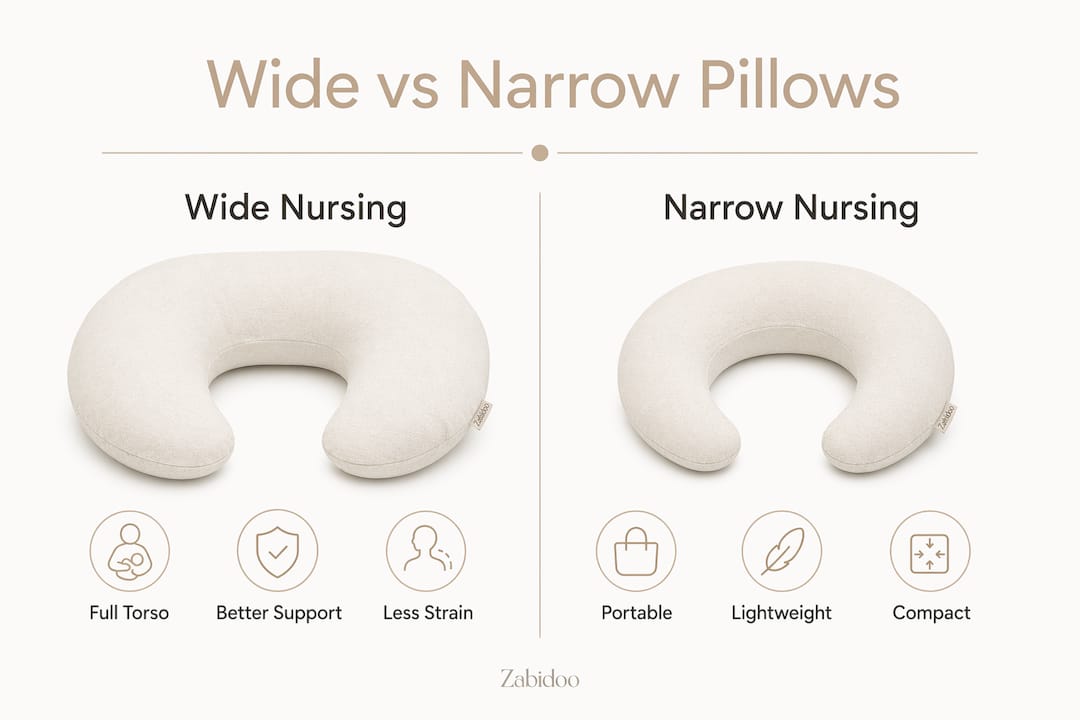
A wide nursing pillow is defined by its wrap-around torso design, which supports the mother’s entire midsection during feeding, while a narrow nursing pillow provides targeted cushioning directly beneath the baby. For breastfeeding mums, this distinction is not cosmetic. The wide pillow vs narrow pillow choice directly shapes your posture, your baby’s latch, and how much strain you carry through every single feed. Australian mums are increasingly recognising that the right pillow width is one of the most consequential decisions in their feeding setup, yet most product descriptions gloss over it entirely.
How do wide and narrow pillows affect breastfeeding posture?
Wide nursing pillows reduce the need for mothers to lean forward, significantly lowering neck and back strain during feeding. This matters because the forward lean most mums adopt with a narrow pillow is not a neutral position. It compresses the lumbar spine, rounds the shoulders, and over the course of multiple daily feeds, creates chronic discomfort that many women incorrectly attribute to “just part of breastfeeding.”
Physical therapists note that narrow pillows force rounded, twisted postures that impair breathing and cause upper back fatigue. A wide, wrap-around design keeps the baby elevated at chest height, so the mother’s spine stays upright rather than curving forward to meet the infant. The difference in strain between these two postures is cumulative. A mum feeding eight to twelve times per day for months will feel that difference in her neck, wrists, and lower back.

Wrap-around pillow designs reduce maternal postural stress by supporting the lumbar region and distributing infant weight more evenly across the torso. Narrow pillows concentrate that weight in a single zone, which increases the likelihood of compensatory postures. The result is a mum who constantly repositions, fidgets, and tenses her shoulders to compensate for inadequate support.
Posture benefits specific to wide nursing pillows include:
- Neutral spine alignment, with the nose and chest staying centred rather than pitched forward
- Reduced shoulder elevation and neck tension during prolonged feeds
- Lower lumbar support that prevents the classic “c-curve” slouch
- Distributed infant weight across the torso rather than a single pressure point
- Reduced need to reposition mid-feed, which disrupts latch
Pro Tip: Place your wide nursing pillow so it sits snugly against your abdomen before you pick up your baby. If you are reaching forward to settle the baby onto the pillow, it is positioned too far away and you will hunch regardless of pillow width.
What are the size and structural differences between pillow types?
Standard pillow widths range from 20 to 36 inches, but nursing pillows operate on a different logic entirely. Width in a nursing context defines the type of support delivered, not just the surface area. A wide nursing pillow typically takes a C-shape or U-shape that wraps around the mother’s torso, while a narrow nursing pillow is usually rectangular or a small half-moon shape positioned beneath the baby.
Pillow loft, meaning height, matters as much as width for spinal alignment. A wide pillow that lacks sufficient height will still force a mum to lean down. Conversely, a narrow pillow with excessive loft may push the baby too high and create a different kind of forward strain. The two dimensions must work together. Zabbidoo’s nursing pillow, for example, is built to an 18cm lift specifically because that height brings the baby to the mother rather than requiring the mother to descend to the baby.
Standard bed pillows fail under infant weight because they are designed to conform, not to resist compression. Dedicated nursing pillows maintain their height against 5 to 15 pounds of infant pressure. This is the structural distinction that separates a purpose-built nursing pillow from a repurposed household cushion.
| Feature | Wide nursing pillow | Narrow nursing pillow |
|---|---|---|
| Shape | C-shape, U-shape, or wrap-around | Rectangular or half-moon |
| Typical width | 50 to 70 cm across torso | 30 to 45 cm beneath baby |
| Loft (height) | 15 to 20 cm for adequate lift | 10 to 15 cm, variable |
| Support type | Full torso and lumbar support | Targeted support under infant |
| Firmness | Firm structural panels to resist sinking | Moderate, may compress under weight |
| Best use | Stationary, extended feeding sessions | Portable, supplementary support |
Which pillow type suits your feeding environment?
Narrow pillows carry a genuine advantage in one specific context: portability. They are lighter, easier to pack into a nappy bag, and less cumbersome when feeding in a car, at a café, or in a hospital room. For a mum who feeds predominantly on the go, a compact pillow is a practical choice for those sessions. The trade-off is that it delivers less postural support, which is acceptable for short or occasional feeds but problematic as a primary pillow.
Wide nursing pillows are best suited to the stationary feeding environment most mums use most often, the couch, the nursing chair, or the bed. Adjustable-fill or open-ended designs are particularly valued by second-time mothers, who know from experience that a closed-loop cushion becomes restrictive as the baby grows and starts moving their legs. An open-ended or adjustable circumference model accommodates a three-month-old and a six-month-old without requiring a second purchase.
When choosing between pillow widths, consider the following practical factors:
- Feeding location: Home-based mums benefit most from wide wrap-around designs; mums who feed frequently in public may want both options
- Baby’s current size and growth stage: Newborns need less lateral room; babies past three months benefit from open-ended designs
- Your body frame: Smaller-framed mums may find very wide C-pillows unwieldy; a medium-width wrap-around may suit better
- Existing back or neck conditions: Any pre-existing postural issues make a wide, firm pillow a higher priority, not a luxury
- Storage and washing: Wide pillows require more space and larger washing machines; check cover removability before purchasing
Pro Tip: If you are a second-time mum, resist the urge to reuse your first nursing pillow without checking its firmness. A pillow that has already been compressed through one feeding journey may not maintain the loft needed to support a second baby properly.
Common mistakes when choosing between wide and narrow nursing pillows
The most frequent mistake is choosing a pillow based on softness. Softness feels appealing in the shop, but a pillow that cannot maintain stable height under baby weight will compromise both positioning and latch within weeks. Firmness is not a comfort sacrifice. It is the structural requirement that makes the pillow functional.
The second mistake is treating width and loft as separate decisions. They are not. A wide pillow without sufficient height still forces a forward lean. A narrow pillow with high loft may push the baby awkwardly. The two dimensions must be evaluated together, which is why testing a pillow in a seated position before purchasing is worth the effort. If you cannot test in person, look for brands that publish specific loft measurements rather than vague descriptors like “medium firm.”
The third mistake is ignoring materials. A pillow cover that traps heat will make feeding uncomfortable in Australian summers, and a fill that compresses permanently after washing defeats the purpose of the purchase. Look for premium pillow materials that balance breathability with structural integrity. French flax linen, for instance, is both temperature-regulating and durable under repeated washing.
Pro Tip: Press your fist firmly into the centre of any nursing pillow you are considering. If it sinks more than halfway and does not spring back within two seconds, it will not hold your baby’s weight through a full feed.
How to maintain your nursing pillow and when to replace it
A nursing pillow that has lost its shape is no longer doing its job, regardless of how new it looks on the outside. Replacing a pillow when it loses loft or firmness is not overcautious. It is the practical response to a support tool that has stopped supporting.
Follow these steps to extend the life of your nursing pillow and recognise when it needs replacing:
- Remove and wash the cover weekly. Milk residue, sweat, and skin contact accumulate quickly. A removable, machine-washable cover is a non-negotiable feature for hygiene.
- Air the pillow insert after each use. Moisture trapped inside the fill accelerates compression and can encourage mould in humid climates.
- Check loft monthly by pressing the centre. If the pillow no longer springs back to its original height, the fill is breaking down.
- Inspect the structural panels or seams every two months. Wide pillows with firm panels can develop weak points at seams under repeated pressure.
- Replace the pillow if it has flattened noticeably or if you find yourself leaning forward again during feeds. That postural shift is the clearest signal that the pillow is no longer providing adequate lift.
For safety, never use a nursing pillow as an unsupervised infant sleep surface. The same firmness that supports feeding posture can create a risk if a baby rolls against it without supervision.
Key takeaways
Wide nursing pillows outperform narrow ones for posture, latch support, and long-term maternal comfort because they combine torso coverage with firm, height-stable construction.
| Point | Details |
|---|---|
| Width defines support type | Wide pillows wrap the torso; narrow pillows target only the area beneath the baby. |
| Loft and width work together | A wide pillow without adequate height still causes forward lean; both dimensions matter. |
| Firmness is structural, not optional | Pillows that compress under infant weight fail at their core function within weeks. |
| Adjustable designs suit growing babies | Open-ended or adjustable-fill pillows accommodate infant growth past the newborn stage. |
| Replace on function, not appearance | When you start leaning forward again, the pillow has lost its support capacity. |
What I have learned from using both
I used a narrow half-moon pillow with my first baby and spent four months wondering why my upper back ached constantly after feeds. A physiotherapist eventually pointed out that I was pitching forward by roughly 20 degrees every time I settled my daughter onto the pillow. I had adapted to the pillow’s limitations rather than questioning whether the pillow was right for me.
With my second, I switched to a wide wrap-around design with a firm fill and a measured 18cm loft. The difference was immediate and, honestly, a little annoying in retrospect. The forward lean disappeared. The shoulder tension I had normalised as “just feeding fatigue” was gone within a week. A lactation consultant I spoke with confirmed what I had experienced: most mums do not realise they are compensating for a poor pillow until they use a better one.
My honest view is that the wide versus narrow debate is really a debate about whether you want total support or targeted support. Narrow pillows are not bad. They are simply limited. For the volume of feeding a newborn demands, and for the postural load that places on a mother’s body, total support is not a luxury. It is the baseline requirement. I would encourage any mum, first-time or otherwise, to prioritise pillow height and firmness over aesthetics or price when making this decision. Your back will thank you at the six-month mark.
— Marietjie
Why Zabbidoo was designed for exactly this problem

Zabbidoo’s nursing pillow was built specifically to address what most nursing pillows get wrong. The 18cm lift brings your baby up to you rather than pulling you down to them. The firm compression-resistant fill holds its shape through months of daily feeds, not just the first few weeks. The French flax linen cover is breathable in Australian summers and machine washable for practical hygiene. Whether you are feeding a newborn or a rolling six-month-old, the open-ended design adjusts to your baby’s growth. Australian mums consistently report that the reduction in neck and back strain is noticeable from the very first feed. If you are ready to stop compensating for your pillow, Zabbidoo is the place to start.
FAQ
What is the main difference between a wide and narrow nursing pillow?
A wide nursing pillow wraps around the mother’s torso to provide full lateral and lumbar support, while a narrow nursing pillow sits beneath the baby to provide targeted cushioning. Wide designs reduce forward lean and postural strain more effectively during extended feeding sessions.
Can a narrow pillow cause back pain during breastfeeding?
Yes. Physical therapists note that narrow pillows force mothers into rounded, forward-leaning postures that place sustained pressure on the neck and upper back. Over multiple daily feeds, this cumulative strain is a common cause of postpartum back pain.
How do I know if my nursing pillow has lost its support?
The clearest sign is that you begin leaning forward again during feeds after a period of comfortable upright positioning. Press the centre of the pillow firmly. If it does not spring back to its original height within two seconds, the fill has compressed beyond functional use.
Are wide nursing pillows suitable for smaller-framed mums?
Yes, but fit matters. Smaller-framed mums should look for medium-width wrap-around designs rather than the largest C or U-shapes, which can feel unwieldy. The key measurement to check is loft height, which should be sufficient to bring the baby to chest level without requiring the mother to lean.
How often should a nursing pillow be replaced?
Replace a nursing pillow when it no longer maintains its loft under infant weight, typically showing visible flattening or a failure to spring back after compression. For mums feeding frequently, this can occur within six to twelve months depending on fill quality and care.