

If your nursing pillow keeps sliding away from your body, the fastest fix is to tighten and re-seat it hard against your waist, adding a non-slip pad underneath if it still won’t hold. For a lasting solution, switch to a firmer, stability-focused pillow with strong compression resistance and a wide opening, such as the Zabbidoo Nursing Pillow. Always supervise your baby while feeding and never use a nursing pillow for infant sleep.
TL;DR:
- Firmer nursing pillows with a high lift, wide openings, and secure straps stay in place better during longer feeds and reduce slipping issues.
- Proper positioning, including seating on a supportive chair and bringing the baby up to breast level, minimizes forward pressure that causes pillows to slide off.
- Using non-slip grip pads, textured covers, and regular pillow maintenance helps preserve stability and shape over time.
- Avoid using nursing pillows for infant sleep, as soft surfaces increase suffocation and entrapment risks, with safety standards now emphasizing firmer, flatter designs.
- When the pillow’s softness or flattening causes repeated slipping, upgrading to a more supportive, contour-keeping pillow is the most effective long-term solution.
Table of Contents
- Quick fixes to stop your nursing pillow sliding mid-feed
- How should you sit and hold baby so the pillow doesn’t slide?
- What pillow features actually stop slipping?
- Cheap hacks and simple upkeep that keep your pillow stable
- What safety rules matter most for nursing pillow use?
- Why does an ergonomic, higher-lift design stop pillows slipping?
- Which nursing pillows are actually known for staying put?
- What actually stops the sliding, according to Marietjie
- Ready for a pillow that doesn’t need constant fixing?
- Sources
- FAQ
Quick fixes to stop your nursing pillow sliding mid-feed
You don’t need to stop the feed to fix a slipping pillow. Most sliding happens because the pillow isn’t seated properly against your body, not because the pillow itself is faulty. Try these in order, starting with the fastest.
- Shove it into your waist. Grab both sides and pull the pillow firmly against your stomach, right at belly-button height, so there’s no gap between the pillow and your torso.
- Angle the opening toward you. Most slipping happens because the U-shaped gap has drifted away from your body. Rotate the pillow slightly so the opening cups your waist rather than sitting flat against it.
- Adjust any strap. If your pillow has a caregiver attachment, cinch it one notch tighter. A loose strap does nothing to stop the pillow rotating as baby moves.
- Fill the gap with a rolled towel. Tuck a thin rolled towel or receiving blanket behind the pillow where it meets your lower back. This stops the whole setup sliding backward off your lap, a fix nursing guides recommend when a pillow sits too low for your torso height.
- Add grip underneath. A small strip of silicone shelf liner or a scrap of yoga mat under the pillow stops it skating across a chair cushion or couch fabric.
If baby is genuinely unsettled rather than just briefly wriggling, pause the feed, reposition properly, and start again. A few seconds of resettling beats ten minutes of fighting a pillow that’s fighting back.
Pro Tip: Keep a rolled hand towel wedged beside your favourite feeding chair. It takes two seconds to grab and fixes height and gap problems in one move, without breaking baby’s latch.
How should you sit and hold baby so the pillow doesn’t slide?
Sliding often starts with you, not the pillow. If you’re leaning forward to reach baby, you’re putting downward and forward pressure on the front edge of the pillow every single feed, and that’s exactly the motion that walks it off your lap.
Lactation consultants use a simple check here: “close enough to kiss.” If you can lean down and kiss your baby’s forehead without hunching your shoulders or craning your neck, baby is sitting at the right height and you’re not overloading the front of the pillow. If you have to duck down, the pillow is too low, or you’re not lifting baby high enough onto it.
Get your seat right first:
- Choose a supportive chair with a firm seat base, not a soft couch that lets your hips sink and tips the pillow forward.
- Keep both feet flat on the floor, or on a low stool, so your pelvis isn’t tilted.
- Add a small lumbar cushion behind your lower back if you feel yourself curling forward after a few minutes.
Once you’re seated, check the line from ear to shoulder to hip. It should run roughly straight, not curved forward. The core mistake most new mums make is hunching down to bring the breast to the baby. It should be the reverse: bring baby up to the breast, which is exactly what lactation consultants recommend as the single biggest posture fix for both latch and pillow stability.
Different holds need small tweaks. In a cradle hold, keep baby’s whole body facing you, not just the head, to stop them sliding sideways off the pillow’s curve. In cross-cradle or football holds, use your free arm to brace the pillow against your side rather than relying on the pillow alone to hold its position.
What pillow features actually stop slipping?
Not all nursing pillows are built the same, and the differences show up fastest in how well the pillow holds its shape and position during a real feed, not in a showroom.
- Firmness and compression resistance. A firm core keeps its contour under sustained weight. A soft, squishy filling flattens within minutes, which is exactly what causes sliding and repeated repositioning during longer feeds, as noted in Forbes’ review.
- A wide opening that matches your waist. If the U-shaped gap is too narrow, it rides up on your stomach. Too wide, and baby sinks into a gap instead of sitting on a stable shelf. The right opening width fits snugly against your torso with no dead space.
- A caregiver strap or attachment. Many IBCLCs consider a secure strap essential, since it stops the pillow rotating away from your body as baby squirms, a problem Forbes’ review of top nursing pillows flags repeatedly.
- Grippy, machine-washable covers. A slick synthetic cover slides on bare skin or clothing; a textured cotton or linen weave grips instead. Check seam quality too. Loose stitching lets filling shift and go lumpy, undermining stability over time.
Newer pillow designs are also trending firmer and flatter overall, a shift Consumer Reports links directly to safer, more stable performance rather than just comfort marketing. If you’re shopping, these features matter more than the print on the cover.
Cheap hacks and simple upkeep that keep your pillow stable
Most slipping problems can be solved for the price of a hardware store visit, and a few minutes of maintenance keep a good pillow performing like new for years.
- Slide a strip of non-slip shelf liner or a cut piece of silicone yoga mat under the pillow’s base. It adds real friction against slippery chair fabric or leather, but only use it while you’re actively holding and watching baby, never as a set-and-forget prop.
- Swap a slick synthetic cover for a fitted cotton one, or drape a plain cotton receiving blanket over the top layer. The extra texture stops baby’s clothing sliding against the pillow surface.
- Wash covers regularly and run your hand along every seam every few weeks, feeling for lumps, thin patches, or stitching that’s starting to give way.
- Test compression at home: press your palm into the pillow’s core for ten seconds and watch how fast it springs back. A slow, weak rebound signals the filling is failing, and a flattened pillow slides far more easily than a firm one.
Pro Tip: Do the ten-second press test every couple of months. If the dent lingers for more than a second or two, the filling has started to break down, and no amount of tightening or grip pads will fully fix the slipping after that point.
What safety rules matter most for nursing pillow use?
The single most important rule: never use a nursing pillow for infant sleep, napping, or unsupervised lounging. These pillows are designed to support a feeding position with an adult present, not to cushion a sleeping baby. Soft, curved surfaces create real suffocation, entrapment, and fall risks when a baby is left on one alone, particularly if they roll or slump into the pillow’s centre.
Between 2010 and 2022, nursing pillows were linked to over 150 infant deaths in the United States, prompting Consumer Reports to push for firmer, flatter designs and clearer warning labels, a case documented in its nursing pillow safety guidance.
In response, the Consumer Product Safety Commission approved a mandatory federal safety standard covering nursing pillows sold in the US. The standard sets performance requirements aimed at reducing suffocation, entrapment, and fall risks, and pushes manufacturers toward firmer builds, clearer warning labels, and packaging instructions that spell out safe use.
Keep this checklist front of mind every feed:
- Stay within arm’s reach and supervise the entire time the pillow is in use.
- If baby starts nodding off, move them to a firm, flat sleep surface immediately rather than letting them settle on the pillow.
- Never leave the pillow, with or without baby on it, on a bed, couch, or any elevated surface unattended.
You can read more on why nursing pillows and infant sleep don’t mix if you want the full safety picture beyond slipping alone.
Why does an ergonomic, higher-lift design stop pillows slipping?
Most slipping complaints trace back to one design flaw: the pillow sits too low, so mum leans forward to reach baby, and that forward lean is what drags the pillow out of position feed after feed. Zabbidoo’s approach starts by fixing the height problem rather than treating the symptoms.
The pillow uses an 18cm lift, noticeably higher than standard designs, which brings baby up toward the breast instead of asking mum to hunch down to baby. That single change removes most of the forward pressure that walks a lower pillow off your lap. It puts the “close enough to kiss” test within easy reach without any strain.
Height alone doesn’t solve slipping if the filling collapses halfway through a feed. That’s where compression resistance matters. A pillow that holds its contour under sustained weight keeps its shape and position for the whole feed, not just the first five minutes, echoing what product testing consistently finds about firmer cores outperforming soft ones over time.
A few checks work whether you’re trying this at home or in a store:
- Press the core firmly for ten seconds and watch how quickly it rebounds.
- Check the opening width against your own waist, not just the display model.
- Test any strap or attachment by tugging it gently to feel whether it actually locks the pillow in place.
The breathable French flax linen cover adds grip against clothing too, which matters more than most shoppers expect during a warm feed.
Which nursing pillows are actually known for staying put?
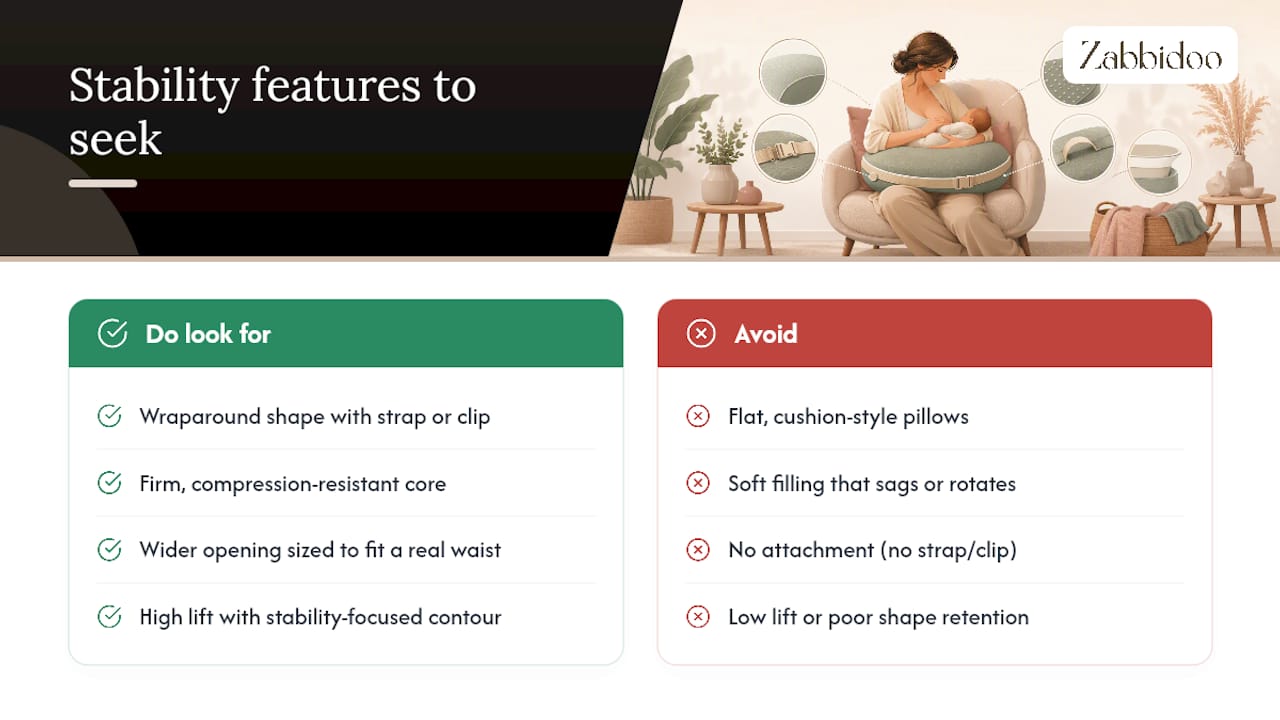
When you’re comparing pillows specifically for stability, the pattern is consistent: firmer cores, wider openings sized to fit a real waist, and some form of caregiver attachment separate the pillows that stay put from the ones that don’t.
Wraparound designs with a strap or clip tend to outperform flat, cushion-style pillows because the strap does the job your hands would otherwise have to do, holding the pillow against your torso even when baby wriggles. Forbes’ testing of top nursing pillows repeatedly flags this attachment feature as a deciding factor for parents who’d previously struggled with sliding.
Firmness separates pillows within that wraparound category further. A wraparound shape with soft filling still sags and rotates over a long feed. Pair the wraparound shape with a firm, compression-resistant core, and you get a pillow that holds its position because it holds its shape.
One example of such a pillow uses a high lift to fix the height and reach problem, a stability-focused contour to reduce rotation, and a firm core designed to resist compression across long or repeated feeds. If you’re shopping specifically to solve a slipping problem rather than just buy any cushion, those three attributes—height, shape retention, and secure fit—matter more than colour or print.
What actually stops the sliding, according to Marietjie
Talk to enough mums about their nursing pillow, and the same story comes up: it worked beautifully for the first two weeks, then started drifting sideways the moment baby got heavier or wrigglier. The cause is rarely the pillow’s design alone. It’s usually a soft couch, a slouched posture, and a filling that’s already starting to flatten, all working against you at once. Small changes fix most of it: sitting further back in a firmer chair, checking the “close enough to kiss” line before you settle in, and not assuming a pillow that felt fine in the shop will still feel fine after fifty feeds. Try the free fixes first. If your pillow still won’t hold, that’s your body telling you it’s time for a firmer one.
— Marietjie
Ready for a pillow that doesn’t need constant fixing?
If you’ve tried the towels, the grip pads, and the strap adjustments and you’re still fighting your pillow every feed, the problem probably isn’t your technique. It’s the pillow. Zabbidoo’s nursing pillow was built around the three things that actually stop slipping: an 18cm lift that brings baby to you instead of forcing you to hunch, a stability-focused contour that resists rotating out of position, and a firm core with genuine compression resistance so it still holds its shape at feed number two hundred, not just feed number one.

Some pillows feature breathable linen covers, machine washable components, and additional conveniences such as built-in pockets and portable handles for easy movement between rooms. Check delivery details and add shipping protection at checkout if you want extra peace of mind on arrival. Head to the nursing pillow product page to see the full specs and place your order today.
Sources
- Cpsc
- How to Choose a Nursing Pillow and Use It Safely - Consumer Reports
- Best nursing pillows 2026 - Forbes
FAQ
When should you stop using a nursing pillow?
Most parents stop once baby can sit up unsupported or reliably push up on their own, typically somewhere between four and six months, since the pillow’s support becomes less necessary and baby’s added strength increases the chance of them wriggling off it.
Is it okay to let baby sleep on a nursing pillow?
No. Nursing pillows are not designed or tested as sleep surfaces, and Consumer Reports links them to over 150 infant deaths tied to suffocation, entrapment, and falls. Always move a drowsy baby to a firm, flat sleep surface.
How do you position a breastfeeding pillow correctly?
Pull the pillow firmly against your waist with the opening angled toward your body, then use the “close enough to kiss” check: if you can lean down and kiss baby’s forehead without hunching, the height and position are right.
What can you use instead of a nursing pillow?
Rolled towels, firm couch cushions, or a folded blanket can prop baby to breast height in a pinch, though none match the consistent shape retention of a purpose-built, firmer pillow like the Zabbidoo Nursing Pillow for regular, repeated feeds.