

Short answer: yes, a Boppy can be too soft for some newborns, and if yours sinks under your baby’s weight instead of holding them at breast height, it’s not doing its job safely or comfortably. A soft, collapsing pillow lets a baby’s chin drop toward their chest, which can affect both latch and airway position during feeds. That’s not a reason to panic. It’s a reason to check what you’ve got, right now, and act on what you find.
Do this today:
- Feed only, supervised. Use the pillow purely for held, awake feeding sessions, never for propping baby to sleep or leaving them unattended even for a minute.
- Watch the airway. If your baby’s chin tucks toward their chest or their head tips backward while resting on the pillow, reposition immediately or feed without it.
- Run the squash test. Press down firmly in the centre of the pillow with your hand. If it bottoms out and barely pushes back, it’s too soft to trust for reliable support.
If your pillow fails that quick press test, don’t wait for it to “break in” or get better. Replace it. The rest of this guide shows you exactly how to test properly, what’s actually happened to your pillow, and what a genuinely firm alternative looks like.
Key Takeaways
A too-soft nursing pillow lets a baby sink and their chin tuck toward their chest, which compromises both latch and airway position, so firmness is a safety feature, not just a comfort preference.
| Point | Details |
|---|---|
| Run the compression test now | Press a two-kilogram weight into the centre; if it sinks over two centimetres without rebounding, it’s too soft. |
| Feeding only, always supervised | Never use a nursing pillow for sleep or unattended lounging, regardless of how firm it feels. |
| Replace on clear triggers | Visible fill breakdown, a stretched cover, or a failed compression test all mean it’s time for a new pillow. |
| Choose lift and compression resistance | Zabbidoo’s pillow offers 18cm of lift and shape retaining fill designed to hold baby at breast height through a full feed. |
Table of Contents
- Why a Boppy can feel too soft to properly support your baby
- What the safety data says about nursing pillow firmness
- How to test whether your nursing pillow is actually firm enough
- What to do if your Boppy fails the firmness test
- What to look for in a firmer nursing pillow
- How Zabbidoo’s nursing pillow solves the softness problem
- When to retire a nursing pillow altogether
- Get a nursing pillow built to hold its shape, not sink under it
- Sources
Why a Boppy can feel too soft to properly support your baby
A Boppy relies on loose polyester fibre fill, and that fill is precisely why it feels the way it does. Unlike foam, which holds a shape until real pressure is applied, loose fibre shifts and redistributes the moment any weight lands on it. Put a five-kilogram baby on that fill and it doesn’t resist. It moves out of the way.
The C-shape design compounds the problem. A curved pillow that wraps around your waist is great for keeping baby close, but it doesn’t do much to hold height. Wirecutter’s testing of nursing pillows found that classic C-shaped pillows can shift away from the parent’s body and feel less structured than strapped or more rigid alternatives, which directly affects how stable the latch position stays through a feed. A pillow that slides means you’re constantly readjusting, and baby’s head position drifts with it.
Age matters too. A brand new Boppy has more loft than one that’s been through eighteen months of daily feeds and a dozen washes. Polyester fibre compresses permanently over time. It loses volume, the cover fabric stretches, and what started as a supportive cushion becomes a flat, saggy version of itself. If you’ve had the same pillow through two babies, or even through one baby’s first year, there’s a good chance it’s simply worn out.
Picture the common scenario: you sit baby on the pillow to feed, and within a minute they’ve sunk two or three centimetres lower than where you placed them. Your shoulders round forward to compensate. Baby’s chin drifts toward their chest. That’s the too-soft problem in a single image, and it’s exactly what firmer designs are built to prevent.
What the safety data says about nursing pillow firmness
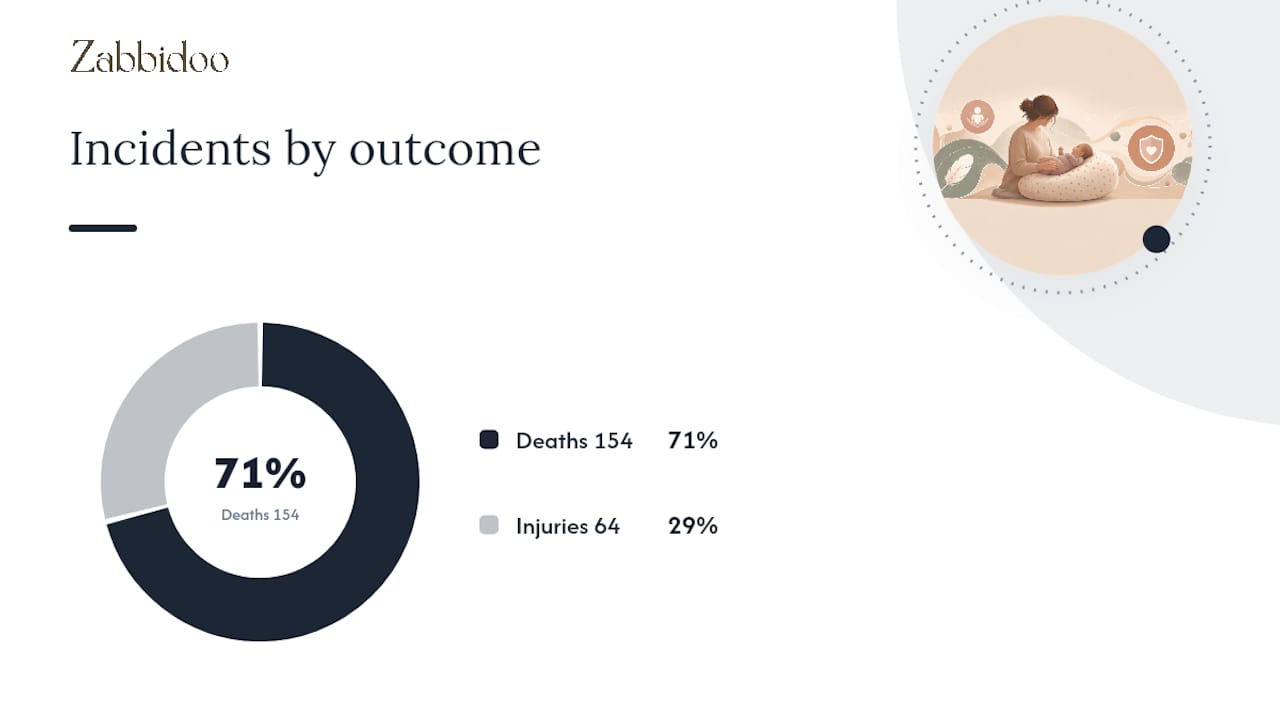
The concern about soft nursing pillows isn’t anecdotal. Between 2010 and 2022, 154 infant deaths and 64 injuries were linked to nursing pillows, the large majority tied to uses other than supervised feeding, including sleep and unsupervised lounging. That statistic is the reason nursing pillows now carry firm warnings against use as sleep surfaces, and it’s the reason regulators have stepped in on design standards.
New federal rules that took effect in 2025 respond directly to that pattern. Manufacturers must now build nursing pillows with firmer cushions, wider openings, no infant restraint straps, and clearer warning labels discouraging sleep or unsupervised use. The firmness requirement exists because a softer pillow is more likely to let an infant’s face sink into fabric, and a firmer one resists that collapse.
| Safety element | What the rule requires | Why it matters |
|---|---|---|
| Cushion firmness | Must resist compression under standard testing | Prevents baby’s face or head sinking into fabric |
| Opening width | Wider gap sized to fit an adult torso, not a baby | Stops the pillow doubling as an infant lounger |
| Infant straps | Removed from new designs | Straps encouraged unsupervised use, a known risk factor |
| Warning labels | Clear, prominent “feeding only, supervised” language | Reduces sleep and lounging misuse |
Consumer Reports has noted that Boppy updated its own model to be firmer with a wider opening, which tells you something useful: even the manufacturer most associated with the soft, squishy C-shape has acknowledged that firmness needed improving. Lactation professionals echo the same logic from the feeding side. Cincinnati Children’s Clara Chlon has spoken to the risks that arise when infants sink into soft pillow sides and can’t reposition their own head or airway, a mechanical problem that firmness directly addresses.
How to test whether your nursing pillow is actually firm enough
You don’t need lab equipment to check this. A tape measure, a bag of rice or a stack of books, and five minutes will tell you most of what you need to know.
- Inspect it visually first. Look for collapsed seams, lumpy or unevenly distributed fill, and a cover that’s gone slack or thin. Any of these signals the fill has broken down.
- Run a controlled compression test. Place a firm household item of known weight, a two-kilogram bag of rice works well, in the centre of the pillow and measure how far it sinks. If it compresses more than a few centimetres and doesn’t spring back within a couple of seconds, the support is too soft.
- Check the opening width. Wrap the pillow around your own waist the way you would when feeding. It should sit snugly around you, not gape open or squeeze so tight it tips forward.
- Measure the lift. Sit in your usual feeding position and check whether the pillow brings a baby’s head to roughly nipple height without you leaning down or hunching your shoulders. If you find yourself curling forward every feed, the lift is falling short.
- Photograph the results. Take a shot of the compression depth and note the date. Repeat the test every couple of months to track how quickly the fill is deteriorating.
Pro Tip: Use the same weight and the same spot on the pillow every time you test, and photograph the compression next to a tape measure. That gives you a repeatable before-and-after record rather than a memory of “it feels softer than last month,” which is much harder to trust.
Never run any of these tests with your baby actually on the pillow, and never leave a baby alone on a nursing pillow at any point, testing or otherwise. The whole point of testing firmness is to catch a problem before it affects a real feed.
What to do if your Boppy fails the firmness test
If your pillow sinks too far or won’t hold shape, there are a few safe stopgaps while you sort out a longer-term fix. Try repositioning baby slightly higher on the pillow, propping a firm cushion or rolled towel behind your own back for extra height, or switching to a football hold or laid-back nursing position that doesn’t rely on the pillow’s structure at all. All of these work fine as supervised, short-term measures.

What you shouldn’t do is try to engineer more firmness yourself. Stuffing extra loose fibre or fabric into a worn cover, or piling blankets underneath the pillow to boost height, adds soft material into a feeding setup rather than removing the problem. Loose fill and loose bedding near an infant’s face are exactly what current safety standards are trying to eliminate, so a DIY fix that adds more of it works against the goal, not toward it.
Use these triggers as your decision rule for replacement:
- The pillow compresses more than roughly two centimetres under a two-kilogram test weight and doesn’t rebound.
- You can visibly see or feel lumps, flat patches, or fill that’s shifted permanently to one side.
- The cover has stretched, thinned, or torn, exposing the inner fill.
- The pillow predates the 2025 firmness and labelling standards and shows no updated safety label.
Once a pillow is retired, most council kerbside collections won’t take stuffed items, so check local textile recycling programs or donate only if the pillow genuinely still meets a firm, supportive standard. A pillow that’s failed your own compression test shouldn’t be passed on to another family’s newborn.
What to look for in a firmer nursing pillow
Buying a replacement is where you can fix the underlying problem instead of managing around it. Six features separate a genuinely supportive pillow from another version of the same soft, sinking design:
- Compression resistance. The fill or foam should hold its shape under sustained weight rather than flattening within weeks.
- Lift and height. Look for a specified height in centimetres that brings baby to breast level without you leaning forward, a detail few brands actually publish.
- Stable base and shape retention. A pillow that doesn’t shift or rotate on your lap reduces how often you’re repositioning mid-feed.
- Wider, adult-fit opening. The gap should be sized for an adult torso, in line with current safety standards, not tight enough to double as an infant seat.
- Clear safety labelling. No infant restraint straps, and explicit “feeding only, supervised” warnings on the product itself.
- Washable, breathable cover. Natural fibres that can go through the machine regularly matter more than they sound, given how often a nursing pillow gets used.
Prioritise in that order. Safety features (firmness, opening width, no straps) come first, comfort and lift second, and materials last, though a poor cover fabric will make even a well-designed pillow unpleasant to use through a hot week of feeds. When you’re comparing options in person or online, ask directly: what’s the measured lift in centimetres, and does the compression resistance meet current firmness standards? A brand that can answer both questions specifically is usually one that’s actually engineered for the problem, not just marketing around it.
How Zabbidoo’s nursing pillow solves the softness problem
Zabbidoo built its nursing pillow around the exact list above, starting with the two numbers that matter most: lift and compression resistance.
- 18cm lift brings baby to breast height without you hunching or leaning down through a feed, addressing the posture strain that lactation professionals point to when a pillow sits too low.
- High compression resistance keeps the shape intact under sustained weight instead of sinking the way loose-fibre fill does, so baby’s position stays consistent from the start of a feed to the end.
- Stability-focused design reduces the constant readjustment that comes with a pillow that slides or rotates on your lap.
- A wider opening fits comfortably around an adult waist, in line with current safety guidance, rather than gaping or cinching too tight.
- Breathable French flax linen cover stays cool through long feeding sessions and is fully machine washable, along with the other removable components.
- A built-in pocket and portable handle make it practical to carry between rooms or pack for visits, on top of the core support features.
The 18cm lift figure matters because it’s a fixed measurement you can compare directly against whatever you’re currently using, rather than a vague comfort claim. Compression resistance works the same way: it’s the difference between a pillow that holds baby steady through a twenty-minute feed and one that lets them sink lower with every passing minute.
None of this replaces supervision. Use any nursing pillow, including this one, only for awake, supervised feeding, tummy time, or seated support, never as a sleep surface.
Boppy issues versus firmer ergonomic design
- Soft C-shaped pillow: sinks under weight, baby leans lower through the feed, chin can tuck toward chest.
- Firmer ergonomic pillow: holds height and shape, baby stays at breast level, less mid-feed repositioning.
- Soft pillow: parent hunches forward to compensate for lost lift.
- Firmer pillow: parent sits upright, reducing neck and shoulder strain over a feeding session.
If you’re not sure which category your current pillow falls into, run the compression test above before you decide anything. Replace it if it fails.
When to retire a nursing pillow altogether
Most babies outgrow the need for a nursing pillow somewhere between six and nine months, once they can sit unassisted and feeding positions naturally shift. A baby who’s rolling, grabbing at fabric, or attempting to pull themselves up doesn’t need a soft prop nearby, and a mobile baby on a pillow is a very different safety picture from a newborn held securely in your arms.
As feeding needs change, a firm chair with armrests, lap feeding without any pillow at all, or supervised tummy time on a flat floor mat all serve older babies better than a cushion built for tiny newborns. None of these carry the sinking or repositioning risk that a soft pillow does once a baby is bigger and more mobile.
One rule holds at every age and stage: a nursing pillow is never a sleep surface. If your baby drifts off mid-feed, move them to a firm, flat cot or bassinet immediately rather than letting them settle on the pillow, even for what feels like a few safe minutes.
A note from Zabbidoo’s editorial team
Every soft-pillow complaint we’ve read follows the same pattern: a new mum notices her baby sinking lower with each feed, assumes it’s normal because that’s what the pillow she was given does, and adjusts her own posture instead of questioning the product. That adjustment, hunching forward, twisting sideways, holding baby up with one tired arm, is the real cost of a too-soft pillow, and it’s rarely framed as a design failure. It should be.
Firmness isn’t a nice-to-have feature bolted onto a nursing pillow for marketing purposes. It’s the mechanical property that determines whether baby’s head stays where you put it or drifts throughout a feed. Get that one variable right and a lot of the “learning curve” people associate with breastfeeding positioning simply disappears.
If you’ve got questions about testing your current pillow or want to know more about how Zabbidoo’s design compares to what you’re using now, reach out through our website. We’d rather answer a specific question about your setup than have you guess.
Get a nursing pillow built to hold its shape, not sink under it
If you’ve just run the compression test and watched your current pillow bottom out, you already know what a soft pillow costs you: a lower baby, a rounder back, and a feed that needs constant readjusting. Zabbidoo’s nursing pillow was built to fix that specific problem, with 18cm of lift that brings baby to breast height and compression resistance that holds through every feed, not just the first few weeks out of the box.

The wider opening fits an adult waist properly, in line with current safety standards, and the French flax linen cover is fully machine washable, so it stays practical through the messiest weeks of newborn life. It also doubles for supervised tummy time and general support as your baby grows, without the strap-based features that current guidance has moved away from.
Check the full spec list and measurements on the Zabbidoo nursing pillow product page, and compare the lift and firmness figures directly against whatever you’re using now. If you want more detail on positioning technique before you buy, our guide on how support pillows improve nursing posture walks through the mechanics in more depth.
Sources
- Is your nursing pillow safe? (Consumer Reports)
- Mother
- The 3 best nursing pillows of 2026 | Wirecutter
- How to use a Boppy pillow: feeding, tummy time & more (ScienceInsights)
Safety standards and product designs continue to evolve, so it’s worth checking the current guidance from your own paediatrician or a lactation consultant alongside these sources, particularly if you’re using an older pillow that predates the 2025 rule changes.
This article is general information, not a substitute for advice from a qualified doctor. Consult a qualified healthcare professional about your own circumstances before acting on anything here.