

A latch support pillow is a firm, shaped cushion designed to lift your baby to breast height during feeding, reducing the strain that causes poor latch and maternal discomfort. Most mothers assume any pillow will do the job. The evidence says otherwise. Structured positioning support dramatically improves latch quality, with 97.1% of mothers achieving a LATCH score above 8 after counselling that included positioning guidance, compared to just 3.9% before. That gap shows how much technique and support tools matter. A nursing pillow, used correctly, is one of the most practical tools in the latch support process.
What is a latch support pillow and how does it work?
A latch support pillow is a specialised nursing aid that holds your baby at the correct height so your breast comes to the baby, not the other way around. The industry term is “nursing pillow,” but the latch support function is what separates a purpose-built design from a standard cushion. Without adequate height, mothers hunch forward, which shifts the baby’s position and breaks the latch.
Proper latch mechanics require the baby’s mouth to cover the nipple plus 1–2 inches of the lower areola asymmetrically. That coverage is only possible when the baby’s head and neck are stable and at the right angle. A pillow that collapses under the baby’s weight makes that position impossible to hold for an entire feed.

The science of latch support comes down to pressure and stability. Stable infant positioning allows the nipple and areola complex to draw fully into the baby’s mouth, creating the sub-atmospheric pressure needed for effective milk transfer. Without that seal, feeding becomes inefficient and painful for the mother.
Lactation consultants describe the pillow’s role as ergonomic rather than passive. Pillows reduce fatigue-induced hunching, which supports better latch indirectly by keeping the mother’s posture upright and her arms free to guide rather than carry the baby’s full weight. That distinction matters. The pillow lifts; the mother still actively supports.
How does a latch support pillow improve posture and feeding?
Poor posture is the most common reason a good latch breaks down mid-feed. When a mother leans forward to bring her breast to the baby, her shoulders round, her neck strains, and her arms tire. That fatigue causes micro-adjustments that shift the baby’s head and break the seal.
A latch support pillow interrupts that cycle by placing the baby at the correct height from the start. The mother sits upright, the baby rests on the pillow at breast level, and the arms guide rather than bear weight. This is the core of breastfeeding ergonomics: the body stays in a neutral position throughout the feed.
The benefits extend beyond comfort. LATCH scores improve consistently at 2 and 4 months postpartum when positioning support is maintained. That means the pillow’s value is not just in the early weeks. Mothers who use positioning aids tend to breastfeed longer because feeding stays comfortable as the baby grows heavier.
Key posture benefits of correct pillow use include:
- Shoulders stay back and relaxed rather than rounded forward
- Neck remains neutral instead of craning downward
- Wrists and forearms rest rather than grip and hold
- The baby’s ear, shoulder, and hip stay aligned, which supports swallowing
- The mother’s lower back stays supported when the pillow wraps around the waist
Pro Tip: Place the pillow snugly against your body before latching. If there is a gap between the pillow and your torso, the baby will sink into that space and drop below breast height, forcing you to hunch.
What types of latch support pillows are available?
Nursing pillows vary significantly in shape, firmness, and height. Choosing the wrong type is one of the most common reasons mothers report that “the pillow didn’t help.” The pillow height and lift directly determines whether the baby reaches breast level without the mother compensating with her posture.
Soft pillows collapse under the baby’s weight, causing position shifts that interfere with latch stability. Firmness is not a comfort preference. It is a functional requirement. A pillow that cannot maintain its height under compression fails its primary job within minutes of a feed starting.
| Feature | Lower-density options | Higher-density options |
|---|---|---|
| Firmness | Soft, compresses easily | Firm, holds shape under weight |
| Height retention | Drops during feed | Maintains consistent lift |
| Latch stability | Inconsistent | Reliable |
| Lumbar support | Minimal | Often built-in or wraparound |
| Suitable for | Short-term or occasional use | Daily feeding, longer sessions |
Shape also matters. A curved or crescent design wraps around the waist and prevents the pillow from sliding forward. Flat or rectangular designs offer less stability and require more repositioning. Mothers with a larger frame or those recovering from a caesarean section often benefit from a higher-profile pillow that does not press on the abdomen.
One caution applies regardless of pillow type. Safety guidelines are clear: nursing pillows are for feeding only. Never leave a baby unattended on a nursing pillow, and never use one as a sleep surface. The curved shape that supports feeding creates an unsafe incline for an unsupervised infant.
How to use a latch support pillow safely and effectively
Correct use of a nursing pillow follows a consistent sequence. Getting the setup right before the baby latches prevents the most common problems: slipping, repositioning mid-feed, and the mother compensating with her posture.
- Sit upright in a chair with back support before placing the pillow. Slouching at the start means the pillow sits at the wrong angle from the beginning.
- Position the pillow around your waist so it sits snugly against your body with no gap between the pillow and your torso.
- Place your baby on the pillow in your chosen hold, with the baby’s body turned fully toward you, tummy to tummy.
- Check head and neck alignment. The baby’s ear, shoulder, and hip should form a straight line. A twisted neck makes swallowing harder and breaks the latch.
- Bring the baby to the breast, not the breast to the baby. If you are leaning forward, the pillow is too low or too far from your body.
- Keep one hand free to support the baby’s head and guide the latch. The pillow carries the weight; your hand guides the position.
- Stay present throughout the feed. Never leave the room or fall asleep with the baby on the pillow.
Pro Tip: If you find yourself constantly readjusting, the pillow is likely too soft. A firm pillow holds the baby’s position without you needing to correct it every few minutes.
Common mistakes include using the pillow as a substitute for active support, placing it too far from the body, and continuing to use a pillow that has lost its firmness over time. A compressed pillow is worse than no pillow because it creates a false sense of support while actually dropping the baby below breast height.
Who benefits most from a latch support pillow?
A latch support pillow is most useful for mothers in the early weeks of breastfeeding, when technique is still developing and arm fatigue sets in quickly. That said, the benefit is not universal. The right tool depends on the feeding hold, the mother’s body type, and the baby’s size and age.
Situations where a nursing pillow makes the most difference:
- Cradle and cross-cradle holds, where the baby lies horizontally across the mother’s body and the arms bear significant weight
- Mothers recovering from caesarean sections, where abdominal pressure from leaning forward is painful
- Mothers with larger breasts, where maintaining breast position and baby height simultaneously is physically demanding
- Premature or low-birth-weight babies, who need precise positioning to maintain a seal
- Mothers experiencing back, neck, or wrist pain from repeated feeding sessions
Some holds require less pillow support. The side-lying position and the rugby hold, where the baby tucks under the arm, often work well without a pillow because the body itself provides the necessary stability. Mothers who feed exclusively in these positions may find a pillow adds bulk without adding benefit.
Nursing pillows are transitional aids. There is no fixed end date for use. As feeding confidence grows and the mother’s body adapts to the physical demands of nursing, many mothers naturally reduce their reliance on the pillow. Transitioning off a nursing pillow is a gradual process, not a milestone to rush.
Personal preference and comfort are the most reliable guides. A pillow that helps you feed comfortably and consistently is worth using for as long as it serves that purpose.
Key takeaways
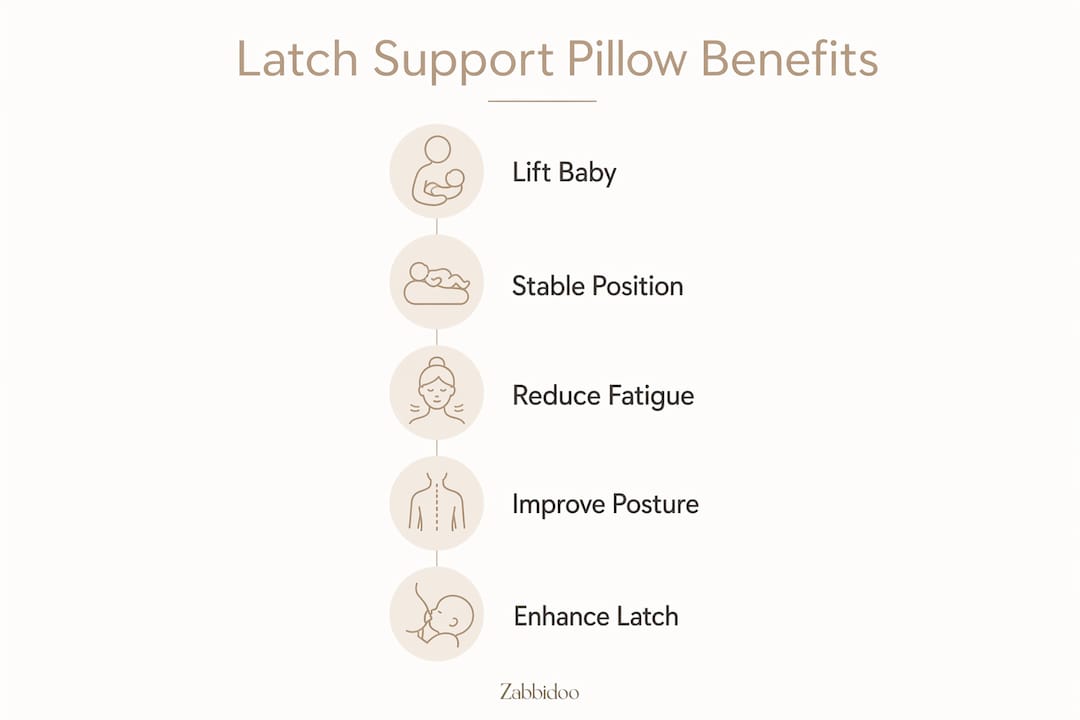
A latch support pillow works by lifting the baby to breast height, maintaining stable positioning, and reducing the maternal strain that causes poor latch and early feeding abandonment.
| Point | Details |
|---|---|
| Definition and purpose | A nursing pillow lifts the baby to breast height to support a deep, stable latch. |
| Firmness is non-negotiable | Soft pillows collapse under weight, causing position shifts that break the latch. |
| Posture drives latch quality | Upright maternal posture keeps the baby aligned and reduces neck, shoulder, and wrist strain. |
| Safety rule | Use nursing pillows for feeding only. Never leave a baby unattended on one. |
| Transitional use | There is no fixed end date. Mothers reduce pillow use naturally as technique and confidence grow. |
What I have learned from watching mothers use these pillows
I have spent a lot of time talking with new mothers about what actually helps in those early, exhausting weeks of breastfeeding. The nursing pillow comes up constantly, but so does the frustration when it does not deliver what they expected.
The most common pattern I see is this: a mother buys a pillow, places it loosely around her waist, and then wonders why she is still hunching. The pillow is not the problem. The setup is. A pillow that sits even a few centimetres away from the body creates a gap the baby sinks into, and the mother compensates by leaning forward. The pillow becomes decoration.
What I find genuinely useful is the shift in mindset from “the pillow holds the baby” to “the pillow holds the height.” That reframe changes how mothers set up, how they sit, and how they guide the latch. The arms stay active. The pillow does the lifting. That combination is what actually works.
I also want to say clearly: a pillow is a tool, not a test. Some mothers find them indispensable for months. Others use them for two weeks and never look back. Neither approach is wrong. What matters is that feeding is comfortable, the latch is effective, and the mother feels supported, literally and otherwise. If a pillow helps you get there, use it without guilt. If you outgrow it, let it go without ceremony.
— Marietjie
Zabbidoo’s nursing pillow: built for real latch support
Most nursing pillows are designed to look supportive. Zabbidoo’s nursing pillow is designed to stay supportive, feed after feed, week after week.

The Zabbidoo nursing pillow sits at 18cm high, which brings the baby to breast height without the mother needing to lean in. It uses high-density foam that resists compression, so it holds its shape under the baby’s weight throughout a full feed. The wraparound design sits flush against the body, eliminating the gap that causes babies to sink and mothers to hunch. It is covered in breathable French flax linen, which stays cool during long sessions. For mothers who want a nursing pillow that does what it promises, Zabbidoo is worth a close look.
FAQ
What is a latch support pillow used for?
A latch support pillow lifts the baby to breast height during feeding, reducing the maternal strain that causes poor latch and hunching. It supports the latch support process by keeping the baby stable and correctly positioned throughout the feed.
How does pillow firmness affect breastfeeding?
Firm pillows maintain consistent height under the baby’s weight. Soft pillows collapse, causing the baby to drop below breast level, which forces the mother to lean forward and breaks the latch.
Is a nursing pillow safe for my baby to sleep on?
No. Safety guidelines recommend using nursing pillows for feeding only. Never leave a baby unattended on a nursing pillow or use it as a sleep surface.
When should I stop using a latch support pillow?
There is no fixed end date. Lactation consultants confirm that comfort and confidence guide this decision. Many mothers naturally reduce pillow use as their technique and arm strength develop over the first few months.
Does a nursing pillow actually improve latch quality?
Positioning support significantly improves latch outcomes. Research shows that structured positioning guidance lifts LATCH scores above 8 in the vast majority of mothers, compared to a very small proportion before support was introduced.