

The ergonomics of breastfeeding is defined as the practice of positioning your body and your baby to protect your spine, shoulders, neck, and arms during every feed. Without this foundation, musculoskeletal pain in the neck, shoulders, and back becomes highly prevalent among breastfeeding mothers in the first six months postpartum. The good news is that most of this pain is preventable. Neutral spine alignment, firm support tools, and a few position changes are all it takes to feed comfortably and sustainably.
What is breastfeeding ergonomics and why does it matter?
Breastfeeding ergonomics is the application of body mechanics principles to nursing. The goal is simple: bring your baby to your breast, not your breast to your baby. When you hunch forward to meet a baby lying flat on your lap, your head shifts forward, your shoulders round, and your lower back curves. Repeat that posture eight to twelve times a day, and the physical cost adds up fast.
Healthcare authorities in 2026 consistently recommend neutral spine alignment and supportive aids as the foundation of safe nursing posture. Neutral spine means your ears sit directly above your shoulders, your shoulders sit above your hips, and your lower back holds its natural curve. That alignment keeps muscle load distributed evenly instead of concentrating stress on a few overworked areas.
The term “breastfeeding ergonomics” is not yet standard clinical vocabulary. Physiotherapists and lactation consultants more commonly refer to “ergonomic nursing technique” or “supported feeding posture.” Both phrases describe the same thing: a setup that protects your body while your baby feeds.
What common posture problems affect breastfeeding mothers?
The most documented issue is Head Forward Posture, or HFP. HFP develops when nursing postures involve forward head flexion and unsupported arms, causing the neck and shoulder muscles to work overtime. For every 2.5 centimetres your head moves forward of your shoulders, the effective load on your cervical spine roughly doubles. That is a significant mechanical burden across a single feed, let alone dozens per week.
The muscles most affected are the upper trapezius, levator scapulae, and deep neck flexors. These muscles are not designed for sustained, static loading. When they hold a forward head position for twenty to forty minutes at a stretch, they develop tension, trigger points, and eventually chronic pain.
Common posture problems include:
- Forward head posture from looking down at the baby without neck support
- Rounded shoulders from unsupported arms holding the baby’s weight
- Lumbar flexion from sitting on soft surfaces without lower back support
- Wrist strain from gripping or cradling the baby’s head for extended periods
- Pelvic tilt from feet dangling without a footrest, pulling the lower back out of alignment
Lack of ergonomic education contributes to pain and early breastfeeding cessation. That is the real cost of ignoring posture. Mothers who experience persistent pain are more likely to stop breastfeeding before they intended to, not because feeding itself failed, but because it hurt too much to continue.
Which breastfeeding positions support ergonomic nursing?
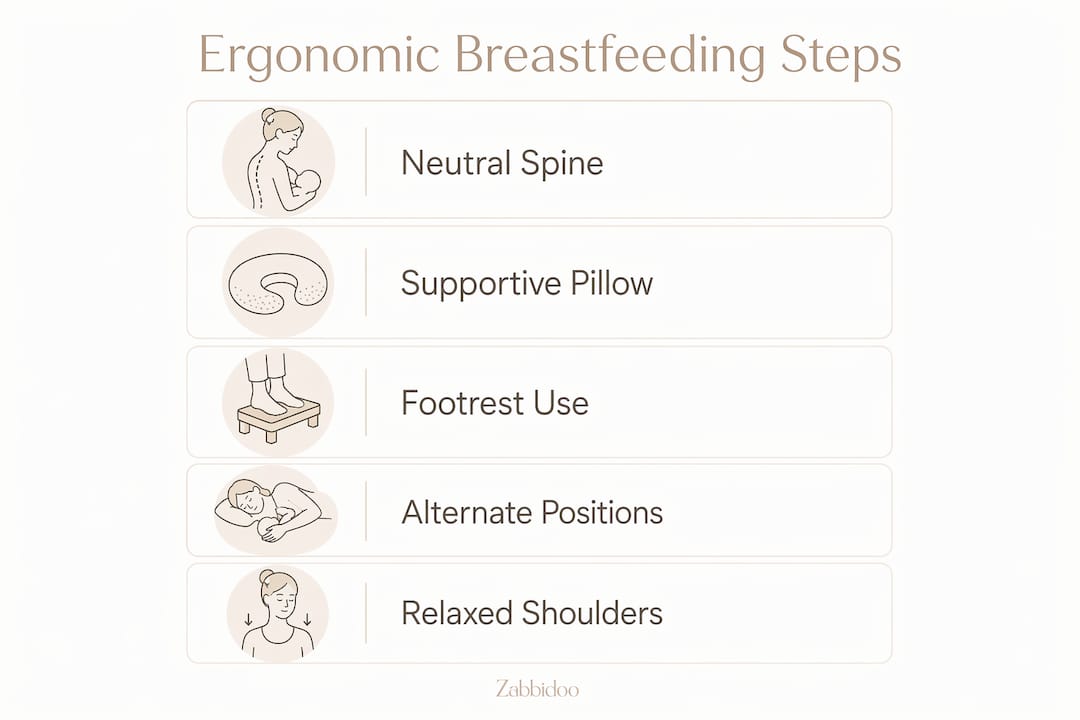
Alternating between cradle, cross-cradle, football, and side-lying positions distributes physical stress across different muscle groups and reduces the risk of chronic pain. No single hold is perfect for every feed. The best approach is to rotate through several positions across the day.
| Position | Ergonomic strengths | Watch out for |
|---|---|---|
| Cradle hold | Natural, intuitive for daytime feeds | Arms fatigue quickly without pillow support |
| Cross-cradle hold | Better head control for latch | Requires firm pillow to avoid forward lean |
| Football hold | Excellent for post-caesarean recovery | Needs armrest or pillow under elbow |
| Side-lying | Unloads spine completely, ideal for night feeds | Needs pillow between knees and behind back |
| Semi-reclined | Gravity assists latch, reduces neck strain | Requires a supportive chair or wedge |
The NHS breastfeeding positioning guide recommends keeping your baby’s body in a straight line, with their nose aligned to your nipple before the latch. This tummy-to-tummy alignment means your baby does not have to turn their head to feed, which also reduces the pulling force on your breast tissue.
The side-lying position deserves special mention for night feeds. It removes almost all spinal load by letting you lie flat, with your baby facing you at breast height. Placing a firm pillow between your knees maintains hip and pelvic alignment. A pillow behind your back stops you rolling backward mid-feed.
Pro Tip: Rotate through at least two different holds each day. International Board Certified Lactation Consultants recommend experimenting with multiple holds to prevent repetitive strain on the same muscle groups.
How can supportive tools improve your nursing setup?
The right tools do most of the ergonomic work for you. A firm, higher-loft nursing pillow brings your baby to breast height so you do not need to lean forward. Low-quality pillows compress under the baby’s weight within minutes. Once they flatten, you unconsciously hunch to compensate, and the postural damage begins.
Key tools for an ergonomic breastfeeding setup include:
- A firm nursing pillow with enough height to support your baby at breast level without you leaning down
- An armrest or chair arm at the right height to support your elbow and forearm, removing the load from your shoulder
- A footrest or sturdy box to raise your feet so your thighs are parallel to the floor and your pelvis stays neutral
- A lumbar cushion placed in the curve of your lower back when sitting upright
- Pillows behind your back and between your knees for side-lying feeds
Using a footrest prevents pelvic tilt and reduces lower back tension during feeds. This is one of the most overlooked adjustments. When your feet dangle, your pelvis tips backward, your lumbar curve flattens, and your lower back muscles strain to compensate. A simple step stool fixes this in seconds.
Pillow height matters more than most mothers realise. The Zabbidoo nursing pillow is designed at 18 centimetres of lift, which brings the baby up to the mother rather than pulling the mother down. That height difference is the gap between a comfortable feed and a painful one. You can read more about why pillow height matters and how it affects your posture across a full day of feeds.

Pro Tip: Before you sit down to feed, set up your chair, footrest, and pillow first. A 30-second setup saves you from 20 minutes of compensating for a poor position.
What ergonomic nursing techniques make breastfeeding sustainable?
Good technique is the layer that sits on top of good tools. Even with the best pillow and chair, poor habits will create pain over time. These steps build a sustainable feeding practice:
- Sit back, not forward. Press your back into the chair before the feed begins. Your spine should be supported from tailbone to shoulder blades before your baby latches.
- Bring the baby to you. Use your pillow to raise your baby to breast height. Your nipple should meet your baby’s nose without you tilting your head down to check.
- Keep your ears over your shoulders. This is the single most effective cue for correcting head forward posture. If you can feel tension in the back of your neck, your head has drifted forward.
- Support your arms fully. Your forearms should rest on the pillow or armrest. Your shoulders should feel relaxed, not raised or braced.
- Change position every few feeds. Rotating positions prevents myofascial trigger points and chronic muscle fatigue, even when you feel no pain in the current hold.
- Take micro-breaks between feeds. Roll your shoulders back, tuck your chin gently, and stretch your neck side to side. These small movements reset muscle tension before it accumulates.
- Relax your jaw and hands. Tension travels up the kinetic chain. A clenched jaw or gripping hand creates shoulder and neck tension that compounds over a feed.
Physical therapy experts emphasise keeping the head aligned over the shoulders and using props to reduce neck strain as the most effective correction for HFP. This is not complicated advice. It is simply a matter of building the habit before pain forces the change.
Relaxation also supports milk flow. Tension in the upper body can inhibit the let-down reflex. A mother who is physically comfortable is more likely to feed calmly and effectively, which benefits both her and her baby.
For a practical starting point, the ergonomic breastfeeding comfort guide from Zabbidoo covers neutral spine alignment and supported positions in detail.
Key takeaways
Good breastfeeding ergonomics requires bringing your baby to breast height with firm support, maintaining neutral spine alignment, and rotating positions regularly to prevent musculoskeletal strain.
| Point | Details |
|---|---|
| Neutral spine is the goal | Keep ears over shoulders and lower back supported throughout every feed. |
| Pillow height is critical | A firm, high-loft pillow prevents forward hunching by raising the baby to breast level. |
| Rotate your holds daily | Changing between cradle, football, and side-lying positions prevents repetitive strain injuries. |
| Footrests protect your lower back | Raising your feet keeps your pelvis neutral and reduces lumbar tension during feeds. |
| Pain is a signal, not a given | Most breastfeeding-related musculoskeletal pain is preventable with the right setup and technique. |
What I’ve learned about posture and breastfeeding comfort
Most mothers I speak with are surprised to learn that their neck and shoulder pain is not just “part of breastfeeding.” They assumed discomfort was unavoidable. It is not.
The single biggest mistake I see is mothers pulling their breast toward a baby lying flat on their lap. That one habit creates a cascade of problems: forward head, rounded shoulders, tight upper back, and wrist strain from supporting the baby’s weight with one hand. Fixing it is straightforward once you see it, but no one tells you to look.
What I find genuinely underappreciated is the role of the footrest. Mothers invest in pillows and chairs, but a $10 step stool under the feet changes the entire pelvic position. The lower back relaxes almost immediately. It is one of those changes that feels minor until you try it, and then you cannot imagine feeding without it.
The other thing I want to say clearly: you do not have to wait until something hurts to make an ergonomic change. Changing positions regularly prevents trigger points from forming in the first place. Prevention is always easier than recovery, especially in the early weeks when your body is already working hard.
Listen to your body. If a position feels strained after five minutes, it is strained. Adjust before the pain sets in, not after.
— Marietjie
Zabbidoo and ergonomic nursing comfort
Breastfeeding should not hurt. Zabbidoo was built around that belief.

The Zabbidoo nursing pillow sits at 18 centimetres of lift, which is the height most standard pillows never reach. That lift brings your baby to your breast without you leaning down, which is the core principle of ergonomic nursing. The pillow holds its shape under pressure, so the support you feel at the start of a feed is still there at the end. Made with French flax linen, it stays breathable across long feeds and through Australian summers. If you are setting up for comfortable, sustainable breastfeeding, the Zabbidoo nursing pillow is where to start.
FAQ
What is the ergonomics of breastfeeding?
The ergonomics of breastfeeding is the practice of positioning your body and your baby to protect your spine, shoulders, and arms during nursing. The core principle is bringing your baby up to breast height rather than leaning forward to meet them.
What causes back and neck pain during breastfeeding?
Head Forward Posture from looking down at the baby, unsupported arms, and sustained spinal flexion are the primary causes. These postures overload the upper trapezius and levator scapulae, leading to neck, shoulder, and back pain.
Which breastfeeding position is most ergonomic?
No single position is best for every feed. The side-lying position unloads the spine most completely, while the semi-reclined position reduces neck strain by using gravity to assist the latch. Rotating between holds is more effective than committing to one position.
How does a nursing pillow help with breastfeeding posture?
A firm, high-loft nursing pillow raises your baby to breast height, removing the need to hunch forward. Low-quality pillows collapse under the baby’s weight, which causes mothers to compensate with poor posture.
How often should I change breastfeeding positions?
Lactation consultants recommend changing holds across feeds throughout the day, even when you feel comfortable. Rotating positions prevents myofascial trigger points and chronic muscle fatigue from developing in the same muscle groups.