

Breastfeeding is one of the most natural things a mother can do, yet the physical toll it takes on your body is rarely talked about honestly. Many new and second-time mums expect feeding to feel peaceful and easy, only to find themselves hunched over, wrists aching, neck tightening, and back screaming after just a few sessions. The good news is that most of this pain is preventable. With the right setup, the right positions, and a few smart techniques, breastfeeding can genuinely feel comfortable for you and your baby from the very first week.
Table of Contents
- What do you need for comfortable breastfeeding?
- Find your ideal breastfeeding position
- Master the latch: Step-by-step for pain-free feeds
- Troubleshooting common breastfeeding challenges
- What most experts miss about breastfeeding ergonomics
- Take breastfeeding comfort to the next level
- Frequently asked questions
Key Takeaways
| Point | Details |
|---|---|
| Ergonomics matter | Proper positioning and support drastically reduce pain and exhaustion during breastfeeding. |
| Master the latch | A correct latch prevents nipple pain and ensures your baby feeds efficiently. |
| Vary your positions | Switching breastfeeding holds helps minimise muscle strain and supports comfort for you and baby. |
| Don’t tough it out alone | If pain persists, seek trained help from health professionals or lactation consultants early. |
What do you need for comfortable breastfeeding?
Setting up your space properly before your baby arrives is one of the smartest things you can do. Comfort is not an accident. It is built through deliberate choices about where you sit, what supports you, and what you have within reach.
The foundational tools for a comfortable breastfeeding setup include a high-quality nursing pillow, a supportive chair or armchair with good back support, a footstool to bring your knees up to hip level, wrist supports or a rolled towel for your arms, and a large water bottle within arm’s reach. Each of these plays a specific role. The footstool, for example, reduces the distance your arms have to travel to hold your baby, which directly lowers shoulder and neck strain.
Mayo Clinic breastfeeding positioning tips reinforce that good posture mechanics require you to bring baby belly-to-belly and avoid leaning forward so your neck, back, and shoulders do not bear excessive load. The problem with most mums is they instinctively lean down to their baby rather than bringing the baby up to them. A firm, height-appropriate nursing pillow solves this instantly.
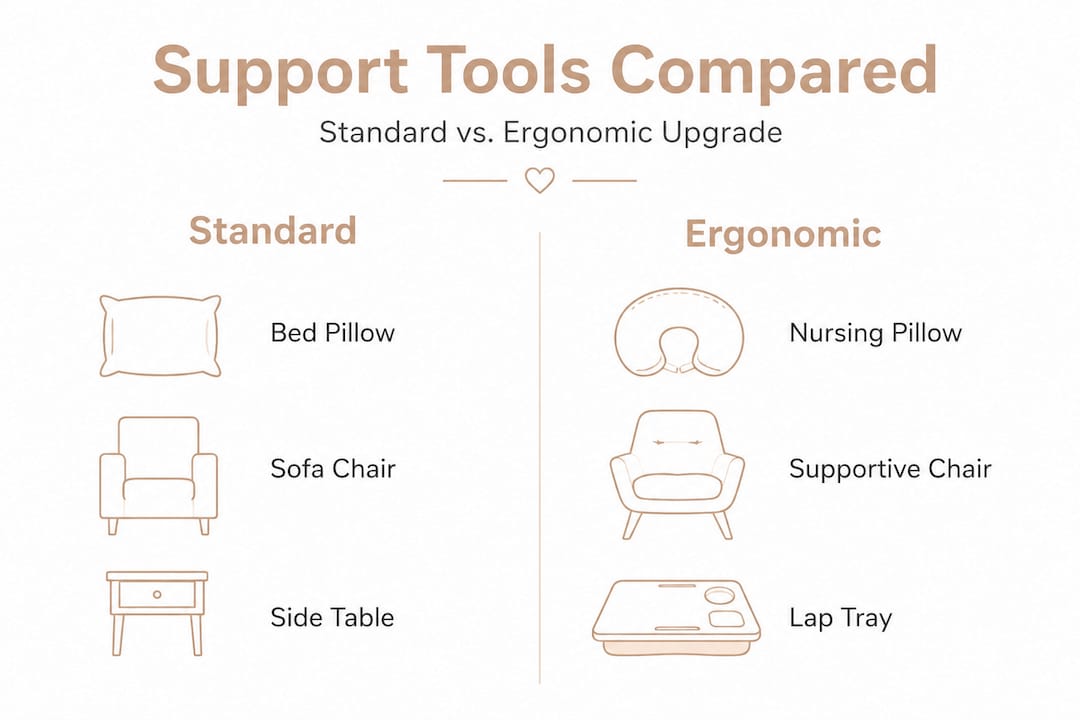
Here is a comparison of common support tools and how they measure up:
| Support tool | Standard option | Ergonomic upgrade | Key benefit |
|---|---|---|---|
| Nursing support | Regular bed pillow | Dedicated nursing pillow (18cm lift) | Brings baby to breast height |
| Seating | Soft couch | Chair with lumbar support | Maintains neutral spine |
| Arm support | No support | Armrest or rolled towel | Reduces shoulder fatigue |
| Foot support | Flat floor | Footstool | Reduces hip and lower back strain |
| Wrist support | None | Wrist brace or folded towel | Prevents carpal tunnel symptoms |
When setting up your nursing station, think of it like building a cockpit: everything you need should be reachable without twisting or stretching. Water, a snack, your phone, a muslin cloth, and nipple cream should all be within easy reach. This is especially important after a caesarean section, when reaching and twisting can cause real discomfort. For more ideas on how to structure your setup, feeding positions for newborns offer a good starting point before you arrive home from hospital.
Pro Tip: Set up two or three nursing stations around your home, including your bedroom, before your baby is born. Night feeds in the early weeks are relentless, and having your pillow, water, and phone already in place saves you precious energy at 3am.
Understanding more about breastfeeding discomfort solutions can also help you recognise early warning signs before minor aches become ongoing injuries.
Find your ideal breastfeeding position
With your equipment ready, the next step is mastering feeding positions that protect your body and enhance comfort. There is no single perfect position. Different holds work better at different times, depending on your birth recovery, your baby’s age, your breast size, and even the time of day.
Here is an overview of the most common holds:
| Position | Best for | Ergonomic note | Watch out for |
|---|---|---|---|
| Cradle hold | Newborns, general use | Needs good arm support | Wrist and elbow fatigue |
| Cross-cradle hold | Premature babies, latch issues | Better head control | More arm tension if unsupported |
| Football/clutch hold | C-section recovery, large breasts | Keeps baby off abdomen | Needs firm side support |
| Side-lying | Night feeds, post-surgery rest | Very low strain on body | Requires careful pillow setup |
| Laid-back (biological nurturing) | Early days, letdown issues | Uses gravity naturally | Less control for some mums |
Position rotation is a recognised comfort strategy, with structured guidance highlighting that different holds are useful in specific circumstances, particularly as your baby grows and your body recovers. Many mums find that what works in week one is not ideal by week six, simply because your baby’s weight and neck strength change significantly.
To set up any hold correctly, follow these steps:
- Sit tall with your back fully supported against the chair back. Do not perch on the edge.
- Place your nursing pillow across your lap, ensuring it is firm and at the right height to bring your baby level with your breast.
- Position your baby on their side, belly facing your belly, not angled upward.
- Support your baby’s neck and shoulders rather than the back of their head, which allows them to tilt back and open wide.
- Bring your baby to your breast using the pillow height, not by leaning your body forward.
- Check that your shoulders are relaxed and your wrists are neutral throughout the feed.
Ergonomic breastfeeding setups that target neutral, supported posture reduce static muscle loading, which is the sustained tension your muscles hold when you stay in one position for too long. A 20-minute feed with poor posture can leave you feeling like you have been at a desk for three hours.

Pro Tip: If you are recovering from a C-section, the football hold and side-lying position are your best friends for the first two to three weeks. Both keep pressure away from your abdomen while still allowing full control of your baby’s latch.
For practical guidance on getting your pillow positioned correctly, the nursing pillow setup guide walks you through it step by step. You might also find the overview of baby pillows for feeding useful when comparing your options.
Master the latch: Step-by-step for pain-free feeds
No matter the hold, comfortable breastfeeding requires a proper latch. A poor latch is the single most common cause of nipple pain, feeding frustration, and early weaning. Getting it right from the start makes an enormous difference.
The key alignment cues come from NHS positioning and attachment guidance: nose at nipple level, a wide open mouth, and chin touching the breast first. These three cues, applied consistently, dramatically reduce the chance of a shallow latch.
Here is the step-by-step process:
- Hold your baby so their nose is level with your nipple, not their mouth. This naturally encourages them to tilt their head back slightly.
- Wait for a wide, gaping open mouth. Do not rush this. Tickle their upper lip with your nipple if needed to encourage the reflex.
- Bring your baby to your breast swiftly once the mouth opens wide, leading with their chin, not the centre of their mouth.
- Check that their chin is firmly pressed into the breast and that you can see more of your areola above their top lip than below their bottom lip.
- Look for full, rounded cheeks during sucking and listen for a rhythmic swallow pattern, not clicking or smacking sounds.
- Feel for no pain beyond the first few seconds of initial latch. Sustained pain means the latch needs to be broken and re-attempted.
“Sore or cracked nipples are usually a sign baby is not positioned and attached properly.” The NHS guidance on sore nipples makes clear that nipple pain is a signal to seek help, not to push through.
Using a firm, stable nursing pillow during this process is more important than many people realise. When the pillow beneath your baby compresses or shifts during the latch attempt, you lose control of positioning, your baby dips slightly, and the latch becomes shallow. Multi-use nursing pillow benefits extend well beyond comfort; the stability a high-quality pillow provides directly supports a consistent, pain-free latch session after session.
Pro Tip: If latching is painful with every single feed, please reach out to a lactation consultant or your midwife within the first 48 hours of noticing the problem. Early intervention prevents cracked nipples, mastitis, and the kind of feeding aversion that can lead to early weaning.
Troubleshooting common breastfeeding challenges
Even with a good latch and solid support, challenges often arise. Knowing how to recognise and address them quickly makes the difference between a breastfeeding journey that lasts and one that ends earlier than planned.
Common ergonomic and technical problems include:
- Nipple pain and cracking: Almost always indicates a latch issue or poor positioning; correct before each feed rather than pushing through.
- Upper back and neck tension: Often caused by leaning forward or using a pillow that is too flat; raise your baby height to fix this.
- Wrist and forearm pain: Common in the early weeks; use wrist supports or adjust your arm position so you are not gripping or flexing continuously.
- Fatigue during feeds: Frequently a sign that your body is doing too much work to hold the position; your nursing pillow should do the heavy lifting.
- Blocked ducts or mastitis: Sometimes linked to sustained pressure on one area of the breast from poor positioning; vary your holds regularly.
- Pacifier interference: Early introduction can affect latch mechanics, so discuss timing with your midwife or lactation consultant.
One often-overlooked factor is the institutional environment around birth. The Baby-Friendly Hospital Initiative, backed by UNICEF and WHO, outlines Ten Steps for hospital care that include hands-on breastfeeding counselling, rooming-in, skin-to-skin contact, and the active removal of barriers that undermine breastfeeding. Hospitals that follow these steps produce measurably better breastfeeding outcomes at discharge.
Research into BFHI-aligned staff training shows that structured programmes lead to meaningful improvements in early initiation rates and exclusive breastfeeding at discharge. In practical terms, this means the quality of support you receive in those first 24 to 48 hours matters enormously for your confidence and technique.
Pro Tip: Do not hesitate to ask for hands-on help from hospital staff before you leave the ward. Watching a lactation consultant guide a latch in real time is worth more than any video or article. If the support you need is not offered, ask for it directly.
For ongoing challenges at home, revisiting causes and solutions for discomfort can help you pinpoint what is happening. If fatigue and strain are your main issues, the nursing pillow workflow article offers practical strategies for reducing physical effort across your daily feeds.
What most experts miss about breastfeeding ergonomics
Here is something that rarely gets said in mainstream breastfeeding advice: the obsession with finding the perfect position is actually holding many mums back. Most guides focus heavily on the baby, on latch mechanics and hold names and feeding cues. What gets far less attention is the mum’s body and the reality that even a textbook latch in a technically correct hold can cause real pain if you stay in that same position for weeks on end.
Mayo Clinic positioning guidance acknowledges that prolonged static posture causes pain even when latch is technically correct. This is the biomechanical reality of breastfeeding: your body was not designed to hold one position for 20 to 40 minutes, eight to twelve times a day. Rotation is not optional. It is maintenance.
The real shift in thinking is this: comfort is dynamic, not fixed. Your ideal setup at week one is not the same as week eight, and treating it as though it should be is a recipe for chronic strain. As your baby grows heavier, your pillow needs may change. As your milk supply regulates, your preferred hold may shift. Staying flexible and responsive to your body’s signals is not indecision. It is good practice.
Our perspective at Zabbidoo is that mother-first ergonomics is the missing piece in most breastfeeding conversations. When you prioritise your own comfort and body mechanics, the feed goes better for your baby too, because a relaxed, well-supported mum is far more able to guide a good latch than one who is tense and compensating for poor support. Looking into height-adjustable nursing pillows is one concrete way to start building this adaptive, mum-first approach into your daily routine.
Take breastfeeding comfort to the next level
Dynamic, mother-first comfort does not happen by accident. It is built with the right tools.

At Zabbidoo, we designed our nursing pillow specifically to address what standard pillows consistently get wrong: they compress under your baby’s weight, they sit too low, and they force you to hunch. Our pillow lifts your baby 18cm to bring them to breast height, maintains its shape under sustained pressure, and is crafted from breathable French flax linen so it stays comfortable across long feeding sessions. Whether you are exploring your nursing pillow setup options or ready to invest in a genuine ergonomic solution, Zabbidoo exists to make your breastfeeding journey easier, less painful, and genuinely sustainable. Visit zabbidoo.com to explore the full range.
Frequently asked questions
How do I know if my baby is latching correctly?
Look for a wide open mouth, chin firmly touching the breast, round cheeks during sucking, and no sustained pain. If feeds hurt consistently or your nipples look pinched or compressed after a feed, the latch likely needs correction.
What can help reduce pain while breastfeeding?
Proper positioning, a firm ergonomic nursing pillow, and early latch correction address the majority of breastfeeding pain. If pain persists beyond the first few seconds of each feed, seek support from a lactation consultant promptly rather than waiting it out. Good posture mechanics are foundational to reducing that pain at the source.
Why is my back sore after breastfeeding?
Back soreness almost always comes from leaning forward to reach your baby rather than bringing your baby up to you. Using a nursing pillow that holds its height under weight, sitting fully upright, and using a footstool to raise your knees will protect your back significantly. Avoiding forward lean is one of the simplest and most effective changes you can make.
Can hospital staff help with breastfeeding?
Absolutely. Staff trained under the Baby-Friendly Hospital Initiative are specifically equipped to provide hands-on guidance, latch support, and practical troubleshooting. Ask for help before you leave the ward, and do not feel awkward about requesting a second or third demonstration if you need it.