

Many new mums describe the early weeks of feeding as a guessing game played through exhaustion and sore arms. You try to hold your baby close, bend forward to get the angle right, and somehow still end up with a shallow latch and an unsettled bub. The good news is that breastfeeding discomfort is rarely permanent, and small adjustments to how you position yourself and your baby can completely change the experience. This article walks you through the foundational setup, the most effective holds, step-by-step guidance for each, and practical fixes for the challenges that come up most often.
Table of Contents
- Set up for breastfeeding success: positioning basics
- Comparing the top breastfeeding positions for newborns
- Step-by-step: how to master each breastfeeding position
- Troubleshooting: common breastfeeding position challenges and fixes
- Why finding your own comfort in breastfeeding positions matters most
- Recommended support for your breastfeeding journey
- Frequently asked questions
Key Takeaways
| Point | Details |
|---|---|
| Start with setup | Core positioning—close, aligned, and comfortable for you and baby—is the foundation for every hold. |
| Try several positions | Experiment with cross-cradle, laid-back, football hold, and side-lying to find your best fit at different times. |
| Listen to comfort cues | If you or your baby are uncomfortable or feeds are ineffective, make adjustments instead of persisting through pain. |
| Use support tools | Pillows and comfort products can dramatically improve your breastfeeding experience and prevent muscle strain. |
| Personalise your routine | There’s no one right way—combine professional guidance with what feels natural for you and your newborn. |
Set up for breastfeeding success: positioning basics
Before you even decide which hold to try, it helps to understand why positioning matters beyond simply “holding the baby.” The mechanics of a good latch depend almost entirely on how your baby’s body is aligned relative to yours, and how supported you both are before feeding begins.
Think of it this way: if you are leaning forward, straining your neck, and gripping your baby’s head tightly just to make contact with the nipple, your body is already working against you. Tense shoulders, a rounded back, and unsupported arms all make it harder for your baby to open wide, turn their head freely, and draw in enough breast tissue for a deep, effective latch.
The NHS positioning and attachment guidance outlines the fundamentals that make any position work: nose to nipple level, baby close and facing the breast, head and neck in a straight line, chin touching first, and relaxed shoulders and arms throughout the feed. These principles apply whether you are sitting upright, lying down, or reclining.
Here is what to get right before you start any hold:
- Support your own body first. Sit or recline in a position where your back is supported and your arms are not carrying your baby’s full weight without help.
- Bring baby to breast, not breast to baby. This is the single most common mistake. Leaning down causes the neck and back strain that so many mums report.
- Keep baby’s ears, shoulders, and hips in a straight line. A twisted body makes swallowing harder and limits how wide they can open their mouth.
- Watch baby’s chin, not their mouth. The chin should make first contact with the breast and press in firmly so the lower jaw draws in more tissue.
- Use a pillow or cushion under your arms. Carrying even a small baby for 20 to 40 minutes across multiple feeds a day adds up quickly in terms of shoulder and wrist strain.
“Comfort during feeding is not a luxury. It directly affects your ability to relax, let down milk, and sustain breastfeeding long-term.”
If you find that feeds are uncomfortable despite your best efforts, check positioning and attachment early and get support rather than persisting through pain. Early help from a midwife or lactation consultant makes a significant difference. For broader support for new mums navigating the early weeks, ergonomic setup is one of the most practical starting points.
Pro Tip: Set up your feeding station before your baby wakes. Have your pillow in place, water nearby, and your phone within reach. Being prepared means you settle into position calmly rather than scrambling while your baby is already distressed.
Comparing the top breastfeeding positions for newborns
Now that setup is clear, it is worth understanding what each main hold offers before you commit to learning the detailed steps. Every position has a different sweet spot, and knowing what suits your situation makes it much easier to choose.
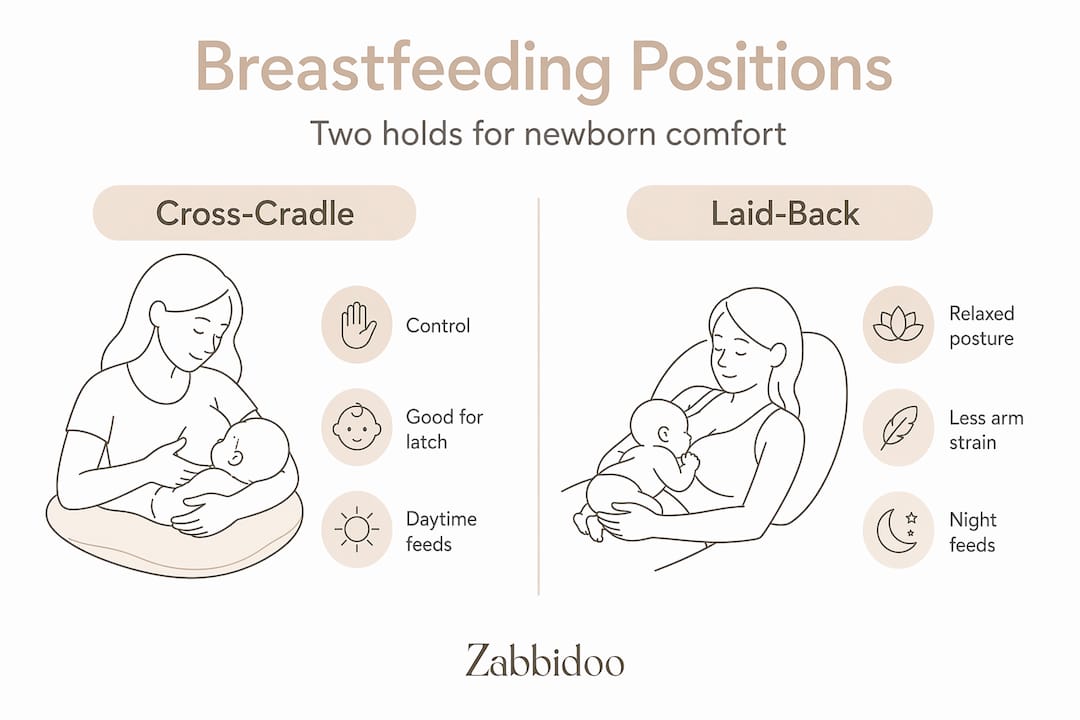
The cross-cradle hold is widely recommended for newborns because it gives you maximum control over your baby’s head, allowing you to guide them precisely to latch. The laid-back or reclined position, also described by Mayo Clinic, works particularly well for feeding positions for newborns because it uses gravity and your baby’s instincts rather than relying on precise positioning by the parent.

Here is how the main positions compare:
| Position | Best for | Comfort level | Control | Suited to night feeds |
|---|---|---|---|---|
| Cross-cradle | Newborns, latch issues | Moderate | High | No |
| Laid-back / biological nurturing | All newborns, smaller breast size | High | Moderate | Sometimes |
| Football hold | After caesarean, twins, large breasts | Moderate | High | No |
| Side-lying | Night feeds, recovery, tired mums | Very high | Low | Yes |
According to La Leche League Canada, the side-lying position is one of the most restful options available, allowing both parent and baby to remain horizontal during feeds, which is a significant advantage in the early weeks of sleep deprivation.
Practical guidance for choosing:
- Start with cross-cradle if your baby is struggling to latch or you want more precision during the first week or two.
- Try laid-back if you have a fast let-down or your baby seems overwhelmed by milk flow, as gravity helps slow things down.
- Use football hold if you had a caesarean and want to keep weight away from your abdominal incision.
- Switch to side-lying for overnight feeds once you and your baby have a confident latch established.
Pro Tip: There is no rule that says you must stick to one position. Many mums use cross-cradle during the day for control and side-lying at night for rest. Let your circumstances guide you.
Step-by-step: how to master each breastfeeding position
With a clear picture of the options, here is how to actually do each position with proper mechanics.
Cross-cradle hold
- Sit upright with back supported and a firm pillow under the arm opposite to the breast you are feeding from.
- Hold your baby with the opposite arm, supporting their head in the palm of your hand and their body along your forearm.
- Align their nose with your nipple, not their mouth. Wait for a wide gape before bringing them in.
- Guide their chin to make first contact, then draw them in firmly so the lower jaw takes in a generous amount of breast tissue below the nipple.
- Signs you have it right: rhythmic sucking and swallowing, no nipple pain, baby’s chin pressed to breast, and cheeks rounded rather than drawn in.
Laid-back or biological nurturing
The University Hospitals Sussex NHS Foundation Trust notes that this position uses a baby’s natural reflexes to latch, with evidence suggesting improved feeding effectiveness, particularly in the newborn period. The approach is gentler on both mum and baby.
- Recline comfortably at roughly 45 degrees with your head and shoulders well supported.
- Place your baby tummy-down on your chest, with their head near your breast and body aligned down your front.
- Allow them to bob, root, and self-attach. You do not need to actively guide them in many cases.
- Use your hands to support their bottom or steady their body rather than controlling their head.
- Stay relaxed. Your body warmth and scent help your baby find the nipple independently.
Football hold
- Position yourself sitting upright, with a firm pillow along your side at waist level.
- Hold your baby tucked under your arm like a rugby ball, facing upward, with their legs extending behind you.
- Support their head at the level of your breast with your hand and fingers spread behind their ears.
- Guide nose to nipple, wait for a wide gape, then bring baby in firmly as with other holds.
- This position keeps baby off your abdomen and gives excellent visibility of the latch.
Side-lying
- Lie on your side with a pillow supporting your head and one between your knees for hip alignment.
- Place your baby facing you on the mattress, their mouth level with your lower breast.
- Draw them in close, ensuring their body is fully facing yours and not twisted.
- Offer the breast by supporting it from underneath if needed.
“A 2022 EMG study found that neck muscle load did not differ significantly across cradle, cross-cradle, and football holds when posture was corrected and supported, confirming that how you hold yourself matters as much as which hold you choose.”
Using a baby feeding checklist can help you confirm you have got the fundamentals right for each session. For additional practical breastfeeding tips around comfort and confidence, small details like arm support and pillow height consistently make the biggest difference.
Pro Tip: After you achieve a good latch, try to release any tension in your jaw and shoulders. Mums often hold significant tension in their upper body during feeds, which contributes to fatigue and soreness over time.
Troubleshooting: common breastfeeding position challenges and fixes
Even with the best technique, challenges arise. Here is how to identify and address the most frequent positioning problems.
| Problem | Likely cause | Fix |
|---|---|---|
| Nipple pain during feed | Shallow latch, baby not centred | Detach gently, reposition nose to nipple, re-latch |
| Baby pulling away repeatedly | Fast let-down, awkward angle | Try laid-back position to use gravity to slow flow |
| Neck or shoulder soreness | Leaning forward, unsupported arms | Raise pillow height, bring baby up to breast level |
| Baby falling asleep quickly without deep swallows | Shallow attachment, low milk transfer | Check chin contact, try tickling foot to keep baby alert |
| Clicking sound during feed | Poor seal, tongue placement | Check latch depth, consult lactation consultant |
The NHS guidance on early feeding notes that when babies seem to fall asleep before reaching deep, rhythmic swallowing, it is often a signal to check latch depth and attachment rather than assuming the baby is simply tired.
Common signals that you need to revisit your positioning:
- Nipples appear pinched, creased, or flattened after feeds
- Your baby takes a very long time to settle or seems unsatisfied
- You feel a sharp or burning pain throughout the feed rather than just at the initial latch
- You notice a clicking or smacking sound during feeding
“Pain in breastfeeding is not something to push through. It is your body signalling that something in the attachment or positioning needs adjusting.”
If any of these problems persist beyond a few days of trying adjustments, reach out to a midwife, child health nurse, or lactation consultant. For more targeted advice on what might be going wrong, breastfeeding discomfort causes and solutions can help you identify the source of the problem before your next appointment.
Why finding your own comfort in breastfeeding positions matters most
Here is something that most guides do not say clearly enough: the “correct” breastfeeding position is the one where your baby feeds well and you finish the session without wincing.
Expert recommendations exist for good reason. The mechanics behind nose-to-nipple alignment, chin contact, and head-neck support are backed by solid evidence. But when a guide presents the cross-cradle hold as definitively superior, or insists that biological nurturing is the only natural option, it often creates unnecessary pressure for mums who find that neither feels intuitive.
The reality is that most experienced mums end up with a blended approach. They use the cross-cradle steps to get a confident latch in the early weeks, then relax into something closer to a standard cradle hold as their baby grows. They side-lie at 3am because it keeps everyone calm, then switch back to upright during the day feed when they want full visibility and control.
What actually makes positions work is not the precise hold itself but the consistent application of the core mechanics: good alignment, baby at breast level, chin leading, and a mum whose body is relaxed and supported. When you get those fundamentals right, nearly any variation of the main holds works well.
A nursing pillow that holds its shape across hours of feeding can resolve a surprising number of stubborn positioning problems. If your current pillow flattens out mid-feed, you start compensating with your posture without realising it. That is when the neck and wrist strain creeps in. The right support pillows for nursing comfort act as a reliable foundation, not just a comfort afterthought.
Trust your instincts. The books and guides are starting points. Your daily experience with your specific baby is the real teacher.
Recommended support for your breastfeeding journey
Getting the position right is only part of the picture. Having the right support under your arms and beneath your baby makes every hold more sustainable, especially across multiple feeds a day in those intense early weeks.

The Zabbidoo nursing pillow is designed with an 18cm lift that brings your baby up to breast level without you having to hunch forward. Unlike standard pillows that compress under weight and lose their shape by the third feed of the day, Zabbidoo holds firm across every session. It works across all the main holds, including cross-cradle, football, and laid-back positions, and doubles as a tummy time support as your baby grows. Pair it with the free pacifier clip chain to keep settling tools within easy reach between feeds.
Frequently asked questions
How can I tell if my baby is latching correctly in any position?
Look for a wide-open mouth, chin pressed to the breast, rhythmic sucking and swallowing, and an absence of nipple pain during the feed. The NHS positioning guidance outlines these as the key indicators of a correct latch regardless of which hold you are using.
Which breastfeeding position is least likely to cause neck or shoulder pain?
A laid-back or reclined position distributes your baby’s weight across your body and encourages you to relax naturally, minimising strain on the neck and shoulders. Biological nurturing positions use gravity to do much of the work so your muscles do not have to.
Is it normal to switch positions during a feed or between feeds?
Yes, it is completely normal and often beneficial to change positions, as different holds suit different times of day, your baby’s mood, and your own energy levels. The NHS attachment guidance encourages adapting holds for comfort rather than rigidly sticking to one approach.
When should I seek help with breastfeeding positions?
If you experience persistent soreness, your baby is unsettled or not gaining weight well, or feeds feel consistently uncomfortable, contact a lactation consultant or midwife as soon as possible. The NHS first few days guidance is clear that early help with positioning and attachment prevents longer-term difficulties.
Are there positions that work better after a caesarean or during night feeds?
Side-lying is ideal for both situations, allowing you to rest while keeping your baby close and feeding effectively. La Leche League Canada describes it as one of the most restorative positions for post-birth recovery and overnight nursing sessions.