

Yes, a purpose-built bottle feeding pillow makes feeding noticeably more comfortable, but only when it’s used under active adult supervision. The feature that matters most is height, sometimes called lift: a pillow that raises your baby closer to your chest stops you hunching forward for twenty minutes at a stretch. Pair that with compression resistance, meaning the fill doesn’t flatten under your baby’s weight, and you’ve covered the two things that separate a genuinely supportive pillow from a glorified cushion.
TL;DR:
- A proper bottle feeding pillow must have an at least 18cm lift height to reduce neck strain and improve feeding posture for both parent and baby.
- The fill should resist compression to maintain support over time, and the pillow should have a stable base with a non-slip cover for safety during use.
- Adjustability for height and firmness helps accommodate baby growth and different seating arrangements, especially for parents recovering from surgery.
- Regular cleaning involves washing the cover at recommended temperatures and spot-treating the inner fill to ensure hygiene and extend pillow lifespan.
- Brands that clearly specify lift height, fill type, and durability are more reliable, with Zabbidoo exemplifying these standards through transparency and quality materials.
Table of Contents
- Why use a bottle feeding pillow for comfort and safety?
- What features should you check before buying?
- How do you set up and use a bottle feeding pillow safely?
- How do you clean and maintain a feeding pillow?
- Why Zabbidoo’s nursing pillow meets the ergonomic checklist
- What design variations should you know about?
- What size and portability options exist for feeding pillows?
- How does a bottle feeding pillow compare to other support aids?
- What age or weight suits different feeding pillows?
- Which brands are known for quality and safety?
- A few frequent-feeding truths nobody tells new parents
- Recommended pick: the Zabbidoo nursing pillow
- Sources
Why use a bottle feeding pillow for comfort and safety?
Feeding a newborn eight to ten times a day adds up to hours of holding weight in one position. A well-designed feeding pillow takes that load off your forearms and brings your baby up to chest height instead of you dropping your shoulders down to theirs. That single adjustment is what physiotherapists mean when they talk about posture correction for parents with back pain: the strain isn’t from one feed, it’s from the same bad angle repeated hundreds of times a week.
The right height also changes the feeding angle for your baby, keeping the bottle and airway aligned instead of forcing a chin-tuck or a stretched neck.
A few situations make a good pillow more than a nice-to-have:
- Recovering from a caesarean, where anything pressing on the abdomen is genuinely painful
- Feeding twins, where you need both arms doing something useful at once
- Limited grip strength or mobility, where holding a bottle steady for 20 minutes is its own challenge
None of that changes the non-negotiable rule: these pillows support supervised feeding, not sleep, and a baby should never be left propped and unattended, even for a minute.
What features should you check before buying?
Not every pillow marketed for bottle feeding delivers on comfort. Before you buy, run the numbers on these five things:
- Lift height — look for a stated measurement in centimetres, not a vague “raised design.” Zabbidoo’s pillow documents an 18cm lift, which is enough to bring most newborns to chest height without you leaning down.
- Compression resistance — the fill needs to hold its shape under repeated pressure, not flatten after a fortnight.
- Stability — check the base shape and whether the cover material has enough grip to stop the pillow sliding off your lap mid-feed.
- Cover fabric — removable, machine-washable covers in breathable fabric handle the inevitable spit-up without fuss.
- Adjustability — some pillows let you tweak the filling to change firmness or height slightly as your baby grows.
Pro Tip: Before buying, do the press test: push your palm into the centre of the pillow and hold for a few seconds. If it springs back without a lasting dent, the compression resistance is doing its job. If it’s still sagging when you check ten seconds later, keep looking.
How do you set up and use a bottle feeding pillow safely?
Getting the setup right takes less than a minute, and it’s worth doing the same way every time so it becomes automatic.
- Position the pillow at your waist, not your lap edge, so your baby sits high enough that you’re not craning your neck to see their face.
- Check the height brings baby to your mouth level, roughly, not the other way around. If you’re still bending forward, the pillow isn’t doing its job.
- Support the head and chin with your hand while resting the arm on the pillow, keeping the bottle at a slight incline so your baby controls the pace rather than gulping.
- Never walk away. These pillows are feeding aids, not minders. If the phone rings, take your baby with you.
- Skip the car. A feeding pillow has no place in a moving vehicle, regardless of how tempting it looks for a road trip feed.
For twins, a symmetrical pillow with two supported positions lets you feed both babies at once, but it demands more attention, not less. One set of eyes has to watch two faces, so this setup works best with a second adult nearby if either baby needs quick adjusting. Independent guidance is consistent on this point: nursing pillows adapted for bottle feeding are safe under supervision only, never as an unattended prop.
How do you clean and maintain a feeding pillow?
A pillow that’s washed properly lasts years; one that isn’t turns into a hygiene problem within months, given how often bottle feeding involves spills.
- Remove the cover and wash on the temperature the label specifies, usually a warm rather than hot cycle to protect the fibres.
- Tumble dry on low or air dry fully before refitting, since a damp cover trapped against the fill invites mould.
- Spot clean the inner fill if it gets damp, and check seams for fraying before every use.
- If the pillow has adjustable filling, topping it up can restore lost height and firmness rather than replacing the whole thing.
- Once the fill stays compressed after cleaning, or the cover no longer fits snugly, it’s time to retire the pillow.
Why Zabbidoo’s nursing pillow meets the ergonomic checklist
Zabbidoo built its nursing pillow around the exact checklist above, rather than treating comfort as an afterthought. The 18cm lift brings your baby to you instead of you folding forward to reach them, which matters most in the early weeks when every feed session runs long.
The difference between an average pillow and a supportive one comes down to what happens after the first ten minutes of a feed. Fill that holds its shape and a base that doesn’t slide mean you’re not fighting the pillow on top of managing a hungry baby.
The fill resists compression under sustained weight, and the stability-focused base cuts down how often you need to reposition mid-feed. The cover is French flax linen, chosen for being breathable and durable enough to handle frequent washing without losing its softness. Components are machine-washable, which matters given how often spills happen in the first few months.
What design variations should you know about?
Not every feeding pillow follows the same shape, and the differences aren’t cosmetic. C-shaped pillows wrap around your waist and suit most bottle-feeding setups, giving support on both sides regardless of which arm you favour. U-shaped or full-wrap designs add support behind the back too, which some parents find useful for long feeds on a couch without armrests.
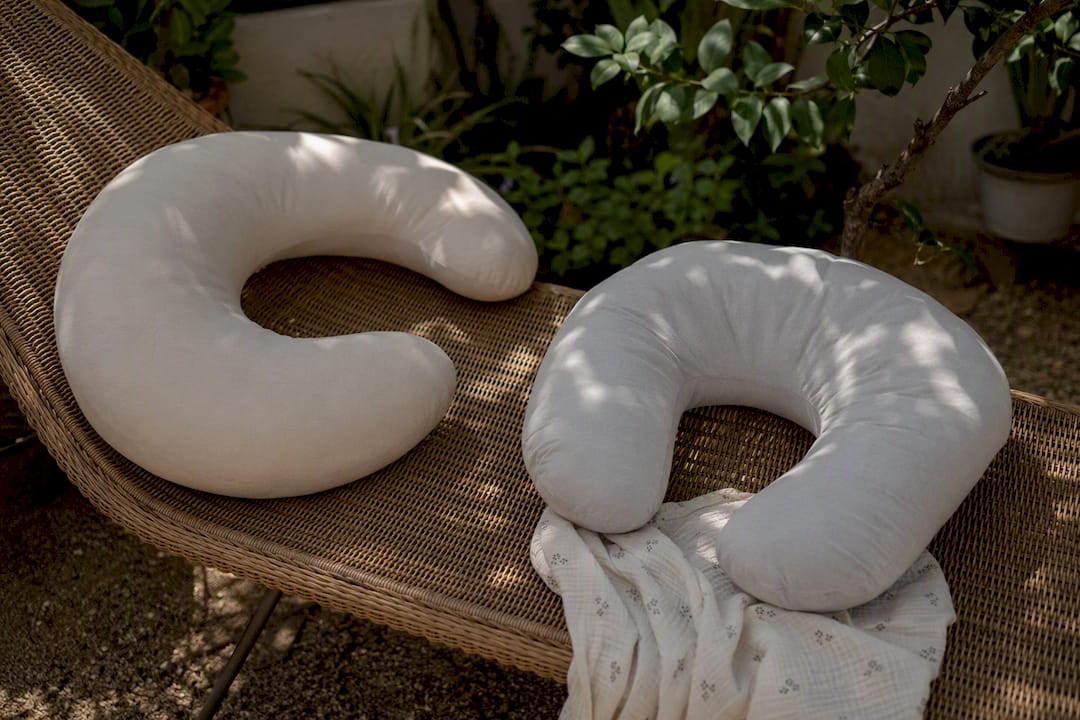
Firmness varies by design intent as much as by fill type. A firmer pillow suits early newborn feeding, where head control is minimal and stability matters more than plush comfort. A slightly softer, more contoured pillow can suit an older baby who’s started to wriggle and push against the support.
Height adjustability is the variation worth paying most attention to. Some pillows come with a fixed lift; others let you add or remove filling to fine-tune the height as your baby grows or as your own seated position changes, whether that’s a dining chair, a recliner, or a hospital bed after delivery. For a parent recovering from a caesarean, that adjustability can mean the difference between comfortable feeding and pillow that presses awkwardly on a healing abdomen.
For the caregiver, the ergonomic payoff isn’t just about the arms. A pillow angled correctly reduces the tendency to round the shoulders and drop the chin, a posture that, held for hours a day, contributes to the kind of chronic neck and upper back tension many new parents report in the first few months.
What size and portability options exist for feeding pillows?
Feeding pillows range from full-size, wraparound designs meant to stay on a nursing chair at home, to compact, travel-friendly versions that fold or roll for a nappy bag. The trade-off is straightforward: bigger pillows generally offer more surface area and stability, while compact ones sacrifice some support for the convenience of fitting in a car boot or a suitcase.
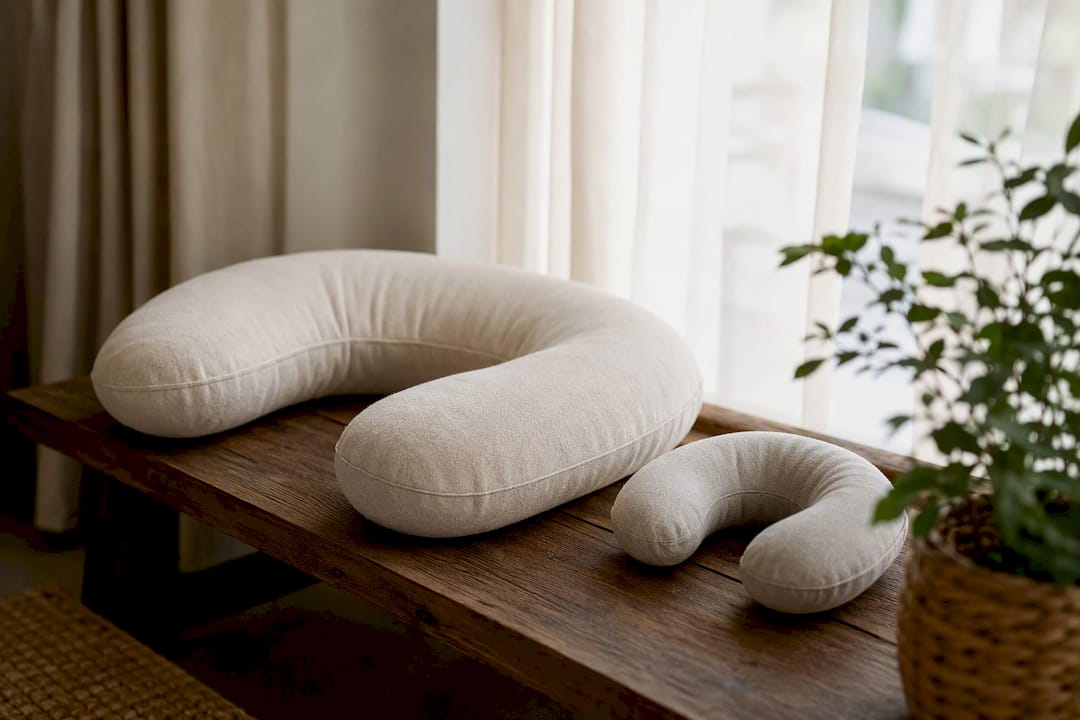
If you’re feeding primarily at home, a full-size pillow with a firm base is worth the extra space it takes up. If you’re often out, at a relative’s house, in the car between errands, or travelling, a smaller, lighter pillow that still holds its shape matters more than one with maximum surface coverage.
Some pillows include a carry handle or a built-in pocket for a muslin cloth, dummy, or spare bib, small additions that matter more than they sound once you’re juggling a baby, a bag, and a bottle at the same time. Weight is also worth checking. A pillow that feels light empty can feel bulky once you’re carrying it alongside a nappy bag and a capsule, so don’t judge portability from the product photo alone.
How does a bottle feeding pillow compare to other support aids?
A regular bed pillow can technically prop a baby up for a bottle, but it wasn’t built for the job, and it shows. Standard pillows compress unevenly, slide out of position, and offer no consistent height, meaning you end up adjusting constantly through a feed rather than settling in.
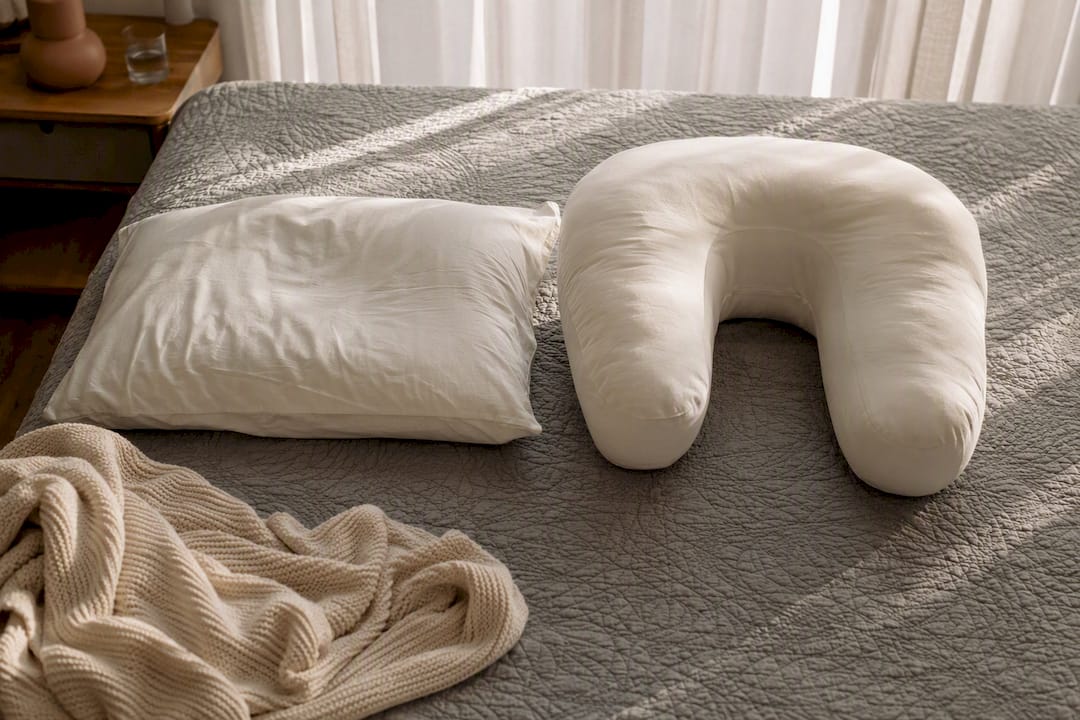
A nursing pillow designed originally for breastfeeding can double for bottle feeding reasonably well, since both tasks need the same basic thing: a stable, elevated surface that brings baby to chest height. The main difference is shape. Breastfeeding pillows are often curved to wrap around the waist for latch positioning, while pillows designed with bottle feeding specifically in mind tend to prioritise a flatter, more even surface and a firmer, more compression-resistant fill, since there’s no need to accommodate a specific latch angle.
A purpose-built bottle feeding pillow sits between the two, keeping the ergonomic benefits of a nursing pillow while optimising for the flatter positioning bottle feeding needs. If you’re only ever going to bottle feed, that focus is worth paying for. If you’re combination feeding, a well-made nursing pillow that also works for bottles, like Zabbidoo’s, covers both jobs without needing two separate products.
What age or weight suits different feeding pillows?
Most feeding pillows work from birth, provided the design supports a newborn’s lack of head control with adequate side support and a stable, non-tipping base. This is where firmness earns its keep: a soft, sinking pillow doesn’t give a two-week-old baby’s head enough resistance to rest against safely, even with your hand supporting their chin.
As babies grow and develop stronger neck control, usually somewhere around three to four months, the requirements loosen slightly, and some hands-free bottle support cushions on the market specify a minimum age around this point precisely because they rely less on active parental hand support. That’s a different category to the pillows discussed throughout this article, which are designed for active, supervised feeding where your hands remain on your baby the entire time.
There’s no strict weight ceiling for a well-made feeding pillow, since it’s supporting your arm and your baby’s position rather than bearing their full body weight the way a bassinet mattress does. Practically, most parents find a feeding pillow most useful from birth through to around six to eight months, after which many babies prefer sitting up for bottles anyway.
Which brands are known for quality and safety?
Quality in this category comes down to three things: a stated lift measurement, a fill that holds its shape, and a cover that survives repeated washing without pilling or losing shape. Brands that publish these specifications clearly, rather than relying on vague marketing language like “ergonomic design,” are generally the ones worth trusting with something your baby rests against for twenty minutes several times a day.
Zabbidoo built its reputation on exactly that transparency, listing its 18cm lift and compression-resistant fill as core specifications rather than an afterthought, alongside a French flax linen cover chosen for breathability over cheaper synthetic alternatives. Independent safety guidance from sources like Pillows.com.au reinforces the same standard across the category: supervised use, a stable base, and no exceptions for sleep. When you’re comparing options, treat the absence of a stated lift measurement or fill type as a red flag rather than a minor omission.
A few frequent-feeding truths nobody tells new parents
The posture hack that actually saves time isn’t a fancy technique, it’s simply setting the pillow at the same height and position every single feed, so your body doesn’t have to relearn the angle each time. Do it enough times and it becomes automatic, the way buckling a car seat eventually does.
If I had to pick the one feature that consistently makes the biggest difference to comfort, it’s lift height, not softness. A soft pillow that sits too low still has you leaning forward, and that’s the posture doing the damage over weeks of feeding, not the firmness of the fill.
If you’ve read this far because you’re actually shopping, the nursing pillow page has the full specifications laid out.
— Marietjie
Recommended pick: the Zabbidoo nursing pillow
If you’ve been ticking off the checklist as you read, height, compression resistance, a stable base, a washable cover, Zabbidoo’s nursing pillow was built to match every point on it rather than one or two.

It’s got the 18cm lift that stops the hunch-and-lean cycle, a compression-resistant fill that doesn’t flatten out after a few weeks of daily use, a stability-focused base that cuts down on mid-feed repositioning, and a French flax linen cover you can wash without watching it wear out. It suits new parents managing frequent feeds, anyone recovering from a caesarean who needs to avoid pressure on the abdomen, and parents feeding twins who need two stable, supported positions rather than one.
If you’re ordering, the gift wrapping option is worth adding for a baby shower present, and shipping protection covers you if a parcel goes missing in transit. Head to the product page, check the sizing details against your own setup, and place your order when you’re ready.