

Bring your baby up to breast or bottle level, not the other way around. That’s the whole trick. A firm, height elevated nursing pillow paired with a supportive chair stops the forward hunch that wrecks your neck, shoulders and lower back during those long early weeks of feeding.
Before you read another word, here’s what you need in the room:
- A chair with proper lumbar support and armrests set at elbow height
- A nursing pillow with enough lift to bring baby to nipple level
- A footstool or ottoman to keep your feet flat and knees slightly raised
- A small side table or organiser within arm’s reach
- Soft, adjustable lighting and a phone holder or stand
- Burp cloths, a water bottle and a snack close by
The science backs this up. A randomised controlled trial comparing mothers who used a breastfeeding pillow against a control group found a statistically significant drop in reported discomfort. That’s not marketing spin. It’s a measured outcome across 70 mothers using a standard discomfort scale.
Key Takeaways
A firm, height-elevated nursing pillow paired with proper chair and foot support is the single most effective change for reducing feeding related strain.
| Point | Details |
|---|---|
| Bring baby up, not you down | Adjust pillow height so baby reaches nipple or bottle level without hunching forward. |
| Support the whole body | Combine armrests at elbow height, lumbar support and a footstool for full spinal alignment. |
| Firm beats soft | A stable, compression-resistant pillow reduces repositioning and lowers airway restriction risk. |
| Never leave baby unsupervised on a pillow | Nursing pillows are feeding tools, not sleep surfaces or loungers. |
| Zabbidoo pillow matches the setup | Its 18cm lift, compression resistance and washable French flax linen cover are built around this exact ergonomic approach. |
Table of Contents
- Feeding station setup: the essential components and why each one matters
- How do you position baby for each feeding hold?
- What safety mistakes should you avoid with nursing pillows?
- Feeding station maintenance tips for the long haul
- A few honest words on trial and error
- Where the Zabbidoo nursing pillow fits into your setup
- Frequently asked questions about feeding station setup
- Sources
Feeding station setup: the essential components and why each one matters
Every piece of your feeding station setup earns its place by solving a specific ergonomic problem. Skip one and your body compensates somewhere else, usually your neck or wrists.
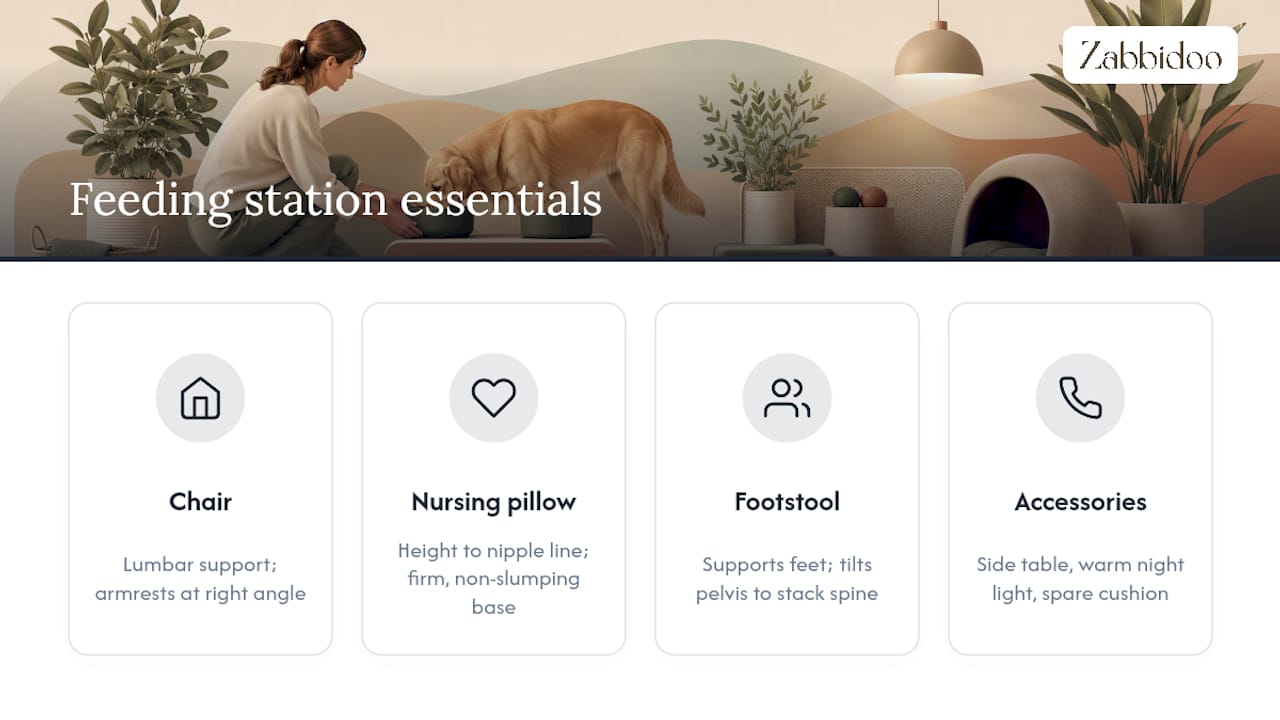
The chair is your foundation. Look for lumbar support that fills the small of your back and armrests positioned so your elbows rest at roughly a right angle. If the armrests sit too low, your shoulders creep up toward your ears within minutes, a posture pattern physiotherapists link directly to tension headaches and upper back pain in new mums, as pelvic health practitioners note.
The nursing pillow does the heavy lifting, literally. It needs enough height to bring baby up to your nipple line, firmness that doesn’t compress flat under weight, and a stable base so it doesn’t slide as baby wriggles. A cover in breathable, washable fabric like French flax linen matters more than it sounds. Night feeds get sweaty, and a cover you can strip off and wash saves you from a stiff, unhygienic pillow by week three.
The footstool finishes the chain. Supported feet keep your pelvis tilted correctly, which keeps your spine stacked instead of curved forward.
Round it out with a side table for your phone and water, warm but not harsh lighting for night feeds, and a spare cushion tucked beside you for propping your own back during side-lying feeds.
No pillow on hand tonight? Stack a firm cushion, fold a thick blanket underneath for height, and wedge a rolled towel against your side for stability until you sort out something purpose built.
Pro Tip: Test your setup before baby arrives by sitting in it for ten minutes with a bag of rice or a doll roughly baby’s weight. If your shoulders are up near your ears by minute five, adjust something now rather than during a 3am feed.
How do you position baby for each feeding hold?
Get the parent right first, then the baby. Sit with your back against the lumbar support, feet flat on the footstool, and both arms resting on the pillow rather than floating in the air.
- Set your base. Shoulders down and relaxed, not hunched toward your ears.
- Bring baby up, not you down. Adjust the pillow height so baby’s mouth reaches your nipple without you leaning forward. NHS guidance puts it simply: baby’s nose should sit level with your nipple, chin touching the breast.
- Check the kiss test. If baby’s face is close enough that you could lean down and kiss their forehead without craning, you’re in the right spot, a rule Raisingchildren uses as a quick positioning check.
- Adjust per hold. In cradle and cross-cradle, the pillow sits square across your lap. For football or underarm hold, often recommended after a caesarean or with twins, tuck baby beside you rather than across, with the pillow supporting your forearm on that side. Side-lying feeds need the extra cushion behind your own back, not just under baby.
For bottle feeds, keep your wrist neutral rather than bent, and rest your forearm fully on the pillow so your hand isn’t bearing the bottle’s weight alone. Swap arms partway through the feed to spread the load evenly, and tilt the bottle just enough to keep the teat filled with milk, steep angles make baby gulp air and unsettle faster.
If you notice yourself hunching, the pillow’s probably sitting too low, raise it or raise the chair seat instead. If latch feels shallow or shows signs of discomfort, lower baby slightly and realign chin to breast before trying again.

What safety mistakes should you avoid with nursing pillows?
A nursing pillow is a feeding tool, not a sleep surface. Consumer Reports is blunt about this: never use one as a lounger, and never leave baby propped in it unsupervised, even for a moment.
Height matters too, and there’s a real Goldilocks zone. Too little lift and you’re hunching again. Too much, and baby’s chin can tuck toward their chest instead of resting naturally against the breast, which can restrict the airway on a soft, collapsing pillow. This is exactly why firmness and stability count as safety features, not just comfort ones. A pillow that holds its shape under pressure keeps baby’s alignment consistent feed after feed, which is part of why that RCT showing reduced maternal discomfort specifically used a stable pillow design rather than a soft, sinking one.
Run this check every feed:
- Nose and mouth completely clear of fabric or breast tissue
- Chin touching the breast, not tucked down toward the chest
- An awake adult present the entire time, always
Feeding station maintenance tips for the long haul
Your setup needs upkeep, same as anything else you use daily for months. Follow this simple maintenance routine:
- Wash covers weekly, more often after reflux or leaky feeds. Machine-washable components save you from hand-washing at 2am.
- Check compression regularly. Press the pillow flat with your hand and let go. If it stays flattened instead of springing back, it’s lost the support that keeps baby at the right height, and it’s time to replace it.
- Build the habit. Keep a second pillow in whichever room you feed in most at night, so you’re never hunting for one half asleep. Link a quick posture check, shoulders down, feet supported, to the start of every feed until it’s automatic.
If pain persists past a few weeks despite an adjusted feeding posture, see a lactation consultant for latch issues or a pelvic health physio for ongoing back or wrist pain. Persistent discomfort usually means something in the mechanics needs a professional eye, not just a better cushion.
A few honest words on trial and error
One small change fixed weeks of shoulder pain for me: raising my chair seat two inches so my feet actually reached the footstool properly. I’d been sitting too low, tipping my pelvis back, and rounding my shoulders without even noticing. Nobody warns you how much two inches can matter.
Give yourself permission to fiddle with height, angle and position over several days rather than expecting the perfect setup on night one. If pain sticks around, ask for help, a physio or lactation consultant will spot what you can’t feel yourself.
Where the Zabbidoo nursing pillow fits into your setup
Every feature on the Zabbidoo nursing pillow maps directly to a problem this guide just walked you through. The 18cm lift brings baby to breast level instead of forcing you to hunch down to reach them. High compression resistance means the pillow holds its shape feed after feed, rather than sinking flat under baby’s weight and forcing constant repositioning. The stability focused design keeps it in place as baby wriggles, and the hypoallergenic French flax linen cover breathes through hot night feeds and comes off for an easy machine wash.

A built-in pocket keeps your phone or nipple cream within reach, and the carry handle means you can move the whole setup from the nursery to the lounge without a second thought. When fitting it to your body, start with the pillow sitting just below your natural waistline, then adjust the strap until baby reaches nipple height without you leaning forward at all. If you’re petite, you may need less lift than the pillow’s full height offers, adjustable positioning helps here. Have a look at the nursing pillow and get your feeding station sorted before the next feed.
Frequently asked questions about feeding station setup
How high should a nursing pillow be? High enough that baby reaches nipple or bottle level without you leaning forward, but not so high that their chin tucks toward their chest. Most mums find the right height sits somewhere in the middle, adjust based on your own torso length and chair height.
Can I use a regular pillow instead of a nursing pillow? Temporarily, yes. Stack a firm cushion with a folded blanket underneath for height and stability. It won’t hold shape as well over a full feed, so it’s a stopgap rather than a long-term fix.
Is it safe to let baby sleep on a nursing pillow? No. Consumer Reports is clear that nursing pillows aren’t sleep surfaces and should only be used with an awake adult present throughout the feed.
How often should I replace my nursing pillow? Once it loses compression resistance and stays flattened after you press it, it’s no longer supporting baby at the right height and needs replacing.
Sources
- The Use of Breastfeeding Pillow to Reduce Discomfort for Breastfeeding Mothers
- Raisingchildren
- Breastfeeding: positioning and attachment - NHS
- How to choose a nursing pillow and use it safely - Consumer Reports