

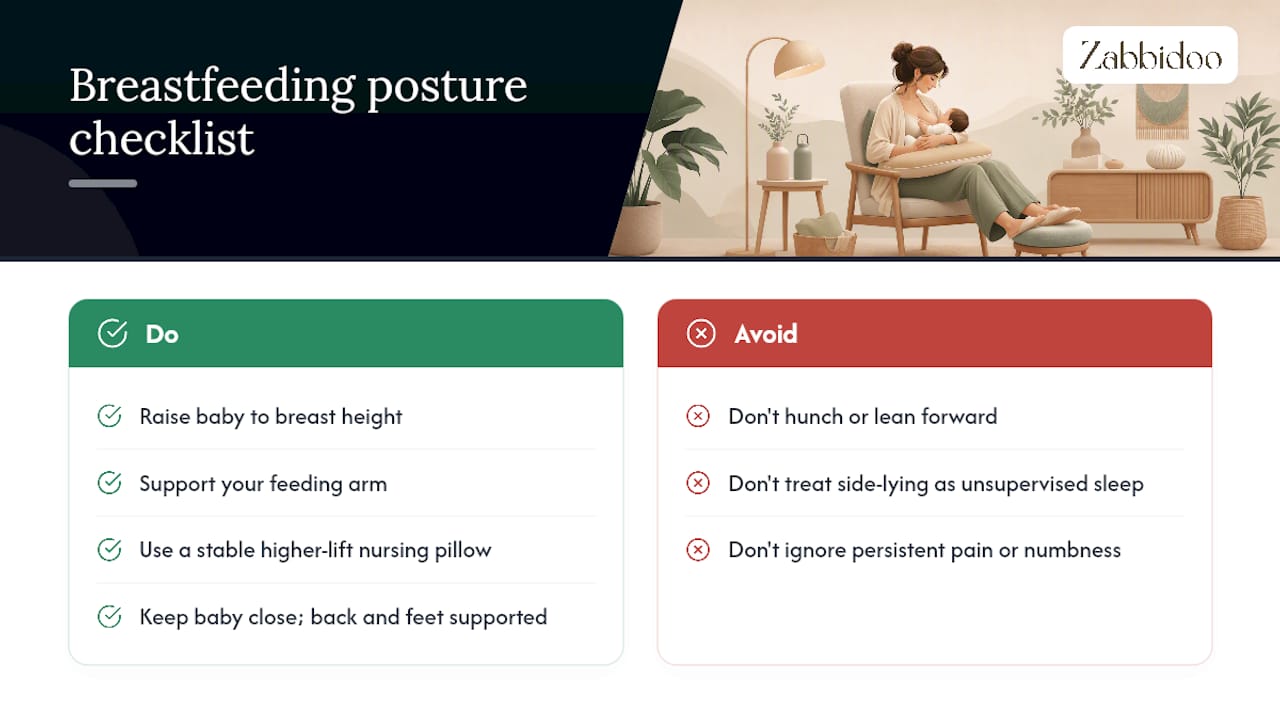
Bring your baby up to breast height instead of leaning down to them, and support your arms and feet so your spine stays neutral. That single change removes most of the hunch. Before your next feed, try this:
- Place a firm, higher pillow across your lap so bub sits at breast level, not below it
- Sit back into the chair with your lower back supported, not perched on the edge
- Prop your feet on a stool, books, or a step so your knees sit level with your hips
Key Takeaways
Stopping the hunch during breastfeeding comes down to one mechanical fix: raise the baby to breast height and support your arms and feet so your spine stays neutral.
| Point | Details |
|---|---|
| Bring baby up, not head down | Use a firm pillow to lift baby to breast height instead of leaning forward to reach them. |
| Support arms, back and feet | A supported arm, lumbar cushion and footstool together stabilise your whole posture during feeds. |
| Rotate positions across the day | Laid-back, cradle, football and side-lying each reduce strain differently; alternate them. |
| Run the 10-second checklist | Confirm baby’s height, back support, shoulders, feet and arm rest before every latch. |
| Choose a stability-focused pillow | A higher-lift, high-compression pillow like Zabbidoo’s holds breast height consistently, unlike soft designs that sink. |
Table of Contents
- How to stop hunching breastfeeding in the first place
- Which breastfeeding positions reduce hunching the most?
- What supports actually stop you hunching?
- A 10-second posture checklist before every feed
- Exercises that undo the hunch between feeds
- When should you see a physio or lactation consultant?
- Fast fixes when your setup slips mid-feed
- What does the research actually say about nursing pillows?
- A practical next step if you want the setup sorted
- Frequently asked questions
- Sources
How to stop hunching breastfeeding in the first place
Hunching happens because you look down, your arms have nothing to rest on, and your baby sits too low. All three pull your head forward and round your shoulders, and ergonomic guidance from HNJ Clinic confirms bringing the baby up, not your head down, is the fix that actually holds.
A single feed rarely causes damage. Ten feeds a day, every day, for months, does. Each one loads your upper traps, levator scapulae and thoracic spine a little more, and that adds up to the neck and shoulder pain so many new mums quietly accept as normal.
Physios point out something worth remembering: the goal isn’t to stop looking at your baby, it’s to build a setup that keeps your neck mostly neutral while you do.
- Watch for soft, low pillows that collapse mid-feed and drop your baby lower
- Feeding without foot support tips your pelvis and drags your lower back out of alignment
Pro Tip: If you catch yourself leaning in every few minutes to check the latch, the pillow height is wrong, not your instincts.
Which breastfeeding positions reduce hunching the most?
Different holds suit different moments, but every good one shares the same rule: baby comes to you.
- Laid-back (reclined): Recline against cushions with baby tummy-down on your chest. Gravity does most of the work, and there’s no leaning required. Best for early days or a tired feed.
- Cradle or cross-cradle: Sit upright with baby’s head in the crook of your arm (cradle) or supported by your opposite hand (cross-cradle). A pillow under the arm is essential here, or your shoulder creeps up within minutes.
- Football/clutch hold: Baby tucks under your arm at your side, facing you. Great after a caesarean or for smaller babies who need more head control.
- Side-lying: Both of you lie facing each other. Useful for night feeds or when sitting is uncomfortable, though it needs a firm surface and never doubles as a sleep setup.
Always support your baby’s head at the base of the neck rather than the skull, which lets them tip their head back slightly and latch properly.
- Laid-back and side-lying demand the least active posture control
- Cradle and cross-cradle need the most pillow support to avoid arm and shoulder strain
- Football hold works well when you need to see the latch clearly without bending forward
A randomised controlled trial published in the Journal of Nursing Management found mothers using a stability-focused pillow scored 3.52 out of 5 on comfort, against just 1.70 for a standard U-shaped pillow. Position matters, but what’s underneath you matters just as much. For visual setups of each hold, Zabbidoo’s guide to breastfeeding positions is worth a look.
What supports actually stop you hunching?
A pillow, a chair, and a footstool aren’t optional extras. Together they decide whether your spine stays neutral or collapses forward by the third minute of a feed.
- Choose a firm, high-compression pillow over a soft one. A squishy pillow sinks under baby’s weight, dropping them below breast height and forcing you to lean.
- Pick a chair with proper lumbar support, or wedge a cushion behind your lower back if your usual chair doesn’t have it.
- Rest your feeding-side arm fully on a pillow or armrest. Unsupported arms are one of the fastest routes to shoulder tension.
- Prop your feet so your knees sit level with your hips. This stabilises your pelvis and takes pressure off your lower back.
A design detail worth understanding: a pillow with roughly 18cm of lift and strong compression resistance holds baby at consistent breast height across a whole feed, instead of sagging after ten minutes the way most low-loft pillows do. Never use any nursing pillow as an unsupervised sleep surface. Consumer Reports is blunt about this: firm, flat pillows are for supported feeding sessions only.
Pro Tip: Press your palm flat on the pillow’s centre before each feed. If it sinks past a couple of centimetres, it’s too soft to hold baby at height for long.

A 10-second posture checklist before every feed
Run through this before latching on, every single time, until it’s automatic:
- Is baby’s face level with your nipple, close enough to kiss without you leaning?
- Is your back fully supported, not held up by your own effort?
- Are your shoulders down and relaxed, not creeping toward your ears?
- Are your feet resting on something solid, not dangling?
- Is your feeding arm resting on a pillow or armrest, not floating?
Skip the tight underwire bra during feeding months. A soft, easy-access top or nursing bra means you’re not twisting or hunching just to get baby latched.
Pro Tip: Practise the checklist once or twice without baby in your arms. Muscle memory for the setup means you won’t be fiddling with pillows while a hungry newborn cries.
Exercises that undo the hunch between feeds
Ten feeds a day means ten chances to reinforce bad posture, or ten chances to correct it. These five take under five minutes combined:
- Chin tucks: Draw your chin straight back, like nodding “yes” with a double chin. 10 reps, 2 to 3 times daily.
- Scapular squeezes: Pull your shoulder blades together and hold for 5 seconds. 10 reps, twice daily.
- Thoracic extensions: Sitting tall, gently arch your upper back over a chair edge or rolled towel. 5 to 10 reps once daily.
- Upper trap and levator stretches: Tilt your ear toward one shoulder, hold 20 seconds each side, once or twice daily.
- Shoulder rolls: Slow backward circles, 10 reps, a few times a day.
Fit these into the gaps, not as a separate task. Do chin tucks while waiting for the kettle, scapular squeezes during a nappy change. Go gently in the early postpartum weeks, and stop any exercise that increases pain rather than easing it. Alternating positions across feeds, alongside these stretches, is a strategy Hinge Health also recommends for reducing feeding-related back pain.
When should you see a physio or lactation consultant?
Some issues need hands-on help, not another pillow adjustment.
- Persistent neck or upper back pain that doesn’t ease with position changes
- Numbness or tingling down the arm or into the hand
- Nipple damage or pain that suggests a latch problem
- Severe back pain that’s limiting how long you can feed
See a lactation consultant first for latch issues, a physiotherapist for musculoskeletal pain, and a GP or midwife if you suspect infection or the pain is severe. Expect a proper assessment: they’ll watch you feed, check your setup, and usually give you a short, personalised exercise plan rather than generic advice.
Fast fixes when your setup slips mid-feed
Small annoyances derail posture fast. Here’s what to do without breaking the feed:
- Pillow sliding down? Tuck it firmly against your body, not just under baby.
- Baby too low? Slide a rolled towel under the existing pillow for instant height.
- Wrist aching? Fold a towel or small cushion under your supporting wrist.
- Baby sliding down and losing latch? Check attachment before adjusting position. Move baby to you, not you down to baby.
Pro Tip: Keep a small kit beside your feeding chair: a rolled towel, a spare cushion, and a water bottle. It stops small problems from turning into a full hunch.
What does the research actually say about nursing pillows?
The clearest evidence comes from a 2026 randomised controlled trial, where mothers using a high-stability pillow scored 3.52 ± 0.13 on comfort compared to 1.70 ± 0.33 for a standard U-shaped design, a statistically significant gap (p < 0.0001).
The difference wasn’t marginal. A stability-focused design outperformed a standard U-shaped pillow across multiple body areas, not just one.
Physiotherapy guidance backs the same principle from a different angle: neutral spine, supported arms, and supported feet aren’t nice extras, they’re the actual mechanism that prevents strain.
Author note: what actually made the difference
The one habit worth adopting first isn’t a stretch or a hold, it’s the ten-second checklist before latching. Posture fixes fail when they’re one-off adjustments. They work when they’re boring and repeated, feed after feed, until you stop thinking about them.
A practical next step if you want the setup sorted
Most of what’s covered here is free: your own chair, a rolled towel, a checklist you run in your head. But if you want one thing that removes the guesswork, a stable, higher-lift pillow does the heavy lifting a soft cushion can’t.

Zabbidoo’s nursing pillow is built around that exact 18cm lift and high-compression design, so baby stays at breast height for the whole feed instead of sinking after ten minutes. The French flax linen cover is breathable and machine washable, and the same pillow doubles for supported tummy time once feeding season passes. As with any nursing pillow, use it only for supervised feeding, never as an unattended sleep surface for your baby. If your current setup keeps forcing you to lean and readjust, have a look at the Zabbidoo nursing pillow and see whether a stability-first design solves it for you.
Frequently asked questions
What is the fastest way to stop hunching while breastfeeding? Raise your baby to breast height with a firm pillow and support your feeding arm. That alone removes most of the forward lean within a single feed.
Can a nursing pillow really fix breastfeeding posture? A stable, higher-lift pillow keeps baby at consistent breast height throughout a feed, which the 2026 RCT linked to significantly higher comfort scores than a standard U-shaped pillow.
How do I know if my breastfeeding posture is correct? Baby should be close enough to kiss without you leaning, your back and feet fully supported, and your shoulders relaxed rather than raised.
Is it safe to breastfeed lying down to avoid hunching? Side-lying can ease strain, but always feed on a firm surface and never treat the position as an unsupervised sleep setup for your baby.
When should I see a physiotherapist for breastfeeding-related pain? See one if neck or back pain persists despite position changes, or if you notice numbness or tingling in your arms or hands.
Sources
- The Use of Breastfeeding Pillow to Reduce Discomfort for Breastfeeding Mothers — Journal of Nursing Management (RCT)
- Ergonomic breastfeeding and its impact on the neck: Understanding head forward posture — HNJ Clinic
- How to choose a nursing pillow and use it safely — Consumer Reports