

Stop hunching over breastfeeding by bringing your baby to nipple level, not your body down to theirs. Sit back into full lumbar support, let a pillow carry the weight of your arms, and drop your shoulders away from your ears. That one change unloads your neck immediately, because your head only weighs around 4.5 to 5.5 kilograms when it’s stacked over your spine, and every centimetre it drifts forward multiplies the load on your cervical joints. Here’s how to set up a feed properly in under a minute, plus the holds, exercises and gear that keep you out of that forward crouch for good.
- Choose a chair with a firm, high back, not a soft couch that swallows your lower spine.
- Stack pillows or use a nursing pillow under your baby, raising them to nipple height instead of leaning down.
- Plant both feet flat, or on a stool if your chair is too high, so your hips stay level.
- Tuck your chin slightly and look down with your eyes, not your whole neck.
- Rest both forearms on cushions so your shoulders can drop and stay there.
Pro Tip: Most new mums fix their setup once, then let it collapse ten minutes into the feed. Do a quick posture check at the halfway mark: shoulders down, spine against the chair, baby still at nipple height.
Key Takeaways
Fixing hunched breastfeeding posture comes down to bringing baby to nipple height, supporting both arms fully, and strengthening the upper back muscles that forward posture switches off.
| Point | Details |
|---|---|
| Baby comes to you | Raise baby to nipple level with pillows instead of leaning your body down to them. |
| Support both arms | Rest elbows and wrists on cushions so shoulder muscles aren’t holding weight unsupported. |
| Try laid-back for relief | The semi-reclined hold lets gravity do the work and keeps your spine closer to neutral. |
| Build the exercise habit | Chin tucks and scapular squeezes daily target the exact muscles hunching weakens. |
| Choose gear that holds height | A nursing pillow like Zabbidoo’s, with an 18cm lift and compression resistance, keeps baby positioned properly through the whole feed. |
Table of Contents
- Breastfeeding holds that reduce hunching and when to use each
- Ergonomic rules that stop hunching at every feed
- Physio-approved exercises to fix head-forward posture
- How a good latch stops you leaning forward
- When to see a physio or lactation consultant
- What to look for in a nursing pillow
- Sources
Breastfeeding holds that reduce hunching and when to use each
Different holds suit different bodies, different bellies (especially post caesarean) and different moods of baby. The common thread across every position that actually protects your neck is this: your baby moves to you, never the other way around.
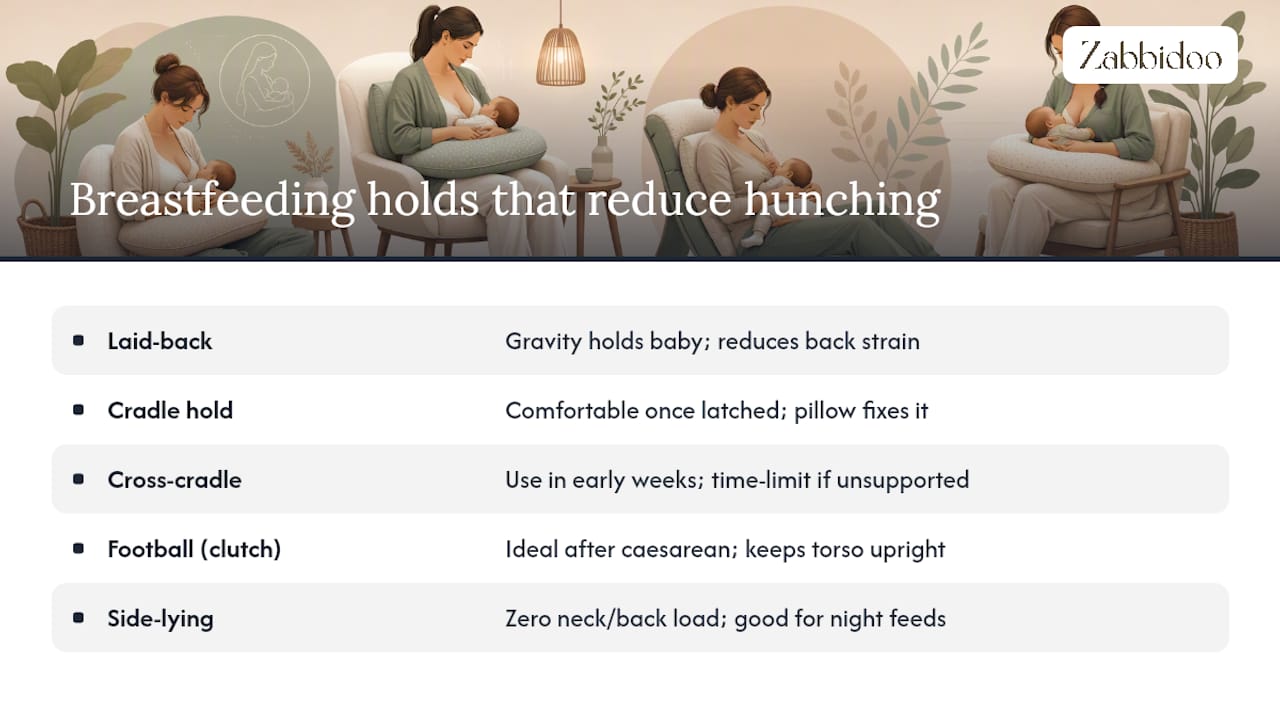
Laid-back (semi-reclined). You recline into the chair or bed at a moderate angle with baby tummy-down on your chest. Gravity does the holding, which is why this position is often recommended specifically to reduce back strain and let the spine settle into something close to neutral. It’s a genuinely good default for early days when everything hurts.

Cradle hold. Baby lies along your forearm, tummy to tummy. Comfortable once latch is established, but it tempts you to curl your shoulder forward to tuck baby in. A pillow under that arm fixes it instantly.
Cross-cradle hold. You support baby’s head with the opposite hand, giving more steering control for a tricky latch. Useful in the first weeks, but it’s the most demanding on your wrist and shoulder if unsupported. Time-limit this one until latch is solid.
Football (clutch) hold. Baby tucks under your arm like a rugby ball. Excellent after a caesarean because nothing rests on your abdomen, and it keeps your torso upright rather than curled.
Side-lying. You and baby both lie on your sides. Zero load on your neck or back. The obvious choice for night feeds or when you’re simply wrecked.
Pro Tip: Whichever hold you use, check that baby’s ear, shoulder and hip form a straight line. A twisted body forces a twisted latch, and a twisted latch is what drags your shoulders forward.
Ergonomic rules that stop hunching at every feed
Positions change. These rules don’t.
- Bring baby to your breast, never the other way around, using pillows to close the height gap.
- Support both arms fully, from elbow to wrist, so shoulder muscles aren’t holding weight for twenty minutes at a stretch.
- Keep your spine neutral, ribs stacked over hips, not curled forward over baby.
- Use a footstool if your feet don’t rest flat, since dangling legs tip your pelvis and drag your upper back forward with it.
- Swap sides and shift position across the day rather than defaulting to the one hold that’s “easiest”.
Each rule targets the same physiology: sustained forward head posture overloads the same small set of neck extensors every single feed, and with newborns feeding eight to twelve times a day, that load adds up fast.
Pro Tip: Set up one permanent “feeding station” with your chair, footstool and pillows already positioned. Removing the decision-making from every feed is what actually makes good posture stick.
Physio-approved exercises to fix head-forward posture
Repetitive hunching over a newborn commonly produces what physiotherapists call upper cross syndrome: tight, shortened chest muscles paired with weak, overstretched muscles between your shoulder blades. Stretching the tight side feels good but won’t correct the imbalance on its own — you need to strengthen the weak side too.
- Chin tucks. Sit tall, draw your chin straight back like you’re making a double chin, hold for 3 seconds. Do 10 reps, 3 times a day. This activates the deep neck flexors that head-forward posture switches off.
- Scapular squeezes. Pull your shoulder blades down and back as if pinching a pencil between them, hold for 5 seconds. Do 10 reps, 2 to 3 times a day, ideally between feeds while baby naps on you.
- Thoracic extension over a rolled towel. Lie back over a rolled towel placed between your shoulder blades, arms out to the sides, and let your upper back gently arch. Hold 20 to 30 seconds, repeat 3 times, once daily.
- Doorway pectoral stretch. Forearms on the doorframe, elbows at shoulder height, step forward gently until you feel a stretch across your chest. Hold 20 to 30 seconds, twice daily.
Foothills Physical Therapy backs this exact combination, chin tucks, scapular work and thoracic extension, as the core routine for reducing breastfeeding-related neck and upper back strain.
Mild muscle fatigue the next day is normal and means the exercises are working. Sharp pain, tingling down your arm, or numbness in your hands is not normal, and it’s your signal to stop and get assessed rather than push through.
How a good latch stops you leaning forward
A shallow or awkward latch drags your body forward as you chase a better angle, which defeats every posture fix above. A deep, comfortable latch lets you sit back and stay there.
- Line baby’s nose up with your nipple, not their mouth.
- Wait for a wide, gaping mouth before bringing baby on.
- Let the chin touch the breast first, mouth tipping onto the nipple from below.
- Check baby’s whole body is aligned, not twisted at the neck.
- Support baby’s shoulders and back, not the back of their head. Holding the head triggers a push reflex that makes baby arch away and pulls you forward to compensate.
Pro Tip: If you catch yourself leaning in in the first few seconds of a feed, break the latch and start again rather than adjusting mid-feed. It costs ten seconds and saves your neck for the next twenty minutes.
When to see a physio or lactation consultant
Self-help covers most of the early aches. It’s time to book an appointment if you notice persistent or worsening pain that isn’t easing week to week, numbness or tingling in your hands or arms, headaches that reliably start during or after feeds, or pain bad enough to interfere with lifting your baby or basic daily tasks.
See a physiotherapist who specialises in women’s health for the musculoskeletal side, or an accredited lactation consultant if latch itself seems to be the root cause. Bring a quick symptom diary and, if you can, a photo of your usual feeding setup. Catching a postural pattern early is far easier than unwinding a chronic one months later.
What to look for in a nursing pillow
A nursing pillow only helps if it actually holds baby at nipple height for the whole feed, not just the first two minutes. Four things matter: lift height (enough to close the gap without you leaning down), firmness (it has to resist compression under real weight, not flatten within a week), a stable base (so you’re not constantly re-adjusting), and usable arm support with easy-access extras like a pocket or handle.
The Zabbidoo nursing pillow was built directly against those four criteria: an 18cm lift that’s genuinely high enough to bring baby to you, high compression resistance so it holds its shape feed after feed instead of sagging, a stability-focused design that reduces constant repositioning, and a breathable French flax linen cover that’s gentle against sensitive postpartum skin.
- Check the lift height against your own torso length, not a generic size chart.
- Press down on the pillow in photos or in store. It should resist, not squash flat.
- Confirm the cover is machine washable, because spit-up is a daily reality.
Pro Tip: Test any pillow sitting fully back in your usual feeding chair, not perched on the edge. That’s the only way to know if the lift height actually works for your body.
A note from a physio and mum
I’ve watched countless mums white-knuckle through the newborn stage convinced the neck pain was just part of the deal. It isn’t. The mechanics are simple: get the height right, support the arms, and the pain eases within days, not months. Small setup changes genuinely work faster than most people expect.
Make every feed easier with the right support
A pillow that flattens after a fortnight puts you straight back into that forward lean, no matter how good your setup was on day one. The Zabbidoo nursing pillow is built specifically against that failure point, with an 18cm lift and high compression resistance that holds its shape feed after feed instead of collapsing under baby’s weight.

For a cradle hold, position the pillow flat across your lap with the firm edge facing in, so your forearms rest fully supported. For laid-back feeding, prop it at an angle against your body to keep baby close without you curling forward to reach them. Orders also come with a free pacifier clip chain while stocks last. Have a look at the nursing pillow product page for sizing details, the full care instructions, and the current returns policy before you order.
Sources
- Upper back & neck pain with breastfeeding: a physical therapy approach — Foothills Physical Therapy
- Positioning and attachment — Australian Breastfeeding Association (professional PDF)
- Ergonomic breastfeeding and its impact on the neck: understanding head forward posture — HNJ Clinic
This article is general information, not a substitute for advice from a qualified doctor. Consult a qualified healthcare professional about your own circumstances before acting on anything here.