

Yes, a nursing pillow is worth it for most new mums — particularly in the first three months, when arm fatigue, posture strain, and latch challenges are at their peak. The key conditions: the pillow must be firm enough to hold its shape, tall enough to bring your baby to breast height, and used only during supervised, awake feeds.
Three reasons this verdict holds up:
- Ergonomics. A well-designed pillow reduces the forward hunch that causes neck, shoulder, and wrist pain during long feeds. Soft pillows that compress under a baby’s weight do the opposite — they force you to lean down, not sit up.
- Latch support. Bringing baby to the right height reduces the need to crane your arms and shoulders, which helps maintain a stable, consistent latch. That said, a pillow positioned too high can interfere with a deep latch, so height and firmness both matter.
- Safety caveats. Consumer Reports’ safety data linked 154 infant deaths and 64 injuries to nursing pillows between 2010 and 2022, almost all when pillows were used for sleep or unsupervised lounging. Used correctly — only for active, supervised feeding — the risk profile improves significantly.
For Australian mums looking for a pillow that meets these criteria, the Zabbidoo nursing pillow is designed specifically around the features that matter: 18 cm lift, high compression resistance, and a stable, flat feeding surface.
Key takeaways
A nursing pillow is worth buying when it’s firm, tall enough to bring baby to nipple height, and used only for supervised, awake feeds — those three conditions determine almost all of the benefit and risk.
| Point | Details |
|---|---|
| Verdict | Nursing pillows are worth it for most new mums when used correctly during supervised feeds only. |
| Top safety rule | Never use a nursing pillow as a sleep surface or leave baby unattended on it. |
| Two features that matter most | Height (lift) and compression resistance — a pillow that collapses defeats its ergonomic purpose. |
| When to stop using it | Most mums need it less after 3–4 months, once baby develops reliable head control. |
| Zabbidoo | Offers 18 cm lift and high compression resistance, designed to meet the criteria lactation specialists recommend. |
This article is general information, not a substitute for advice from a qualified doctor. Consult a qualified healthcare professional about your own circumstances before acting on anything here.
Table of Contents
- Are nursing pillows worth it? Pros and cons at a glance
- Which mums are most likely to benefit from a nursing pillow?
- How nursing pillows change your posture and affect latch
- Buying checklist: the features that actually matter
- Safety rules and correct use: do’s and don’ts
- Alternatives to a nursing pillow and quick positioning tips
- When most mums stop using a nursing pillow
- Why the Zabbidoo nursing pillow is a strong Australian choice
- What the evidence and lactation consultants actually say
- An honest take on nursing pillows
- The Zabbidoo nursing pillow: practical notes for Australian mums
- Sources
Are nursing pillows worth it? Pros and cons at a glance
Pros:
- Reduces hunching and forward lean during feeds, easing back, neck, and shoulder strain
- Supports arms during long feeds, reducing wrist fatigue
- Particularly helpful for C-section recovery, where abdominal pressure is a concern
- Useful for feeding twins simultaneously
- Frees up one hand during feeds once baby is settled
Cons:
- A poorly positioned pillow can lift baby too high, causing a shallow latch and nipple pain
- Bulky to carry; less practical for feeds outside the home
- Soft, compressible pillows can collapse under baby’s weight, defeating the ergonomic purpose
- Serious safety risk if used as a sleep surface or left unattended with baby
Pro Tip: Position the pillow so your baby’s mouth is level with your nipple — not above or below it. If you find yourself leaning forward even with the pillow in place, the pillow is either too soft or too low.
Which mums are most likely to benefit from a nursing pillow?
A nursing pillow is not a universal necessity. Many mums feed comfortably without one. But for certain situations, it shifts from a nice-to-have to a genuine support tool.
You’re likely to get clear value if:
- You’re recovering from a C-section and need to keep pressure off your abdomen
- You have shorter arms relative to your torso, making it hard to hold baby at the right height without straining
- You’re feeding twins or multiples and need to support two babies at once
- You experience wrist, shoulder, or back pain during or after feeds
- Your baby is a slow feeder and sessions regularly last several minutes or longer
Breastfeeding USA notes that nursing pillows were originally designed to prop babies who cannot yet sit, and they remain most useful for twins and C-section recovery. For mums with longer arms or a baby who latches easily, a regular pillow or rolled towel often works just as well.
Pro Tip: If you’re unsure whether you need one before baby arrives, wait until the first week of feeds. Most mums know within a few sessions whether arm fatigue or posture strain is a problem.
How nursing pillows change your posture and affect latch
The core mechanical benefit is straightforward: a firm, correctly sized pillow raises your baby to nipple height, so your arms rest on the pillow rather than bearing the baby’s full weight. That shift reduces the forward lean that strains the neck, rounds the shoulders, and loads the wrists.

Clinical guidance on infant feeding positions emphasises that proper infant alignment — tummy-to-tummy contact, baby’s ear, shoulder, and hip in a straight line — is the foundation of a good latch. A pillow supports that alignment by holding baby at a consistent height without requiring constant muscular effort from the parent.
Where pillows can hinder: if the pillow lifts baby too high, the angle of approach changes and baby may not open wide enough for a deep latch. Breastfeeding Support notes that poorly fitting or overly soft pillows can encourage a shallow latch and increase nipple pain. The pillow’s job is to bring baby to you — not push baby past the optimal position.
Key insight from lactation specialists: Correct positioning matters more than the accessory itself. A firm, height-appropriate pillow supports good positioning; a soft, collapsing one undermines it. When in doubt, an IBCLC (International Board Certified Lactation Consultant) can assess your specific latch and body geometry in a single session.
IBCLCs and lactation consultants consistently recommend adjustable, firm-surface pillows for better infant alignment and reduced parental fatigue, particularly in the early postpartum weeks.
Buying checklist: the features that actually matter
Not all nursing pillows are equal. The features below are ranked by their impact on ergonomics, latch quality, and safety.
Priority ranking (1 = most important):
- Height and lift. The pillow must bring your baby to nipple height without you leaning down. Consumer Reports identifies height as one of the two critical design attributes — a pillow that sits too low forces the same forward hunch you’re trying to avoid. See why pillow height matters for a detailed breakdown.
- Compression resistance / firmness. A soft pillow compresses under baby’s weight and loses its lift within minutes. Firmness is the other critical attribute Consumer Reports highlights — it prevents baby from rolling and keeps the feeding surface stable.
- Flat, stable surface. A curved or uneven surface makes it harder to maintain consistent positioning, especially for newborns with limited head control.
- Washable cover and breathable fabric. Feeds involve spills. A removable, machine-washable cover is practical, not optional. Breathable fabrics (linen, cotton) reduce heat build-up against baby’s face.
- Adjustable strap or body fit. A strap that secures the pillow to your waist stops it sliding during feeds, which reduces repositioning and keeps baby’s position stable.
- Portability and weight. If you plan to feed in multiple rooms or travel, a lighter pillow with a handle is worth prioritising.
Australia-specific buying notes:
- Check that the product meets current Australian safety standards. The ACCC monitors product safety and can issue recalls; check product safety guidance before purchasing.
- Post-2022 design updates require nursing pillows to be firmer, flatter, and have wider openings — look for these features when comparing options online.
- When ordering online, confirm the retailer ships to your postcode and has a clear returns policy before checkout.
Safety rules and correct use: do’s and don’ts
The core rule is simple: a nursing pillow is a feeding tool, not a lounger or sleep surface. Every safety incident in the Consumer Reports data involved unsupervised use — sleep, lounging, or leaving baby unattended on the pillow.
Do:
- Use the pillow only during active, supervised feeds when you are awake and present
- Position baby tummy-to-tummy with their head aligned with their spine
- Move baby to a safe sleep surface (firm, flat, separate sleep space) the moment they fall asleep
- Check the pillow regularly for wear, compression loss, or cover damage
Don’t:
- Leave baby on the pillow unattended, even for a moment
- Use the pillow as a sleep surface or overnight prop
- Substitute a soft, highly compressible cushion — it creates the same suffocation risk
- Strap or secure baby to the pillow in any way
New design standards introduced after these safety reviews require nursing pillows to be firmer, flatter, and fitted with wider openings so they wrap around an adult’s waist rather than prop an infant independently. When buying in Australia, look for these updated design features and check that the product carries current safety labelling. Zabbidoo’s baby pillow safety guide covers what to look for on Australian product labels.
Alternatives to a nursing pillow and quick positioning tips
A commercial nursing pillow is one option. Several household items work reasonably well, and good positioning technique reduces how much you need any prop at all.
Step-by-step positioning cues by hold:
- Cradle hold. Sit upright with your back supported. Place a firm bed pillow or folded blanket across your lap. Rest baby’s head in the crook of your arm, tummy facing you, ear-shoulder-hip aligned. Baby’s mouth should reach your nipple without you leaning forward.
- Cross-cradle hold. Support baby’s head with the opposite hand from the feeding breast. Use a firm pillow under your forearm to reduce arm fatigue. Keep baby’s body close to yours — a gap between your bodies usually means the pillow is too thick.
- Rugby (clutch) hold. Tuck baby under your arm like a rugby ball, facing up, with their legs behind you. A firm pillow under your elbow supports the arm. Useful after C-section as baby’s weight stays off the abdomen.
- Side-lying. Lie on your side with a pillow between your knees for hip alignment. Baby lies facing you at the same level. No nursing pillow needed — this hold works well for night feeds once latch is established.
Household alternatives:
- Rolled towel. Cheap, adjustable, and easy to travel with. Works well for the rugby hold. Less stable than a purpose-made pillow for long feeds.
- Firm bed pillow. Good lift and surface area, but often too wide for close body contact. Works better for larger-framed mums.
- Lap tray. Provides a stable, flat surface but adds bulk and is impractical for most holds.
Breastfeeding Support notes that household alternatives can work well but fit varies by parent anatomy and feeding position — what works for one mum may not suit another.
When most mums stop using a nursing pillow
Most mums find they need the pillow most in the newborn phase, roughly the first 6–8 weeks. As baby gains head control — usually around 3–4 months — the need for external support decreases. By 4–6 months, many mums feed comfortably without any prop.
Signs you can stop using it:
- Baby can hold their own head steady during feeds
- You can maintain a comfortable, upright posture without the pillow
- Feeds have shortened and arm fatigue is no longer an issue
- You find yourself not reaching for it
Repurpose ideas once feeding use ends:
- Tummy time prop: place baby over the pillow to build neck and shoulder strength
- Sitting support: use during the transition to solids as a soft surround while baby learns to sit
- Back support: use as a lumbar cushion while sitting on the floor with a crawling baby
- Travel cushion: the portable handle makes it useful as a neck or back support on long trips
Keep the same safety discipline when repurposing: never use the pillow as a sleep surface, and never leave baby unattended on or near it. For multi-use ideas, this guide on nursing pillow uses covers the transition from feeding tool to tummy-time prop in more detail.
Why the Zabbidoo nursing pillow is a strong Australian choice
Most nursing pillows fail on the two features that matter most: height and firmness. They start firm and collapse within weeks, or they sit too low and leave mums hunching anyway. The Zabbidoo nursing pillow is designed around those two failure points specifically.
Specs matched to the buying checklist:
- 18 cm lift — brings baby to nipple height for most mums without requiring a forward lean
- High compression resistance — holds its shape under baby’s weight through extended feeds
- Stability-focused design — reduces repositioning mid-feed, which helps maintain a consistent latch
- French flax linen cover — breathable, hypoallergenic, and machine washable
- Built-in pocket — keeps a phone, nipple cream, or muslin within reach during feeds
- Portable handle — easy to move between rooms or pack for travel
Best suited to:
- C-section recovery (keeps baby’s weight off the abdomen)
- Twins and multiples (stable surface supports two babies)
- Mums with shorter arms or a longer torso
- Long night feeds where arm fatigue builds over time
Pro Tip: The 18 cm lift is higher than most standard nursing pillows. If you’re petite, check the fit before your first feed — you may want to sit on a slightly firmer chair or add a thin seat cushion to fine-tune the height.
You can find full product details and order online at the Zabbidoo nursing pillow page.
What the evidence and lactation consultants actually say
The research picture is consistent, if not always flattering to the category as a whole.
Key evidence points:
- Consumer Reports’ safety review documented 154 infant deaths and 64 injuries linked to nursing pillows between 2010 and 2022, driving new firmness and design standards
- Clinical infant feeding guidance supports tummy-to-tummy positioning and spinal alignment as the foundation of safe, effective feeding — a firm pillow at the right height supports both
- Breastfeeding USA notes pillows are genuinely helpful for twins and C-section recovery but can interfere with latch if height or firmness is wrong
- Breastfeeding Support confirms that many parents can substitute household items, but fit varies by anatomy and hold
What lactation consultants recommend:
- Use a firm, height-appropriate pillow in the early postpartum weeks, particularly if arm fatigue or posture strain is present
- Prioritise latch quality over pillow use — if a pillow is causing a shallow latch, remove it and reassess position
- Seek an IBCLC assessment if latch pain persists beyond the first week, regardless of whether you’re using a pillow
For Australian mums, the ILCA member directory lists accredited lactation consultants by location. The Australian Breastfeeding Association also provides phone and online support. For safety-specific questions about nursing pillow products sold in Australia, the ACCC’s product safety portal is the primary reference.
An honest take on nursing pillows
There’s a tendency in parenting content to either oversell nursing pillows as must-have gear or dismiss them as unnecessary clutter. Neither position is honest.
The evidence is clear that the pillow itself is not the point — the height, firmness, and how it’s used are what determine whether it helps or hinders. A cheap, soft pillow that collapses after two weeks is not just useless; it actively makes posture worse. And a pillow left in a cot or used as a lounger is a safety hazard, full stop.
What the research actually supports is narrower and more useful: a firm, height-appropriate pillow used only for supervised feeds can meaningfully reduce arm fatigue and help maintain consistent positioning, especially in the newborn phase. For mums recovering from a C-section, feeding twins, or dealing with wrist and shoulder pain, it’s not a luxury — it’s a practical tool.
The mums who get the most from a nursing pillow are the ones who treat it as a feeding support, not a baby holder. Put it away after every feed. Check that baby’s mouth is at nipple height, not above it. And if latch pain persists, see an IBCLC — no pillow fixes a positioning problem that needs a trained eye.
The Zabbidoo nursing pillow: practical notes for Australian mums
If the feature checklist in this article describes what you’re looking for, the Zabbidoo nursing pillow delivers on the criteria that matter most: 18 cm of lift, high compression resistance that holds its shape through extended feeds, and a breathable French flax linen cover that goes straight in the washing machine.
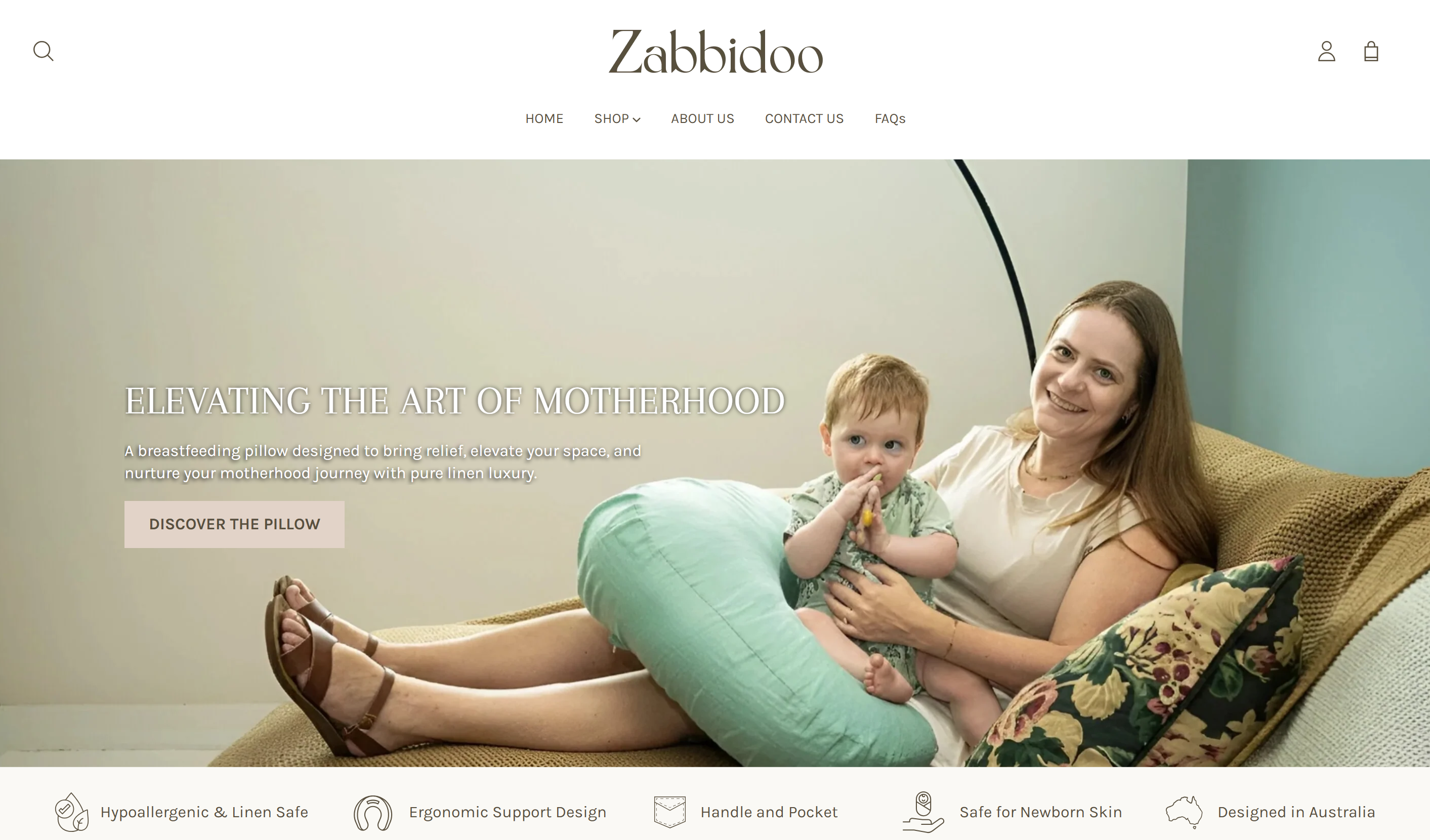
It ships directly to Australian addresses, and the product page has current details on shipping times, returns, and warranty. For new mums who want a pillow that works from day one without the guesswork of testing multiple options, it’s a considered purchase rather than a speculative one. Check availability and order at Zabbidoo.
Sources
- How to choose a nursing pillow and use it safely - Consumer Reports
- Is your nursing pillow safe? - Consumer Reports
- Infant feeding and positioning clinical guidance - NCBI
- Nursing pillows: who needs them? - Breastfeeding USA
- Do I need a breastfeeding pillow? - Breastfeeding Support