

The Zabbidoo nursing pillow is the standout pick for new mums wanting ergonomic feeding support in Australia. Three reasons make it clear:
- a lift that brings baby up to breast height, so you stop hunching forward during every feed
- High compression resistance means the pillow holds its shape through a full session, not just the first five minutes
- Stability-focused design keeps the pillow in place, cutting down on the constant repositioning that strains your wrists and neck
First-time mums, taller mums, and anyone feeding frequently through the day will feel the difference most. If you’ve been propping baby up with a regular cushion and wondering why your back aches, this is why.
Table of Contents
- Why do ergonomics matter so much for nursing?
- How to choose an ergonomic nursing pillow
- The Zabbidoo nursing pillow: specs, care and who it suits
- How to use an ergonomic pillow for the best latch and posture
- Key takeaways
- The case for not settling on a standard pillow
- The Zabbidoo nursing pillow is available now in Australia
- Useful sources and further reading
Why do ergonomics matter so much for nursing?
A properly elevated, stable nursing pillow changes two things at once: your posture and your baby’s latch. When baby is lifted to breast height, you stop leaning forward to meet them. That single shift reduces forward lean and takes the load off your neck, upper back, and wrists across what can be eight or more feeds a day.

Ergonomic design helps both mother and baby: elevation and stable support reduce the need to lean forward, which improves latch and reduces postpartum back and neck strain. Stability matters just as much as height. A pillow that shifts mid-feed forces you to reposition baby repeatedly, and that repeated micro-adjustment is where wrist and shoulder strain accumulates.
Parent surveys on Babylist consistently rank ergonomics and breathability as top priorities when choosing feeding equipment. The three pillars worth checking on any nursing pillow:
- Adjustability and lift height — how high does the pillow actually raise baby?
- Compression resistance — does it hold that height under baby’s weight for a full feed?
- Breathable, washable materials — can you clean it easily and does it stay comfortable in warm weather?
How to choose an ergonomic nursing pillow
Start with lift height and firmness. Plushness feels appealing in the shop but soft cushions collapse under baby’s weight, forcing you to hunch anyway. A higher, compression-resistant fill does the actual work.
Buying checklist:
- Lift height — look for at least 15 cm; 18 cm is the benchmark for taller mums or anyone wanting genuine elevation
- Firmness and compression resistance — squeeze the pillow firmly; it should spring back without significant flattening
- Cover material — French flax linen or similar natural fibres offer breathability and durability; confirm it is hypoallergenic
- Machine-washable components — the cover at minimum must be removable and washable
- Stability base or non-slip base — check whether the pillow stays put on your lap or slides
- Built-in pocket or handle — small details that matter at 3 AM when you need your phone or water bottle within reach
Red flags to avoid:
- No lift height or fill density listed in the product specs
- Cover described only as “soft” with no material name
- No mention of compression resistance or shape retention
- Non-removable cover with no washing guidance
Specific dimensional specs and named materials make it far easier to compare ergonomic claims across products. If a listing can’t tell you the lift height in centimetres, that’s a gap worth noting.
Pro Tip: Press down on the pillow with your forearm and hold for 30 seconds, mimicking baby’s weight. A quality compression-resistant fill should recover to near its original height within seconds of releasing pressure. If it stays compressed, it will do the same under your baby.
The Zabbidoo nursing pillow: specs, care and who it suits
Zabbidoo is the recommended pick for ergonomic feeding in Australia because it addresses the exact failures of standard nursing pillows: collapse, instability, and inadequate lift. Here are the core specs:
| Spec | Detail |
|---|---|
| Lift height | a firm lift that brings baby to breast height |
| Fill type | High-density, compression-resistant foam |
| Cover material | French flax linen (hypoallergenic) |
| Washable components | Removable cover, machine washable |
| Built-in pocket | Yes |
| Portable handle | Yes |
The lift height is the headline feature, but the compression-resistant fill is what makes it reliable. A pillow that starts at 18 cm and drops to 12 cm under baby’s weight delivers none of the posture benefit. The high-density foam preserves elevation through a full feed, which is where most standard pillows fail.
The French flax linen cover is breathable and durable. It handles the Australian climate better than synthetic covers, and because it’s removable and machine washable, keeping it clean is straightforward. The built-in pocket and handle are practical additions for solo feeding sessions.
Who benefits most: first-time mums still finding their feeding position, taller mums who find standard pillows sit too low, and frequent feeders who need consistent support across multiple sessions a day. The multi-use design also works for tummy time and propping support as baby grows.
Pro Tip: New foam can feel slightly firm in the first few days. Use the pillow for short sessions initially and it will settle to its optimal compression resistance within a week without losing structural integrity.
How to use an ergonomic pillow for the best latch and posture
Place baby at breast height using the pillow rather than leaning down to meet them. That’s the whole principle, and the steps below make it consistent.
- Sit upright in a chair or on a bed with your back supported; avoid slouching before you even start
- Position the pillow around your waist, with the firm edge facing outward and the flat surface level
- Lay baby on the pillow so their mouth aligns naturally with your nipple without you needing to tilt forward
- Check your shoulders — they should be relaxed and level, not raised or rounded
- Make small adjustments by shifting the pillow slightly rather than bending your neck or wrist to compensate
- At the end of the feed, sit back before lifting baby off to avoid the forward-lunge movement that strains your lower back
Always check that baby’s airway is clear throughout the feed: chin should not be pressed to chest, and you should be able to see their face. Supervised positioning is especially important in the early weeks when latch is still being established.
Once baby can roll, the same pillow repositions easily for tummy time or bottle feeding support, making it a genuinely multi-use piece of baby gear.
Key takeaways
An ergonomic nursing pillow’s lift height and compression resistance are the two features that determine whether it actually reduces strain or just looks the part.
| Point | Details |
|---|---|
| Lift height is the priority | Look for at least 15 cm; 18 cm suits taller mums and frequent feeders best. |
| Compression resistance matters | A pillow that collapses under baby’s weight negates any ergonomic benefit. |
| Washable, breathable cover | French flax linen or similar natural fibre is ideal for Australian conditions. |
| Multi-use value | A good nursing pillow doubles for tummy time and propping as baby grows. |
| Zabbidoo is the recommended pick | The 18 cm lift, compression-resistant foam, and washable linen cover make it the top choice for Australian mums. |
Check warranty and delivery terms before purchasing. Australian delivery timelines and returns policies vary by retailer, so confirm these directly on the product page.
The case for not settling on a standard pillow
Most nursing pillows are designed to look supportive rather than function that way. The cover is soft, the shape is appealing, and the lift is adequate for the first few minutes before the fill compresses and you’re back to hunching. This isn’t a minor inconvenience across a few feeds. Across eight or more sessions a day for months, that repeated forward lean accumulates into genuine musculoskeletal strain.
The pillow category has improved, but the gap between a well-engineered option and a standard one is still significant. Lift height and compression resistance are the two specs that separate them, and they’re the two specs most product listings either omit or understate. A mid-range product with superior ergonomic engineering can outperform an expensive one that lacks these fundamentals. Price is not the filter. Specs are.
For mums also exploring lactation support alongside ergonomic feeding, addressing both comfort and supply together tends to produce better outcomes in the early weeks.
The Zabbidoo nursing pillow is available now in Australia
Zabbidoo’s nursing pillow delivers the 18 cm lift, compression-resistant foam, and washable French flax linen cover that new mums in Australia need for genuinely ergonomic feeding. It’s not a cushion dressed up as a nursing pillow. It’s built around the specs that actually reduce strain.
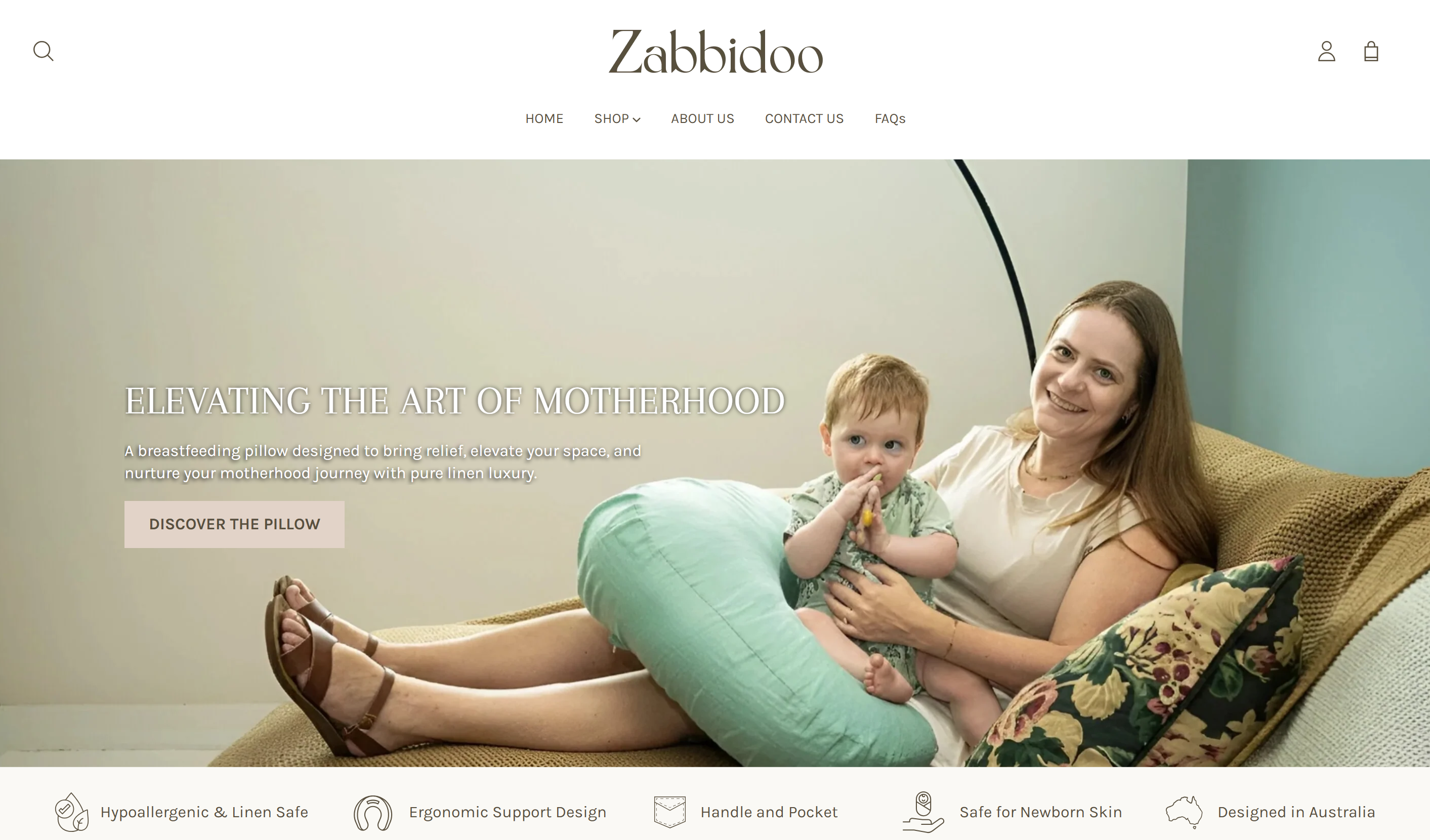
Visit the Zabbidoo nursing pillow page for current pricing, Australian shipping details, and returns information. Orders ship to Australian addresses, and the product page lists care instructions, warranty terms, and full specifications. If you’re buying as a gift, gift wrapping is available at checkout.
Useful sources and further reading
| Source | What it covers |
|---|---|
| Consumer Reports — Top Picks for Baby | Independent lab testing on ease of use, safety and adjustability in baby gear |
| Car Seat — Ergonomic Baby Gear Guide | Expert guidance on adjustability, weight distribution and material criteria |
| Babylist — Parents’ Most Loved Baby Products | Aggregate parent preferences on ergonomics, breathability and practical features |
| Zabbidoo — Nursing Pillow product page | Full specs, care instructions, warranty and Australian purchase details |
| Zabbidoo — Ergonomic feeding guide for Australian mothers | Practical posture and positioning guidance specific to Australian mums |
Cross-reference any pillow you’re considering against the checklist in the how-to-choose section above. If a product listing can’t answer the lift height, fill type, and washability questions, that’s your answer.