

Upright holds, including the koala position, the upright cradle and the upright football hold, are safe, comfortable options many parents reach for when a baby has reflux, feeds fast, or has simply grown too long for lying-down holds. The trick is bringing baby up to breast height with a cushion or firmer prop instead of hunching down to them. If pain or slow weight gain doesn’t ease within a couple of days of adjusting, a lactation consultant or GP visit is the next step.
TL;DR:
- Bringing the baby to breast height with support reduces neck and shoulder strain and improves latch quality during upright feeding.
- Proper setup involves a firm back chair, careful height adjustment with support, and avoiding leaning forward to prevent discomfort.
- Upright feeding positions can lower ear and respiratory illness risks by using gravity to prevent milk from traveling toward the eustachian tubes.
- Small adjustments in hold and height typically resolve common issues like shallow latch, nipple pain, or gagging within a day or two.
- Persistent problems or weight gain issues should prompt consultation with a healthcare professional, including bringing a feeding log or video.
Table of Contents
- What are the best upright feeding positions to try first?
- How do you set up each upright hold correctly?
- Why does upright feeding actually help?
- How do you set up a comfortable upright feeding space?
- What common problems come up with upright feeding, and how do you fix them?
- When should you get professional help with feeding?
- Is there really one “right” upright hold?
- Can a nursing pillow actually make upright feeding easier?
- Where can you read more on upright feeding?
- Sources
What are the best upright feeding positions to try first?
Upright feeding positions all share one idea: baby sits more vertically against you rather than lying flat across your lap. Which one suits you depends on your baby’s age, how fast your milk flows, and whether reflux is part of the picture.
- Koala hold (straddle hold): Baby sits astride one thigh, facing you, spine upright. Best for reflux, older babies who can hold their head steadily, and toddlers who still feed occasionally. Keep a hand across their upper back for support, not gripping the head.
- Upright cradle hold: A more vertical version of the classic cradle, baby’s body angled up rather than flat. Works well for newborns who need extra head support but still benefit from an inclined position after feeds with reflux.
- Upright football (underarm) hold: Baby tucked under your arm at your side, facing you, legs pointing behind. Good after a caesarean, for smaller or premature babies, or when you want a clear view of the latch.
- Hip or side straddle hold: Baby sits on your hip, one leg either side, useful once they have decent head and neck control. Handy for discreet feeding in public because it looks like a normal cuddle.
Every hold needs the same basic check: is baby’s spine reasonably straight, and can their head tip back slightly to latch deeply? If either answer is no, the hold needs adjusting before you push through discomfort.
How do you set up each upright hold correctly?
Getting the mechanics right matters more than which hold you pick. A koala hold done badly causes more nipple pain than a cradle hold done well, so work through these steps rather than guessing.
- Sit with proper back support first. Choose a chair with armrests or a solid backrest, not a soft couch that lets you sink and curl forward. Your spine should be close to upright, shoulders relaxed down, not hunched toward baby.
- Bring baby to you, not you down to baby. This is the single biggest fix for neck and shoulder strain. Stack pillows, fold a towel, or use a firmer nursing pillow under baby until their mouth sits level with your nipple without you leaning forward.
- For the koala hold, sit baby astride your thigh facing you, knees bent slightly, chest against yours. Support their upper back and shoulders with your forearm; avoid pushing on the back of the head, which tips the chin down and shallows the latch.
- For the upright cradle, hold baby along your forearm at a steeper angle than usual, tummy turned toward yours (tummy-to-tummy alignment). Their nose sits level with your nipple, not their mouth, so that when they tilt their head back slightly, chin leads in first.
- For the upright football hold, tuck baby’s body along your side under your arm, supporting their neck and shoulders with your hand, legs pointing toward your back. Guide them onto the breast chin first, watching for a wide, symmetrical mouth opening rather than a small pursed one.
- Check the latch before settling in. Lips flanged out, more areola visible above baby’s top lip than below, rhythmic swallowing rather than clicking. If it feels pinching or sharp after the first few sucks, break the seal gently with a clean finger and start again.
- Adjust height in small steps as baby feeds. A folded towel under your arm, a firmer cushion under baby, or simply straightening the leg baby straddles a fraction can lift them a centimetre or two without a full reposition.
Pro Tip: The most common error is leaning your whole torso forward to “reach” baby instead of raising baby to you. If your lower back aches after a feed, that’s the tell. Prop baby higher rather than folding yourself lower.
Newborns without full head control need more hand support through the neck and shoulders in every upright hold, particularly the cradle and football positions, until they’re a few months old and can hold their own head steady.

Why does upright feeding actually help?
The case for upright feeding isn’t just comfort talk. A longitudinal study on infant feeding position found that parents instructed to feed babies with the head upright reported significantly lower ear and respiratory illness over a year of follow-up, along with less need for antibiotics and bronchodilator inhalations compared with a control group.
Babies fed with their head upright showed a lower burden of parent-reported ear and respiratory illness across a full year, alongside reduced use of antibiotics and bronchodilator inhalers, in a study following infants over their first year.
The likely mechanism is straightforward anatomy: milk pooling in a horizontal position has more opportunity to travel toward the eustachian tubes or be aspirated, and a more vertical posture uses gravity to keep flow heading the right way. As babies grow, their epiglottis and larynx shift position and this risk naturally eases, but in the early months, posture does real work.
The Australian Breastfeeding Association’s positioning guidance backs the same principle from a comfort angle: trying multiple holds, including upright ones, helps when a baby resists lying flat or has reflux. Raising Children Network’s advice on breastfeeding positions adds that a slight recline, rather than a rigidly bolt-upright posture, is usually what actually feels comfortable and sustainable.
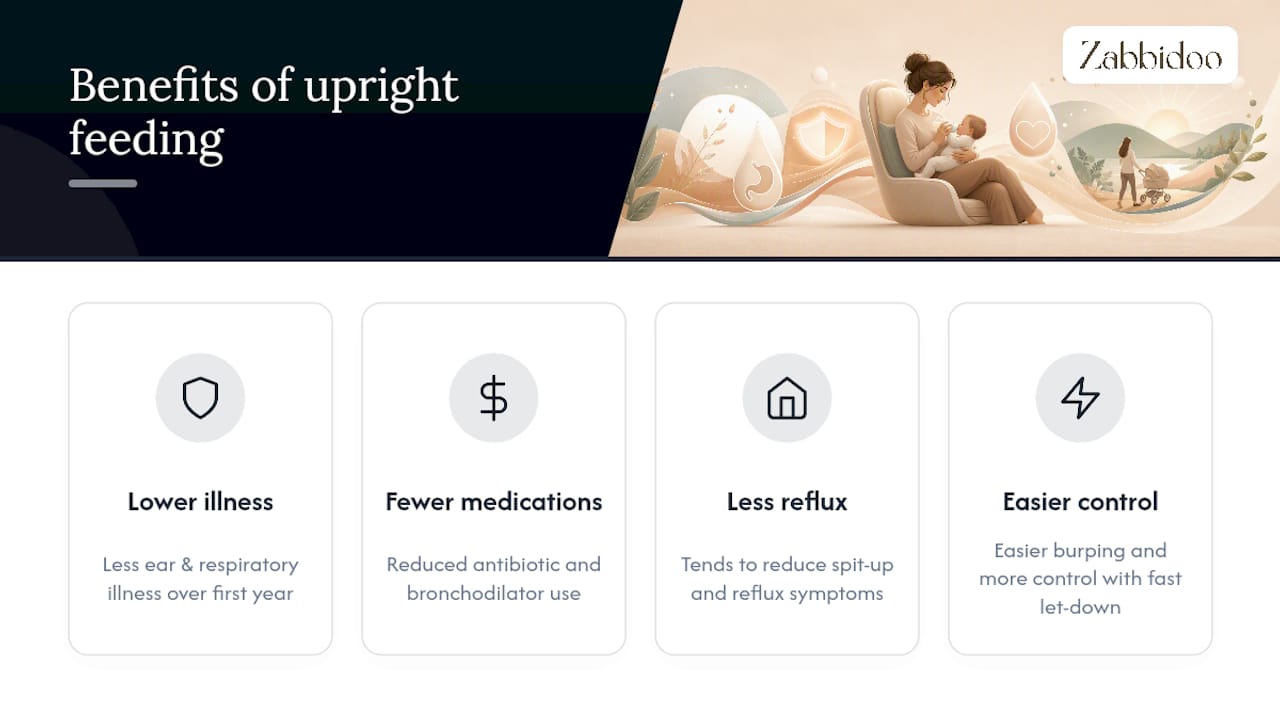
There’s a practical payoff too. Feeding upright makes burping easier mid-feed, tends to reduce spit-up, and gives you more control when let-down is fast and forceful, since gravity works against the flow instead of with it.
How do you set up a comfortable upright feeding space?
Your setup matters as much as the hold itself. A great koala position falls apart fast in a soft armchair with no back support.
- Pick a chair with a firm back and, ideally, armrests. A slight recline (not flat) is more sustainable than sitting bolt upright for a 40 minute feed.
- Use a footstool to raise your knees slightly, which shortens the distance baby needs to travel and reduces strain on your lower back.
- Pillows behind your lower back and under your feeding-side arm stop you slumping forward as fatigue sets in halfway through a feed.
- Stack whatever height support you have, a folded towel, a firm cushion, or a purpose-built nursing pillow, until baby’s mouth reaches your nipple without you bending forward.
This is where lift height genuinely matters. A flat cushion often isn’t enough once a baby is a few months old and heavier; a standard pillow can compress under weight and drop baby back down mid-feed. A firmer support built around an 18cm lift keeps that height consistent through a full feed instead of collapsing after ten minutes, which is exactly the kind of repeated repositioning that wears out your arms and back over weeks of feeding.
Pro Tip: Always keep a hand supporting baby’s neck, not the back of their head, so their chin can tilt up slightly. Pressing the skull forward tucks the chin down and shallows the latch every time.

What common problems come up with upright feeding, and how do you fix them?
Most upright-feeding frustrations trace back to one of three issues, and each has a fast fix you can try mid-feed rather than starting over from scratch.
- Shallow latch. Tip baby’s head back slightly so the chin leads, bring their shoulder blades toward you rather than just the head, and aim your nipple toward the roof of their mouth, not straight in. If it’s painful, slide a clean finger into the corner of their mouth to break suction, then reattach.
- Nipple pain that doesn’t ease after the first few sucks. Try a slight recline rather than bolt upright, alternate which hold you use feed to feed, and hand express a little milk first to soften the areola so baby can latch further back rather than clamping the tip.
- Gagging or coughing during feeds. Lean back a touch more to slow gravity-assisted flow, support baby’s chest so they can control the pace and pull off if needed, and rule out nasal congestion. Persistent gagging alongside a shallow latch is also worth checking against tongue tie.
Small, repeated position tweaks fix most of these within a day or two. If nothing improves, that’s the signal to stop self-adjusting.
When should you get professional help with feeding?
Some signs mean it’s time to stop troubleshooting alone. Persistent pain beyond the first week, a baby not gaining weight as expected, frequent choking or gagging regardless of position, or a strong suspicion of tongue tie all warrant a proper assessment rather than more DIY adjustments.
Contact the Australian Breastfeeding Association’s helpline, a local lactation consultant, or your GP. Bring a short feeding log (times, duration, which side) and, if you can, a video of an actual feed. Tongue tie assessment and other structural issues are worth discussing directly with a health professional, and background reading on breastfeeding difficulties including tongue and lip ties can help you understand what questions to ask.
A reasonable rule of thumb: try two genuine position adjustments over 24 to 48 hours. If things aren’t clearly better, book the appointment rather than waiting it out.
Is there really one “right” upright hold?
There isn’t, and I’d argue the parents who struggle most with upright feeding are the ones treating the koala hold or the upright cradle as a fixed technique they have to nail perfectly. They’re not exam answers. They’re starting points you bend to fit your body, your chair, and your particular baby’s head control that week.
The single tweak that fixes most discomfort I see discussed isn’t a hold swap at all, it’s height. Bring baby up to you before you try anything else.
For more detail on individual holds and troubleshooting, our guide to infant feeding positions that work covers ground this article doesn’t have room for, including options for reflux-specific feeding positions.
— Marietjie
Can a nursing pillow actually make upright feeding easier?
Every upright hold in this article works better when baby sits at breast height without you folding forward to reach them, and that’s precisely the gap Zabbidoo’s nursing pillow was built to close. Its 18cm lift raises baby to you instead of asking your spine to do the compromising, which matters most in the koala and hip straddle holds where a flat cushion simply isn’t tall enough once baby passes a few months old.

The compression-resistant fill keeps that height steady through a full feed rather than flattening out at the twenty-minute mark, and the stability-focused shape means less mid-feed repositioning when baby wriggles or straddles awkwardly. The breathable French flax linen cover is a small thing that matters on long feeds in warmer rooms. If you’re feeding an older or heavier baby, dealing with recurring shoulder and back strain, or find yourself reaching for a fourth cushion every session, it’s worth a proper look. Check the nursing pillow product page for sizing and fit details, or read our newborn feeding posture guide first if you want the reasoning before you buy.
Where can you read more on upright feeding?
For primary guidance beyond this article, the Australian Breastfeeding Association’s positioning resource covers hold variations in depth, and Raising Children Network offers photo-based position guidance. The PMC study on upright feeding and infant morbidity is worth reading directly if you want the clinical detail behind the reflux and ear-health claims. For fixing nipple pain specifically, our quick position fixes for nipple pain expands on the troubleshooting steps above.
Sources
- Feeding young infants with their head in upright position reduces respiratory and ear morbidity — PMC
- Positioning – how to hold and help your baby to breastfeed — Australian Breastfeeding Association
- Breastfeeding positions — Raising Children Network