

The three burping positions that work best after a feed are over-the-shoulder, sitting upright on your lap, and face-down across your lap. Raising Children Network confirms there is no single magic method — different babies respond to different holds, so having all three in your toolkit matters.
Here is a quick summary of why each works:
- Over-the-shoulder: keeps baby upright so swallowed air rises naturally to the top of the stomach, where it can escape easily.
- Sitting upright on your lap: a slight forward lean adds gentle abdominal pressure that helps air move up and out.
- Face-down across your lap: tummy contact creates mild pressure on the stomach, which can shift trapped wind.
All three positions suit newborns from birth, including the 0–3 month stage when head and neck control is still developing. Whatever hold you choose, always support the head and neck throughout. The Australian Breastfeeding Association notes that for some babies, a quiet shoulder hold or short upright cuddle is enough — no vigorous patting needed.
Key takeaways
The most effective burping approach combines the right position, correct timing, and a calm upright hold after the feed — technique and consistency matter more than force.
| Point | Details |
|---|---|
| Three core positions | Over-the-shoulder, sitting upright on lap, and face-down across the lap each suit different babies. |
| Burping timing | Bottle-fed: every 60–90 mL; breastfed: when switching breasts; always try at the end of a feed. |
| Upright time after feeds | Keep baby upright for 10–15 minutes after feeding to reduce spit-up. |
| If baby won’t burp | Switch positions, try gentle back rubs or bicycle legs, and stop if baby is calm and settled. |
| Zabbidoo nursing pillow | An 18 cm lift and stable fill make it easier to maintain a comfortable upright hold during and after feeds. |
Table of Contents
- When should you burp your baby after feeding?
- How to do each of the three burping positions
- What to do after your baby burps
- What if your baby won’t burp?
- Common mistakes to avoid when burping your baby
- What the evidence says about burping and feeding ergonomics
- A practical note on finding what works
- Zabbidoo’s nursing pillow makes upright holds easier
- Sources
When should you burp your baby after feeding?
Timing matters as much as technique. Nemours KidsHealth recommends burping bottle-fed babies every 60–90 mL (roughly 2–3 oz) during a feed, not just at the end. For breastfed babies, burp at natural pauses or when switching breasts. Always attempt a burp at the end of every feed, regardless of method.
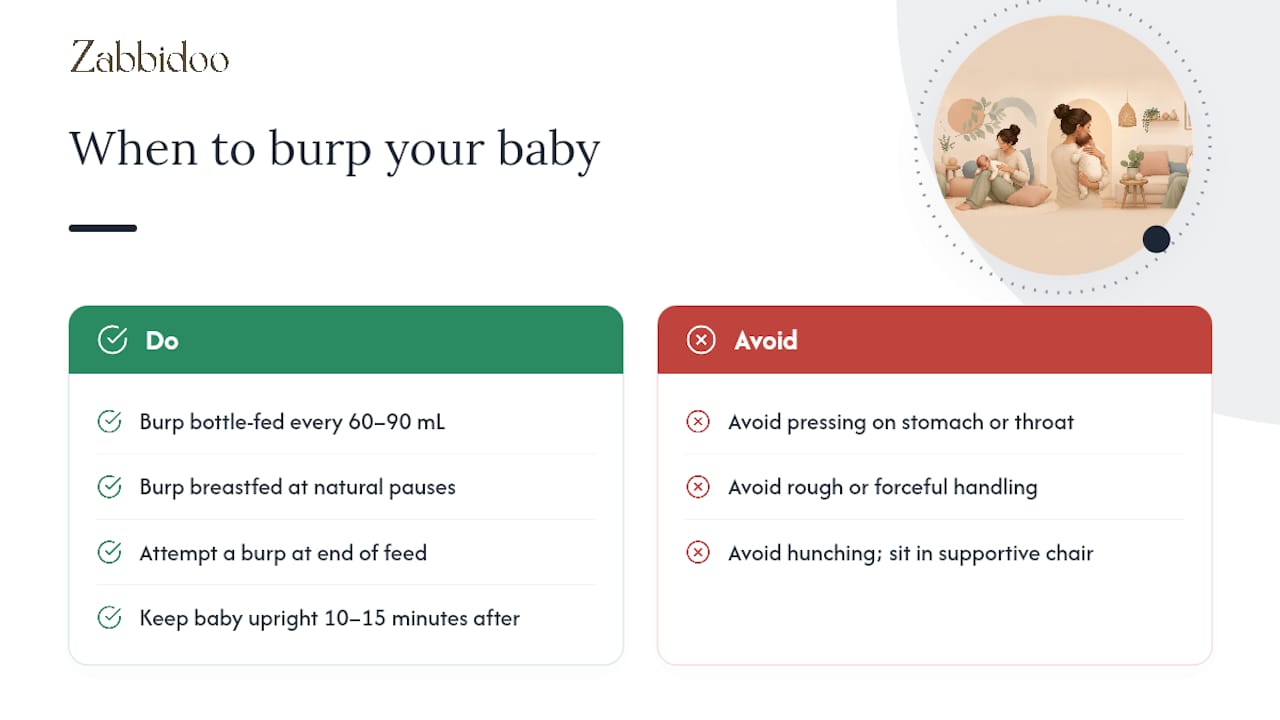
After the feed is done, keep your baby upright for around 10–15 minutes. That window lets gravity do the work and reduces the chance of spit-up.
Safe handling basics apply every time: support the head and neck, keep the spine in a neutral position, and never press on the stomach or throat. Rough or forceful handling does not produce a faster burp — it just unsettles the baby.
Pro Tip: Sit in a supportive chair with your feet flat on the floor when burping. Hunching over a newborn for 10–15 minutes strains your lower back quickly. Good newborn feeding posture protects you as much as it helps your baby.
How to do each of the three burping positions
Position 1: Over the shoulder
- Hold your baby against your chest with their chin resting on your shoulder.
- Use one hand to support the bottom and keep the baby secure.
- Place your other hand flat on the mid-to-low back, not the upper spine.
- Pat or rub gently in slow upward strokes.
- If no burp comes after 1–3 minutes, switch to another position rather than increasing pressure.
Position 2: Sitting upright on your lap
- Sit your baby on your thigh, facing slightly away from you.
- Lean them forward about 30 degrees — not slumped, just tilted.
- Support the head by cupping your palm under the chin, with the heel of your hand resting lightly on the chest. Keep fingers away from the throat.
- Use your free hand to pat or rub the mid-back.
- MedlinePlus confirms that this upright posture moves air to the top of the stomach, and the forward lean adds gentle pressure to help it eject.
Position 3: Face-down across your lap
- Lay your baby face-down across both thighs, with their head slightly higher than their chest. Turn the head to one side so the airway stays clear.
- Support the head with one hand so it does not hang unsupported.
- Pat or rub the back gently with the other hand.
- Avoid this position if your baby has heavy spit-up or has just vomited — the face-down angle can make reflux worse.
A note on timing: Try each position for 1–3 minutes before switching. Spending longer than that on one hold rarely produces a burp and can overstimulate a tired newborn. The goal is comfort, not a mechanical routine.
What to do after your baby burps
Once a burp comes, keep your baby upright for the full 10–15 minutes. A cloth over your shoulder before you start saves you a clothing change — spit-up often follows a burp, especially in the newborn weeks.
If spit-up does occur, wipe gently without rubbing the tummy, check that your baby is breathing comfortably, and settle them in a calm upright cuddle. Avoid laying them flat immediately after a feed.
When to call your GP or maternal child health nurse: Seek advice if your baby vomits forcefully or frequently, is not gaining weight as expected, seems in persistent pain after feeds, or shows signs of reflux or GERD. These are not problems to manage with burping technique alone.
The Australian Breastfeeding Association points out that some babies simply do not burp after every feed, and that is usually fine if they are settled and feeding well.
What if your baby won’t burp?
Try these steps before giving up or increasing pressure:
- Switch positions. Move from over-the-shoulder to sitting upright, or try face-down across the lap. A change in angle often shifts trapped air.
- Gentle back rubs. Slow circular or upward strokes on the mid-back are more effective than firm pats.
- Bicycle legs. Lay your baby on their back and gently cycle their legs to help move gas through the digestive tract.
- Tummy massage. With your baby on their back, use two fingers to make gentle clockwise circles below the navel.
- Stop and cuddle. If your baby is calm and settled after a few attempts, a quiet upright hold is often enough. Cleveland Clinic notes that many babies will not burp every time, and that is usually fine.
If repeated handling seems to increase fussiness or spit-up, put the patting aside. A still, upright cuddle lets the body do the work.
Pro Tip: For babies with reflux, upright holds and gentle pats are generally preferred over repeated repositioning. Less movement, more stillness.
Common mistakes to avoid when burping your baby
Most burping problems come down to a handful of avoidable errors.
Pressing on the stomach or throat. The hand supporting the chest should rest lightly — fingers never pressing into the abdomen or wrapping around the throat. Pressure in the wrong place can cause discomfort or trigger vomiting.
Letting the head flop. A newborn’s neck muscles cannot hold the head steady. Any position where the head is unsupported, even briefly, carries a risk of strain. Keep one hand on the head at all times.
Handling roughly to force a burp. Firm, fast patting does not work better than gentle strokes. Safe infant handling guidance is clear: rough handling when soothing or burping a baby carries real safety risks and should always be avoided.
For babies with reflux or GERD: Favour upright positions and avoid the face-down-across-the-lap hold after heavy feeds. If your baby has a diagnosed reflux condition, check with your GP or paediatrician before settling on a burping routine.
Age matters too. Newborns need more active head support than a three-month-old who has started developing neck strength. Adjust your grip as your baby grows.
What the evidence says about burping and feeding ergonomics
The three recommended positions — over-the-shoulder, sitting upright, face-down across the lap — appear consistently across clinical and authoritative sources. Timing guidance is equally consistent: every 60–90 mL for bottle feeds, at breast switches for nursing, and 10–15 minutes upright after every feed.
| Guidance point | Recommendation | Source |
|---|---|---|
| Bottle-feed burping frequency | Every 60–90 mL (2–3 oz) | Nemours KidsHealth |
| Breastfeed burping timing | When switching breasts | Nemours KidsHealth |
| Upright time after feeds | 10–15 minutes | Nemours KidsHealth |
| Recommended positions | Over-shoulder, sitting, face-down | Raising Children Network |
Beyond technique, caregiver posture shapes how well burping actually goes. When you are hunched forward or holding your baby at an awkward angle, maintaining a stable upright hold for 10–15 minutes becomes genuinely hard. Possums and other postnatal support resources highlight that a neutral spine and proper support height make it easier to keep baby in a safe, settled position throughout. An ergonomic lift that brings baby up to your level, rather than pulling you down to theirs, reduces strain on your neck, back, and wrists during those repeated daily holds.
- Stable upright holds are easier to maintain when the caregiver is not compensating for a low or collapsing support surface.
- Reducing caregiver strain means less repositioning, which means less disturbance for the baby during the settling window.
- Good ergonomic feeding guidance applies to burping holds just as much as to the feed itself.
A practical note on finding what works
Most parents try more than one position before landing on the one their baby responds to. That trial-and-error is not a sign of doing it wrong — it is just how newborn care works. What matters most is staying gentle, reading your baby’s cues, and not treating every feed as a test you need to pass with a burp.

If feeding or wind problems persist despite trying different approaches, speak with your GP, maternal child health nurse, or a lactation consultant. Persistent discomfort after feeds deserves a professional eye, not just a different patting technique.
Zabbidoo’s nursing pillow makes upright holds easier
Holding a newborn upright for 10–15 minutes after every feed, multiple times a day, is harder than it sounds — especially when your back is already under strain. The Zabbidoo nursing pillow is built specifically to solve that problem.

Its 18 cm lift brings baby up to a comfortable height so you are not rounding your shoulders or craning your neck to maintain a stable hold. The high-compression-resistant fill keeps its shape feed after feed, so the support you start with is the support you finish with. The breathable French flax linen cover stays cool against your baby’s skin, and the machine-washable components make the inevitable spit-up clean-up straightforward.
For upright settling after a feed, a stable, height-appropriate support makes a real difference to how long you can comfortably hold that position. Visit the Zabbidoo nursing pillow page to see the full specs and order.
Sources
- How to burp a baby and get rid of wind
- MedlinePlus — burping position images
- Burping Your Baby | Nemours KidsHealth
- Purple crying — Don’t Shake
- Possums — infant feeding and posture resources
- Wind in babies — Australian Breastfeeding Association
This article is general information, not a substitute for advice from a qualified doctor. Consult a qualified healthcare professional about your own circumstances before acting on anything here.