

A deeper latch and correct body alignment stop most nipple pain fast, often within a feed or two. The fix is almost always mechanical: bring baby to breast height, line up nose to nipple, and wait for a wide, open mouth before latching. The NHS and the Australian Breastfeeding Association both point to attachment, not anatomy, as the usual cause of pain. A meta-analysis in BMC Pregnancy and Childbirth even found the laid-back position tied to significantly lower nipple pain and trauma than more traditional holds.
Try this right now:
- Break the latch gently (slide a clean finger into the corner of baby’s mouth).
- Wait until baby’s mouth is wide open, like a yawn, before bringing them back on.
- Aim your nipple toward the roof of the mouth, not straight in.
Key Takeaways
Correcting body alignment and achieving a nose-to-nipple, deep latch resolves most breastfeeding nipple pain faster than any cream or product alone.
| Point | Details |
|---|---|
| Fix alignment first | Line up baby’s nose with your nipple and bring baby to breast height before latching. |
| Try laid-back position | Reclining lets baby self-attach and is linked to lower nipple pain and trauma in research. |
| Watch for red flags | Persistent pain, cracking, fever or a breast lump need prompt midwife or GP attention. |
| Vary your holds | Switching between cross-cradle, football and side-lying rests sore spots and improves drainage. |
| Use ergonomic support | A stable, height-elevated pillow like Zabbidoo helps you hold a correct latch position without hunching. |
Table of Contents
- What causes nipple pain positioning problems in the first place?
- Quick checklist to run at your next feed
- Which breastfeeding positions actually reduce nipple pain?
- What does a correct, pain-free latch actually look like?
- How does posture and support gear affect your latch?
- When is nipple pain a sign of something more serious?
- How do you help sore nipples heal between feeds?
- A nursing pillow that actually holds its shape through a feed
- Frequently asked questions
- Sources
What causes nipple pain positioning problems in the first place?
Nipple pain almost always starts with a shallow latch. When baby’s mouth doesn’t open wide enough, the nipple sits near the front of the mouth and gets pinched against the hard palate with every suck. A correct, pain-free latch lands the nipple further back, near the soft palate, where compression doesn’t hurt and milk actually transfers well.
This is why positioning and latch are really the same problem wearing two names. Get the position right (baby’s body aligned, brought in close, nose level with the nipple) and the latch tends to follow. Force the latch without fixing the position, and you’re fighting the mechanics every single feed.
Quick checklist to run at your next feed
Before you assume something’s wrong with you, run through this in under a minute:
- Is baby’s whole body facing yours, tummy to tummy, not twisted at the neck?
- Is baby’s nose roughly level with your nipple before latching?
- Did you wait for a wide gape, mouth open like a big yawn, before bringing baby on?
- Is baby’s chin pressed firmly into the breast?
- Are you supporting baby’s shoulders and neck, not pushing on the back of the head?
That last point matters more than most mums realise. Pushing on the back of baby’s head often triggers a bracing reflex where they arch backward and pull off, taking a chunk of nipple with them. Support the shoulders instead and let the head tip back freely.
If the checklist reveals a problem, break the latch and start again rather than trying to “push through” the pain. Re-latching takes ten seconds and saves days of soreness.
Pro Tip: Change the pillow height before you change the position. Most shallow latches happen because mum leans forward to reach baby, rather than baby being lifted to breast height in the first place.
Which breastfeeding positions actually reduce nipple pain?
Different holds shift where the pressure lands on your nipple, so switching positions is one of the simplest fixes going. Here’s how to try the four that matter most.
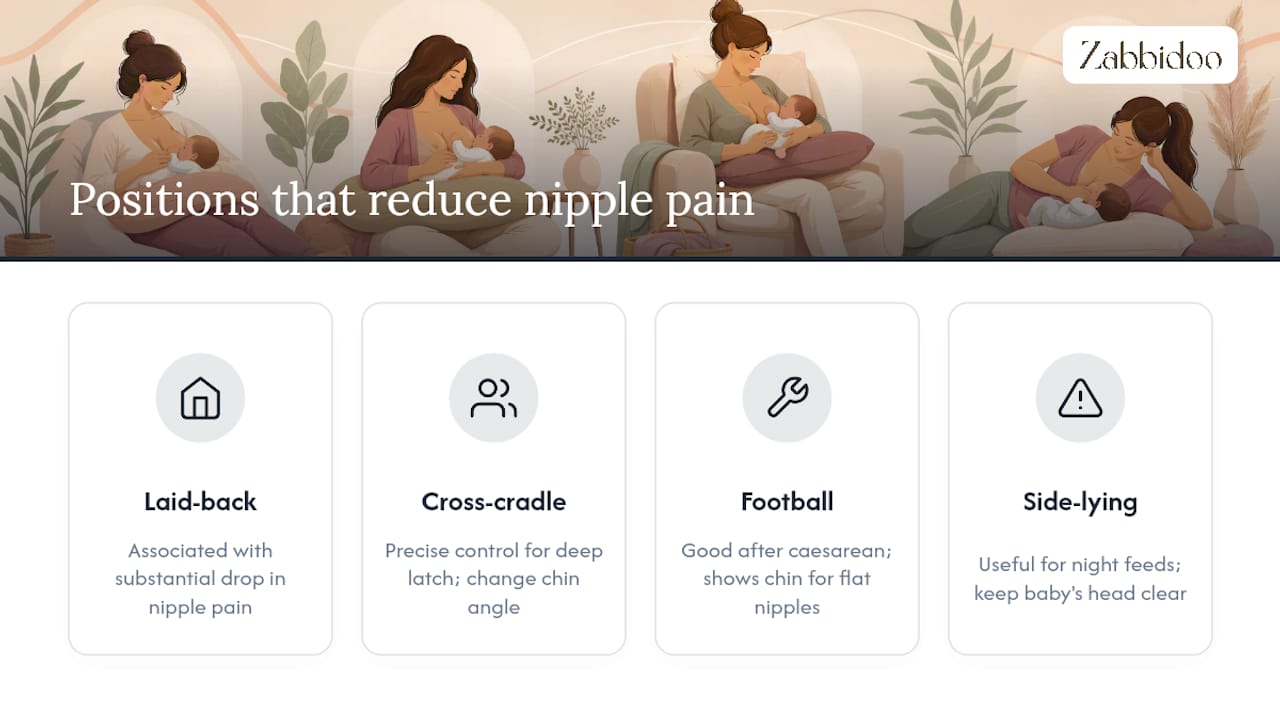
1. Laid-back (biological nurturing). Recline back at roughly 45 degrees, supported by cushions, and lay baby tummy-down on your chest. Gravity does most of the work: baby’s own rooting reflex takes over, and they tend to self-attach with a deeper latch than positions where you’re doing all the steering. The meta-analysis found this position associated with a substantial drop in reported nipple pain and trauma compared with cradle-style holds, which is why it’s worth trying first if you’re struggling.

2. Cross-cradle. Hold baby’s body with the arm opposite the feeding breast, supporting the neck and shoulders (not the head) with your open hand. This gives you precise control to guide baby onto a deep latch, which makes it useful in the early weeks while you’re both still learning.
3. Football (clutch) hold. Tuck baby under your arm like a rugby ball, feet pointing behind you, supported on a pillow at breast height. This one is a standout after a caesarean because there’s no weight on your abdomen, and it also works well for larger breasts or flatter nipples where you need more visibility and control over the chin.
4. Side-lying. Lie on your side with baby facing you, tummy to tummy. Useful for night feeds and for resting sore nipples, but keep baby’s head clear of pillows and never leave baby unsupervised in this position.
If pain sits on one side of the nipple, try a hold that changes the angle of baby’s chin, cross-cradle to football, for instance. Different holds put pressure on different parts of the nipple, and varying position also helps different segments of the breast drain properly.
What does a correct, pain-free latch actually look like?
Aim for:
- A big mouthful, more breast tissue than nipple, with lips flanged outward like a fish
- Chin pressed into the breast, nose lightly touching or just clear of it
- More areola visible above baby’s top lip than below
- Rounded, full cheeks with slow, rhythmic sucking and audible swallowing
Avoid:
- Nipple sitting right at the front of baby’s mouth
- Clicking or smacking sounds while feeding
- Dimpled or caved-in cheeks
- Pain that continues past the first few seconds of latching
The HSE notes that a correct latch lets baby suck, swallow and breathe comfortably, and those visible cues are how you confirm it’s working, not just guess.
Pro Tip: If pain persists past the first few sucks despite a textbook-looking latch, don’t keep pushing through it. That pattern sometimes points to tongue-tie or a high palate, and it’s worth asking a lactation consultant to check baby’s mouth rather than assuming your technique is at fault.
How does posture and support gear affect your latch?
Bringing baby to your breast, rather than leaning your breast down to baby, keeps your spine neutral and lets baby take a deep, comfortable mouthful instead of a shallow grab. The NHS specifically recommends raising baby to nipple height rather than hunching forward to meet them.
A well-designed nursing pillow does exactly this job: it lifts baby to the right height and frees both your hands to guide the latch instead of holding baby’s whole weight.
- Set pillow height so baby’s mouth meets your nipple without you tilting forward.
- Support your feet on a low stool if your chair is too high, it changes your hip angle and reduces strain.
- Rest your feeding-side arm fully on the pillow rather than holding it unsupported.
Pro Tip: Check the pillow doesn’t sag under baby’s weight partway through a feed. A pillow that compresses drops baby lower and pulls you straight back into that forward lean you’re trying to avoid.
When is nipple pain a sign of something more serious?
Some tenderness in the first few days as your nipples adjust is common and usually settles fast. Pain that persists at every feed, or gets worse, is not something to push through.
Contact your midwife, a lactation consultant, or your GP if you notice:
- Pain lasting throughout the whole feed, every feed
- Cracking, bleeding, or open sores
- White spots or blisters on the nipple
- Fever, a hot or lumpy breast, or flu-like aches, which can signal mastitis and needs prompt medical attention
How do you help sore nipples heal between feeds?
Small, low-effort habits between feeds make a real difference to healing:
- Rub a little of your own expressed milk onto the nipple and let it air-dry, it has natural protective properties.
- Skip soap on your nipples; it strips natural oils and dries out already-tender skin.
- Change breast pads often and avoid plastic-backed ones, which trap moisture against the skin.
- Use 100% pure lanolin for cracked nipples if needed, and check with your midwife or GP before combining it with any other topical treatment.
Pro Tip: Cotton bras and pads breathe far better than synthetic ones, and that alone can shave a day or two off healing time.
Small changes, real relief
Most of the nipple pain I hear about comes down to one of two things: baby wasn’t quite deep enough, or mum was leaning forward without realising it. Fixing both usually takes minutes, not weeks.
My advice is always the same order: fix the latch first, then add ergonomic support to make that fixed position easy to hold for a whole feed. If pain doesn’t ease after a few honest attempts at repositioning, that’s your cue to get hands-on help rather than white-knuckling through another feed.
A nursing pillow that actually holds its shape through a feed
Most nursing pillows on the market flatten within weeks, which drops baby lower and drags you straight back into the forward lean that causes shallow latching in the first place. Zabbidoo was built to fix that specific failure.

Its 18cm lift brings baby to nipple height without you hunching forward, directly supporting the alignment principles covered above. High compression resistance means it holds that height feed after feed instead of sagging under baby’s weight partway through, and the stability-focused design cuts down on the constant repositioning that interrupts a deep latch. The cover is hypoallergenic French flax linen, machine washable, with a built-in pocket and carry handle for feeds away from home.
None of that replaces good technique. Try the positioning fixes above first, then use a pillow like this to make the correct posture easy to hold for an entire feed rather than fighting gravity the whole time. Have a look at the nursing pillow range and see which fits your feeding setup.
Frequently asked questions
What is the fastest way to fix nipple pain positioning during a feed? Break the latch, wait for baby’s mouth to open wide, and re-latch with the nose level to your nipple and chin pressed into the breast. Most pain eases within one or two feeds once alignment is corrected.
Which breastfeeding position causes the least nipple pain? The laid-back position is linked to the lowest reported nipple pain and trauma in research, largely because baby self-attaches with gravity’s help rather than being guided into a shallow latch.
Is it normal for nipples to hurt for the first few days of breastfeeding? Mild tenderness in the first few days as nipples adjust is common. Pain that continues through every feed, or that involves cracking or bleeding, is not normal and needs an attachment check.
Can a nursing pillow really reduce nipple pain? A stable, height-elevated pillow brings baby to nipple level so you don’t lean forward, which supports a deeper latch. It works alongside correct technique, not instead of it.
When should I see a lactation consultant instead of trying to fix it myself? If pain persists despite correcting position and latch over several feeds, or you notice cracking, bleeding, or signs of tongue-tie, get a hands-on assessment rather than continuing to troubleshoot alone.
This article is general information, not a substitute for advice from a qualified doctor. Consult a qualified healthcare professional about your own circumstances before acting on anything here.
Sources
- Positioning and attachment – NHS
- Positioning – Australian Breastfeeding Association
- Breastfeeding with sore nipples – La Leche League International
- Laid‑back breastfeeding and lactation‑related nipple problems (meta‑analysis) – BMC Pregnancy and Childbirth
- Positioning and attachment – HSE