

Yes, a pillow makes a good tummy time tool for short, supervised sessions on a firm, flat floor, but it’s never a substitute for a safe sleep surface. Position your baby with elbows and forearms forward, face fully clear of fabric, and stay within arm’s reach the whole time. A stable, compression-resistant support like the Zabbidoo nursing pillow helps keep that position steady rather than collapsing under your baby’s weight.
TL;DR:
- Use only firm, flat floors like a carpet or mat for tummy time, avoiding soft surfaces such as beds or sofas due to risk of suffocation and falls.
- Ensure the pillow is stable, compression-resistant, and placed correctly under the chest with elbows and forearms forward, never under the chin or face.
- Limit newborn tummy time sessions to 3-5 minutes, gradually increasing as the baby’s neck and shoulder strength develop, with close supervision at all times.
- Rotate between support pillows, lap, and direct floor practice to promote motor development and reduce reliance on incline positioning.
- Confirm the pillow’s firmness with a hand press before each use, and move the baby immediately to a safe sleep surface if they show signs of fatigue or fall asleep.
Table of Contents
- Your quick tummy time pillow use safety checklist
- How do you position a baby on a tummy time pillow?
- How long should tummy time last at each age?
- Which surfaces are safe, and what should you avoid?
- What mistakes should you watch for, and how do you fix them?
- How do you move from a pillow to independent floor tummy time?
- Which pillow features actually matter for safe tummy time?
- Why we designed a pillow around stability, not just comfort
- Where the Zabbidoo nursing pillow fits into your routine
- Where this guidance comes from
- Sources
Your quick tummy time pillow use safety checklist
Run through this before every session, not just the first one.
- Set the pillow on a firm, flat floor. A carpeted room or a clean mat or blanket underneath works well.
- Wait 20 to 30 minutes after a feed. Your baby needs to be awake and alert, not drowsy or mid-digest.
- Check the face and airway are completely free of fabric before you start, with elbows and forearms resting over the pillow.
- Test the pillow’s firmness with your own hand pressure. If it sinks easily, it’s not stable enough for this job.
- Stay within arm’s reach for the entire session and stop immediately if your baby seems distressed.
Pro Tip: Press down on the centre of the pillow with your palm before placing your baby. If your hand sinks more than a couple of centimetres, the pillow lacks the compression resistance needed for safe support.
Active supervision isn’t optional here. Babies can slump or lose head control in seconds, and a pillow that seemed fine a minute ago can become a suffocation risk if you’re not watching closely.
How do you position a baby on a tummy time pillow?
Getting the position right matters more than the pillow itself. Here’s the order to work through:
- Place the pillow correctly. The inner curve should sit under your baby’s upper chest and armpits, never under the chin or face. If it’s pushed too high, the face tips forward into the fabric.
- Bring the arms forward. Drape both elbows and forearms over the top edge of the cushion so they form a tripod with the chest. This is the single biggest thing parents get wrong. Left to gravity, arms drift down beside the body and the baby simply drapes over the pillow face first, which does nothing for neck strength and adds real risk.
- Check the hips and legs. They should stay flat on the floor behind the pillow. If the hips lift or the pillow rides too far under the belly, the spine hyperextends and the position becomes uncomfortable fast.
- Get down to eye level. Lie on the floor facing your baby, or use a small toy or mirror at face height. Direct engagement is one of the most reliable ways to extend tolerated tummy time, more so than toys placed off to the side.
- Watch for sliding. If your baby’s chin drops toward the pillow or the face angles down, slide two fingers under the chin and gently lift while repositioning the shoulders back onto the support. If the airway looks compromised at any point, lift your baby off immediately and restart once settled.
That last step is the one parents rush. A baby who’s slid three or four centimetres forward on a pillow can go from comfortable to face down surprisingly quickly, so check position every 30 to 60 seconds rather than assuming it will hold.
How long should tummy time last at each age?
Session length depends far more on your baby’s age and tolerance than on the clock.
- Newborns: aim for 2 to 3 short sessions a day, each lasting 3 to 5 minutes. That’s genuinely all most newborns can manage before fatigue sets in.
- Around 4 months: build toward a cumulative 10 to 15 minutes, spread across three sessions daily, as neck and shoulder strength improve.
- Signs your baby is ready for more: steady head lifts held for several seconds, less fussing at the start of a session, and pushing through the forearms rather than just resting on them.
- Signs to pull back: red-faced straining, crying that doesn’t settle with repositioning, or a session that’s clearly shorter on tolerance than the day before. Try a different position (lap or chest tummy time) instead of pushing through.
If your baby was born premature or has a diagnosed reflux condition, timing and positioning both need a closer look — nursing parents can find more details on safe practices in whitening strips while breastfeeding: what nursing parents need to know. Reflux can make lying prone genuinely uncomfortable straight after a feed, and prematurity often means motor milestones arrive on a different schedule. A paediatrician, maternal health nurse or paediatric physiotherapist can tell you whether to adjust frequency, timing, or the angle of support you’re using.
Which surfaces are safe, and what should you avoid?
The floor rule sounds almost too simple to repeat, but it’s the one parents bend most often when a baby’s fussing and the couch is right there.
- Always use a firm, flat floor. Carpet with a clean mat, or a hard floor with a folded blanket, both work.
- Never place a pillow on a bed, sofa, or any soft, elevated surface. These add fall risk on top of suffocation risk, and a pillow that already compresses under body weight sinks even further into soft bedding.
- Wait 20 to 30 minutes after a feed before starting, which reduces spit-up and general discomfort during the session.
- Stay close enough to touch your baby throughout, watching the angle of the head and airway rather than glancing over occasionally.
- Clear the immediate area of loose bedding, spare pillows, and soft toys that could end up near the face if your baby shifts position.
Tummy time should always happen on a firm, flat floor. Pillows and soft surfaces are for supervised play only, never for unsupervised sleep or lounging, and that distinction is worth repeating every time you set up a session.
The napping trap catches a lot of exhausted parents. A baby who drifts off mid tummy time needs to be moved to a proper flat sleep surface straight away, even if that means interrupting a nap that seemed peaceful. A nursing pillow that’s fine for five minutes of supervised play is not a safe place for an unattended baby to sleep, full stop.
What mistakes should you watch for, and how do you fix them?
Most tummy time problems trace back to one of four habits, and each has a fast fix.
- Arms dangling at the sides. The fix is simple: physically bring the elbows and forearms forward so they rest on top of the pillow, forming that tripod base rather than letting your baby collapse chin first.
- The pillow collapses under pressure. Swap to a firmer, more compression-resistant cushion, or fold a towel underneath the existing one for extra lift. A pillow that flattens the moment your baby pushes down defeats the purpose entirely.
- Using the pillow as a sleep spot. The moment your baby’s eyes close or breathing slows into sleep rhythm, transfer them to a safe, flat sleep surface immediately. Don’t let “just a few more minutes” become the default.
- Only ever using the pillow. Rotate between pillow-supported time, lap tummy time, and bare-floor practice. Leaning on the incline for every single session can delay the push-up strength your baby needs to eventually manage without any support at all.
Each of these takes seconds to correct once you know what to look for, which is really the whole point of a checklist you actually use rather than one you read once and forget.
How do you move from a pillow to independent floor tummy time?
A pillow should work as a stepping stone, not a permanent fixture. Here’s a sensible sequence to follow as strength builds:
- Start chest to chest. Lay your baby prone on your own chest while reclined, which is the gentlest possible incline and builds early tolerance.
- Move to the pillow. Once your baby handles chest time well, transition to the nursing pillow incline for slightly longer, more structured sessions.
- Try a low wedge on the floor. A shallower incline than the pillow, still on a firm floor, asks a little more of the neck and shoulders.
- Finish on bare floor with toys. Full independent tummy time, no incline at all, with a toy or mirror to hold interest.
Advance to the next stage when your baby consistently pushes through the forearms and holds their head up for several seconds without your prompting. There’s no fixed timeline for this. Some babies move through all four stages within a few weeks; others take longer, and that’s completely normal. Mixing positions within the same day, rather than sticking to one stage exclusively, builds a broader base of motor skills and keeps the whole exercise from feeling like a chore for either of you.
Which pillow features actually matter for safe tummy time?
Not every cushion marketed for babies holds up under the weight and movement of active tummy time. Four features do the real work: firm support that resists sinking, high compression resistance so the shape holds under pressure, a stable base that doesn’t tip or slide on the floor, and a breathable, washable cover for the inevitable mess.
- Firm support keeps the face from sinking into the fabric, which is the core safety issue with soft cushions.
- Compression resistance means the pillow holds its shape session after session instead of flattening within weeks.
- A stable base reduces how often you need to reposition your baby mid session.
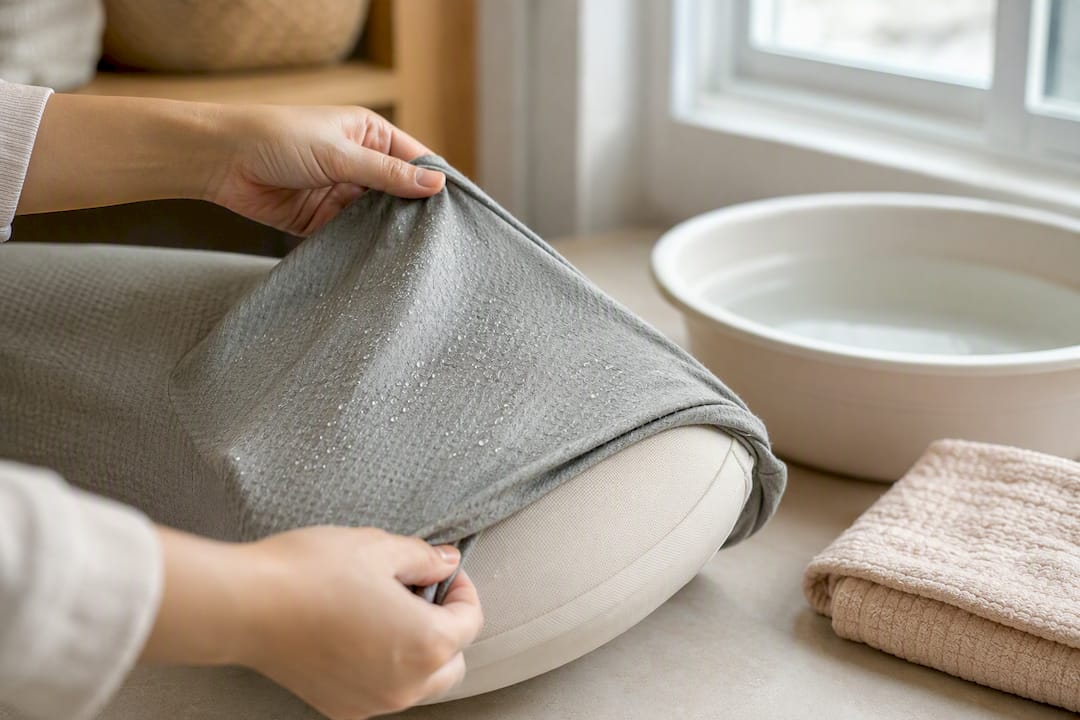
- A breathable, washable cover matters more than it sounds. Reflux, drool, and the occasional feed all land on this pillow eventually.
The Zabbidoo nursing pillow’s 18 centimetre lift and high compression resistance were built primarily for feeding posture, but the same qualities carry over directly to tummy time: a taller, firmer support reduces sliding and keeps the airway clear more reliably than a low, soft cushion that gives way under weight. Set it up on the floor rather than a raised surface, check firmness with a hand press before every session, and treat it as one tool among several rather than the only place tummy time happens. For a broader look at pillow safety across feeding and play, Zabbidoo’s guide on choosing safe baby pillows covers the same priorities in more depth.
Pro Tip: If the cover feels the slightest bit damp from drool or spit-up, swap it before the next session. A slightly slick surface makes sliding, and repositioning, more likely.
Why we designed a pillow around stability, not just comfort
Marietjie’s note on this one is simple: most nursing pillows are built for softness first, and stability becomes an afterthought. That’s backwards for a product that’s also going to carry a baby’s weight during tummy time. Getting the lift and the compression resistance right was about solving the feeding posture problem first, but the same firmness that stops a pillow collapsing under a nursing baby is exactly what stops a face sinking during supported play. If your baby has reflux, was born premature, or has any diagnosed muscle tone concern, talk to your paediatrician before building a routine around any incline, pillow included.
— Marietjie
Where the Zabbidoo nursing pillow fits into your routine
If you’ve read this far, you already know the features that matter: firm support, high compression resistance, a stable base that doesn’t slide, and a cover you can actually wash after the daily mess of feeding and play. The Zabbidoo nursing pillow was built around exactly those priorities, starting with its 18 centimetre lift for feeding posture and carrying straight through to short, supervised tummy time sessions on the floor.

It suits parents juggling both jobs with one product. Feeding support during the day, a stable prop for a few minutes of supervised tummy time afterwards, and a machine-washable cover for the inevitable spills between. The built-in pocket keeps a muslin or toy within reach, and the handle makes it easy to carry between rooms as your routine shifts. Check the product page for sizing and availability, or add gift wrapping if you’re buying ahead of a friend’s due date.
Where this guidance comes from
The safety and timing advice here draws on RCH’s Kids Health Info fact sheet on tummy time, paediatric occupational therapy guidance on using an incline as a modification, and practical positioning notes from TopHealthGear and Nestlé Family. For more on general infant pillow safety, see Zabbidoo’s pillow safety overview.
This article is general information, not a substitute for advice from a qualified doctor. Consult a qualified healthcare professional about your own circumstances before acting on anything here.
Sources
- Kids Health Info : Tummy time for your baby
- Tummy time for your baby: advice from a pediatric OT
- How to Use a Tummy Time Pillow Safely?
- Tummy time ideas — Nestlé Family