

The single most useful measurement for most breastfeeding parents is a lift that generally brings a newborn to breast level when you’re seated, so your shoulders stay down and your neck stays neutral instead of craning forward for every feed.
Here’s what that means in practice:
- Target lift: 15–20 cm (roughly 6–8 inches) suits most adults seated in a standard chair or sofa
- Zabbidoo’s 18 cm lift sits squarely in that range, designed specifically to bring baby up to the parent rather than the parent hunching down
- Petite parents (under 160 cm) may find 14–16 cm sufficient; taller parents often need 18–20 cm or an adjustable design
- Quick first step: sit in your usual feeding chair, measure from your lap surface to your nipple line with a tape measure — that number is your starting target
If you’re shopping online, check the product’s listed height first. Length and width matter for stability, but height is the number that determines posture.
Key takeaways
The right nursing pillow size comes down to one measurement: the height of lift that brings your baby to breast level without you hunching, typically 15–20 cm for most seated adults.
| Point | Details |
|---|---|
| Target lift height | Aim for 15–20 cm; measure from lap to nipple line to find your specific number. |
| Compression resistance | Press the core before buying — a pillow that sinks under load loses the lift you need. |
| Shape selection | C-shaped pillows suit most first-time parents; U-shaped adds back support for tandem feeding. |
| Safety non-negotiables | Never leave baby unattended on a nursing pillow; firmness is a safety feature, not a flaw. |
| Zabbidoo’s approach | The 18 cm lift with a high-compression core holds height through a full feed and suits most standard chair heights. |
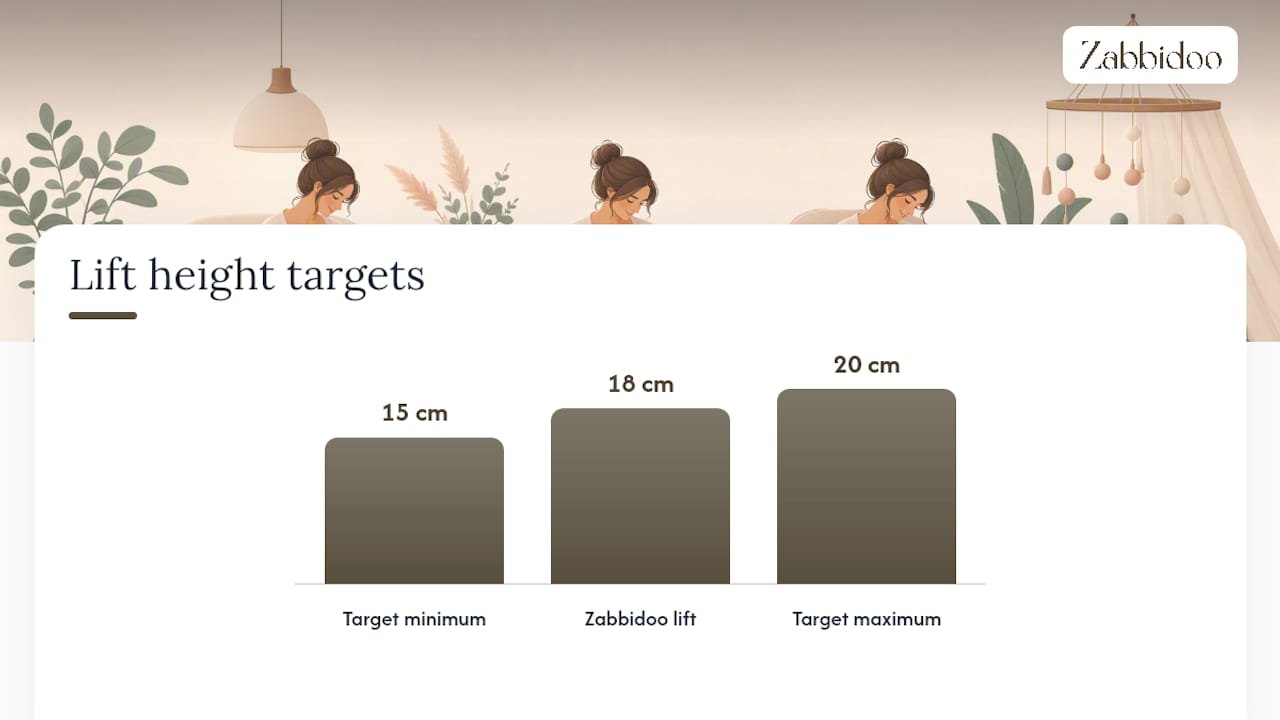
Table of Contents
- How pillow shape changes where the lift actually lands
- How to measure your body and chair to find the right pillow height
- What the numbers on product labels actually mean
- Safety rules: what firmness standards mean for you and your baby
- Can a regular bed pillow fill in for a nursing pillow?
- Why lift and compression resistance matter more than you’d think
- What I’d tell every new mum about height and stability
- The Zabbidoo nursing pillow: built around the 18 cm lift
- Sources
How pillow shape changes where the lift actually lands
Shape is not just aesthetics. It determines where the height is delivered, how the pillow wraps your body, and whether it stays put during a feed.
Shopping guides consistently list C-shaped and U-shaped pillows as the most versatile options, and for good reason.
C-shaped pillows wrap around one side of your torso. They’re compact, easy to position, and work well for cradle and cross-cradle holds. Most first-time breastfeeding parents start here because the shape is intuitive and the footprint is manageable. The trade-off: they offer less back support than a full wrap.

U-shaped pillows encircle the whole torso, which gives you back support on both sides and makes tandem feeding (twins or two babies) far easier. They’re bulkier, though, and can be awkward in smaller chairs or on a sofa with armrests.
Wrap or wearable pillows fasten around your waist with a strap or clip. The advantage is that they move with you, which matters if you’re walking and nursing or shifting positions frequently. The strap also keeps the pillow from sliding, which is a genuine problem with loose C-shapes on slippery sofas.

Wedge pillows are flat triangular inserts rather than full wraps. They’re useful for propping a baby at a slight angle during bottle feeding or tummy time, but they don’t deliver the same circumferential support for breastfeeding. Think of them as a supplement, not a primary nursing pillow.
Travel or inflatable pillows compress into a bag and inflate on demand. Wirecutter notes that many parents end up with two pillows: a full-size home version and a compact travel option. Inflatable designs let you tune the firmness and height by how much air you add, which is a practical workaround for parents who fall between standard sizes.
For a first-time breastfeeding parent, a C-shaped pillow at the right height is the most practical starting point. You can always add a wedge or travel pillow later. For a detailed breakdown of how shape affects pain and posture, Zabbidoo’s pillow shape guide for pain-free nursing covers the ergonomic differences clearly.
How to measure your body and chair to find the right pillow height
This takes about three minutes and a tape measure. Do it before you buy.
-
Measure your seated torso drop. Sit in your usual feeding chair with your feet flat on the floor. Sit upright — don’t slump. Measure from the top of your thigh (lap surface) straight up to your nipple line. Write that number down in centimetres.
-
Subtract for infant thickness. A newborn lying on their side is roughly 10–12 cm thick from back to mouth. Subtract that from your torso-drop measurement. The result is the pillow height you need. Example: if your lap-to-nipple measurement is 28 cm and your newborn is approximately 11 cm thick, you need a pillow around 17 cm high.
-
Check your chair’s armrest clearance. If your armrests are higher than your lap by more than 5 cm, the pillow may not fit under them comfortably. Either choose a chair without armrests for feeding, or look for a slimmer-profile pillow that slides under the armrest rather than sitting on top of it.
-
Account for your chair’s seat height. A low sofa drops your lap closer to the floor, which effectively increases the lift you need. A higher dining chair does the opposite. If you feed in multiple spots, measure in the lowest seat you’ll regularly use — that’s your worst-case scenario.
Matching pillow height to torso length is the most common reason pillows fail to deliver comfort. Taller parents typically need thicker or adjustable-height designs; petite parents often find large pillows cumbersome and end up propping them awkwardly.
Pro Tip: Once you have a pillow, do the shoulder test before you commit to it. Sit with the pillow in place and your baby (or a rolled towel of similar weight) resting on it. If your shoulders are pulled up toward your ears or your elbows are floating, the pillow is too low. Shoulders relaxed, elbows resting — that’s the fit you’re after.
For more on matching thickness to your body, Zabbidoo’s guide on nursing pillow thickness and ergonomic support walks through the testing method in detail.
What the numbers on product labels actually mean
Product specs list several dimensions, and they’re not always labelled consistently. Here’s how to read them.
A useful labelled specimen: IKEA’s LEN nursing pillow lists 60 cm length, 50 cm width, and 18 cm height. For an average-height adult, that 18 cm lift is well within the practical target range. For a petite parent under 160 cm, the 60 cm length may feel slightly long, but the height itself is still workable.
Wirecutter’s testing found that very long or large pillows — some reaching around 115 cm in total circumference — can be too cumbersome for smaller-framed users, who often do better with a shorter C-shape or a compact wrap design.
When you’re comparing specs online, prioritise the height figure first. Length and width affect how the pillow wraps and how stable it feels, but height is what determines whether your shoulders stay down.
Safety rules: what firmness standards mean for you and your baby
The most important safety rule is simple: never leave a baby unattended on a nursing pillow. These are feeding tools, not sleep surfaces.
Consumer Reports highlights that modern nursing pillow design has shifted toward firmer, flatter profiles specifically to reduce the risk of infant sinking and suffocation. A pillow that feels noticeably less squishy than older designs is not a quality issue — it’s a safety feature.
Key safe-use rules:
- Never use a nursing pillow as a sleep surface. Even a short, unsupervised nap on a soft pillow poses a suffocation risk for newborns.
- Keep baby’s airway clear at all times. The pillow should bring baby to breast level, not cradle their head or face.
- Check strap tension if your pillow has a fastening. Straps should hold the pillow snugly against your body without wrapping tightly around the baby. Some manufacturers have updated their strap designs specifically to prevent overtightening.
- Stop using the pillow for feeding support when your baby can push up independently — typically around 4–6 months, though developmental readiness varies. At that point, the pillow becomes more useful for tummy time and sitting support.
- Firmness matters. Peer-reviewed design literature identifies firmness, airflow and structural stability as the key safety variables in infant support cushions. A pillow that compresses flat under a baby’s weight is not providing the lift or the safety margin it should.
For a broader overview of safe use, Zabbidoo’s guide on baby pillow safety covers the practical checks in plain language.
Can a regular bed pillow fill in for a nursing pillow?
Short answer: occasionally, with supervision, and not as a long-term solution.
Boppy’s guidance is direct on this: regular bed pillows typically lack the shape, firmness and contour needed to keep a baby stable at breast height. A standard pillow is designed to compress under your head — exactly the opposite of what you need under a baby.
The practical risks are real. A soft pillow sinks under the baby’s weight, which drops them below breast level and forces you to hunch. The baby’s position becomes unstable, latch suffers, and you end up using one hand to hold the pillow in place rather than supporting the baby. On a very soft pillow, there’s also a suffocation risk if the baby’s face rolls into the fabric.
A regular pillow can work as a short-term bridge — say, in the first day or two before your nursing pillow arrives — if you use it with full hand support and stay actively engaged throughout the feed. Stack two firm pillows if one isn’t giving enough height. But treat it as a temporary measure, not a substitute.
Why lift and compression resistance matter more than you’d think
The ergonomic principle behind every good nursing pillow is straightforward: lift the baby to the parent, not the parent down to the baby. When the lift is correct, your shoulders drop, your elbows rest, and your neck stays neutral. When it’s wrong by even a few centimetres, you compensate by rounding forward — and over 8–12 feeds a day, that adds up fast.
Compression resistance is the part most parents don’t think about until a pillow fails them. A pillow that starts at 18 cm and compresses to 12 cm under a baby’s weight is effectively a 12 cm pillow. You lose the lift you paid for, the baby sinks, and you start repositioning mid-feed.
Zabbidoo’s nursing pillow is built around this problem. The 18 cm lift is paired with a high-compression core that holds its shape under load, a breathable French flax linen cover that stays cool during long feeds, and a machine-washable design for practical daily use. The pillow also works for tummy time and sitting support as the baby grows, so the investment extends well past the newborn phase.
Pro Tip: To test compression resistance before you buy, press the centre of the pillow firmly with both hands and release. A well-built core rebounds quickly and the edges stay stable. If the pillow stays compressed or the edges fold inward, it will lose height during a feed.
For more on how design choices affect maternal comfort, Zabbidoo’s piece on how support pillows transform nursing comfort covers the ergonomic reasoning in depth.
What I’d tell every new mum about height and stability
Most parents shopping for a nursing pillow focus on softness. It feels intuitive — soft means comfortable. But softness and support are not the same thing, and in a nursing pillow, they’re often in direct tension.
The parents who struggle most with feeding posture are usually using a pillow that’s either too low or too soft to hold its height. They compensate by leaning forward, which loads the neck and upper back. By week three, that compensation becomes habit, and by week six, it’s a pain problem.
Height first, firmness second, softness last. That’s the order of priority that actually matters for long feeds. A pillow that feels slightly firm in the shop will feel exactly right once a baby is resting on it and you’re not fighting to hold your position.
The Zabbidoo nursing pillow: built around the 18 cm lift
Most nursing pillows are designed to be soft and appealing on a shelf. Zabbidoo’s nursing pillow is designed around the measurement that actually matters: the 18 cm lift that brings your baby to breast level without you rounding your shoulders.

If your lap-to-nipple measurement (from the steps above) falls between 22–30 cm, the 18 cm lift will work well for you at standard chair height. The high-compression core holds that height through a full feed, the French flax linen cover breathes in warm weather, and the removable cover goes straight in the washing machine. There’s also a built-in pocket for your phone or nipple cream, and a carry handle for moving between rooms.
If you have questions about fit for your body type or chair setup, reach out before you order. View the Zabbidoo nursing pillow and check current availability.
Sources
- How to choose a nursing pillow and use it safely - Consumer Reports
- The 3 Best Nursing Pillows of 2026 | Reviews by Wirecutter
- LEN nursing pillow, grey, 60x50x18 cm - IKEA UK
- Best Nursing Pillow: Types, Safety & How to Choose (2026)
- Nursing Pillow for Breastfeeding - An Ultimate Buying Guide for 2025
- MDPI article (infant support/related design discussion)
Always check the manufacturer’s listed height, width and wash instructions before purchasing, and verify current safety guidance with your midwife, lactation consultant or the Australian Breastfeeding Association.