

Nursery cushions are ergonomic supports designed to improve comfort for babies and caregivers during feeding, tummy time, and play. They serve a dual function: reducing physical strain on parents and providing a safe, padded surface for infants to rest and develop. The role of nursery cushions extends well beyond decoration. Used correctly, they support proper feeding posture, reduce caregiver back and wrist strain, and create a calmer, more cohesive nursery environment. Used incorrectly, particularly in infant sleep spaces, they carry serious safety risks. Understanding both sides is what separates a well-set-up nursery from a hazardous one.
What safety considerations should parents know about nursery cushions?
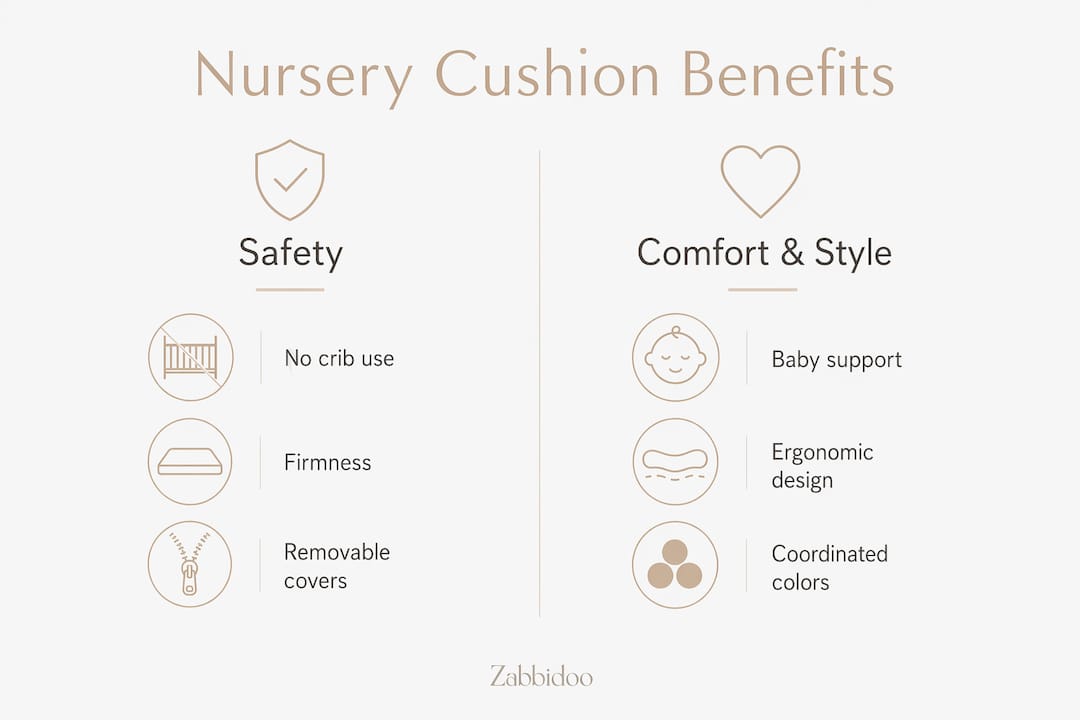
Nursery cushion safety is the most critical factor parents must understand before purchasing or placing any cushion near a baby. The American Academy of Pediatrics (AAP) is unambiguous: soft surfaces in infant sleep environments significantly increase the risk of sleep-related death. Infants sleeping on soft surfaces face up to 67 times higher risk of sleep-related death compared to firm, flat, clear surfaces. That figure alone should anchor every decision you make about what goes into a cot.
The AAP also confirms that removing soft objects from the crib, combined with safe room-sharing, can reduce SIDS risk by up to 50%. This is not a minor adjustment. It is one of the most effective, evidence-backed steps a parent can take.
In Australia, the ACCC reinforces this position. Australian Consumer Safety Regulators advise against anti-roll pillows, nests, and any product that modifies a flat sleeping surface, citing high suffocation risk. This includes the popular “baby nest” products that have flooded the market in recent years.
Cushions that must never be placed in a sleep space include:
- Thick cot bumpers (5–10cm), which restrict airflow and create entrapment zones
- Anti-roll pillows or positioning wedges
- Loose decorative cushions of any size
- Feeding pillows left unattended in the cot
The key distinction parents need to understand is between sleep-safe and non-sleep-safe cushions. Modern slim crib cushions (2–4cm thick) differ significantly from traditional thick bumpers (5–10cm). Slim crib cushions are designed to prevent limb entrapment along cot sides, positioned away from the baby’s head zone. They are not intended to be soft sleeping surfaces. Even so, the AAP recommends avoiding all cot bumpers regardless of thickness until clearer safety evidence exists.
One point that surprises many parents: even firm cushions pose a suffocation risk when used improperly in infant sleep environments. Infants lack the motor skills to reposition themselves away from soft objects. A cushion that feels firm to an adult can still obstruct an infant’s airway. The safest cot is a bare one: firm mattress, fitted sheet, nothing else.
Pro Tip: Keep all cushions, including nursing pillows, on a chair or shelf when not in active use. Never leave them in or near the cot after a feeding session.
How do nursery cushions benefit baby comfort and caregiver ergonomics?
The practical benefits of nursery cushions are most visible during feeding and supervised play. For caregivers, the ergonomic advantage is significant. Nursing cushions reduce caregiver strain during feeding by providing arm and back support, helping prevent the posture-related discomfort that builds up across multiple daily feeds. Without adequate support, parents hunch forward to bring the baby to breast or bottle. That repeated posture causes neck, shoulder, and wrist pain over weeks and months.
A well-designed nursing cushion brings the baby up to the parent, not the other way around. Zabbidoo’s nursing pillow, for example, lifts the baby 18cm, which keeps the parent’s spine in a neutral position throughout the feed. That height difference matters more than most parents realise until they have spent six weeks feeding without it.
For babies, cushions support comfortable positioning during tummy time and play, providing a soft surface that encourages safe exploration and physical development. Tummy time on a flat floor can feel uncomfortable for newborns. A low, firm cushion placed under the chest gives just enough lift to make the position more manageable and encourages the baby to lift their head.
Key benefits of nursery cushions for babies and caregivers:
- Ergonomic arm and back support during breastfeeding and bottle feeding
- Improved latch positioning through consistent height and stability
- Comfortable, supportive surface for supervised tummy time
- Pressure relief for caregivers during extended holding and feeding sessions
- A familiar, textured surface that provides sensory comfort during play
The distinction between cushion types matters here. A nursing pillow is a functional tool, not a decorative one. Decorative floor cushions serve a different purpose: they create a soft play zone for older infants and toddlers. Mixing up these categories, such as using a decorative cushion for feeding support, leads to poor posture outcomes for the parent and unstable positioning for the baby.
Pro Tip: When choosing a nursing cushion, test its compression resistance. Press down firmly and hold for ten seconds. If it collapses more than halfway, it will not maintain the height needed for proper feeding posture across a full feed.
What materials and designs make nursery cushions safe and durable?
Material selection directly affects how safe, hygienic, and long-lasting a nursery cushion will be. Nurseries demand frequent washing. Textiles designed for nursery use need to retain colour, structure, and hygiene through at least 10–15 wash cycles. Not all fabrics meet that standard.
Fabric comparison for nursery cushions
| Fabric | Wash tolerance | Breathability | Best suited for |
|---|---|---|---|
| Polyester embroidery | High (60°C safe) | Moderate | Decorative covers, frequent washing |
| French flax linen | Moderate (gentle cycle) | High | Nursing pillows, direct skin contact |
| Cotton | Moderate (40–60°C) | High | General nursery cushions |
| Velvet or chenille | Low (spot clean only) | Low | Decorative use, out of reach of baby |
Polyester fabrics maintain colour and durability through 60°C washes, unlike many natural fibres that shrink or fade. For covers that will be washed weekly, polyester-blend fabrics are the practical choice. For cushions that sit against a baby’s skin during feeding, breathable natural fibres like linen or cotton are preferable because they regulate temperature better.
Filling matters as much as the outer fabric. Hypoallergenic polyester fibrefill is the standard for nursery cushions because it resists dust mites, dries quickly after washing, and holds its shape well. Memory foam inserts offer firmer support but can retain heat, which is a concern for nursing pillows used in direct contact with a baby.
Closure design is often overlooked but has a real impact on longevity. Concealed zip closures outperform envelope backs in maintaining cushion shape after repeated washing. Envelope backs tend to gap over time, allowing the insert to shift and bunch. A concealed zip keeps the cover taut and the cushion looking and performing as intended.
Pro Tip: Always buy cushion covers with removable, machine-washable covers. Spot-cleaning alone is not sufficient for a nursery environment where spit-up, milk, and nappy leaks are routine.
How can nursery cushions create a calm, cohesive nursery space?
Nursery cushions contribute to the visual and emotional tone of the room, not just its function. A well-styled nursery reduces visual noise, which research in environmental psychology links to calmer behaviour in both infants and caregivers. The goal is cohesion, not maximalism.
Using a letter cushion as a styling anchor is one of the most effective ways to unify a nursery’s colour and texture scheme. A single signature cushion, whether it spells the baby’s name or features a bold initial, sets the palette for the entire room. From there, you repeat two or three colours across the rug, curtains, and blankets to create depth without clutter.
Practical styling principles for nursery cushions:
- Choose a maximum of three colours and repeat them across all textiles
- Layer textures (linen, knit, cotton) rather than patterns to avoid visual overload
- Select cushion sizes proportional to the furniture: a large floor cushion suits a reading nook, a smaller lumbar cushion suits a nursing chair
- Opt for timeless tones (warm neutrals, soft sage, dusty rose) over trend-driven palettes that date quickly
Designers emphasise the importance of a single signature cushion in nursery decor to achieve both comfort and visual harmony. The instinct to layer many cushions is understandable, but it creates visual noise and, in a nursery, creates more objects to remove before every sleep. One or two well-chosen cushions do more for a room than six mismatched ones.
Colour choices also affect longevity. Trend-driven palettes, like the grey-and-white nurseries that dominated a decade ago, date quickly. Warm neutrals, soft greens, and earthy tones age well and grow with the child from infancy through toddlerhood. That means fewer redecoration costs and a room that still feels right when your child is three.
Key takeaways
Nursery cushions serve a genuine ergonomic and developmental purpose, but their safe use, correct material selection, and intentional placement are what determine whether they help or harm.
| Point | Details |
|---|---|
| Safety is non-negotiable | Never place any cushion, firm or soft, in an infant’s sleep space. |
| Ergonomic support matters | A nursing cushion with adequate height and compression resistance reduces caregiver strain across daily feeds. |
| Material affects hygiene | Choose fabrics rated for 60°C washing and hypoallergenic fills for cushions used in direct baby contact. |
| Concealed zips last longer | Zip closures maintain cushion shape through repeated washing better than envelope backs. |
| One styling anchor is enough | A single signature cushion unifies the nursery palette without creating visual clutter or safety hazards. |
What I’ve learned from watching parents choose nursery cushions
Most parents get the decorative side right and the functional side wrong. They spend time matching colours and textures, then grab the first nursing pillow they see without checking its height or compression resistance. Six weeks later, they are feeding with a collapsed cushion and a sore neck.
The firmness question trips people up most. Parents often assume a softer cushion is safer and more comfortable for the baby. The opposite is true for nursing pillows. A cushion that compresses under the baby’s weight drops the baby below the optimal feeding height, forcing the parent to hunch. That is the exact problem a nursing pillow is supposed to solve.
Hygiene is the other area where I see consistent underestimation. A nursing cushion used for multiple daily feeds needs washing at least weekly. If the cover is not removable or the fabric is not rated for warm washes, the cushion becomes a hygiene problem within a month. Check the care label before you buy, not after.
My honest recommendation: buy fewer cushions, but buy the right ones. One well-made nursing pillow, one or two decorative cushions for the chair or floor, and nothing in the cot. That combination covers every function without creating clutter or risk. When you are choosing a nursing pillow for feeding, prioritise height, compression resistance, and a washable cover over aesthetics. The look matters, but it matters less than whether the cushion still works at 3 AM on week eight.
— Marietjie
Zabbidoo’s nursing pillows: built for real feeding sessions
Zabbidoo designs nursing pillows specifically for the ergonomic demands of daily feeding. Every design decision addresses what standard pillows get wrong: inadequate height, poor compression resistance, and covers that are difficult to clean.

The Zabbidoo nursing pillow lifts the baby 18cm, bringing them to the parent rather than forcing the parent to lean down. The fill maintains its shape under pressure, so the support you feel at the start of a feed is the same support you feel at the end. Covers are made from breathable French flax linen and are fully removable for machine washing. For parents who want a nursing cushion that performs as well as it looks, explore Zabbidoo’s range and find the right fit for your nursery and feeding routine.
FAQ
What is the role of nursery cushions in infant care?
Nursery cushions provide ergonomic support for caregivers during feeding and a comfortable surface for babies during supervised tummy time and play. They are not intended for use in infant sleep spaces.
Are nursery cushions safe to use in a cot?
No. The AAP and ACCC both advise against placing any cushion, including slim crib cushions and anti-roll pillows, in an infant’s sleep environment due to suffocation and entrapment risk.
What fabric is best for nursery cushions?
Polyester-blend fabrics tolerate frequent 60°C washing without fading or shrinking, making them the most practical choice for nursery cushion covers. Linen and cotton are preferable for cushions in direct contact with a baby’s skin.
How often should nursery cushions be washed?
Nursing cushions used daily should be washed at least once a week. Choose covers with concealed zip closures and check that the fabric is rated for machine washing before purchasing.
How do I choose a nursing cushion that actually supports my posture?
Look for a nursing cushion with at least 15–18cm of lift and firm compression resistance. Press the cushion down firmly for ten seconds. If it collapses significantly, it will not maintain the height needed for a neutral feeding posture.