

Neck support in breastfeeding is defined as the practice of maintaining neutral cervical spine alignment during feeds to prevent musculoskeletal strain. Breastfeeding-related neck pain is common among lactating mothers who feed 8–12 times per day in sessions lasting 20–40 minutes each. That cumulative load on an unsupported neck adds up fast. The NHS breastfeeding positioning guidance confirms that neutral spine alignment, where ears sit directly over shoulders, protects the cervical spine from long-term strain. Getting this right from the start makes breastfeeding more comfortable and more sustainable.
What is the role of neck support in breastfeeding?
Neck support in breastfeeding prevents Head Forward Posture (HFP), the single most common cause of nursing-related neck pain. HFP occurs when a mother leans her head forward to look at her baby during a feed. For every 2.5 centimetres the head moves forward from neutral, the effective load on the cervical spine roughly doubles. Over dozens of daily feeds, that strain accumulates into chronic tightness, headaches, and disrupted sleep.
The NHS positioning guidance states that elevating the baby to breast height, rather than bending down to the baby, is the primary mechanism for maintaining neutral alignment. This single adjustment removes the need for the neck muscles to work against gravity. When the neck is properly supported, the deep cervical flexors can relax fully instead of contracting continuously throughout each feed.

Physical therapists also note that neck pain often originates in the upper back and shoulders, not the neck itself. Ignoring thoracic support multiplies the load on the cervical spine several times the weight of the head alone. This means neck support is never just about the neck. It requires the whole postural chain, from lower back through shoulders, to work together.
How does poor neck support cause breastfeeding pain?
Poor neck support creates a cascade of postural problems that build with every feed. The key issues are:
- Head Forward Posture (HFP): The head shifts forward, increasing cervical load and compressing the joints at the base of the skull.
- Elevated shoulders: Without forearm support, mothers unconsciously raise their shoulders to hold the baby’s weight, creating tension across the upper trapezius.
- Thoracic rounding: Slumping through the mid-back pulls the head further forward, compounding cervical strain.
- Wrist and forearm tension: Gripping or cradling without support sends tension upstream through the arms into the neck and upper back.
Neutral wrist and forearm positioning is often overlooked, yet it directly affects how much tension travels up into the neck. A mother who grips tightly or holds her arm unsupported for 30 minutes will feel it in her neck long before she feels it in her wrist.
Pro Tip: Place your forearms fully on the armrest or nursing pillow before the baby latches. If your shoulders are still raised, the support is too low.
The weight of a baby between 5.1 and 8 kg correlates directly with increased neck pain risk, particularly in holds like the football hold and inverted cradle hold. Heavier babies in static, flexed-neck positions create the highest strain. This is why support equipment matters more as the baby grows, not less.
What ergonomic setup gives the best neck support for nursing?
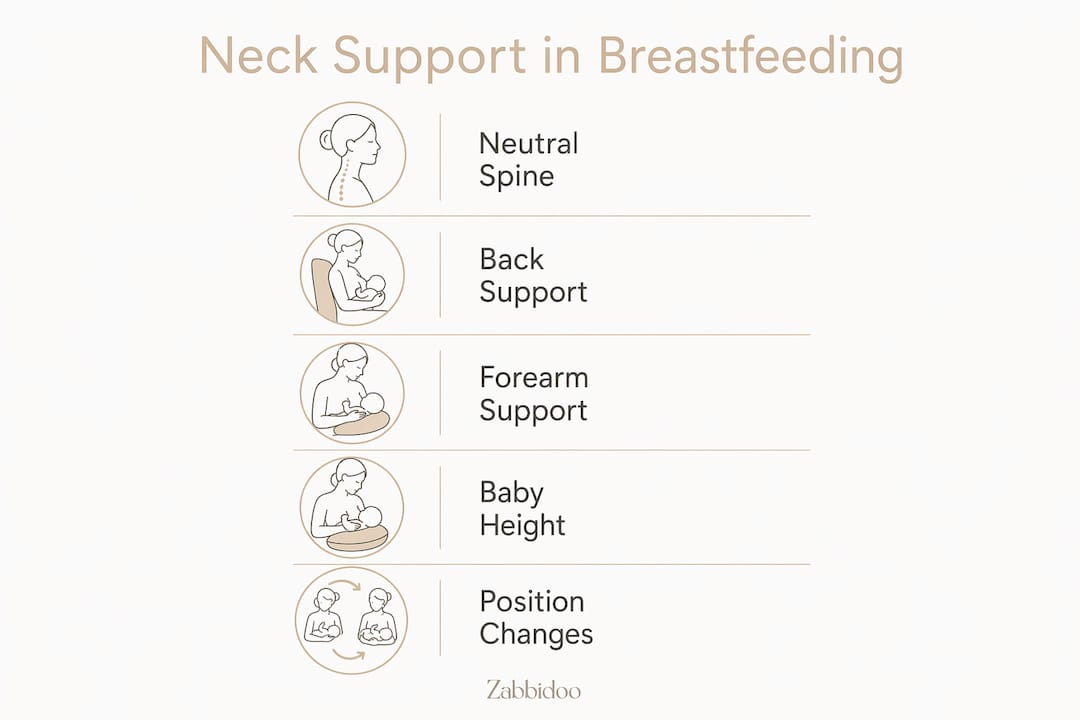
A proper ergonomic setup for breastfeeding works across three levels: back support, forearm support, and baby height. Each level depends on the one below it. If the lower back is unsupported, the whole spine collapses forward and no amount of neck adjustment will help.
The three levels of support
- Back support: Sit in a chair with a firm back. Use a lumbar cushion if the chair does not support the natural curve of your lower back. Avoid soft sofas that let the pelvis tilt backward.
- Forearm support: Rest both forearms on armrests or a nursing pillow at a height that allows your shoulders to drop fully. The arms should carry the baby’s weight, not your neck muscles.
- Baby height: The baby’s mouth should come to the breast, not the breast down to the baby. A nursing pillow that holds its shape under the baby’s weight is the most reliable way to achieve this.
Physical therapists recommend that the ideal setup includes firm back support, forearm support, and adjustable baby height. A footrest also helps by tilting the pelvis slightly forward, which naturally straightens the lumbar spine and reduces the tendency to slump.
Most standard nursing pillows collapse under a baby’s weight within weeks of regular use. A pillow that compresses loses height, which forces the mother to lean down to compensate. The Zabbidoo nursing pillow is designed with an 18cm lift and firm compression resistance specifically to keep the baby at breast height throughout the feed. That consistent height is what prevents the nursing hunch from developing in the first place.
Pro Tip: Check your pillow height by sitting in your usual feeding position and placing the pillow in your lap. Your baby’s mouth should reach your nipple without you leaning forward at all. If you are still bending, add a folded blanket underneath.
A chair with adjustable armrests is ideal. If yours are fixed and too low, a rolled towel or firm cushion on each armrest raises the support point without requiring a new chair.
How do position changes protect your neck during feeds?
Varying your breastfeeding position is one of the most effective and underused strategies for protecting neck health. Alternating between cradle, football, and side-lying holds engages different muscle groups and prevents any single set of muscles from reaching fatigue. Static postures held for 20–40 minutes at a time are the primary driver of muscle overload.
The side-lying position is particularly valuable for night feeds. It removes gravitational load from the neck entirely and allows both the mother and baby to rest. The football hold works well for mothers recovering from a caesarean section, as it keeps the baby’s weight off the abdomen. Rotating between these positions across the day distributes strain rather than concentrating it.
Small exercises during feeds also make a measurable difference:
- Chin tucks: Gently draw the chin straight back, lengthening the back of the neck. Hold for 3–5 seconds. This resets the cervical spine toward neutral and strengthens the deep neck flexors.
- Scapular squeezes: Draw the shoulder blades gently together and down. This counteracts the forward rounding that builds during feeds.
- Shoulder rolls: Slowly roll both shoulders backward three times. This releases the upper trapezius without disrupting the latch.
Chin tucks and scapular squeezes strengthen the deep neck flexors over time, reducing fatigue and pain across the breastfeeding period. They take under 10 seconds and can be done without disturbing the baby.
Pro Tip: Set a quiet phone reminder every 20 minutes during feeds. Use it as a cue to do one chin tuck and one scapular squeeze. Over a week, this habit builds real postural endurance.
For mothers experiencing lower back pain alongside neck strain, addressing both areas together produces faster relief than treating each in isolation. The spine functions as a connected system.
Common mistakes that undermine neck support
Neck pain during breastfeeding is not inevitable. It results from sustained unsupported posture, not from breastfeeding itself. That distinction matters because it means the pain is preventable.
The most common mistakes mothers make include:
- Bringing the baby down to the breast: This is the single biggest driver of the nursing hunch. Active arm and back support keeps the baby elevated so the neck stays neutral.
- Relying on the “perfect hold” without addressing the setup: A textbook cradle hold still causes neck pain if the mother is sitting in a collapsed sofa with no forearm support.
- Ignoring upper back and shoulder support: The neck cannot stay neutral if the thoracic spine is rounded. Back support is not optional.
- Sticking to one hold for every feed: Prolonged use of the football hold or inverted cradle hold with a heavier baby creates static flexion and rotation in the neck, which accelerates muscle fatigue.
- Using a pillow that has lost its shape: A flat or compressed pillow provides no height benefit. It forces the mother to compensate by leaning, which defeats the purpose entirely.
The ergonomics of breastfeeding are straightforward once you understand the mechanics. The challenge is that most mothers are never taught them. Pain becomes normalised as part of new motherhood when it is actually a signal that the setup needs adjusting.
Key takeaways
Proper neck support in breastfeeding requires neutral spine alignment, firm forearm and back support, and consistent baby height to prevent cervical strain across every feed.
| Point | Details |
|---|---|
| Neutral alignment prevents pain | Ears over shoulders is the target position; Head Forward Posture multiplies cervical load with every feed. |
| Baby height is the priority | Bring the baby up to the breast, not the breast down to the baby, to remove strain from neck muscles. |
| Support works as a system | Back, forearm, and baby height support must all be in place; fixing only one level leaves the others to compensate. |
| Position variation reduces overload | Rotating between cradle, football, and side-lying holds prevents any single muscle group from reaching fatigue. |
| Pillow firmness matters | A pillow that collapses loses its height benefit and forces the mother to hunch, undoing the ergonomic setup. |
What I have learned from watching mothers feed
By Marietjie
The thing that strikes me most is how quickly mothers accept neck pain as normal. I have spoken with women who are six months into breastfeeding and genuinely believe the aching across their shoulders is just part of the experience. It is not. It is a setup problem, and it is almost always fixable.
The most common thing I see is a mother sitting in a deep, soft couch with a flat pillow in her lap, leaning forward to meet her baby. Her shoulders are up near her ears. Her upper back is completely rounded. She has never been told that the couch is the problem, or that the pillow has lost its shape.
What I have found is that small, specific changes produce real relief faster than most mothers expect. Switching to a firm chair, adding a lumbar cushion, and using a pillow that actually holds its height can change the experience within a single feed. The chin tuck exercise sounds almost too simple to work, but done consistently it genuinely rebuilds the endurance of the deep neck muscles.
My honest view is that breastfeeding support in Australia focuses heavily on latch and milk supply, which are critical, but almost ignores the mother’s body. A mother who is in pain every feed is a mother who is more likely to stop breastfeeding earlier than she wanted to. Neck support is not a luxury. It is part of making breastfeeding work.
— Marietjie
Zabbidoo’s nursing pillow and neck support
Neck pain during breastfeeding comes down to one core problem: the baby is too low, and the mother leans down to compensate. Zabbidoo’s nursing pillow is built to solve exactly that. Its 18cm lift brings the baby to breast height without the mother needing to hunch, and its firm compression resistance means it holds that height throughout the feed, not just at the start.

The pillow’s stability reduces the constant repositioning that strains the neck and shoulders. Its French flax linen cover is breathable, which matters during longer feeds. For mothers who want a practical, well-designed starting point for an ergonomic feeding setup, Zabbidoo is worth a close look.
FAQ
What is the main cause of neck pain during breastfeeding?
Head Forward Posture is the primary cause. It develops when a mother leans down to the baby instead of bringing the baby up to breast height, increasing the load on the cervical spine with every feed.
How do I support my neck while breastfeeding?
Sit in a firm chair with lumbar support, rest both forearms on a nursing pillow or armrests, and use a firm pillow to raise the baby to breast height. This three-level setup keeps the neck in neutral alignment.
Does the type of nursing pillow affect neck pain?
A pillow that compresses and loses height forces the mother to lean forward, which causes neck strain. A firm pillow that maintains its height throughout the feed is the most effective option for preventing the nursing hunch.
Can changing breastfeeding positions reduce neck pain?
Rotating between cradle, football, and side-lying holds distributes strain across different muscle groups. Experts recommend alternating holds to prevent any single set of muscles from reaching overload.
Are neck exercises safe to do during breastfeeding?
Chin tucks and scapular squeezes are safe, gentle exercises that can be done during feeds without disturbing the baby. They strengthen the deep neck flexors and counteract the forward rounding that builds during prolonged nursing sessions.