

A firm, height-elevated nursing pillow is the fastest fix for feeding in a recliner without wrecking your neck, back or wrists. The Zabbidoo nursing pillow is built for exactly this: a stable, high-lift design that brings baby up to breast height instead of forcing you to hunch down into a recliner’s soft cushioning.
- Reduces neck, back and wrist strain by lifting baby to a comfortable feeding height, rather than you dropping your shoulders and spine to reach them.
- Improves stability during the feed, so you spend less time repositioning a slipping cushion mid latch.
Mothers using a nursing pillow reported a median fatigue score of just 0.15, compared with 2.7 for those feeding without one, on a standard visual analog scale. Zabbidoo’s version adds an 18cm lift, high compression resistance so it doesn’t flatten under weight, and a breathable cover for feeds that run long.
Key Takeaways
A firm, height-elevated nursing pillow reduces feeding fatigue and protects the neck, back and wrists more effectively than an unsupported recliner setup alone.
| Point | Details |
|---|---|
| Lift matters most | An 18cm lift brings baby to breast height so you don’t hunch forward in a deep recliner. |
| Firmness beats softness | High compression resistance stops the pillow flattening and creating a strain-causing gap. |
| Strap it snugly | An adjustable strap prevents mid-feed slipping and repositioning. |
| Check the fatigue evidence | Pillow users reported a median fatigue score of 0.15 versus 2.7 for non-users. |
| Zabbidoo fits the checklist | Its 18cm lift, compression resistance and breathable French flax linen cover match every recliner-feeding requirement above. |
Table of Contents
- What to look for when buying a nursing pillow for a recliner
- How do you set up a nursing pillow in a recliner?
- Are there downsides to using a nursing pillow in a recliner?
- What specs and sizing details actually matter?
- What does the research say about nursing pillow ergonomics?
- Feeding in recliner: what actually matters most
- Why the Zabbidoo nursing pillow suits recliner feeding
- Frequently asked questions about feeding in a recliner
- Sources
What to look for when buying a nursing pillow for a recliner
Recliners are deep, soft and often reclined at an angle, which is exactly the setup where a poorly chosen pillow falls apart. Here’s what actually matters when you’re comparing options.
Height and lift. A recliner seat sits lower and further back than a firm dining chair, which means your lap-to-chest distance is often greater than in upright seating. A pillow with more lift, such as an 18cm profile, closes that gap without you leaning forward. Shorter torsos generally need less lift; taller mums or those in deep recliners usually need more.

Compression resistance. Cheap fill flattens within weeks, and a flattened pillow means baby sinks lower each time you sit down. High compression resistance keeps the shape consistent feed after feed, which matters more in a recliner because you’re already fighting extra cushioning underneath you.
Stability. A wraparound shape with an adjustable strap stops the pillow sliding off your lap when you shift position, which happens constantly in a recliner as you adjust the footrest or backrest.
Adjustability and fit. Strap length, arm width and the size of the opening all affect whether the pillow sits flush against your body. One size rarely fits every body shape or every recliner depth.
Materials. Look for a washable, removable cover in a breathable fabric like French flax linen, plus hypoallergenic fill for sensitive skin.
Portability. A built-in handle makes it easy to move the pillow from the recliner to a couch or nursery chair without wrestling with bulk.
Price. Budget pillows sit around the lower end of the market and often use softer fill that loses shape fast. Spending more typically buys better shape retention, sturdier straps and safer, tested materials, which pays off over months of daily use.
Pro Tip: If you can’t test firmness in person, check the product page for compression-resistance claims and strap adjustability specifically, not just “comfort” marketing language. Consumer Reports flags firm, flat cushions with adjustable straps as the safest, most functional combination.
How do you set up a nursing pillow in a recliner?
Getting the chair right comes before the pillow. Recline the backrest to a moderate angle rather than fully flat, keep the footrest at a height that supports your knees without dropping your hips lower than your knees, and add a small lumbar cushion if the recliner’s built-in back support leaves a gap at your lower spine.
- Sit back fully so your spine contacts the backrest and your hips are pushed into the seat, not perched on the edge.
- Strap the pillow snugly around your waist so there’s no gap between your body and the cushion. A loose pillow forces forward leaning, which defeats the point of the lift entirely.
- Place baby tummy to tummy with you, close enough that their nose lines up with your nipple. If you could lean down and kiss their head without moving your torso, the height’s right.
- Check alignment so baby’s ear, shoulder and hip form a straight line, avoiding a twisted neck during the feed.
- Drop your shoulders and let the pillow, not your arms, carry baby’s weight.
- Rest your forearms on the pillow surface so your wrists stay neutral and your hands stay open instead of gripping or flexing to hold baby in place.
- Add foot support, even a small stool or the recliner’s built-in footrest, to keep your knees level with or slightly above your hips.
A few non-negotiables while you’re set up like this: never leave baby on a nursing pillow unsupervised, never carry baby while they’re resting on the pillow, and keep your eyes on baby throughout the feed rather than on your phone.
Are there downsides to using a nursing pillow in a recliner?
Used well, a nursing pillow shortens feeds, protects your wrists and makes one-handed bottle feeding realistic for a tired partner. Used badly, it can actively work against you.
- Real benefits: less arm fatigue, better spinal alignment, longer comfortable sessions, and an easier handoff for partners doing night feeds.
- Common problems: a pillow that’s too soft or the wrong height can leave a gap that pulls you forward, or lift baby so high it distorts the latch instead of improving it.
- Especially useful for: mums recovering from a C-section who need to keep weight off their lap, anyone with existing wrist or shoulder pain, and parents tandem feeding twins.
- Less critical for: experienced feeders who’ve already found a comfortable position without extra support.
- Fixes for the usual problems: tighten the strap, add a small folded cloth under the pillow if there’s still a gap, or adjust the recliner’s angle slightly more upright.
A too-soft pillow that doesn’t sit flush against your waist creates the exact gap it’s meant to eliminate, forcing you back into the hunched posture you bought it to avoid.
What specs and sizing details actually matter?
Before buying, check the product page for these details rather than relying on lifestyle photos alone.
- Lift height — Zabbidoo’s is 18cm, aimed at bringing baby to breast height without you leaning forward.
- Fill type and compression resistance — determines whether the pillow still holds its shape after months of daily use.
- Opening width — needs to be generous enough for larger babies or tandem feeding.
- Cover material — breathable fabrics like French flax linen manage heat better during long feeds.
- Washability — a removable, machine-washable cover matters more than most buyers expect once reflux or spit-up enters the picture.
- Waist and strap sizing — check whether the strap adjusts to your actual waist circumference, not just a generic “one size.”
| Spec to check | Why it matters |
|---|---|
| Lift height (e.g. 18cm) | Determines how much you need to lean forward in a recliner |
| Fill/compression resistance | Affects whether the pillow holds shape after weeks of use |
| Cover fabric | Breathable materials like French flax linen reduce overheating |
| Strap adjustability | Prevents the gap that causes hunching mid feed |
| Washing instructions | Machine-washable covers matter for spit-up and daily wear |
What does the research say about nursing pillow ergonomics?
The fatigue data is the clearest signal here: mothers using a nursing pillow reported a median fatigue score of 0.15 versus 2.7 for non-users on a visual analog scale, a sizeable gap even accounting for the usual limits of self-reported fatigue measures.
Posture education backs this up from a different angle. A quasi-experimental study on ergonomic breastfeeding education_PF1(Rf_SL)_PFA(IS)_PN(IS).pdf) found infant attachment and suckling scores improved significantly (mean increase 5.47, p<0.0001), alongside better maternal posture scores on the RULA assessment tool.
IBCLC Natasha Allen-Hallyburton puts it simply in her guidance on breastfeeding pillow support:
A good support pillow should create a firm, stable base that promotes full-body contact, so the mother isn’t relying on arm strength alone to hold the baby in position.
Consumer Reports adds a safety layer to all this, recommending firmer, flatter pillows with wide openings and clear warnings against using nursing pillows as loungers.
Feeding in recliner: what actually matters most
Most advice on nursing pillows treats them as optional comfort add-ons, something nice to have if you can afford it. That undersells the evidence. The fatigue data alone suggests the difference between using a stable pillow and going without isn’t marginal comfort, it’s a measurable drop in how exhausted mothers feel after feeds, day after day.
Where conventional advice gets it wrong is treating “any pillow” as good enough. A soft, flattened hand-me-down doesn’t just fail to help, it can actively create the gap that causes hunching, which is the exact problem a pillow is supposed to solve. Firmness and stability aren’t nice-to-haves, they’re the entire mechanism by which a pillow works.
If you take one thing from this guide, prioritise lift and firmness over price or aesthetics. A pillow that stays stable through an hour-long feed in a deep recliner does more for your body than any amount of soft fabric or cute print.
Why the Zabbidoo nursing pillow suits recliner feeding
Feeding in a recliner asks a lot of a pillow: enough lift to beat the seat depth, enough firmness to hold that lift, and enough stability to survive you shifting the footrest mid feed. The Zabbidoo nursing pillow was built around those exact conditions rather than general comfort.

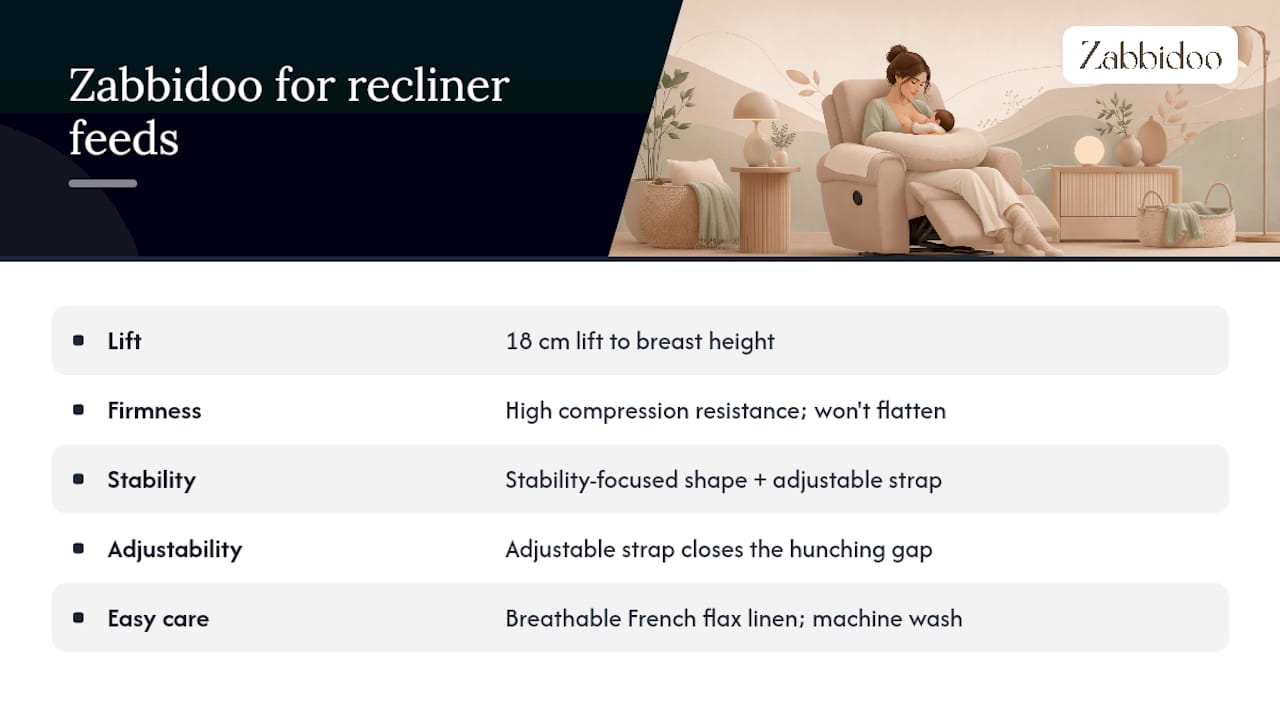
Its 18cm lift brings baby to breast height without you leaning into the backrest, and high compression resistance means it won’t flatten out halfway through a long evening feed. The stability-focused shape and adjustable strap close the gap that causes hunching, while the breathable French flax linen cover stays cool during extended sessions and comes off for a machine wash when needed. Together, those features map directly onto the checklist earlier in this guide: lift, firmness, stability, adjustability and easy care, all in one product.
Pillows at this spec level sit toward the higher end of the market, and that’s a deliberate trade for shape retention and safer, tested materials that hold up over months of daily use rather than needing replacement after a few weeks. If feeding in your recliner currently means sore wrists or a stiff neck by the end of the day, check the Zabbidoo nursing pillow product page for full specs and current availability.
Frequently asked questions about feeding in a recliner
Is a recliner good for breastfeeding? A recliner can work well if you add lumbar support and a stable, firm nursing pillow. Without support, sitting in unsupported furniture correlates with higher neck and back pain during feeds.
How do I stop my baby sinking into the recliner while feeding? Use a firm nursing pillow with high compression resistance strapped snugly around your waist. Soft or flattened pillows let baby sink, which pulls your posture forward.
Can I use a regular pillow instead of a nursing pillow? A regular pillow usually lacks the firmness and shape needed to hold its lift, and can leave gaps that cause hunching. A purpose-built pillow with an adjustable strap gives more consistent support.
What height nursing pillow do I need for a recliner? It depends on your torso height and how deep your recliner seat is. An 18cm lift suits most standard recliners, though taller mums in deeper chairs may need extra lift.
Is it safe to leave my baby on a nursing pillow unsupervised? No. Nursing pillows are feeding aids, not sleep surfaces, and babies should never be left on one unsupervised or carried while resting on it.
Sources
- Study measuring fatigue in breastfeeding mothers (visual analog scale)
- Are breastfeeding pillows worth it? — Natasha Allen-Hallyburton, IBCLC
- How to choose a nursing pillow and use it safely — Consumer Reports
- What to do if you have musculoskeletal pain from breastfeeding — NDC Institute