

Try upright feeding first, then laid-back (biological) nursing, then a football hold if you’ve had a caesarean or your baby has reflux. None of these fixes colic alone. The habit that makes any of them work is a solid latch (or paced bottle-feed) plus burping during and after the feed. If your baby is losing weight, refusing feeds, or seems unwell, see your GP, child health nurse, or a lactation consultant rather than troubleshooting position alone.
TL;DR:
- Upright feeding and laid-back nursing help reduce swallowed air and control milk flow, especially for babies with reflux or gulping issues.
- Proper setup, like a stable pillow, correct latch, and paced bottle flow, is crucial for effectiveness and comfort during feeding.
- Burping frequently during feeds and gentle tummy-down holds after feeding can significantly alleviate trapped gas and colic discomfort.
- No single position is universally best; trial, observation, and adjusting based on your baby’s reactions are essential for successful feeding.
- Seek professional advice if your baby shows signs of weight loss, persistent crying, or feeding-related pain, rather than relying solely on positional changes.
Table of Contents
- Which feeding positions actually help with colic?
- How do you set up each feeding position correctly?
- Burping and post-feed positioning that actually clears gas
- Feeding position or soothing hold: what’s the difference?
- What actually makes feeding positions easier to hold
- How Zabbidoo’s pillow design supports these positions
- A word on the trial-and-error of it all
- Make laid-back and upright feeding easier to hold
- Sources
- FAQ
Which feeding positions actually help with colic?
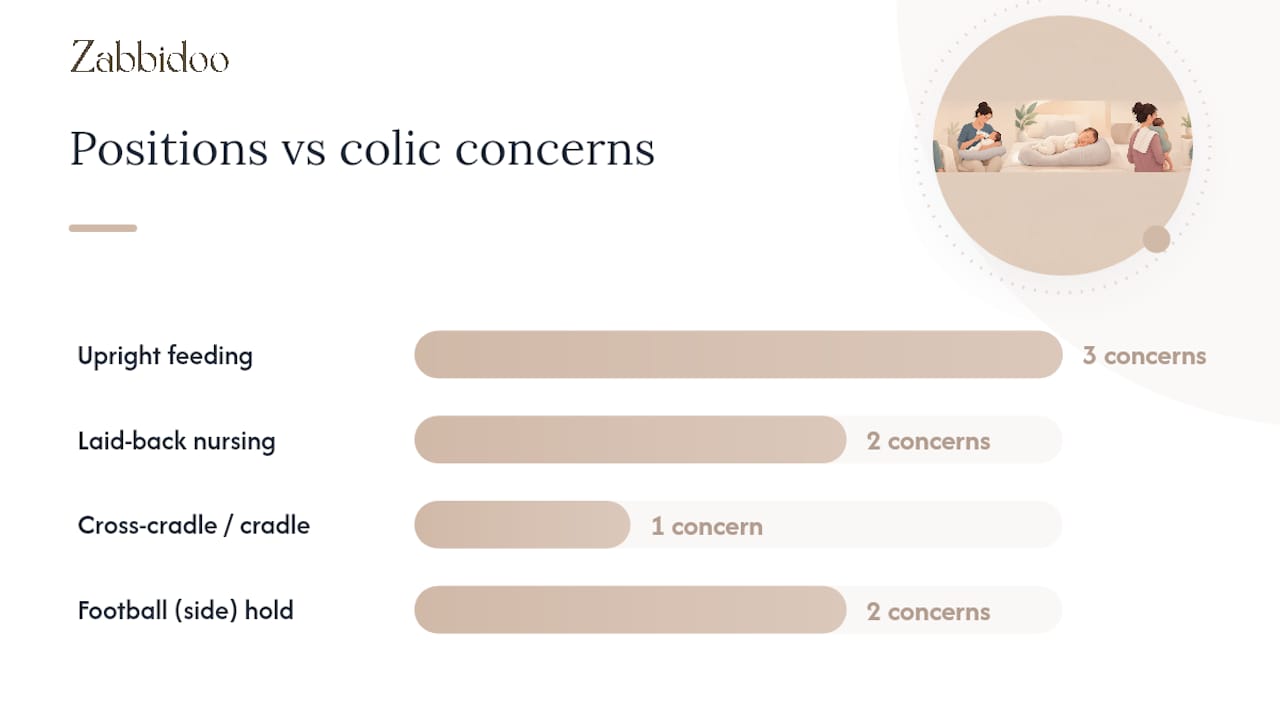
Colic itself has no single cause, but swallowed air, fast let-down, and reflux all make it worse. The positions below target one or more of those triggers, and knowing why each one works makes it easier to pick the right one for your baby on a given day.
Upright feeding keeps your baby’s head above their stomach, so milk moves down with gravity instead of pooling near the airway. The NHS advises sitting your baby up as straight as possible while feeding and checking attachment carefully, since a poor latch is one of the biggest sources of swallowed air. Mayo Clinic gives the same advice: an upright position plus frequent burping limits how much air gets trapped in the first place.
Laid-back (biological) nursing flips the usual script. You recline at maybe 45 degrees, baby lies tummy-down on your chest, and gravity does some of the work that your arms usually do. Raising Children explains that this posture lets gravity moderate the speed of let-down, which matters a lot for babies who gulp, choke, or pull off crying when milk comes too fast. A slower flow means less air gulped alongside the milk.
Cross-cradle and cradle holds give you the most control over your baby’s head and mouth, which is why midwives lean on cross-cradle for small or premature babies who need extra latch guidance. You’re supporting the head and shoulders with one hand and the breast with the other, which makes it easier to correct a shallow latch the moment you spot one.
Football (or side) hold tucks your baby under your arm at your side rather than across your lap, which is genuinely kinder on a healing caesarean scar. It’s also useful for babies with reflux, because you can angle them slightly upright while still keeping precise control of their head.
For bottle-fed babies, the position matters less than the flow. Keep the bottle angled so the teat stays full of milk rather than air, feed at a mild recline rather than lying flat, and switch to a slower-flow teat if your baby seems to be gulping. Mayo Clinic notes that curved bottles, vented liners, and paced bottle-feeding all cut down on swallowed air, and pairing that with our guide to upright feeding positions covers most of the setup questions parents ask.
Worth noting: no position is universally “best”. A baby with reflux might do better upright, while an overwhelmed newborn with a fast let-down often settles better laid-back. Trial and observation beat any single rule.
- Upright feeding reduces air swallowing and reflux discomfort
- Laid-back nursing slows an overactive let-down
- Cross-cradle gives the most latch control for small babies
- Football hold suits post-caesarean recovery and reflux
- Bottle angle and teat flow matter more than bottle brand
How do you set up each feeding position correctly?
Getting the mechanics right matters more than which position you choose. Here’s how to set up the ones that do the heaviest lifting for colic symptoms.
- Set up laid-back nursing properly. Recline in a chair, couch, or bed at roughly 45 degrees, with real back support so you’re not tensing your core to stay upright. Lay baby tummy-down on your chest, facing you, and let them find the breast rather than pushing them to it. A stable, higher pillow under your elbows stops you from hunching forward to compensate, which is the single biggest reason laid-back positions fail in practice.
- Use breast compression during a feed. When sucking slows and swallowing sounds fade, gently squeeze the breast to keep milk flowing. The Australian Breastfeeding Association notes that compression keeps flow steady so baby doesn’t switch into comfort-sucking, which pulls in more air than active feeding does.
- Pace every bottle feed. Hold the bottle almost horizontal rather than tipped steeply, let baby suck for a few seconds, then tilt down briefly so they pause and swallow properly. Our paced bottle-feeding guide walks through the timing in more detail if you’re new to it.
- Check the latch every time. Chin should be buried into the breast, nose clear, and you should see more areola above baby’s top lip than below it. If the latch looks shallow, break suction with a clean finger and start again rather than pushing through.
Pro Tip: If your baby unlatches repeatedly and seems frustrated, try switching position before switching anything else — a fast let-down often looks like fussiness, and laid-back nursing usually calms it within a feed or two.
Burping and post-feed positioning that actually clears gas
Burping isn’t a formality. Trapped air low in the stomach is one of the more fixable contributors to colic pain, and timing matters as much as technique.
Burp partway through a feed, not just at the end, especially if you swap breasts or notice baby pulling away. The classic over-the-shoulder pat works, but sitting baby upright on your lap with a hand supporting the chin does the same job with more visibility. Tummy-across-the-lap, with gentle rubbing along the back, is a good third option if the first two aren’t working.
- Breastfed babies often need a burp break between sides, plus one at the end
- Bottle-fed babies usually need a pause every 60 to 90ml
- If no burp comes after two or three minutes, that’s fine, move on and try again after the next feed
- After feeding, a brief tummy-down hold across your forearm (the “colic curl”) can help gas move, but only while baby is awake and supervised
Never leave a baby tummy-down unsupervised, and never put a sleeping baby down on their front. The CHOP guidance on soothing holds is specifically about awake, supervised comfort, not sleep positioning.
Feeding position or soothing hold: what’s the difference?
Feeding positions and soothing holds solve different problems, and mixing them up is a common source of frustration. A feeding position is about latch, milk flow, and swallowed air while baby is actively feeding. A soothing hold comes after the feed, once you’re managing discomfort rather than intake.
The colic curl (tummy-down along your forearm), the neck-nestle (upright against your chest with gentle bounce), and a football-style soothing cradle all apply gentle pressure or motion that can help trapped gas move along. CHOP notes these holds work through pressure and motion that mimic the womb, not through anything to do with milk flow.

Keep the airway clear in every hold, stay close enough to respond immediately, and never use a tummy-down position once baby is drowsy or asleep.
What actually makes feeding positions easier to hold
A lot of “wrong” positioning isn’t really about technique. It’s about parents physically collapsing forward because their support cushion has gone flat. Lactation guidance points out that a stable, higher-lift pillow stops parents from hunching to reach a baby who’s sitting too low, and that hunching is directly linked to poorer latch and more swallowed air.
When you’re choosing a nursing pillow or bottle-feeding gear, a few features are worth checking before anything else:
- Firm, compression-resistant fill that holds its shape through a 40-minute feed, not just the first five minutes
- Enough height to bring baby up to breast level, rather than you leaning down to baby
- A washable, breathable cover, since spills and reflux happen daily
- For bottles, a vented or lined design that supports paced feeding and reduces swallowed air
Pro Tip: Test a pillow at home for comfort against your own posture before deciding it’s right, most retailers allow a trial period or straightforward return, so use it.
How Zabbidoo’s pillow design supports these positions
The positions above only work if your setup holds up through a full feed, which is the exact problem Zabbidoo’s nursing pillow was built to solve. The 18cm lift brings baby up to breast height instead of asking you to hunch down, which matters directly for laid-back and upright feeding. The compression-resistant fill keeps that height steady rather than sagging halfway through a feed, and the stability-focused shape means you’re not constantly repositioning baby mid-feed to stop them sliding. The cover is French flax linen, which stays breathable through long night feeds. For a closer look at how the lift plays out in an actual feeding setup, our reflux feeding position guide shows the same principle in practice.
A word on the trial-and-error of it all
Colic wears parents down in a way that’s hard to explain until you’ve lived it, and no single position works for every baby every time. Give yourself permission to experiment: try a new position for a full feed before judging it, pair it with paced feeding and proper burping, and don’t treat one bad night as proof something’s wrong. If feeding itself seems painful, or weight gain slows, get your GP, child health nurse, or a lactation consultant to check things properly.
— Marietjie
Make laid-back and upright feeding easier to hold
Most of the positions in this guide fail for one boring reason: the support underneath collapses halfway through the feed and you end up hunching to compensate. Zabbidoo’s nursing pillow was designed around that exact problem, with an 18cm lift that brings baby to breast height, a compression-resistant fill that holds its shape through a full feed, and a stability-focused build that stops the constant repositioning that wrecks a good latch.

The cover is machine washable and breathable, useful for feeds during the night when spills happen and nobody wants to think about laundry. It also doubles for tummy time and general support once feeding season eases off. Try it at home against your own posture and your baby’s usual latch. The Nursing Pillow is available for a one-time purchase, with full specifications on the product page, and if you’re stocking up for feed time, the free pacifier clip chain is worth grabbing while you’re there.
Sources
- Mayo Clinic — Colic: Diagnosis and treatment
- Raising Children — Baby-led attachment and breastfeeding positions
- NHS — Colic and breastfeeding
- CHOP — How to soothe baby colic
This article is general information, not a substitute for advice from a qualified doctor. Consult a qualified healthcare professional about your own circumstances before acting on anything here.
FAQ
What is the best position to feed a baby with colic?
There’s no single best position, but upright feeding and laid-back (biological) nursing are the two most reliable starting points, since both reduce swallowed air and moderate milk flow. Pair whichever you choose with a good latch check and regular burping for the best result.
What is the 3-3-3 rule for colic?
Definitions of this rule vary across parenting sources, and it isn’t part of the clinical guidance this article draws on, so it’s worth treating any specific “3-3-3” claim with caution rather than as an established medical rule. If you’ve seen it referenced for your baby’s symptoms, a GP or child health nurse can tell you whether it applies to your situation.
What is the best way to hold a baby with colic?
For soothing after a feed, the colic curl (tummy-down along your forearm) and the football-style soothing cradle both apply gentle abdominal pressure that can help trapped gas move. Keep these holds supervised and only while baby is awake, never as a sleep position.
How can I tell if my baby is colicky or just hungry?
Hunger cues usually ease quickly once feeding starts and baby settles within minutes. Colic crying tends to happen at similar times each day, often evening, lasts longer even after a full feed, and comes with a tense, gassy-looking belly rather than rooting or lip-smacking beforehand.
When should I see a doctor about feeding position and colic?
See your GP, child health nurse, or a lactation consultant if crying is constant rather than settling with position changes, if your baby isn’t gaining weight, or if feeding itself seems to cause pain or choking. Persistent feeding difficulty needs professional review rather than more position trial and error.