

Your arms feel heavy because the muscles are locked in one position for too long, cutting off their own blood supply and building up fatigue byproducts fast. This is called isometric contraction, and it’s the same reason your arm shakes if you hold a plank too long. The fix isn’t strength, it’s relief: support the weight externally, change position often, and give the muscle a break before it screams at you.
Try these right now:
- Prop a pillow, cushion or armrest under your elbow so your own muscles stop doing all the work.
- Bring the baby up to your chest instead of holding them away from your body. Distance is what turns a light baby into a heavy one.
- Swap arms every few minutes, even mid-feed if you can manage it.
- If your arms are shaking or numb, put the baby down safely in a bassinet or cot and shake it out.
Red flag: if pain sits at the base of your thumb, you feel numbness or tingling, or the ache hasn’t eased after 7 to 10 days of rest and support, it’s time to see a doctor. That’s not ordinary fatigue anymore.
Key Takeaways
Arm fatigue from holding a baby comes from sustained isometric muscle contraction and poor leverage, and it resolves fastest with external support, posture correction and alternating arms.
| Point | Details |
|---|---|
| Isometric fatigue is the cause | Static muscle contraction cuts blood flow and builds fatigue byproducts faster than movement would. |
| Leverage matters more than weight | Holding baby close to your chest reduces torque on your shoulder and elbow compared to holding at arm’s length. |
| Know the red flags | Thumb-side pain, numbness, weakness or discomfort lasting beyond 7 to 10 days needs clinical assessment. |
| Posture fixes work immediately | Stacking hips, raising baby to chest height and supporting forearms ease strain within one feed. |
| A height-elevated pillow reduces load | The Zabbidoo nursing pillow’s 18cm lift and compression resistance stabilise forearms and cut isometric strain during feeds. |
Table of Contents
- Why arm fatigue holding baby happens: the physiology behind it
- When tired arms mean something more than fatigue
- Quick fixes that actually take the load off today
- How to hold your baby to save your arms and back
- Simple exercises to build endurance and prevent recurrence
- Red flags, treatments, and what recovery looks like
- The pillow that takes the weight off your arms
- What new parents get wrong about arm fatigue
- Get the support that actually holds up through every feed
- Frequently asked questions about arm fatigue holding baby
- Sources
Why arm fatigue holding baby happens: the physiology behind it
Holding a baby still for twenty minutes doesn’t sound like exercise. It is one, though, just not the kind that builds muscle. It’s an isometric hold, meaning your bicep, forearm and shoulder muscles are contracted without moving. Static contraction squeezes the small blood vessels running through the muscle, which starves the tissue of fresh oxygen and lets lactic acid pool faster than it would during normal movement. That’s the burning, leaden feeling by the end of a long feed. It’s not really about how much your baby weighs, it’s about how long the muscle has been locked in one shape.
Leverage makes it worse. A four-kilogram baby held close to your chest feels far lighter than the same baby held out at arm’s length, because you’ve changed the torque on your shoulder and elbow joints. The further the weight sits from your body, the harder your muscles have to work to stop your arm from dropping. This is basic physics, but almost nobody explains it to new parents, so they keep unconsciously holding baby lower and further out, which is exactly the posture that wrecks a forearm.
Postpartum bodies add another layer. Relaxin, the hormone that loosens ligaments to prepare for birth, sticks around in your system for months afterward and leaves your joints looser than usual, including your wrists and thumbs. Combine that with disrupted sleep, reduced general fitness from weeks of limited movement, and the sheer volume of holding that comes with round-the-clock feeding, and you’ve got a body that tires faster and recovers slower than it did pre-baby.
A few scenarios tend to trigger it more than others:
- A long cluster-feeding stretch where one arm cradles baby for 40 minutes straight without a break.
- The “hip jut” stance, where you rest baby on a jutted-out hip and lean your spine sideways to compensate.
- Rocking a fussy baby to sleep standing up, arms extended, for longer than feels comfortable.
Isometric muscular failure, not the baby’s actual weight, is the real driver of that heavy, aching sensation. Removing static load through props, carriers or simply switching arms works faster than any exercise.
Pro Tip: Before you settle in for a feed, pull baby’s whole body in against your torso, not just their head. Full-body contact removes the leverage problem instantly and takes real weight off your shoulder and forearm.
When tired arms mean something more than fatigue
Ordinary holding fatigue eases with rest, a pillow and a change of position. If it doesn’t, or if the pain has a specific location and character, you might be dealing with an overuse injury rather than simple tiredness. A few conditions show up often enough in new parents that it’s worth knowing the signs.
- De Quervain’s tenosynovitis (“mommy wrist”): sharp pain right at the base of the thumb and side of the wrist, worse when lifting baby under the arms or twisting to open a jar.
- General tendonitis: a duller, more diffuse ache along the forearm or elbow, often worse after repetitive lifting or bottle prep.
- Nerve compression (like carpal tunnel): numbness or tingling in the thumb, index and middle fingers, sometimes worse at night.
- Rotator cuff strain or bursitis: pain deep in the shoulder, especially when lifting baby overhead or reaching behind you.
The location and pattern of pain is the biggest clue. Thumb-side pain that spikes with lifting points toward De Quervain’s. Numbness and tingling point toward a nerve issue. A shoulder ache that flares with overhead reaching points toward the rotator cuff. Fatigue alone, without any of these specific patterns, usually just means you need better support and more frequent breaks.
See a clinician if pain persists beyond 7 to 10 days despite rest, if you notice real weakness (not just tiredness, but genuine loss of grip or control), if numbness doesn’t resolve, or if the pain is bad enough to interfere with feeding or sleep. For De Quervain’s specifically, a hand specialist will often start with a thumb spica brace and icing, and many cases respond quickly to a single corticosteroid injection. Recovery timelines vary, but a lot of parents feel meaningful relief within a couple of weeks of starting the right treatment. Our guide on wrist pain from breastfeeding covers this in more depth if thumb-side pain is your main issue.
Quick fixes that actually take the load off today
You don’t need a physio appointment to feel better this afternoon. Most of the relief comes down to removing weight from your muscles rather than asking them to work through it.
Start with your feeding setup. Stack a nursing pillow or a couple of firm couch cushions on your lap so baby’s weight rests on the pillow, not your forearms. The goal is to bring baby up to chest height without your arms holding that height themselves. If you’re side-lying or reclined, prop your own elbow on an armrest or extra pillow so your shoulder isn’t doing isolated work for twenty minutes straight.

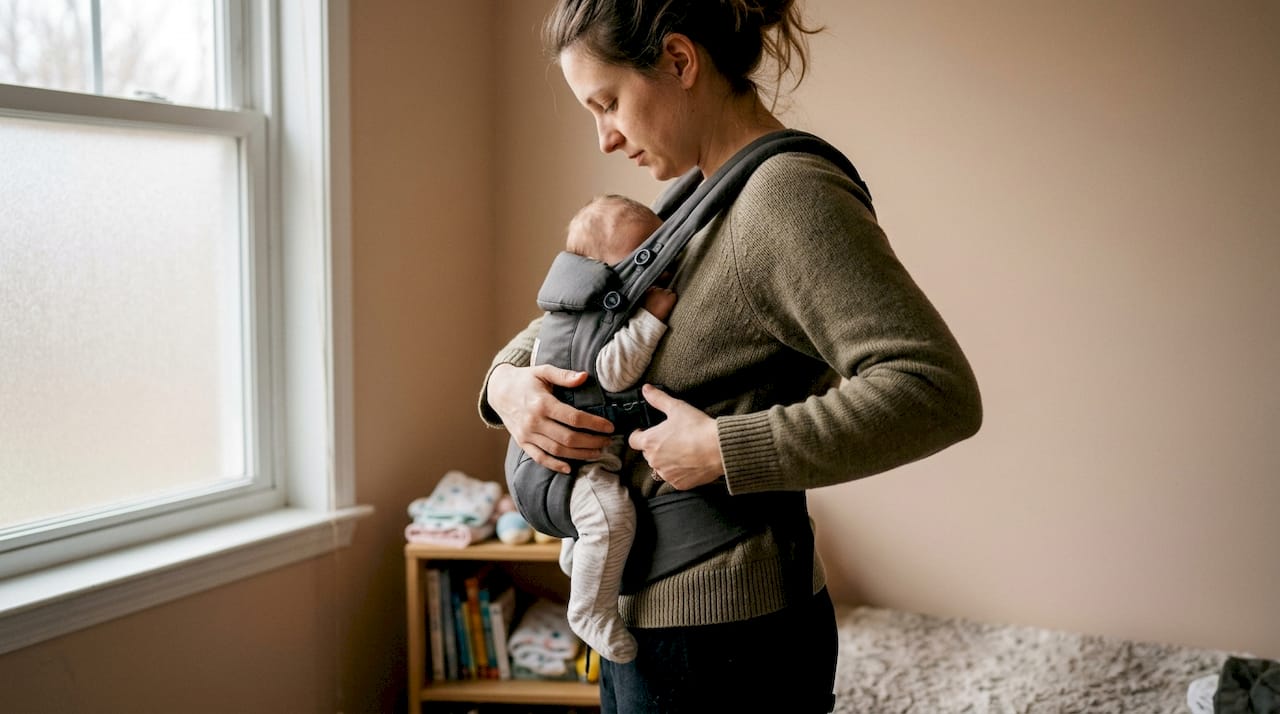
For times you’re carrying rather than feeding, a soft-structured carrier or hip seat shifts weight onto your hips and core, which are built to handle sustained load far better than your arms and shoulders. A hip seat is worth it if you’re doing a lot of standing and settling with a baby who wants to be upright. A structured carrier suits longer stretches, like grocery runs or soothing walks.
If thumb or wrist pain is part of the picture, a thumb spica brace worn during the day (not necessarily while sleeping) reduces strain on the tendon involved in De Quervain’s, and icing for 10 to 15 minutes a few times a day helps settle inflammation. Both are safe to use while breastfeeding.
A few habits worth avoiding altogether:
- Don’t reach for baby one-handed across your body. Turn and use both arms.
- Don’t carry baby at arm’s length “to see their face” for long stretches, bring them in against your chest instead.
- Don’t lift under the armpits only for a young baby. Support the head and back through the transfer, as Raising Children Network recommends.
Here’s a quick rundown of what each support option does best:
- Nursing pillow: best for feeding sessions, keeps baby at chest height and off your forearms.
- Hip seat: best for carrying during settling or short outings, moves load to your hip and core.
- Structured carrier: best for longer periods of movement, distributes weight across both shoulders and hips.
- Thumb spica brace: best for early De Quervain’s symptoms, limits the thumb movement that aggravates the tendon.
Clinicians who treat new parents for overuse injuries consistently point to the same fix: stop asking your arms to hold weight statically for long stretches, and start using props, braces or a support person to share the load.
Pro Tip: During a cluster-feeding evening, set a mental timer for micro-breaks. Every 15 to 20 minutes, shift your grip, adjust the pillow, or hand baby to a partner for two minutes even if the feed isn’t finished. Short interruptions reset the muscle before it hits real fatigue.
How to hold your baby to save your arms and back
Good posture during holds and feeds isn’t about looking correct, it’s about redistributing weight so no single muscle group carries it all. A few adjustments make a genuine difference within one feed.
- Stack your hips. Stand or sit with your weight even on both sides rather than jutting one hip out to rest baby on it.
- Bring baby up, not you down. Use a pillow or cushion to raise baby to chest height instead of hunching your shoulders forward and down to reach them.
- Support your forearms. Rest your elbows on an armrest, pillow or your own lap so your shoulder isn’t holding the full weight of your arm plus baby.
- Soften your knees and lengthen your spine. A locked stance transfers tension straight up into your lower back; a slight knee bend absorbs it instead.
- Rotate through holds. Alternate between cradle, cross-cradle and football holds during a feed, each one loads slightly different muscles, so switching gives the tired ones a break.
The two most common mistakes are the hip jut, which twists your spine and overloads one side, and carrying baby at arm’s length, which multiplies the effective load through pure leverage. If you catch yourself rounding your shoulders forward to look down at baby, that’s a cue to raise the pillow height rather than lower your posture. Trainers who coach new parents on carrying mechanics report that this single correction, bringing baby higher and closer, gives immediate, noticeable relief.
Pro Tip: Set up your feeding chair before you sit down, not after. Have the pillow, a water bottle and a burp cloth within reach so you’re not twisting or reaching mid-feed once baby’s latched. Our ergonomics of breastfeeding guide walks through a full setup checklist if you want more detail.
Simple exercises to build endurance and prevent recurrence
You don’t need a gym program, just five short movements done a couple of times a day.
- Dynamic shoulder swings: 10 slow arm circles each direction, loosens the joint before it stiffens.
- Scapular squeezes: pull shoulder blades together and hold for 5 seconds, 10 reps, counters the forward-rounded feeding posture.
- Bicep eccentric lowering: hold a light weight or a full water bottle, lower it slowly over 4 seconds, 8 reps, builds the exact control needed for sustained holding.
- Wrist glides: slow circles and flexion/extension through the wrist, 10 each direction, keeps the tendons around the thumb mobile.
- Core-activation hip hinge: hands on hips, hinge forward slightly keeping spine long, 10 reps, trains the core to share load with your arms.
If you had a caesarean or are dealing with pelvic floor issues, skip anything that strains your abdomen and check with your GP or physio before adding load. Two or three five-minute sessions spread through the day beat one long session you never get around to. Once these feel easy, add light hand weights or extend hold times, but if pain shows up during any of them, stop and get it checked rather than pushing through.
Postpartum joint laxity means your body genuinely isn’t as stable as it was before birth, which is exactly why gentle, progressive strengthening matters more than pushing hard early on.
Red flags, treatments, and what recovery looks like
Most arm fatigue settles with rest and better support. Some signs mean it’s time to stop self-managing and get assessed.
- Numbness or tingling that doesn’t resolve within a day or two.
- True weakness, not just tiredness, like dropping objects or being unable to grip.
- Sharp, severe pain rather than a dull ache.
- Progressive loss of thumb or wrist movement.
- Any of the above lasting more than 7 to 10 days despite rest, bracing and icing.
A typical visit involves a history of your symptoms, a physical exam checking specific movements (like the Finkelstein test for De Quervain’s), and occasionally imaging if something else is suspected. Treatment usually starts conservatively: a splint or brace, activity modification, and hands-on physiotherapy. For De Quervain’s that doesn’t settle, a corticosteroid injection is a common next step and is generally considered compatible with breastfeeding, though it’s worth confirming with your own provider. Surgery is rare and reserved for cases that don’t respond to months of conservative care. Chiropractic input can also help with the broader body mechanics behind repetitive strain; postpartum chiropractic care is worth considering if pain keeps returning despite the fixes above.
The pillow that takes the weight off your arms
A nursing pillow that actually holds its shape does more than cushion your lap, it changes the mechanics of the hold entirely. By lifting baby up to chest height, it removes the leverage problem that turns a light baby into a heavy one, and it stabilises your forearms so your shoulder muscles stop firing continuously through a feed.
The Zabbidoo nursing pillow was built around exactly this problem. It has an 18cm lift, higher than most standard pillows, which brings baby up rather than forcing you to hunch down to meet them. High compression resistance means it doesn’t flatten and sag halfway through a feed the way cheaper foam pillows do, so the support stays consistent from the first minute to the last. A stability-focused shape reduces the constant repositioning that interrupts feeds and forces your arms back into work mode. The cover is breathable French flax linen, hypoallergenic and machine washable.
A pillow that collapses under weight forces your arms to compensate exactly when you need them to rest. Shape retention isn’t a comfort feature, it’s the entire point.
To use it for breastfeeding, position the pillow around your waist with baby resting on top at chest height, arms free to support rather than hold. For bottle feeds, the same setup works, just angle baby slightly upright. It also doubles as lap support for burping and a stable base for supervised tummy time once baby’s a little older. One safety note worth repeating from paediatric guidance: always keep baby’s airway visible and never prop a young infant on cushioning unsupervised, the pillow supports positioning, it doesn’t replace watching your baby.
What new parents get wrong about arm fatigue
Most advice on this topic treats arm fatigue as something to push through, as if sore arms are just part of the deal with a newborn. That framing does new parents a disservice. The research is clear that this is a mechanical problem, not a toughness problem, and mechanical problems have mechanical fixes.
The bigger miss is that most parents don’t realise how much leverage matters. They’ll happily prop a pillow under their elbow but keep holding baby low and away from their chest, which cancels out half the benefit. Fixing distance from your body does more for arm fatigue than almost any other single change, and it costs nothing.
If I had to prioritise one thing, it wouldn’t be exercises or braces, it would be getting the height and distance right from the very first feed, before bad habits set in. Everything else, the strengthening, the braces, the clinical care if it comes to that, matters far less if the basic mechanics are still working against you every single day.
Get the support that actually holds up through every feed
Cushions and rolled-up towels get you through a night, but they flatten fast and leave you right back where you started, hunched and sore by the third feed of the day. The Zabbidoo nursing pillow is built specifically to not do that. Its 18cm lift and high compression resistance mean it holds its shape feed after feed, so you’re not re-stacking cushions at 3am with one arm while the other holds a hungry baby.

If wrist or thumb pain is part of your picture too, pairing the pillow with proper wrist support makes a real difference, our wrist support guide walks through options that work alongside it. And if your hands are constantly full during settling routines, the free pacifier clip chain that comes with select orders cuts down on one-handed reaching, which is exactly the movement that aggravates De Quervain’s. Head to the nursing pillow page to check sizing and cover options, and get one set up before your next long feed.
Frequently asked questions about arm fatigue holding baby
Why do my arms get so tired holding my baby, even though they’re not heavy? It’s isometric muscle fatigue, your arm muscles are held rigidly in one position, which restricts blood flow and builds up fatigue byproducts quickly. Holding baby further from your chest also increases the leverage your muscles have to work against, making a light baby feel far heavier than they actually are.
How can I prevent arm fatigue from holding my newborn? Bring baby up to chest height rather than holding them at arm’s length, alternate arms regularly, and use a supportive nursing pillow during feeds so your forearms rest instead of working continuously. Building in short strengthening exercises for your shoulders and wrists a few times a week also helps your endurance over time.
What’s the difference between normal arm fatigue and something like De Quervain’s? Ordinary fatigue is a general ache that eases with rest and better support. De Quervain’s causes sharp, specific pain at the base of the thumb that worsens with lifting or twisting motions, and it typically doesn’t improve with rest alone the way normal fatigue does.
Is it normal for my wrists to hurt from holding my baby? Mild wrist tiredness is common given postpartum joint laxity and the sheer volume of lifting, but sharp or persistent wrist pain, especially near the thumb, is worth checking with a hand specialist if it lasts beyond a week or two.
When should I see a doctor about arm pain from holding my baby? See a clinician if you notice numbness, real weakness, sharp localised pain, or if the fatigue hasn’t improved after 7 to 10 days of rest, support and posture changes. These signs suggest an overuse injury rather than ordinary tiredness.
This article is general information, not a substitute for advice from a qualified doctor. Consult a qualified healthcare professional about your own circumstances before acting on anything here.
Sources
- Mommy wrist is real. Here’s what to know about it | The Well by Northwell
- Why do my arms feel heavy after holding my newborn? – Biomedicus
- Trainer reveals the baby carrying mistakes that might be hurting you | The Bump
- Baby carriers, slings and backpacks safety guide | Raising Children Network