

Numb hands while breastfeeding are most commonly caused by postpartum carpal tunnel syndrome, sustained wrist flexion during feeds, or nipple vasospasm. The single best thing you can do right now: raise your baby to breast height so your wrist stays straight, and support your forearm on a firm surface. That one change reduces pressure on the median nerve immediately.
Three things to try on your next feed:
- Raise baby so their ear and shoulder align with your nipple — your wrist should not be bent to bring them up to you.
- Rest your forearm on a firm armrest, rolled towel, or high-lift nursing pillow rather than holding baby’s weight with your wrist.
- Slip on a soft wrist splint or wrap a rolled towel under your wrist to keep it neutral throughout the feed.
Pro Tip: A neutral wrist means your hand is in line with your forearm — not bent up, down, or sideways. Even a slight bend held for 20–30 minutes compresses the median nerve enough to cause pins and needles.
One red flag to know now: if you notice sudden, significant swelling in your hands or wrists, seek medical attention immediately. This can be a sign of postpartum preeclampsia, not carpal tunnel.
Key takeaways
Numb hands while breastfeeding are most commonly caused by postpartum carpal tunnel syndrome and sustained wrist flexion during feeds, and most cases improve with consistent ergonomic changes and conservative care.
| Point | Details |
|---|---|
| Most likely cause | Postpartum carpal tunnel from fluid retention and bent-wrist feeding posture. |
| Immediate fix | Raise baby to breast height, support your forearm, and keep your wrist straight every feed. |
| Conservative care | Night splints, daytime wrist braces, and physiotherapy resolve most cases within weeks to months. |
| Red flag | Sudden severe hand and wrist swelling needs urgent medical review — possible preeclampsia. |
| Zabbidoo nursing pillow | The 18cm lift and compression-resistant design keep baby at feed height, reducing wrist flexion. |
Table of Contents
- What causes numb or tingling hands while breastfeeding?
- How to tell if it’s carpal tunnel, positional strain, or vasospasm
- What to expect for recovery: typical timelines
- Practical strategies to reduce numbness during feeds right now
- Conservative treatments and when to see a doctor in Australia
- How a high-lift nursing pillow reduces wrist and shoulder strain
- What actually changed things for the mums I hear from most
- The Zabbidoo nursing pillow: built for wrist relief
- Sources
What causes numb or tingling hands while breastfeeding?
Most cases of hand numbness during breastfeeding trace back to one of three causes: postpartum carpal tunnel syndrome, positioning-related nerve strain, or nipple vasospasm. Understanding which one you’re dealing with changes what you do about it.
Postpartum carpal tunnel syndrome
The carpal tunnel is a narrow channel in the wrist through which the median nerve passes. During pregnancy, fluid retention swells the surrounding tissue and compresses that nerve. Many mums expect this to resolve after birth, but fluid shifts and hormonal changes can persist for weeks to months postpartum, especially while breastfeeding. Add the repetitive wrist postures of feeding, burping, and lifting, and the nerve stays irritated.
Positioning and repetitive strain
Holding a baby for multiple feeds each day is physically demanding work. Sustained wrist flexion and repetitive infant lifting are documented triggers for both carpal tunnel syndrome and de Quervain’s tenosynovitis in new parents. The classic culprit is cradling baby with a bent wrist while hunching forward to bring your breast down to them, rather than bringing baby up to you.
Nipple vasospasm
Vasospasm is a vascular spasm in the nipple, not a nerve problem. The Australian Breastfeeding Association describes it as sharp, burning nipple pain with colour changes (white, blue, or red) triggered by cold or after feeds. It can feel like pins and needles, but the sensation is local to the breast, not the hand. Management is completely different: warmth helps vasospasm; wrist support helps carpal tunnel.
Less common causes to know about
| Cause | Key feature | Action |
|---|---|---|
| Postpartum carpal tunnel | Thumb, index, middle finger numbness; worse at night | Wrist splint, physio, GP review |
| Positional nerve strain | Symptoms only during or just after feeds | Adjust hold, support arm |
| Nipple vasospasm | Burning nipple pain, colour change, cold-triggered | Warmth, avoid cold, ABA guidance |
| Postpartum preeclampsia | Sudden severe swelling in hands and wrists | Seek urgent medical care immediately |
| Peripheral neuropathy | Widespread or progressive numbness beyond hand | GP referral for assessment |
Pro Tip: If your numbness is only in the pinky and ring finger, that points to the ulnar nerve, not the median nerve. Ulnar symptoms suggest a different compression site — worth mentioning specifically to your GP.
How to tell if it’s carpal tunnel, positional strain, or vasospasm
The pattern of your symptoms is the most useful diagnostic clue before you see a GP.
Carpal tunnel signs:
- Numbness or tingling in the thumb, index finger, middle finger, and the thumb-side half of the ring finger — this is the median nerve’s sensory distribution.
- Symptoms that are worse at night or first thing in the morning, often waking you from sleep.
- Weakness when gripping or pinching — dropping objects, struggling with jar lids.
- Relief when you shake your hand or hang it over the side of the bed.
Positional strain signs:
- Tingling that appears during a feed and fades within minutes of finishing.
- Symptoms that shift depending on which hold you use or which arm takes the weight.
- No night symptoms when your wrist is resting in a neutral position.
Vasospasm signs:
- Sharp, burning pain in the nipple itself, not the hand.
- Visible colour change in the nipple after feeds or cold exposure.
- Symptoms that ease with warmth applied to the breast.
Pro Tip: Keep a simple log for two days: which hand, which fingers, what time, and what hold you were using. That pattern is exactly what a GP or hand therapist needs to triage you quickly.
What to expect for recovery: typical timelines
Many mums find that hand numbness during breastfeeding improves on its own as postpartum fluid balance normalises, but the timeline varies considerably.
- Weeks 1–2 postpartum: Fluid retention is at its peak. Symptoms are often most intense here. Wrist splinting and positioning changes make the biggest difference at this stage.
- Weeks 2–6: Fluid levels begin to settle. Mums who address positioning and use night splints consistently often notice gradual improvement.
- 6 weeks to 3 months: Many cases resolve or significantly reduce with conservative care. A 6-week GP check is a good time to reassess whether symptoms are improving or plateauing.
- Beyond 3 months: Some cases documented in clinical literature persist beyond the puerperium, particularly in mums who are feeding frequently and have not modified their wrist posture. These cases warrant a formal hand therapy or specialist referral.
Feeding frequency matters here. More frequent feeds mean more cumulative wrist strain. Mums feeding 10–12 times a day will generally need more active ergonomic management than those feeding less often. Weaning does tend to accelerate recovery, but it is not the only path — many mums manage symptoms successfully while continuing to breastfeed.
Practical strategies to reduce numbness during feeds right now
Getting your setup right before each feed is the highest-leverage change you can make. Ergonomics education — proper holds, elevated support — can prevent or reduce repetitive strain injuries that develop during frequent infant care.
Before each feed, run through this checklist:
- Sit back in a supported chair with your lower back and arms rested.
- Place a firm, high-lift nursing pillow across your lap before picking up baby.
- Bring baby to breast height — your nipple should meet their mouth, not the other way around.
- Check your wrist: forearm supported, wrist straight, no bend.
- Alternate your hold (cradle, cross-cradle, football) between feeds to vary which muscles and tendons bear the load.
Step-by-step setup for a neutral-wrist feed:
- Sit in a chair with armrests, or place a firm pillow under your elbow.
- Position your nursing pillow so baby’s face is level with your nipple without you leaning forward.
- Rest your forearm along the top of the pillow rather than gripping baby’s head with a bent wrist.
- Use a soft wrist splint on the more affected hand during the feed if symptoms are significant.
- After the feed, gently extend your wrist and fingers for 30 seconds to release tension.
Pro Tip: The football hold (baby tucked under your arm, feet pointing behind you) takes the baby’s weight off your wrist entirely and is often the most comfortable option for mums with significant carpal tunnel symptoms.
For more setup guidance, the ergonomics of breastfeeding resource covers different holds in detail.
Conservative treatments and when to see a doctor in Australia
Most cases of hand numbness during breastfeeding respond well to conservative care. The key is starting early and being consistent.
First-line options:
- Night splints: Keeping the wrist neutral overnight prevents the sustained flexion that typically worsens carpal tunnel symptoms during sleep. Wear one on each affected hand.
- Daytime splints during feeds: A soft wrist brace worn during nursing keeps the wrist from bending under load.
- Physiotherapy or hand therapy: A physiotherapist or accredited hand therapist can assess your specific pattern, provide nerve gliding exercises, and advise on activity modification. In Australia, a GP referral is not required to see a private physio, though a referral may support a Medicare Enhanced Primary Care plan if you qualify.
- Activity modification: Reduce repetitive gripping tasks between feeds — avoid prolonged phone scrolling, typing with bent wrists, or carrying heavy shopping bags by the handles.
- Analgesia: Paracetamol is generally considered compatible with breastfeeding for short-term pain relief. Always confirm with your pharmacist or GP before starting any medication while nursing.
Conservative measures including wrist splints, activity modification, physiotherapy, and corticosteroid injection have evidence of benefit for carpal tunnel syndrome. Steroid injections are sometimes used when splinting alone is insufficient, and your GP can advise on compatibility with breastfeeding.
Red flags — seek prompt medical review:
- Sudden, significant swelling in the hands or wrists (possible postpartum preeclampsia — go to an emergency department).
- Rapid loss of hand strength or grip.
- Progressive numbness spreading beyond the hand into the arm.
- Symptoms severe enough to disrupt feeding or sleep with no improvement after two weeks of conservative care.
Practical Australian access notes: Book a standard GP appointment to discuss symptoms and request a referral for nerve conduction studies or hand therapy if needed. If you have a chronic condition management plan, ask your GP about a Medicare-subsidised allied health referral. For sudden severe swelling, go directly to your nearest emergency department or call 000.
Pro Tip: When you call to book your GP appointment, mention “hand numbness since having my baby” — this flags it as a postpartum issue and helps the receptionist allocate a longer appointment slot.
How a high-lift nursing pillow reduces wrist and shoulder strain
The biomechanics are straightforward. When baby lies too low, you bend your wrist to support their head and hunch your shoulders to bring your breast down to them. That sustained wrist flexion compresses the median nerve. An elevated, stable nursing support that resists compression reduces the need to bend the wrist while holding baby, keeping the wrist in a neutral position that relieves median nerve pressure.
Features that actually matter in a nursing pillow:
- Height/lift: A pillow that raises baby to nipple height without you leaning forward. The practical target is having baby’s ear and shoulder level with your nipple while your forearm rests flat.
- Compression resistance: A pillow that collapses under baby’s weight forces you to compensate by gripping harder. Firm, shape-retaining fill keeps baby at the right height throughout the feed.
- Stability: A pillow that shifts or slides means constant repositioning, which means repeated wrist adjustments.
- Washable cover: Feeds are messy. A removable, machine-washable cover is a practical necessity, not a luxury.
- Portability: A handle or compact design means you can use it in different chairs, on the floor, or when visiting family.
How to set up for three common holds:
- Cradle hold: Place the pillow across your lap, rest baby’s body along the pillow’s length, and lay your forearm flat along the top so your wrist is straight.
- Cross-cradle hold: Shift the pillow slightly to the opposite side, support baby’s head with your opposite hand resting on the pillow’s surface — not gripped in mid-air.
- Laid-back (reclined) hold: Recline your chair slightly, place the pillow across your lower abdomen, and let baby lie on your chest with gravity doing most of the work. Wrist strain is minimal in this position.
Pro Tip: Before your first feed with a new pillow, measure the gap between your lap and your nipple while sitting upright. That’s the lift you need. If the pillow doesn’t close that gap, you’ll still be bending your wrist.
Zabbidoo’s 18cm lift is designed around this exact principle. The multi-use nursing pillow workflow explains how the height and compression resistance work together to keep baby at feed height without you compensating with your wrist.
What actually changed things for the mums I hear from most
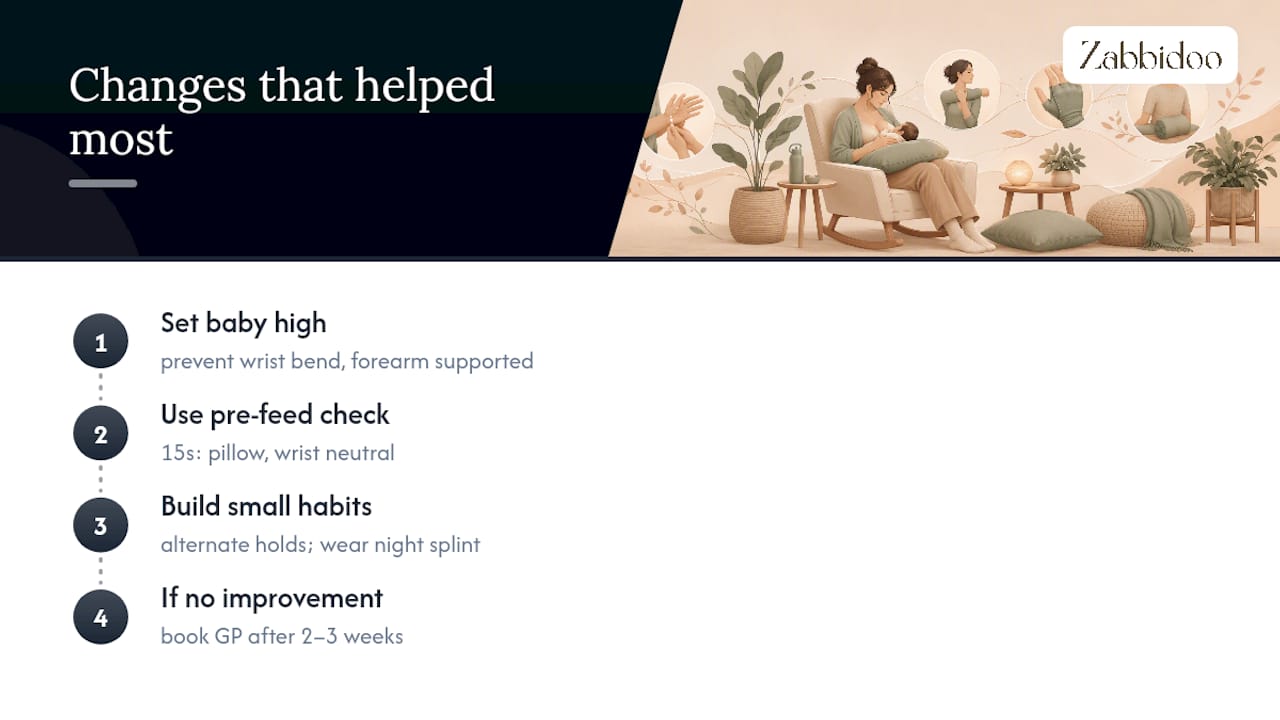
The advice that gets repeated most often in breastfeeding support circles is “fix your latch” or “try a different hold.” Both matter. But the change that makes the most immediate difference to hand numbness is almost always structural: getting baby high enough that the wrist never has to bend.
Most mums don’t realise how much cumulative strain comes from 10 feeds a day at a slightly wrong height. It’s not one dramatic injury — it’s 200 small compressions of the median nerve, repeated daily, for weeks. The wrist splint at night helps. The physio helps. But neither fully works if the root cause (baby too low, wrist bent, forearm unsupported) is still happening at every feed.
The emotional side of this is real too. Managing wrist pain while also managing sleep deprivation, milk supply anxiety, and a newborn is genuinely hard. The goal isn’t perfection at every feed — it’s building a default setup that’s good enough most of the time. A consistent pre-feed checklist (pillow in place, wrist neutral, arm supported) takes about 15 seconds and removes most of the guesswork.
Small habits compound. A quick wrist-neutral check before each feed, alternating holds across the day, and a night splint worn consistently will do more than any single intervention. And if symptoms aren’t improving after two to three weeks of those changes, that’s the signal to book the GP appointment, not wait another month.
For mums managing the emotional side of breastfeeding discomfort alongside the physical, ways to avoid nursing frustration has some practical framing worth reading.
The Zabbidoo nursing pillow: built for wrist relief
Numb hands during breastfeeding are a positioning problem as much as a medical one. The Zabbidoo nursing pillow is designed around the one thing most standard pillows miss: enough lift to keep baby at breast height without you compensating with a bent wrist.

The 18cm lift brings baby up to you. The high compression resistance means the pillow holds that height through a full feed, not just the first few minutes. The stability-focused design reduces the constant repositioning that forces repeated wrist adjustments. The hypoallergenic French flax linen cover is breathable and machine washable, and the built-in pocket and portable handle make it practical for use in any room.
Setting up is straightforward: place the pillow across your lap, rest baby on the pillow’s surface, lay your forearm flat along the top, and check that your wrist is straight. That’s the setup. No hunching, no gripping, no compensating.

If you’re ready to try an ergonomic solution that addresses the root cause of wrist strain during feeds, shop the Zabbidoo nursing pillow and have it delivered across Australia. For red-flag symptoms — sudden swelling, rapid loss of grip strength — please see your GP or emergency department first.
Sources
- Australian Breastfeeding Association — vasospasm and breast symptoms
- Carpal tunnel syndrome in breastfeeding mothers - KellyMom
- Hand pain in pregnancy and the new parent - Hand Therapy Academy
For persistent symptoms, book an appointment with your GP and ask for a referral to a physiotherapist or accredited hand therapist. The Australian Breastfeeding Association also offers a national helpline and local support groups for mums navigating breastfeeding challenges.
This article is general information, not a substitute for advice from a qualified doctor. Consult a qualified healthcare professional about your own circumstances before acting on anything here.