

For many new mums, the most likely culprit behind breastfeeding-related wrist pain is De Quervain’s tenosynovitis, also called “mother’s thumb” — irritation of the tendons running along the thumb side of the wrist. Carpal tunnel syndrome is another common cause, particularly in the early postpartum weeks when pregnancy-related swelling hasn’t fully resolved. Both conditions respond well to early, conservative care.
What to do right now:
- Support your baby’s weight with a firm nursing pillow or rolled towel so your wrist stays neutral during feeds.
- Fit a wrist brace or thumb splint to protect the irritated tendons between and during feeds.
- Apply ice wrapped in a cloth for 10–15 minutes after feeding to reduce inflammation.
- Avoid lifting your baby with a thumb-out “C-grip” — scoop from underneath instead.
- Take paracetamol if pain is significant; discuss ibuprofen with your GP or pharmacist before using it while breastfeeding.
Key takeaways
Wrist pain from breastfeeding is most commonly De Quervain’s tenosynovitis or carpal tunnel syndrome — both respond well to early positioning changes, wrist protection, and conservative care.
| Point | Details |
|---|---|
| Identify the cause early | De Quervain’s (thumb-side pain) and carpal tunnel (finger tingling) need slightly different management — get the right diagnosis. |
| Protect the wrist during feeds | Use a firm nursing pillow to carry the baby’s weight and wear a wrist splint between feeds to rest the tendons. |
| Change your hold | Semi-reclined and side-lying positions remove wrist load; cross-cradle beyond the newborn phase increases strain. |
| Seek help at 2 weeks | If pain hasn’t improved after 2 weeks of self-care, see a GP, physiotherapist, or hand therapist — early review improves outcomes. |
| Zabbidoo nursing pillow | The 18 cm lift and high compression resistance reduce wrist load during feeds, addressing the root mechanical cause. |
Table of Contents
- 1. How breastfeeding causes wrist and thumb pain
- 2. How to recognise mother’s wrist and other breastfeeding-related wrist problems
- 3. Short-term measures you can use today while breastfeeding
- 4. Feeding positions and supports that reduce recurrence
- 5. Gentle stretches and strengthening you can safely start at home
- 6. Red flags, who to contact in Australia, and clinician treatment options
- 7. Do nursing pillows and arm supports actually help?
- 8. What the Zabbidoo nursing pillow does for wrist strain
- Sources
1. How breastfeeding causes wrist and thumb pain
De Quervain’s tenosynovitis develops when the abductor pollicis longus and extensor pollicis brevis tendons — the two that run along the thumb side of your wrist — become inflamed from repeated strain. Every time you scoop your baby up, hold them in a cross-cradle position, or support their head with your thumb extended, those tendons are under load. Do that dozens of times a day for weeks, and the tendon sheath swells and tightens. Pain sits at the base of the thumb and can radiate up the forearm.
Pregnancy hormones, particularly relaxin, loosen connective tissue throughout the body, which leaves tendons more vulnerable to irritation after birth. Fluid retention during pregnancy can also narrow the carpal tunnel — the channel on the palm side of the wrist — causing tingling and numbness in the thumb, index, and middle fingers. For some mums, both conditions overlap.
Patient guidance from Ireland’s HSE identifies De Quervain’s and carpal tunnel as the two most common postpartum wrist problems, linking both to hormonal changes and repetitive lifting postures.
Pro Tip: A poor latch forces you to hold the baby closer and tighter, increasing wrist load. Fixing the latch often reduces wrist strain more than any brace alone — ask a lactation consultant early.
2. How to recognise mother’s wrist and other breastfeeding-related wrist problems
De Quervain’s produces pain at the base of the thumb, on the side of the wrist closest to the thumb. It tends to be sharp on gripping, turning a door handle, or picking up your baby. Swelling over the thumb tendons is common, and the area is often tender to touch.
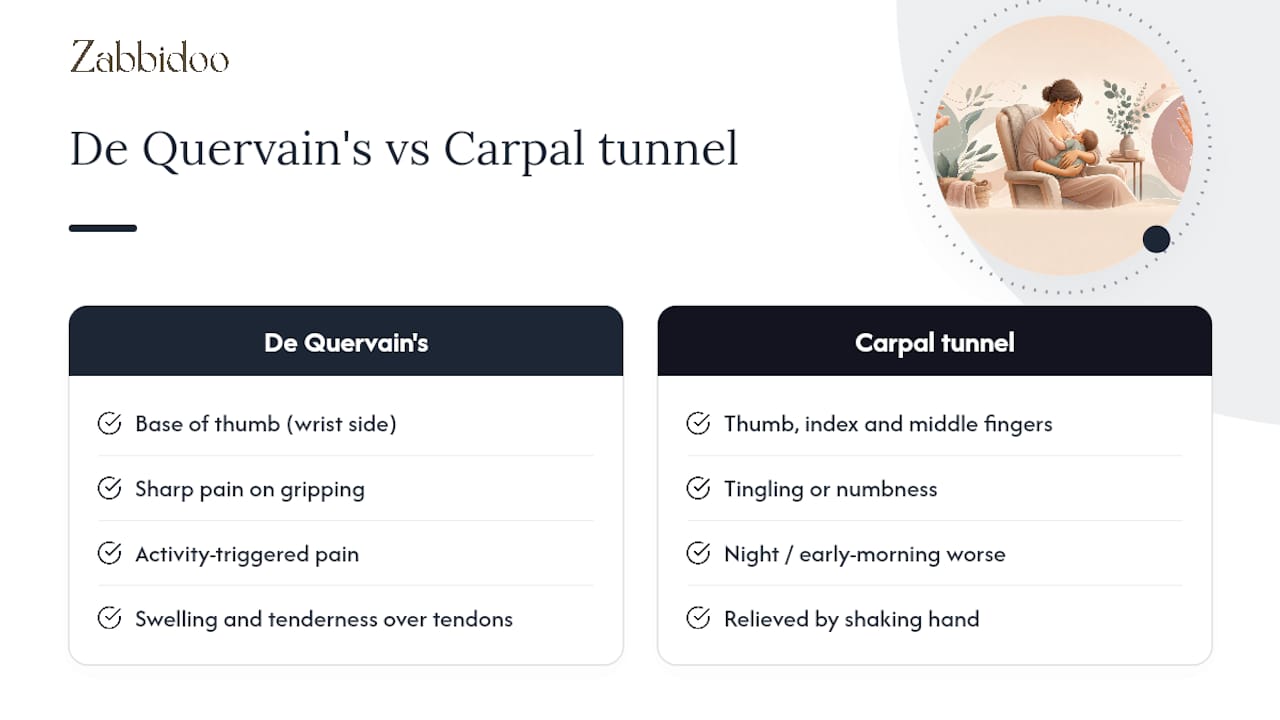
Carpal tunnel syndrome feels different: tingling or numbness in the thumb, index, and middle fingers, often worse at night or first thing in the morning. Shaking your hand out tends to relieve it temporarily.
A quick self-check for De Quervain’s is the Finkelstein test: tuck your thumb into your palm, wrap your fingers over it to make a fist, then gently tilt the fist toward your little finger. Sharp pain at the thumb side of the wrist is a positive result. Do this gently — it can be quite uncomfortable if De Quervain’s is present, so stop if the pain is severe.
Pro Tip: If your symptoms are mainly night-time tingling rather than thumb-side pain, carpal tunnel is more likely than De Quervain’s. The two conditions need slightly different management, so getting the right label early saves time.
3. Short-term measures you can use today while breastfeeding
Most of the immediate relief for breastfeeding-related wrist pain comes down to two things: reducing load on the wrist during feeds, and protecting the irritated tendons between feeds.
Step-by-step for each feed:
- Set up a firm nursing pillow before you pick up your baby — the pillow should bring the baby to nipple height so you aren’t hunching or holding their weight with your arms.
- Position your baby so their body faces yours fully, reducing the need to twist your wrist to support their head.
- Use a thumb-neutral grip: support the baby’s head with your palm and forearm, not with a pinching thumb-and-finger hold.
- If pain flares mid-feed, switch to a side-lying position so gravity does the work.
Between feeds:
- Wear a wrist splint or thumb spica brace to keep the wrist neutral and the thumb tendons rested. Wrist splints that stabilise the thumb without blocking functional grip are particularly useful for De Quervain’s.
- Apply ice for 10–15 minutes, two to three times a day, especially after a long feed.
- Rest the wrist where possible — avoid tasks that involve repeated pinching or gripping (jar lids, heavy bags).
Analgesia: Paracetamol is considered first-line and is compatible with breastfeeding at standard doses. Ibuprofen is generally considered low-risk during breastfeeding but check with your GP or pharmacist before using it regularly, particularly in the early postpartum weeks. Never use aspirin while breastfeeding.
Pro Tip: Wearing a wrist brace during feeds feels awkward at first, but breastfeeding with a wrist brace is entirely manageable once you’ve set up a firm pillow to carry the baby’s weight — the brace protects the tendon while the pillow does the lifting.

4. Feeding positions and supports that reduce recurrence
Changing how you hold your baby is the single most effective long-term strategy for reducing wrist strain. Lactation experts note that the cross-cradle hold, while useful in the newborn phase, increases wrist strain when used as the default position beyond the first few weeks.
Positions worth trying:
- Semi-reclined (laid-back) feeding: You lean back at roughly 45 degrees, baby lies tummy-down on your chest. Gravity holds the baby against you, removing almost all wrist load. Excellent for De Quervain’s flare-ups.
- Side-lying: Both you and baby lie on your sides facing each other. No arm or wrist load at all — particularly useful for night feeds and C-section recovery.
- Football (clutch) hold: Baby’s body tucks under your arm like a rugby ball, supported by your forearm. Keeps the wrist straighter than cross-cradle and gives good latch control.
| Support type | Best for | Limitation |
|---|---|---|
| Firm nursing pillow | Newborn stage; reducing arm fatigue during day feeds | Needs to be high enough to bring baby to nipple level |
| Arm sling / breastfeeding support | Acute De Quervain’s; hands-free support during feeds | Takes practice to set up; less portable |
| Wrist splint / thumb spica | Protecting tendons between and during feeds | Reduces fine motor control temporarily |
Prevention guidance from Athletico recommends supporting the baby with a pillow or sling, avoiding prolonged wrist flexion, and alternating holds to reduce repetitive strain.
Pro Tip: Place the nursing pillow under your forearm, not under the baby’s back. The baby should rest on you, with the pillow supporting your arm. Sliding the pillow under the baby’s back creates a gap that makes you lean forward and crane your wrist to compensate.
5. Gentle stretches and strengthening you can safely start at home
Start these only when acute pain has settled to a manageable level. Sharp pain during any exercise means stop.
- Tendon glides: Hold your hand up, fingers straight. Slowly curl fingertips to touch the top of your palm (hook fist), then straighten. Repeat 10 times, twice daily. This keeps the finger flexor tendons mobile without loading the thumb tendons.
- Gentle thumb stretch: Hold your hand palm-up. Slowly move your thumb away from your fingers (abduction), hold 5 seconds, return. Repeat 8–10 times. Keep the movement pain-free.
- Wrist flexor stretch: Extend your arm in front of you, palm facing up. With your other hand, gently press the fingers back toward the floor until you feel a mild stretch along the forearm. Hold 20–30 seconds, repeat twice each side.
- Wrist extensor stretch: Same position, but palm facing down. Gently press the back of the hand downward. Hold 20–30 seconds, repeat twice.
- Forearm rotation: Elbow bent at 90 degrees, palm facing down. Slowly rotate the forearm so the palm faces up, then back. Repeat 10 times. This mobilises the radioulnar joint and reduces stiffness from sustained feeding positions.
Strengthening (light resistance with a theraband or small weight) should wait until you can complete the stretches above without pain, typically after 2–4 weeks of conservative care. A physiotherapist or hand therapist can progress this safely.
Pro Tip: Do the wrist flexor and extensor stretches immediately after a feed, while the tendons are warm. Two minutes of stretching post-feed is more effective than a longer session done cold.

6. Red flags, who to contact in Australia, and clinician treatment options
Conservative care works for most cases, but some symptoms need earlier review.
See a clinician sooner if you notice:
- Progressive weakness in the hand or difficulty gripping
- Marked or worsening numbness, particularly if it extends beyond the fingers into the hand or forearm
- Severe swelling, redness, or warmth that spreads up the arm
- Symptoms that show no improvement after 2 weeks of consistent self-care
- Pain that prevents you from feeding or caring for your baby
Who to contact in Australia:
- GP: First port of call for assessment, diagnosis, and referral. Can discuss safe analgesia options for breastfeeding and refer for imaging if needed.
- Physiotherapist or hand therapist: Provides splinting, targeted exercises, and hands-on treatment. Hand therapists have specialist training in wrist and tendon conditions — worth seeking out for De Quervain’s specifically.
- Lactation consultant: Addresses positioning and latch, which directly reduces the mechanical load causing the injury. The Australian Breastfeeding Association recommends lactation consultant access for persistent body aches during breastfeeding.
- Specialist referral: If conservative care fails after 6–8 weeks, a GP may refer for ultrasound-guided corticosteroid injection (a clinician decision; discuss breastfeeding safety at the time) or, in rare cases, surgical release of the tendon sheath.
Australian clinical guidance notes that delayed diagnosis and late referral are the main reasons some cases drag on — early assessment genuinely improves outcomes.
7. Do nursing pillows and arm supports actually help?
The short answer: yes, with caveats. A small nurse-led trial tested a purpose-built breastfeeding arm sling against the standard cross-cradle hold in first-time mothers. Mothers using the arm sling reported reduced wrist and arm tension, improved hold security, and greater satisfaction with breastfeeding. The authors noted statistically significant improvements in breastfeeding effectiveness, but the study was small and they recommended larger trials before drawing firm conclusions.
That single trial is the most direct evidence available for arm-support devices specifically. The broader case for nursing pillows rests on the biomechanical logic: anything that transfers the baby’s weight from your arms to a stable surface reduces the sustained load on wrist tendons. A pillow that collapses under the baby’s weight defeats that purpose entirely.
What to look for in a nursing pillow for wrist protection:
- Sufficient lift to bring the baby to nipple level without you leaning down (at least 15–18 cm for most mums)
- High compression resistance so the pillow holds its shape through a full feed
- Stable, non-slip base to prevent repositioning mid-feed
- Breathable, washable cover for hygiene
Pro Tip: Test a pillow’s compression resistance before buying: press your forearm firmly into the centre. If it bottoms out quickly, it won’t support a baby’s weight through a 20-minute feed. Firm is better than soft for wrist protection.
8. What the Zabbidoo nursing pillow does for wrist strain
Most nursing pillows are designed to look supportive. The Zabbidoo nursing pillow is designed to actually be supportive — there’s a difference that matters when your wrist tendons are inflamed.

The 18 cm lift brings the baby to nipple height for most mums, removing the need to hunch or hold the baby’s weight with your arms. High compression resistance means the pillow stays firm through a full feed rather than compressing under the baby’s weight and forcing you to compensate with your wrist. The stability-focused design reduces the constant micro-adjustments that keep wrist tendons under load. The hypoallergenic French flax linen cover is breathable and machine washable — practical for the frequency of use a nursing pillow gets.
For setup: place the pillow around your waist, rest your forearm on it, and bring the baby to the pillow rather than lifting the pillow to the baby. Your wrist should be straight, not bent. The ergonomic breastfeeding guide on the Zabbidoo site walks through the full setup in detail.
Zabbidoo ships Australia-wide with straightforward returns. Order directly at zabbidoo.com.
Sources
- Effectiveness of breastfeeding arm sling innovation in supporting breastfeeding in first‑time mothers (PMC)
- Thumb and wrist pain after having a baby
- Body aches and pains while breastfeeding
- Preventing Wrist Pain When Nursing - Athletico
- How to prevent wrist pain while breastfeeding
This article provides general information only and is not a substitute for professional medical advice. If you are unsure about your symptoms or medication choices while breastfeeding, consult your GP, pharmacist, or a registered health professional.