

Quick relief for wrist pain during feeding
The fastest fix for wrist pain during feeding is a simple one: stop bending your wrist. Neutral wrist positioning is the single most effective way to prevent and relieve the pain that builds up across multiple daily feeds. Everything else, braces, pillows, position changes, works best when you start there.
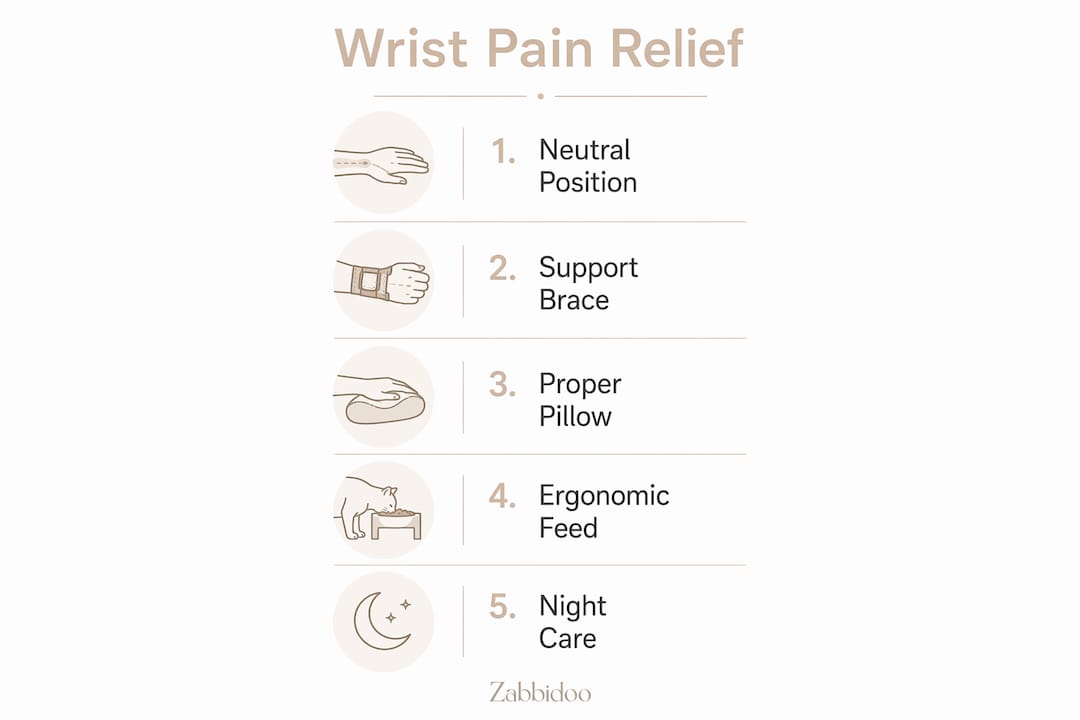
Here are the most effective immediate relief strategies:
- Keep your wrist straight. Avoid “cupping” your baby’s head with a bent wrist. Support the head under your elbow or forearm instead.
- Use a nursing pillow or rolled towel. Prop your arm so your wrist carries no weight. A firm pillow at the right height does the heavy lifting for you.
- Wear a thumb-spica wrist brace. Put it on during feeds and during sleep to stabilise the tendons most affected by feeding strain.
- Apply a cold compress. Cold therapy applied to the sore area for up to 10 minutes, several times a day, reduces swelling and dulls acute pain.
- Alternate your feeding arm. Switching sides between feeds spreads the load and gives each wrist time to recover.
Table of Contents
- How to properly support your wrist during feeding
- Why do your wrists hurt during feeding?
- What wrist supports and braces actually help
- How the Zabbidoo nursing pillow reduces wrist strain
- Mummy wrist vs. carpal tunnel: how to tell the difference
- Zabbidoo: built for the way new mums actually feed
- Key takeaways
How to properly support your wrist during feeding
Good wrist support during feeding is about setting up the whole position, not just strapping on a brace.
- Sit in a supportive chair. Your back and arms need to be supported before your baby even latches. A footstool under your feet brings your lap up and reduces how much your arms have to work.
- Bring baby to breast, not breast to baby. This is where most wrist strain originates. When you hunch forward to meet your baby, your wrists end up bent and loaded. A firm nursing pillow at the correct height fixes this.
- Try the football hold or side-lying position. The football hold tucks baby under your arm, removing weight from your wrist entirely. Side-lying lets the mattress carry your baby’s weight, which is genuinely restful for sore wrists.
- Fit your wrist brace correctly. A thumb-spica brace should hold your wrist in a neutral, straight position without cutting off circulation. Wear it snug but comfortable, and keep it on during sleep.
- Use a sling for feeds on the go. A well-fitted baby carrier offloads your arms completely, which is particularly useful during cluster feeding.
Pro Tip: Wear your wrist brace overnight, not just during feeds. Night-time wrist support prevents your wrist from curling into a flexed position while you sleep, which is when a lot of tendon healing actually happens.
Physiotherapists consistently point to one overlooked factor: pillow height. A nursing pillow that sits too low forces you to lean forward, loading your wrists and neck simultaneously. The Australian Breastfeeding Association notes that a properly elevated nursing pillow reduces the need to bend forward, cutting wrist stress at its source.

Why do your wrists hurt during feeding?
Wrist pain in new mothers is almost always mechanical and hormonal in origin. The two causes reinforce each other in a way that catches many mothers off guard.
After birth, hormonal changes loosen the ligaments throughout your body, including those in your wrists and hands. Your tendons are suddenly working harder to stabilise joints that are less supported than they were before pregnancy. Add the repetitive motion of lifting, positioning, and supporting a baby across eight or more feeds a day, and the tendons around your thumb and wrist take a significant beating.
The two most common conditions that result are De Quervain’s Tenosynovitis (often called “mummy wrist”) and carpal tunnel syndrome. De Quervain’s involves inflammation of the tendons running along the thumb side of the wrist, caused directly by the repeated cupping and lifting involved in feeding and baby care. Carpal tunnel syndrome causes numbness and tingling from pressure on the median nerve, often worsened by sustained wrist flexion during feeds.
Wrist pain during feeding is not just tiredness. It is a real physiological response to repetitive strain on hormonally loosened tendons. Recognising this early is what separates a two-week recovery from a six-month one.
What wrist supports and braces actually help
Not every brace on the market is suited to feeding-related wrist pain. The type of support matters.
- Thumb-spica braces are the gold standard for mummy wrist. They immobilise the thumb and stabilise the tendons along the radial side of the wrist, which are the ones most inflamed by feeding. Thumb-spica supports reduce inflammation and pain by preventing the specific movements that aggravate De Quervain’s.
- Neutral position wrist splints hold the wrist straight without restricting the thumb. These suit mothers whose primary issue is carpal tunnel syndrome rather than De Quervain’s.
- Wear during feeds and overnight. Daytime use during feeds prevents re-injury; night-time use is where the healing happens, since your wrist stays in a safe position for hours at a stretch.
- Fit for comfort over long periods. A brace you pull off after 20 minutes is useless. Look for breathable materials, adjustable straps, and a fit that does not dig into your palm.
- Braces supplement good positioning, they do not replace it. A brace worn during a poorly set-up feed still leaves your tendons under load. Combine brace use with the positioning adjustments covered earlier for the best result.
For mothers dealing with persistent pain, a hand physiotherapy assessment can confirm the diagnosis and guide brace selection precisely.
How the Zabbidoo nursing pillow reduces wrist strain
Most nursing pillows fail at the one job that matters most for wrist health: keeping your baby at the right height so you never have to hunch or reach. Standard pillows compress under a baby’s weight within minutes, dropping your baby lower and forcing your wrists to compensate.
The Zabbidoo nursing pillow is built to a different standard. Its raised lift brings your baby up to breast height rather than making you come down to meet them. The compression-resistant fill holds that height through an entire feed, so you are not constantly repositioning. That stability alone removes a significant source of wrist and shoulder strain.

The French flax linen cover is breathable and durable, which matters when a pillow is in use for multiple feeds a day across many months. The ergonomic design addresses the forward-lean problem that physiotherapists flag as a primary driver of wrist and neck pain during feeding.
Pro Tip: Pair the Zabbidoo pillow with a thumb-spica brace during the early postpartum weeks. The pillow handles the weight; the brace protects the tendons while they recover.
Mummy wrist vs. carpal tunnel: how to tell the difference
The location of your pain is the clearest guide.
- De Quervain’s Tenosynovitis (mummy wrist): Pain and tenderness on the thumb side of the wrist, often extending up the forearm. Gripping, pinching, and lifting a baby are the main triggers. It tends to appear when your baby is in the 6–12 month range and their weight has increased significantly.
- Carpal tunnel syndrome: Numbness, tingling, or a “pins and needles” sensation in the thumb, index, and middle fingers. Symptoms are often worse at night or after sustained wrist flexion during a long feed.
- Overlap is common. Both conditions can occur together, and both are worsened by poor feeding posture.
- Seek medical advice if: pain is severe, does not improve with rest and bracing after two weeks, or is affecting your ability to hold your baby safely. A physiotherapist or GP can confirm the diagnosis and, if needed, refer you for a steroid injection or further treatment.
Early intervention with ergonomic positioning and a wrist brace resolves most cases before they become chronic. If you are unsure whether your symptoms need professional attention, a prenatal and postnatal massage therapist or physiotherapist can assess soft tissue tension and guide your recovery.
Zabbidoo: built for the way new mums actually feed
Wrist pain during feeding is solvable. The combination of neutral wrist positioning, a correctly fitted brace, and a nursing pillow that genuinely holds its shape covers most of what physiotherapists recommend. The missing piece for most mothers is a pillow that does not collapse mid-feed and undo all of that effort.

Zabbidoo’s nursing pillow was designed specifically to address that gap. The 18cm lift, compression-resistant fill, and stable base mean your baby stays at the right height from the first minute to the last, without you having to hunch, reach, or load your wrists to compensate. It works for newborns and continues to earn its place through tummy time and sitting support as your baby grows.
If wrist pain has been making feeds harder than they need to be, the Zabbidoo nursing pillow is a practical, well-made place to start. Visit zabbidoo.com to see the full range and find the right fit for your feeding setup.
Key takeaways
Neutral wrist positioning combined with a firm, height-appropriate nursing pillow is the most effective approach to preventing and relieving wrist pain during feeding.
| Point | Details |
|---|---|
| Neutral wrist position | Keeping your wrist straight during feeds prevents tendon inflammation and reduces pain. |
| Thumb-spica brace | Wear during feeds and overnight to stabilise tendons and allow healing between sessions. |
| Pillow height matters | A nursing pillow that lifts baby to breast height stops forward-leaning, the primary driver of wrist strain. |
| Know your condition | Pain on the thumb side suggests De Quervain’s; numbness and tingling points to carpal tunnel syndrome. |
| Zabbidoo nursing pillow | The 18cm lift and compression-resistant fill keep baby at the correct height throughout the entire feed. |