

A breathable pillow is one designed to allow air to circulate freely through its fill and cover, dissipating heat and moisture so you sleep cooler and drier. Pillow breathability, known in textiles as air permeability, depends on three things working together: the fill material, the cover fabric, and the physical construction of the pillow itself. Shredded foam and polyester fills stay cooler than solid foam because their loose structure creates air gaps that keep heat from building up. If you have ever woken up drenched and uncomfortable, the pillow’s breathability, not just the room temperature, is almost certainly part of the problem.
What makes a pillow breathable: fill materials explained
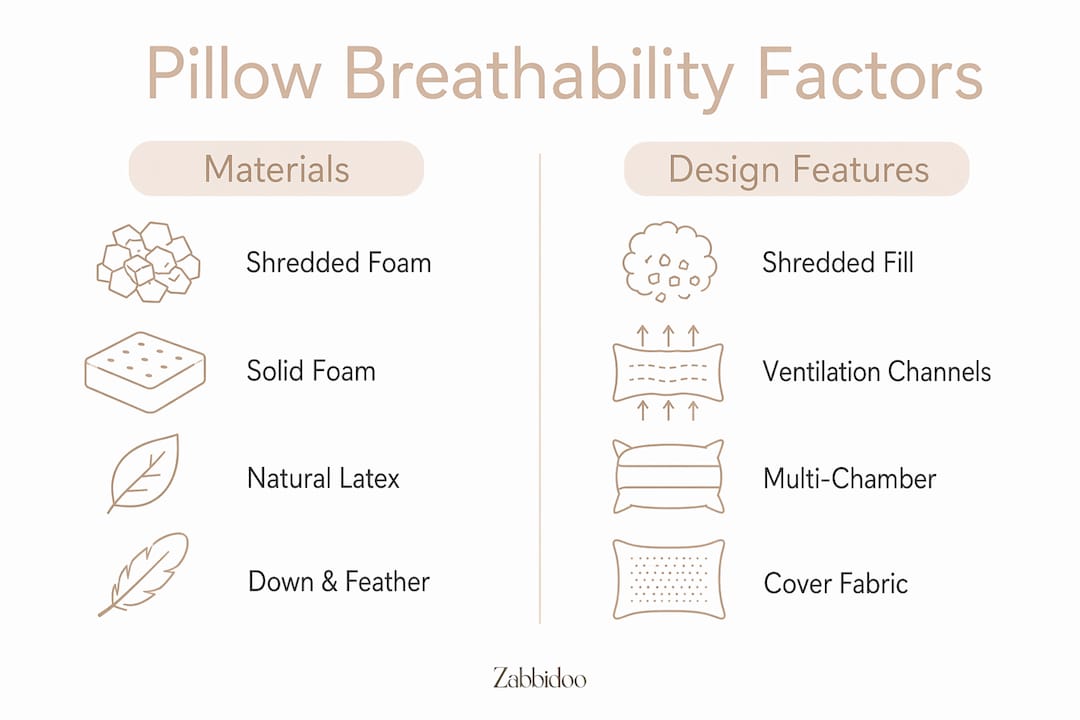
The fill is where breathability begins, and the differences between materials are significant. Air needs pathways to move through the pillow, and whether those pathways exist depends entirely on how the fill is structured.
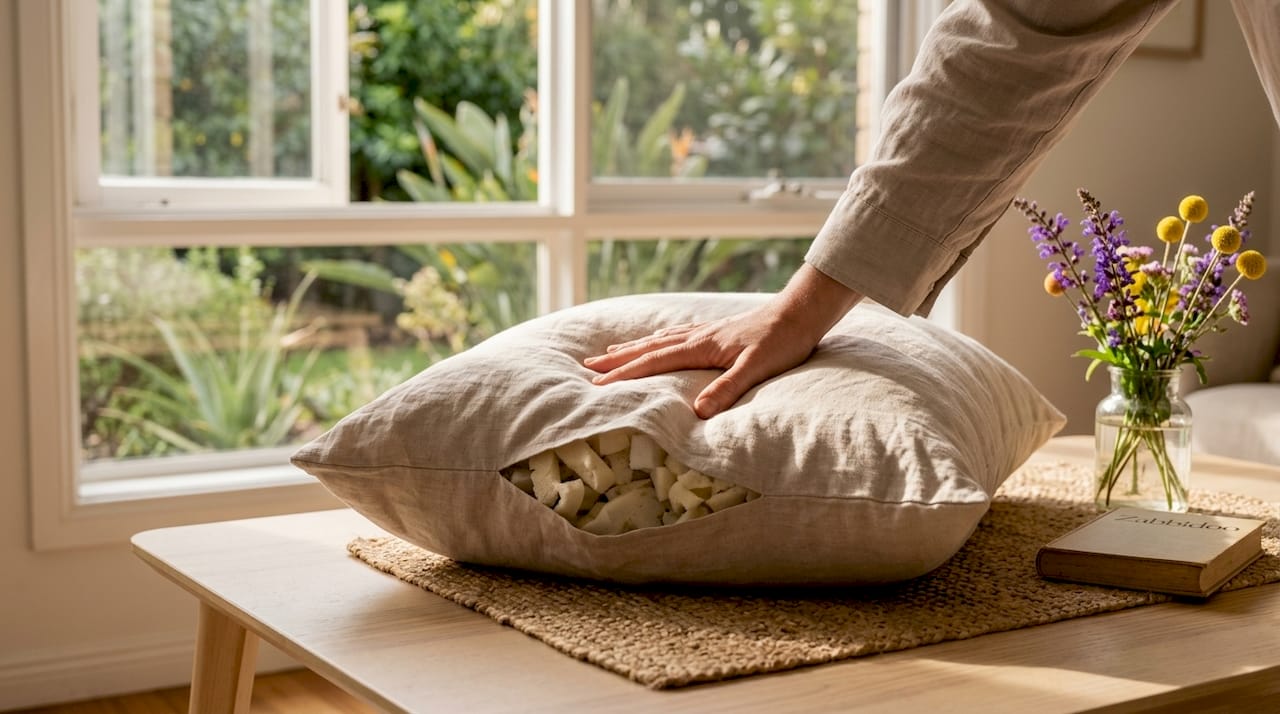
Shredded foam and polyester fills have interstitial spaces between each piece, which promote continuous air circulation. This is the same principle behind a loosely packed bag of rice versus a solid brick: one lets air through, the other does not. Sleep Foundation’s 2026 testing confirmed minimal heat buildup on pillows with shredded fill designs, making them a reliable choice for hot sleepers.
Solid memory foam is the worst performer for breathability. Its dense, closed structure blocks airflow almost entirely, which is why solid foam pillows tend to feel warm within the first hour of sleep. Open-cell foam is a partial improvement. Its internal structure has tiny connected pockets that allow some airflow, but it still falls short of shredded alternatives.
Natural latex sits in an interesting middle ground. It is naturally porous and resists moisture retention, which gives it decent breathability. However, the density of the latex and whether it is Dunlop or Talalay processed affects how much air actually moves through it. Talalay latex, which is produced with a vacuum process that creates a more uniform open-cell structure, generally outperforms Dunlop for airflow.
Down and feather fills vary considerably. A high-fill-power down pillow with a tight weave cover can trap heat despite the natural fibre. A lower fill-power mix with a looser cover breathes far better. The feather content matters too: more feathers relative to down means more rigid quill structures, which create small air channels throughout the fill.
| Fill material | Breathability | Moisture management |
|---|---|---|
| Shredded foam | High | Moderate |
| Solid memory foam | Low | Poor |
| Open-cell foam | Moderate | Moderate |
| Natural latex (Talalay) | Moderate to high | Good |
| Down and feather mix | Variable | Variable |
| Polyester fibrefill | Moderate to high | Moderate |
How does cover fabric affect pillow breathability?
The cover is the first point of contact between your skin and the pillow, and it plays a larger role in breathability than most people realise. A highly breathable fill paired with a dense, non-wicking cover will still feel hot and clammy.
Covers made from bamboo viscose, cotton, or Tencel provide the best combination of airflow and moisture management. These fibres are naturally hydrophilic, meaning they draw moisture away from the skin and release it into the air rather than holding it against you. Good Housekeeping’s textiles lab measures moisture absorption and drying speed as key metrics for cooling bedding, and both bamboo viscose and Tencel perform well on both counts.
Weave structure matters as much as fibre choice. A percale weave in cotton, for example, has a looser, more open structure than a sateen weave, which gives it better airflow even though both are made from the same fibre. Knitted covers, common on many foam pillows, tend to stretch and breathe well but may not wick moisture as efficiently as woven fabrics.
Synthetic covers made from polyester microfibre can feel soft but often trap heat and moisture against the skin. They lack the moisture-wicking chemistry of natural or semi-synthetic fibres like Tencel. French flax linen, which Zabbidoo uses in its nursing pillow, is another strong performer: its natural hollow fibre structure allows air to pass through while absorbing moisture and releasing it quickly.
- Bamboo viscose: soft, moisture-wicking, good airflow
- Tencel (lyocell): excellent moisture management, smooth feel
- French flax linen: durable, highly breathable, quick-drying
- Percale cotton: crisp, open weave, reliable airflow
- Polyester microfibre: soft but poor moisture management
Pro Tip: When assessing a pillow cover, hold it up to a light source. A cover with a visible open weave or slight translucency will generally allow more airflow than one that appears dense and opaque.
What design features improve airflow in a pillow?
Construction is where breathability is either made or lost. Two pillows with identical fill materials can perform very differently depending on how they are put together. Fill geometry directly affects airflow and temperature regulation, which is why shredded fill consistently outperforms solid fill even when both are made from the same foam compound.
Shredded fill creates air gaps throughout the pillow’s interior. As you move during sleep, those pieces shift slightly, which actively pumps air through the structure. This is a passive ventilation mechanism that solid fills simply cannot replicate.
Ventilation channels are a design feature found in some higher-end foam pillows. These are deliberate cuts or perforations through the foam core that create pathways for air to travel from one side of the pillow to the other. They improve breathability meaningfully compared to an unperforated block, though they still do not match shredded fill for overall airflow.
Multi-chamber pillow designs separate the fill into distinct zones, often with a firmer support core and a softer outer layer. The gap between chambers acts as an air channel, and if the outer layer is made from a breathable material, the design can achieve good overall airflow while maintaining support. This approach is particularly relevant for nursing pillows, where sustained contact over long feeding sessions makes heat management a real comfort factor.
| Design type | Airflow mechanism | Best suited for |
|---|---|---|
| Shredded fill | Interstitial air gaps, passive ventilation | Hot sleepers, all-night comfort |
| Ventilated foam core | Perforated channels through solid foam | Foam preference with improved airflow |
| Multi-chamber design | Air gap between fill zones | Support plus breathability balance |
| Solid foam block | No airflow mechanism | Support only, not breathability |
Pro Tip: Compress the pillow firmly with both hands, then release it. A breathable pillow will spring back quickly as air rushes back in. A slow, sluggish return suggests dense fill that resists airflow.
How to choose a breathable pillow for your needs
Choosing a breathable pillow requires looking past marketing language and assessing the actual materials and construction. “Cool to the touch” is a surface sensation, not a measure of sustained breathability. Gel layers may feel cool initially but often trap heat and moisture overnight, which means they address the first five minutes of sleep and not the other seven hours and fifty-five minutes.
Follow these steps when evaluating a pillow for genuine breathability:
- Check the fill type first. Shredded foam, polyester fibrefill, Talalay latex, or a down and feather mix all offer better airflow than solid memory foam. If the product description says “memory foam” without specifying shredded or ventilated, assume it runs warm.
- Read the cover fabric details. Look for bamboo viscose, Tencel, linen, or percale cotton. If the cover material is not listed, that is a red flag. Breathable pillow manufacturers know their cover fabric is a selling point and will name it.
- Look for construction details. Words like “shredded,” “ventilated,” “open-cell,” or “multi-chamber” indicate a design that prioritises airflow. Avoid pillows described only as “plush” or “ultra-soft” with no structural detail.
- Consider moisture management separately from cooling. A pillow can feel cool but still retain moisture across multiple nights. Routine washing and drying preserves breathability by preventing moisture buildup that gradually clogs the fill’s air pathways.
- Match breathability to use case. A pillow used for extended periods of contact, such as a nursing pillow during long feeding sessions, needs stronger moisture management than a standard sleep pillow. The airflow in nursing pillows directly affects comfort during those extended sessions.
Pillow breathability also degrades over time if the pillow is not maintained. Washing removes accumulated moisture, skin oils, and dust that compress fill and reduce airflow. Most shredded foam and polyester pillows are machine washable. Latex and down pillows require more careful care but benefit equally from regular airing.
Key takeaways
A breathable pillow requires the right fill material, a moisture-wicking cover, and a construction that creates genuine airflow pathways rather than relying on surface-level cooling features.
| Point | Details |
|---|---|
| Fill material drives airflow | Shredded foam and polyester create air gaps; solid foam blocks circulation entirely. |
| Cover fabric is equally important | Bamboo viscose, Tencel, and linen wick moisture away from skin and release it quickly. |
| Construction determines performance | Shredded fill, ventilated cores, and multi-chamber designs outperform solid foam blocks. |
| Gel cooling is not breathability | Gel layers feel cool initially but often trap heat and moisture through the night. |
| Maintenance preserves breathability | Regular washing prevents moisture and oil buildup that reduces airflow over time. |
Why most “cooling” pillows miss the point
I have spent a lot of time looking at how pillow materials actually perform under sustained use, and the gap between marketing claims and real-world function is wider than most people expect. The phrase “cooling pillow” has become almost meaningless because it is applied to everything from gel-infused solid foam to genuinely breathable shredded latex designs. They are not the same thing, and the difference matters enormously if you are someone who runs warm or spends extended time in contact with a pillow.
The most overlooked factor is what I call “return-to-dry” capability. A pillow that absorbs moisture but cannot release it quickly will feel progressively warmer and clammier each night. Preventing heat and moisture accumulation across multiple nights requires a pillow that can actually dry out between uses, not just one that wicks moisture away from your skin in the moment.
The fabric choice in nursing pillows is something I feel strongly about, particularly for mums who are feeding for extended periods. A pillow that traps heat during a 40-minute feed is not just uncomfortable. It affects your ability to stay relaxed and focused on the feed itself. French flax linen and open-weave covers are not premium extras in that context. They are functional requirements.
My honest advice: ignore the word “cooling” on any pillow label and go straight to the fill and cover specifications. If those are not listed in detail, the manufacturer is not confident in them.
— Marietjie
Breathable nursing pillows designed for real comfort

Zabbidoo’s nursing pillow is built around the understanding that breathability is not a bonus feature. It is a baseline requirement for any pillow used during extended feeding sessions. The pillow uses a compression-resistant fill that maintains its shape and airflow pathways under sustained pressure, paired with a French flax linen cover that wicks moisture and dries quickly between feeds. At 18cm of lift, it brings your baby up to you rather than forcing you to hunch down, which reduces neck and back strain across every feed. If you are looking for a nursing pillow that combines genuine breathability with ergonomic support, Zabbidoo is designed to deliver both without compromise.
FAQ
What causes a pillow to feel hot during sleep?
Heat buildup in a pillow is caused by poor airflow and moisture retention in the fill and cover. Solid foam fills and synthetic covers are the most common culprits because they block air circulation and hold moisture against the skin.
Which pillow fill is the most breathable?
Shredded foam and polyester fibrefill are consistently rated the most breathable fills because their loose structure creates air gaps that allow continuous circulation. Talalay latex is also a strong performer due to its open-cell structure.
Does the pillow cover really affect breathability?
The cover affects breathability as much as the fill. Covers made from bamboo viscose, Tencel, or French flax linen allow air to pass through and wick moisture away from the skin, while dense polyester covers trap heat regardless of what is inside.
How do I know if a pillow has good moisture management?
Look for covers labelled as moisture-wicking and fills that are described as quick-drying or machine washable. Air permeability testing measures how much air passes through a fabric under controlled pressure, and brands that reference this testing are making a verifiable claim rather than a vague one.
How often should I wash a pillow to maintain breathability?
Most sleep experts recommend washing pillows every three to six months. Regular washing removes accumulated moisture, skin oils, and dust that compress fill over time and reduce the airflow pathways that make a pillow breathable.