

Step by step newborn support is the practice of gently and securely handling your baby to protect their fragile head, neck, and body while promoting comfort and safety. Newborns cannot hold their own heads up. Their neck muscles are too weak, and their skulls are still developing. Getting the basics right from day one protects your baby and builds your confidence faster than anything else. This guide covers what to prepare, how to hold your newborn correctly, common mistakes to avoid, and how to weave proper support into every part of your daily routine.
What do you need before safely handling your newborn?
Preparation is the foundation of safe newborn care. Before you pick up your baby, wash your hands thoroughly with soap and water for at least 20 seconds. Newborns have immature immune systems, and clean hands are the single most effective way to reduce infection risk.
Your environment matters just as much as your technique. Choose a calm, warm space with good lighting. Lay a firm, flat surface nearby for when you need to put your baby down. Reduce noise and distractions so you can focus fully on your baby’s cues.

Pro Tip: Set up a dedicated nappy-changing and feeding station before your baby arrives. Having everything within arm’s reach means you never need to leave your baby unattended on a raised surface.
The table below covers the core supplies every new mum needs in those first weeks.
| Supply | Purpose |
|---|---|
| Nappies (newborn size) | Frequent changes to prevent nappy rash and monitor output |
| Digital thermometer | Accurate temperature readings; a rectal temperature of 38°C or higher in a baby under 3 months is a medical emergency |
| Nursing pillow | Ergonomic support for feeding and tummy time |
| Swaddling blankets | Calming, secure wrapping that mimics the womb |
| Muslin cloths | Burping, wiping, and light covering |
| Baby-safe hand sanitiser | Quick hygiene between full handwashes |
If your baby has a medical condition or was born prematurely, ask your midwife or paediatrician for specific handling guidance before leaving hospital. Standard techniques may need adjustment for babies with particular needs.
Step by step newborn support: how to hold your baby safely
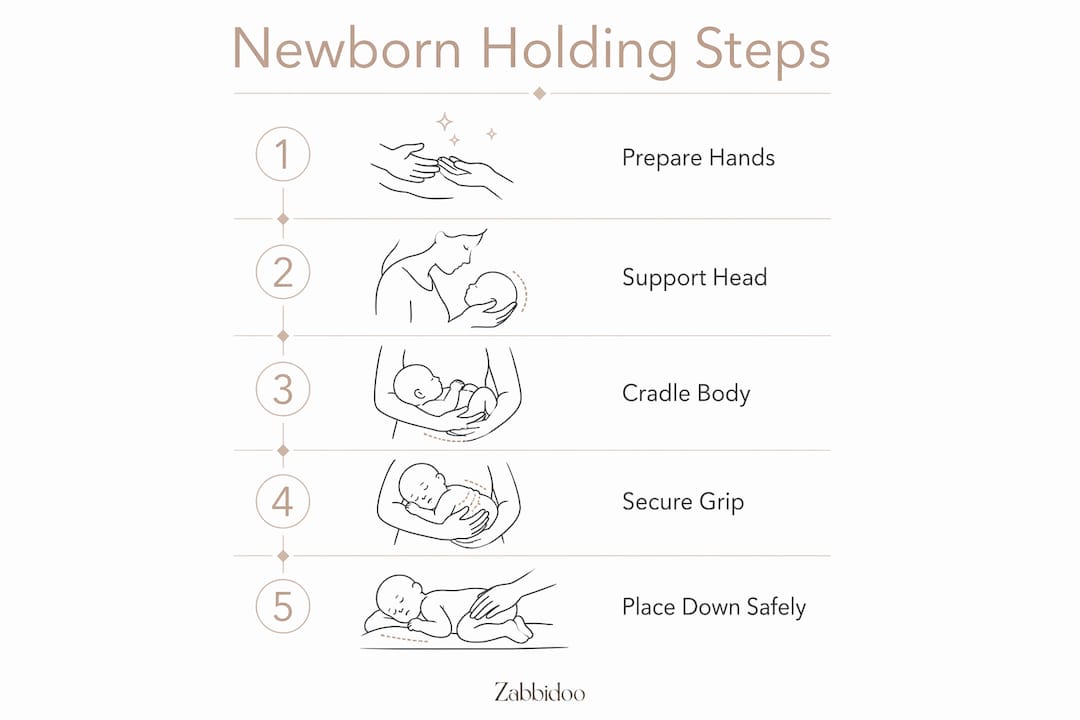
The two-hand lift method is the safest and most reliable way to pick up a newborn. Follow these steps every time.
- Announce your approach. Speak softly before you touch your baby. Sudden contact startles newborns and causes them to tense up.
- Position your hands. Slide one hand under the base of your baby’s skull and upper neck. Place your other hand under their bottom and lower back.
- Distribute the weight evenly. Your hands should support the full length of your baby’s body, from skull to tailbone, so no single point bears all the weight.
- Lift slowly and close to your body. Bring your baby toward your chest in one smooth motion. Avoid jerking or rushing.
- Check the airway. Your baby’s chin should never press against their chest. Keep the head in a neutral position with the face always visible to you.
Common holds and when to use them
Cradle hold. Rest your baby’s head in the crook of your elbow, with your forearm supporting their spine and your hand cupping their bottom. This is ideal for feeding and skin-to-skin contact.
Upright chest-to-chest hold. Place your baby against your chest with their head resting on your shoulder. Support the back of their head with one hand and their bottom with the other. This position is excellent for winding after feeds.
Football hold. Tuck your baby along your forearm with their legs pointing behind you and their head cradled in your hand. This hold works well for breastfeeding positions where extra latch control is needed, particularly after a caesarean.
Pro Tip: Always keep your baby’s face visible during every hold. If you cannot see their nose and mouth, adjust your position immediately.
Here is a quick reference list of what to do and what to avoid.
- Do support the head and neck at all times, including during transfers
- Do move slowly and speak calmly throughout
- Do keep your baby close to your body during lifts
- Don’t lift your baby by the underarms alone, as this leaves the head unsupported
- Don’t pull your baby up by their arms
- Don’t allow the head to flop backward or the chin to drop to the chest
Putting your baby down requires the same care as picking them up. Keep hand support steady until your baby’s head is fully settled on the surface before you withdraw your hands.
What are the most common newborn support mistakes?
Most handling errors come from rushing or from nerves. Knowing what to watch for makes a real difference.
- Unsupported head during transfer. The most frequent mistake is withdrawing hand support too early when passing the baby to another person. Both the giver and the receiver must have hands in place before the transfer is complete.
- Chin pressed to chest. This compresses the airway. Always check that the head is in a neutral position, not tilted forward.
- Lifting from the underarms. This leaves the head with no support and can cause the neck to snap backward.
- Rushing the lift. Fast, jerky movements startle babies and increase the risk of losing your grip.
“Common handling and positioning errors significantly increase newborn risk. Sustained education and practice improve safety and comfort for both baby and parent.” — Blueberry Pediatrics
When your baby is unsettled during handling, slow everything down. Lower your voice, reduce eye contact briefly, and hold your baby firmly against your chest. Rhythmic, gentle movement calms the nervous system faster than any other technique.
Crying peaks around 4–6 weeks and typically subsides by 3 months. If you feel overwhelmed, place your baby safely on their back on a flat surface and step away for a moment. Shaking a baby causes severe brain and eye injury. Seeking help is always the right call.
If you are unsure whether your technique is correct, ask your midwife, child health nurse, or GP to observe you during a hold. A single hands-on session with a professional is worth more than hours of reading.
How does newborn support fit into daily care routines?
Proper support is not just for picking up and putting down. It runs through every part of your day.
Feeding
Newborns feed 8–12 times in 24 hours, with no more than a 4-hour gap in the early weeks. That is a lot of time spent holding your baby in a feeding position. Poor posture during feeds causes maternal neck, back, and wrist pain quickly. A nursing pillow that lifts your baby to breast height removes the need to hunch forward. Zabbidoo’s nursing pillow sits at 18cm, which brings your baby up to you rather than pulling you down to them. That height difference protects your posture across every single feed.
Pro Tip: Check your nursing pillow setup before each feed. The pillow should sit snugly against your body with no gap between the pillow and your waist.
Sleep and awake time
Always place your newborn on their back to sleep on a firm, flat, uncluttered surface. No pillows, blankets, or bumpers belong in the cot. Room-sharing without bed-sharing is the recommended approach for the first 6 months. During awake time, supervised tummy time builds neck and shoulder strength. Start with 2–3 minutes at a time and increase gradually as your baby grows stronger.
Soothing and skin-to-skin
Skin-to-skin contact regulates your baby’s temperature, heart rate, and breathing. Hold your baby upright against your bare chest with their head turned to one side and their airway clear. Support their back and bottom firmly. This position also supports bonding in the first 3 months, which is a clinical recommendation for both baby development and parental mental wellbeing.
The table below shows how support techniques map to daily activities.
| Daily activity | Key support technique |
|---|---|
| Breastfeeding | Cradle or football hold with nursing pillow for height |
| Bottle feeding | Cradle hold, semi-upright, with head above stomach level |
| Winding | Upright chest-to-chest hold with back and head supported |
| Tummy time | Baby on forearms on firm surface, face clear, supervised |
| Settling to sleep | Two-hand transfer to flat surface, head settled before releasing |
When using a baby carrier, check that your baby’s chin is off their chest and their face is visible at all times. The same airway rules apply in a carrier as in your arms.
Key takeaways
Correct newborn support requires consistent head and neck alignment across every hold, transfer, and daily activity from the very first day.
| Point | Details |
|---|---|
| Two-hand lift is non-negotiable | Always support the base of the skull and the full back or bottom during every lift. |
| Airway position is the priority | Keep the chin off the chest and the face visible in every hold and carrier. |
| Preparation reduces errors | Set up your space and supplies before handling your baby to stay focused and calm. |
| Support continues through daily routines | Feeding, winding, tummy time, and settling all require the same head and neck alignment principles. |
| Ask for help early | A single session with a midwife or child health nurse corrects technique faster than self-correction alone. |
What I wish someone had told me about newborn support
By Marietjie
The honest truth is that no amount of reading fully prepares you for the first time you hold your own baby. Your hands shake. You second-guess every movement. That is completely normal, and it does not mean you are doing it wrong.
What I found most useful was slowing down more than felt natural. When I was nervous, my instinct was to grip tighter and move faster. The opposite is what actually works. Slow, deliberate movements settle babies. They can feel your tension, and they respond to it.
The thing most first-time mums miss is that confidence comes from repetition, not from getting it perfect the first time. Every nappy change, every feed, every wind session is practice. By week three, the two-hand lift becomes automatic. By week six, you stop thinking about it at all.
Asking for help is not a sign that you are struggling. The Mayo Clinic lists parental mental wellbeing as a clinical priority in the first three months. That means asking your midwife to watch you hold your baby is not an unusual request. It is exactly what the support system is there for.
Trust your instincts alongside the techniques. If something feels wrong, it probably is. Check the airway, check the head position, and slow down. You will get there.
— Marietjie
Zabbidoo and your newborn support toolkit
The physical demands of newborn care add up fast. Feeding alone can take 6–8 hours a day in the early weeks, and poor posture through those sessions leaves you sore and exhausted.

Zabbidoo’s nursing pillow is built specifically to address what standard pillows get wrong. At 18cm high, it lifts your baby to the correct feeding height so you are not hunching. Its compression-resistant fill keeps its shape across multiple feeds, unlike softer pillows that flatten and force you to compensate with your posture. The French flax linen cover is breathable and durable. It also works for supervised tummy time and propped support during awake periods. For a full picture of safe holding techniques that pair with ergonomic support, the Zabbidoo blog covers the detail you need.
FAQ
What is the correct way to support a newborn’s head?
Place one hand under the base of the skull and upper neck, and the other under the bottom and lower back. Keep the head and spine aligned with the chin off the chest at all times.
How often should a newborn feed in the first weeks?
Newborns feed 8–12 times every 24 hours, with no gap longer than 4 hours. Babies can lose up to 10% of birth weight in the first week and should regain it by days 10–14.
When should I call a doctor about my newborn?
A rectal temperature of 38°C or higher in a baby under 3 months requires immediate medical attention. Also seek help if your baby is not feeding, has unusual colour, or is difficult to rouse.
How do I safely pass my newborn to another person?
Both people must have their hands in position before the transfer begins. The receiver places one hand under the head and one under the bottom, and the giver only withdraws their hands once the baby is fully supported.
When does newborn handling start to feel natural?
Most parents find that the two-hand lift and basic holds become automatic by weeks 3–4 with regular practice. Repetition through daily care activities builds the muscle memory faster than any single technique session.