

Yes, standing or upright breastfeeding is a legitimate, practical option for many mums, especially when a baby is fussy or dealing with reflux. It works best as a transitional technique rather than an everyday default, since gentle movement can calm a distressed baby and help her latch when sitting still just isn’t working. Keep your baby’s airway visible and your own posture supported, and you’ve got a genuinely useful tool for the hard moments.
TL;DR:
- Standing breastfeeding options are effective for reflux, fussy babies, and when the mother needs mobility, but they are best used as transitional positions.
- Proper technique includes aligning the baby’s head, supporting your posture, and elevating your baby to breast height to prevent neck strain and ensure a good latch.
- Reflux or newborn support needs favor the koala or cross-cradle hold, while larger breasts or twin feeding may benefit from rugby or sling nursing.
- Using equipment like nursing pillows or carriers can reduce fatigue and make standing-to-seated transitions safer, especially for prolonged feeds.
- Signs of issues include shallow latch, nipple pain, or baby distress, requiring professional assessment if pain persists or weight gain stalls.
Table of Contents
- Standing and upright breastfeeding holds worth trying
- How to get a good latch while breastfeeding standing up
- Keeping baby safe and your body protected during standing feeds
- How slings and nursing pillows make upright feeding easier
- Fixing the most common standing breastfeeding problems
- When to call an IBCLC or your health professional
- A practical note on trial and error
- Making the standing-to-seated switch easier on your body
- Where to find more breastfeeding guidance
- Sources
Standing and upright breastfeeding holds worth trying
Most mums default to sitting because that’s what the pamphlets show. But several standard holds adapt well to standing, and each one solves a slightly different problem.
Koala or upright hold. Baby sits astride your hip, facing you, spine straight, legs dangling either side. This is arguably the easiest standing position to learn because gravity does most of the work keeping your baby upright. It’s particularly good for babies with reflux, since upright positions after feeding help reduce reflux symptoms by letting gravity assist digestion rather than fighting it. It also suits older babies who have enough neck and trunk control to sit semi-upright, roughly four months and beyond, though some newborns manage it with firm support.
Standing cradle hold. This is your familiar seated cradle hold, just performed on your feet. Baby lies across your forearm, tummy to tummy with you, head resting in the crook of your elbow. Standing versions of the cradle work well in the early newborn weeks when you need one arm free to support your baby’s whole body weight and the other to guide the latch. It’s less stable than the koala hold because you’re managing a horizontal baby rather than a vertical one, so expect more arm fatigue.
Standing cross-cradle. Swap hands from the cradle hold: support baby’s head and neck with the hand opposite the feeding breast, freeing your other hand to shape your breast and guide the latch. This is the hold most lactation consultants suggest for troubleshooting a shallow latch, because it gives you precise control over your baby’s head position at the exact moment of attachment. It’s also a favourite for mums recovering from a caesarean, since it keeps baby’s weight off a tender abdomen even while standing.
Standing rugby or underarm hold. Baby tucks under your arm on the same side as the feeding breast, feet pointing behind you, face level with the nipple. This one earns its keep for mums with larger breasts, mums feeding twins one at a time, or anyone who wants a clear line of sight to the latch without baby’s body blocking the view. Standing versions work because you can use your hip and forearm together to bear the weight, rather than relying purely on arm strength.
Sling nursing. Once your baby has a reliable latch, a well-fitted sling or soft structured carrier lets you nurse hands-free or hands-assisted while standing or walking. A properly fitted carrier redistributes your baby’s weight across your torso instead of your arms, which is the difference between a five-minute standing feed and a twenty-minute one. This suits older babies who’ve already mastered latching and mums who need to keep moving, cooking dinner, settling a toddler, walking a colicky baby around the lounge room at 2 am.
A few quick pointers on matching hold to situation:
- Reflux or frequent spit-up: koala/upright hold, plus staying upright for some time after the feed.
- Newborn who needs full head support: standing cradle or cross-cradle, never the sling until latch is well established.
- C-section recovery: cross-cradle or underarm hold, both of which keep pressure off your abdomen.
- On-the-go or hands needed elsewhere: sling nursing, once latch is confident.
- Fussy or anxious baby refusing to settle: any hold combined with slow swaying or walking, which mainstream guidance from national breastfeeding bodies backs as a genuine technique for calming an upset baby into a latch.
How to get a good latch while breastfeeding standing up
Getting the latch right while standing takes a bit more coordination than sitting, but the sequence is straightforward once you’ve done it a couple of times.
- Set your stance first. Stand with feet roughly hip width apart, knees soft, not locked, especially important for postpartum recovery to maintain your body’s support comfort during feeding (Postpartum Recovery Treatment in Dallas, TX | Evolved Dentistry | Evolved Dentistry Dallas). Tilt your pelvis slightly forward rather than arching your lower back, and engage your core gently, as though you’re bracing for a light push. This one adjustment prevents most of the lower back strain mums report after a few minutes of standing feeds.
- Bring baby up to breast height, not the other way round. This is the single most common mistake across every feeding position, standing or otherwise. If you hunch or lean down to reach your baby, your neck and shoulders pay for it within minutes. Use your arm, a raised hip, or a nursing pillow to lift baby instead.
- Line up ear, shoulder and hip. Whichever hold you’re using, your baby’s body should form a straight line, not twisted at the neck to reach the breast. Queensland Health’s clinical guidance on breastfeeding positioning points to this alignment as one of the core principles behind a pain-free, effective latch, regardless of position.
- Point baby’s nose to your nipple, not her mouth. Babies tip their head back slightly to latch deeply, so if you aim mouth-to-nipple, she’ll end up with a shallow grip on just the tip.
- Wait for the wide gape. Brush your nipple against her top lip and wait. A rushed latch on a partly open mouth is the number one cause of nipple pain. Wide mouth, chin touching the breast first, top lip flanged out, that’s the sequence you’re after.
- Use small movement to settle a fussy baby before or during latch. A gentle sway, a few steps, even a slight bounce, can calm an anxious baby enough to attach where stillness failed.
- Once latched and settled, consider moving to a supported seated position. Standing feeds are genuinely useful for the calming, latching phase, but few mums can sustain the position for a full feed without fatigue setting in.
Pro Tip: Hook one arm under your baby’s thigh so her weight sits in a rough triangle between your forearm and your torso, then use your free hand purely for head guidance. Swap which thigh you’re hooking every few minutes if you’re standing a while, it stops one shoulder from carrying the whole load.
Keeping baby safe and your body protected during standing feeds
Airway safety comes first, every single time, no exceptions. You should always be able to see your baby’s whole face. Her nose needs to stay clear of the breast, her chin should be forward and away from her chest, and her neck should never be twisted to reach the nipple. If you can’t see her face clearly, reposition before you do anything else.
Watch for these warning signs that a hold needs adjusting immediately:
- Baby’s chin is tucked hard into her chest rather than resting lightly on the breast.
- Her head is turned sideways relative to her body rather than facing the breast squarely.
- Fabric from a sling or your own clothing is covering her nose or mouth.
- You can hear noisy, laboured breathing rather than quiet feeding sounds.
Ergonomically, standing feeds are demanding on your body in a way seated feeds simply aren’t. Practitioner guidance generally frames standing as a short-term or transitional tool precisely because maternal fatigue sets in fast, and ongoing shoulder, back or wrist strain from repeated standing feeds is a real risk if it becomes your only position. Switch sides regularly, alternate which arm bears the load, and don’t be afraid to sit down the moment your baby settles into a rhythm.
A handful of practical fatigue rules go a long way. Change holds every few minutes rather than locking one arm in place for the whole feed. Rest your back against a wall or door frame if you’re feeding somewhere you can’t sit. And treat any standing feed lasting beyond a few minutes as your cue to look for a chair, not a personal failure.
How slings and nursing pillows make upright feeding easier
Equipment changes what’s physically possible here. A well-fitted sling shifts your baby’s weight onto your shoulders and torso instead of your arms, which is what makes a genuinely hands-free standing feed achievable rather than an ambitious five-minute experiment. When using a carrier for breastfeeding, position baby high and close, chin clear of her chest, and choose a fabric with enough structure that it doesn’t sag and pull her into a slumped, airway-compromising position.
Quick safety checks before you nurse in a sling:
- Fabric is taut across baby’s back, no loose sag pulling her chin down.
- Her face is fully visible above the fabric edge at all times.
- Her hips are supported in a natural seated position, not dangling.
- You can slide two fingers comfortably under any strap across your chest.
Once your baby is latched and settling into the feed, the standing-to-seated transition is where most mums start to hunch, leaning down toward a low chair or couch cushion to avoid disturbing the latch. This is where a firm, higher-lift nursing pillow earns its place, bringing your baby up to breast height as you sit, rather than forcing you to fold yourself down to hers. Look for a pillow with genuine compression resistance so it holds its shape feed after feed instead of flattening under your baby’s weight within weeks.
Pro Tip: Practise your standing-to-seated transition with an empty pillow first. Knowing exactly where the cushion needs to sit before you’re mid-feed with a wriggling baby saves you an awkward, off-balance shuffle later.
Fixing the most common standing breastfeeding problems
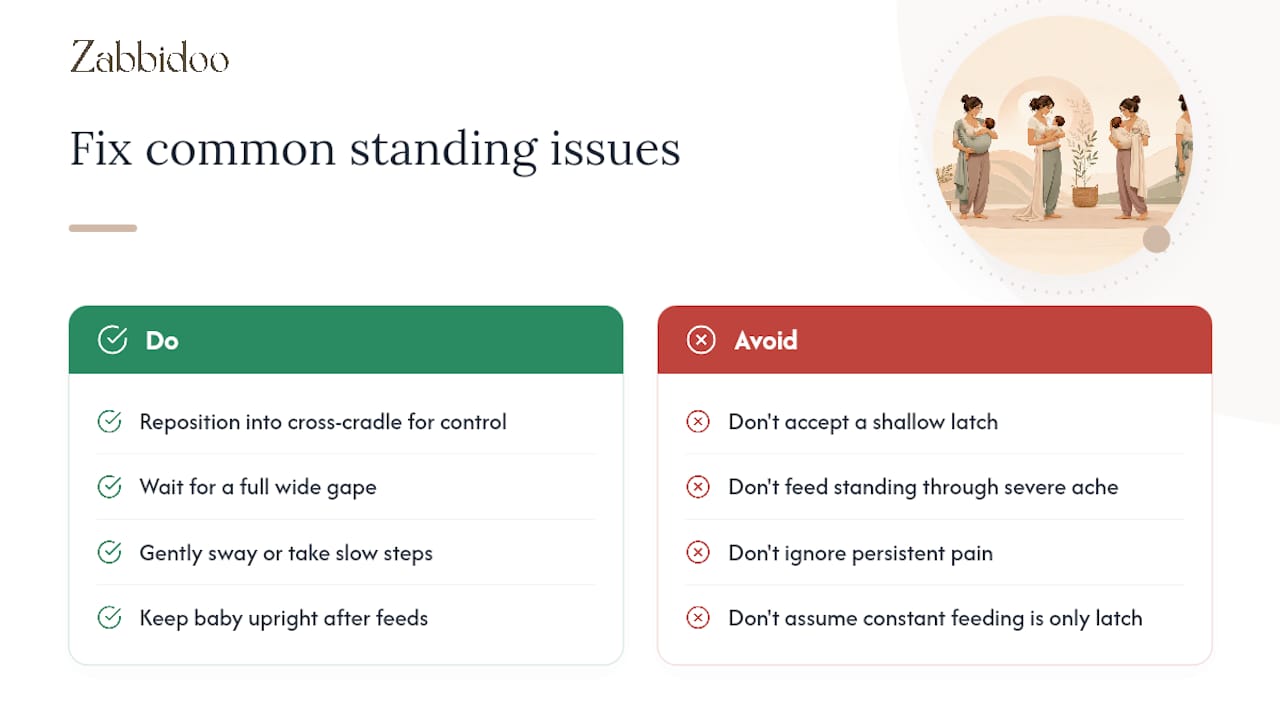
1. Shallow latch or clicking sounds. Reposition into cross-cradle for tighter head control, wait for a full wide gape before bringing baby on, and check that her chin is buried in the breast rather than her nose. A shallow latch standing is fixed exactly the same way a shallow latch sitting is fixed, alignment and patience.
2. Baby fusses or pulls off repeatedly. Try gentle swaying or a few slow steps before reattempting the latch. If fussing happens consistently during or right after feeds, arching, coughing, or spitting up, it’s worth reading it as a possible reflux sign rather than a latch problem alone, and keeping her upright for a while after feeding.
3. Your arms, back or shoulders are aching. That’s your body telling you to switch holds, alternate sides, or move to a seated position with proper support. Standing feeds work well as short bursts, not endurance events.
4. Persistent pain that repositioning doesn’t fix. This is the line where troubleshooting stops and professional support starts. Ongoing pain despite trying different holds, or a baby who seems to feed constantly without settling or gaining weight, are signs that something beyond position is going on.
When to call an IBCLC or your health professional
Trial and error works for plenty of latch niggles, but some signs deserve a proper assessment rather than another round of repositioning. If pain persists despite adjusting your hold, or you notice cracking, bleeding or bruising on your nipples, that’s a clear signal to get support rather than push through.
Book an appointment with an IBCLC, your maternal and child health nurse, or your GP if you notice:
- Nipple pain or damage that doesn’t improve after a few days of careful repositioning.
- Baby isn’t gaining weight as expected, or feeds seem endless without satisfaction.
- You suspect tongue tie, an unusual tongue posture, or another anatomical issue affecting the latch.
- Feeding feels consistently distressing for either of you, standing or otherwise.
Bring a feeding diary if you can, along with a short video of a typical latch and any recent weight records. That gives a lactation consultant far more to work with than a description alone.
A practical note on trial and error
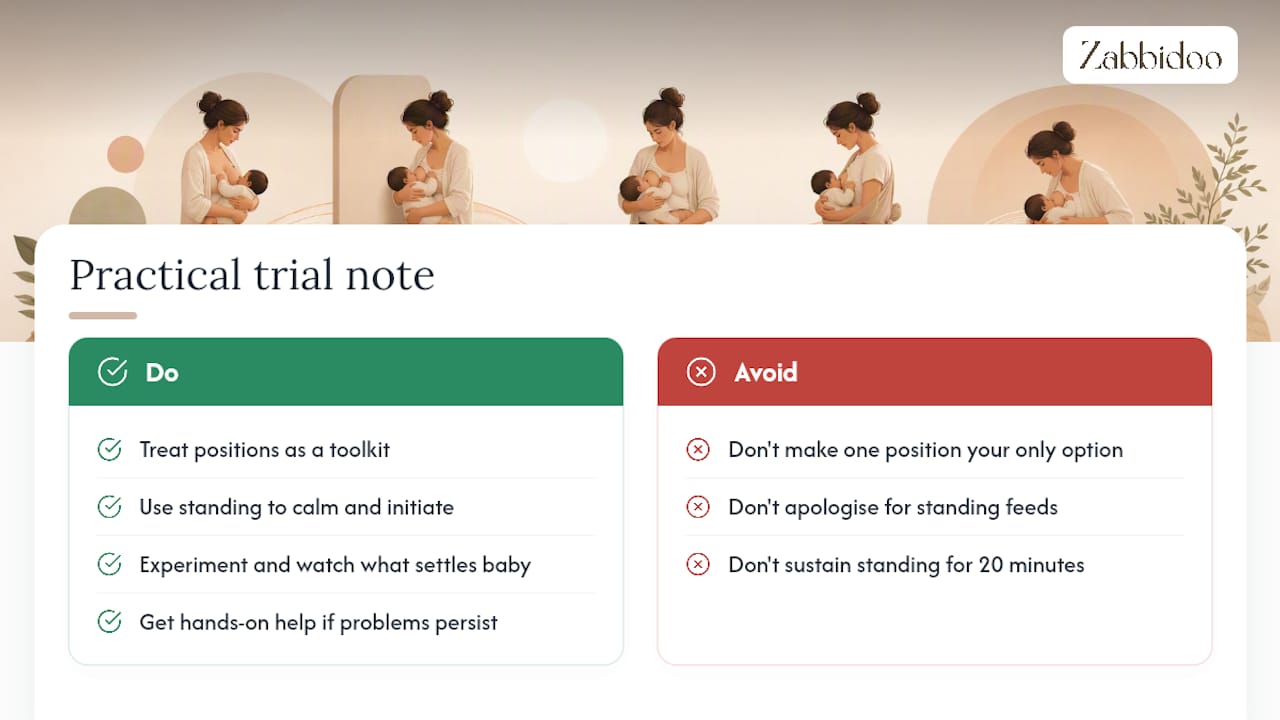
Standing feeds have a reputation problem. Mums often treat them as a backup plan, something to apologise for rather than a legitimate technique with a real purpose. That framing does new mums a disservice. Some of the most useful feeding solutions come from exactly this kind of improvising, standing in a hallway at midnight because sitting down somehow made everything worse.
What I’d push back on is the idea that any one position, standing included, should become your only tool. The mums who cope best tend to be the ones who treat positions as a toolkit rather than a rulebook, koala hold for a reflux flare, cross-cradle for a stubborn latch, seated with a pillow when your arms are done for the day. Standing is brilliant for calming and initiating. It’s rarely the position you want to sustain for twenty minutes straight. Experiment, watch what actually settles your baby, and don’t hesitate to get hands-on help if something feels consistently wrong rather than just awkward.
— Marietjie
Making the standing-to-seated switch easier on your body
Standing feeds solve the calming problem. What they don’t solve is the hunching that follows once you sit down to finish the feed, leaning over a low cushion or couch arm to keep your baby latched while your own spine pays the price. That’s the exact gap a nursing pillow with an 18cm lift can close, bringing your baby up to breast height instead of asking you to fold down to hers.

Compression resistance in these pillows means they hold their shape feed after feed rather than flattening out within a few weeks, which matters more than most mums expect during frequent feedings. A stability-focused shape also cuts down on the constant repositioning that makes a standing-to-seated transition feel fiddly with a squirming baby. The cover may be hypoallergenic and machine washable, and the pillow can include features like a portable handle for moving between rooms, plus a built-in pocket for essentials. Compare the full feature list on the nursing pillow page and see whether the extra lift solves the hunching problem your current setup hasn’t.
Where to find more breastfeeding guidance
For hands-on positioning technique, Queensland Health’s clinical breastfeeding guide covers alignment and latch principles in clinical detail. The Breastfeeding Association’s carrier guidance is worth reading before your first sling feed. Mayo Clinic’s position overview is a solid general reference. For anatomical concerns like tongue tie, ask your GP or maternal and child health service for a referral to a local IBCLC, most public hospitals maintain a lactation service you can access even after discharge.
This article is general information, not a substitute for advice from a qualified doctor. Consult a qualified healthcare professional about your own circumstances before acting on anything here.
Sources
- Using a baby carrier (Breastfeeding Association resource)
- Breastfeeding positioning guidance (Queensland Health)
- Breast-feeding: Positions (Mayo Clinic)