

Most blocked milk ducts are preventable. The main defence is frequent drainage, correct positioning at the breast, and keeping pressure off your chest from bras, straps, or carriers. Feed or express often, loosen anything tight across your chest, and vary your feeding positions. These three habits, backed by guidance from HealthyWA, stop most blockages before they start.
TL;DR:
- Frequent breastfeeding or pumping, especially during the first few months, is essential to prevent milk pooling and reduce the risk of blocked ducts.
- Rotating feeding positions and ensuring proper latch and posture help drain different parts of the breast efficiently, avoiding repeated blockages in the same area.
- Applying warm compresses before feeds, massaging the lump toward the nipple, and breastfeeding or expressing on that side can typically resolve a blocked duct within a few days.
- Sleeping on the same side or with tight clothing and improper posture are common causes of recurrent blockages, making ergonomic setup and breast support crucial for prevention.
- If a lump persists beyond 24 to 48 hours or is accompanied by symptoms like fever or redness, prompt medical consultation is necessary to rule out mastitis or abscess.
Table of Contents
- Quick prevention checklist: everyday habits that lower risk
- What causes blocked ducts and who’s more at risk
- Positioning and attachment: small changes that prevent pooling
- Immediate self-care to clear a blocked duct (step-by-step)
- Managing recurrence: supplements, lifestyle and monitoring
- When to see a health professional (red flags and timeline)
- Ergonomics and posture: how better feeding setup lowers blockage risk
- Publisher perspective: keeping prevention practical
- A practical setup that supports prevention
- Sources
Quick prevention checklist: everyday habits that lower risk
Draining your breasts often is the single biggest lever you have. HealthyWA recommends frequent breastfeeding or pumping multiple times every 24 hours to keep milk moving and stop it pooling in one spot.
A few habits make the biggest difference:
- Feed or pump often, and don’t let a full breast sit for too many hours, even overnight.
- Skip underwire bras and loosen any straps that dig in, including car seat belts and baby carriers.
- Rotate feeding positions across the day so different ducts get emptied properly.
- Rest and drink water when you can. Fatigue and dehydration make you more likely to skip a feed, which is when trouble starts.
Pro Tip: Check your bra fit weekly during the first few months. Your chest size changes fast, and a bra that fit fine at week two can be pressing on a duct by week six.
What causes blocked ducts and who’s more at risk
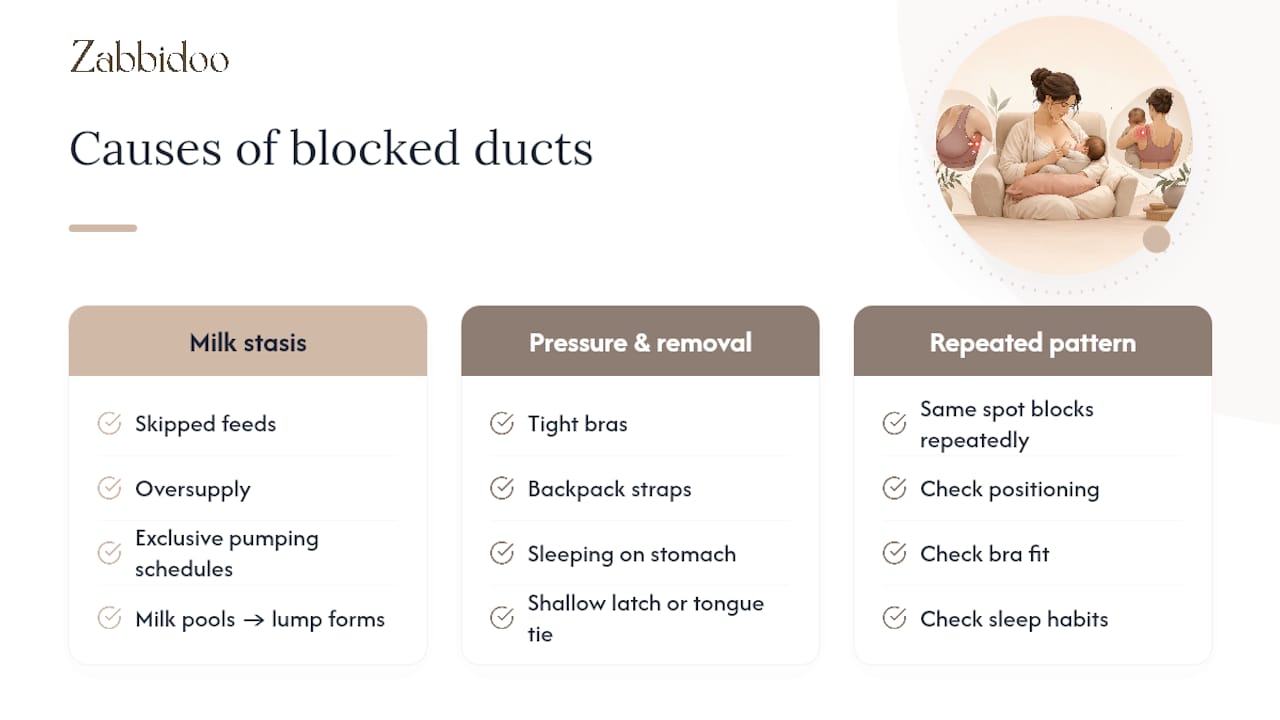
Blocked ducts almost always come down to milk not moving properly. Skipped feeds, oversupply, and exclusive pumping schedules all leave milk sitting in the breast longer than it should, and that pooling is where a lump starts.
Pressure is the other big culprit. Tight bras, backpack straps, and even sleeping on your stomach narrow the ducts from outside, slowing drainage in that spot specifically. On the baby’s end, a shallow latch or tongue tie means milk isn’t being removed efficiently even when feeds happen on schedule, so the breast never fully empties.
Some mothers get one blocked duct and never see it again. Others get the same spot blocking repeatedly, which usually points to a pattern worth tracking. If it’s always the same corner of the same breast, that is your clue to check positioning, bra fit, or sleep habits around that spot.
Positioning and attachment: small changes that prevent pooling
Different feeding positions drain different parts of the breast, and that’s not a minor detail. Cradle hold tends to empty the lower ducts well, cross-cradle gives you more control over latch, football (or underarm) hold reaches ducts near the armpit that other positions miss, and side-lying can help with ducts along the outer breast. Rotating through a few of these across the day, rather than defaulting to one, is one of the more effective breastfeeding techniques for even drainage.

Bringing your baby up to breast height, rather than hunching down to them, matters more than most mothers realise. Hunching narrows your own posture and often drags the latch shallow, because you’re contorting to meet the baby instead of positioning the baby to meet you.
Good attachment should feel like a firm tug, not a pinch. Baby’s lips should be flanged out, their chin buried in the breast, and you should hear swallowing, not clicking. If every feed still hurts after the first minute, or your baby seems to feed constantly without ever settling, get a lactation consultant to check the latch properly.
During the feed itself, a gentle stroke from the lump toward the nipple can help encourage flow, and switching which side you start on occasionally makes sure both breasts get a turn being drained by a hungrier, more vigorous first suck.
Immediate self-care to clear a blocked duct (step-by-step)
Most blocked ducts clear within a couple of days when you act early. Cleveland Clinic’s guidance backs a straightforward sequence, and most blocked ducts resolve within a few days when you follow it consistently:
- Apply a warm compress or take a warm shower for a few minutes before feeding, to loosen the blockage and support safe topical care with Neosporin while breastfeeding.
- Massage the lump firmly, working toward the nipple, while your baby feeds on that side.
- Feed the affected breast first, when suction is strongest, or hand express if the latch isn’t working.
- If milk still won’t move, switch to pumping on that side after the feed to finish draining it.
- Apply a cool pack afterward to settle any inflammation, and repeat the warm-then-cool cycle at the next feed.
Paracetamol or ibuprofen, taken as directed on the packaging, can ease pain and swelling without affecting breastfeeding. If a lump refuses to budge after several rounds of this, a physiotherapist can use therapeutic ultrasound, with drainage typically following within about 20 minutes of treatment. Keep breastfeeding through all of this. It’s part of the treatment, not something to pause.
Managing recurrence: supplements, lifestyle and monitoring
If the same duct keeps blocking, it’s worth looking at both supplements and habits. Some clinicians point to lecithin as a way to make milk less “sticky”, and probiotic strains like Lactobacillus fermentum and L. salivarius show early promise for reducing mastitis recurrence, though the evidence isn’t conclusive yet. Check with your GP or lactation consultant before starting either.
Beyond supplements, a few adjustments tend to help:
- If you’re producing more milk than your baby needs, paced feeding or gradually reducing pump sessions can ease the oversupply that often drives repeat blockages.
- Swap underwire bras and tight carrier straps for looser, supportive alternatives.
- Avoid sleeping face down or on the same side every night if that’s where blockages keep forming.
- See a lactation consultant or physiotherapist if the same spot blocks more than two or three times, rather than treating each one as a one-off.
When to see a health professional (red flags and timeline)
Give self-care 24 to 48 hours to work. If the lump hasn’t budged within 24 to 48 hours, or if you develop fever, chills, or flu-like aches, contact your GP or a lactation consultant rather than waiting it out.
Spreading redness, a hot and increasingly painful breast, or feeling genuinely unwell are signs of mastitis or, less commonly, an abscess, both of which need prompt medical attention. Your GP, an emergency clinic, or a breastfeeding helpline can all point you in the right direction. Treatment usually involves antibiotics if it’s infected, and you should keep breastfeeding or expressing throughout, since ongoing drainage speeds up recovery rather than slowing it.
Ergonomics and posture: how better feeding setup lowers blockage risk
Posture is an underrated piece of prevention. When you hunch toward your baby instead of bringing them up to you, your own positioning tightens and the latch often suffers, which means the breast doesn’t drain evenly.
A stable, elevated setup fixes this at the source. Check that your chair gives proper back support, that your feet aren’t dangling, and that whatever is supporting your baby brings them level with your nipple rather than below it. Small adjustments here, like raising the baby’s height by a few centimetres, often improve latch consistency within a feed or two.
Track what changes after you adjust your setup. If blockages ease off, you’ve found your fix. If they don’t, that’s your signal to loop in a lactation consultant rather than keep tweaking alone.
Publisher perspective: keeping prevention practical
Most of what stops blocked ducts is genuinely simple: feed often, watch your posture, and don’t let clothing or gear press on your chest. What surprises people is how much of it comes down to setup rather than willpower. A mother who “does everything right” but feeds from a low couch, twisted sideways, is fighting her own furniture as much as anything else.
The good news is that most blockages respond fast to basic measures. A warm compress, a change of position, and a proper feed usually sort it within a day or two. Where it doesn’t, get a latch checked early. It’s rarely one big mistake and almost always a small, fixable one.
— Marietjie
A practical setup that supports prevention
Good positioning is easier when your equipment isn’t working against you. Most nursing pillows compress flat within weeks, dropping your baby back down and pulling you into the same hunch that slows drainage in the first place. Zabbidoo’s nursing pillow was built around that exact problem.

It gives a lift that brings your baby up to breast height instead of you folding down to them, holds its shape under sustained use, and stays put through a feed rather than needing constant repositioning. The cover is hypoallergenic and machine washable, with a built-in pocket and a carry handle for moving between rooms. It’s a comfort and setup aid, not a medical device, so pair it with the latch checks and clinical advice covered above. If you’re rebuilding your feeding setup around better posture, have a look at the pillow here.
This article is general information, not a substitute for advice from a qualified doctor. Consult a qualified healthcare professional about your own circumstances before acting on anything here.
Sources
- Blocked milk ducts
- Localised breast inflammation (‘blocked ducts’)
- Clogged Milk Duct: Causes, Symptoms & Treatment
- Mastitis, blocked milk ducts & breast abscess: what to do