

A comfortable, effective latch happens when your baby takes a large mouthful of areola with their chin pressed into the breast and their lower lip flanged outward. No pain. Steady swallowing. Here’s what to try right now.
Three things to do in the next minute:
- Reposition first. Bring your baby’s body in close so their ear, shoulder, and hip form a straight line. Their nose should sit level with your nipple before they open wide.
- Encourage a wide gape. Tickle your baby’s lower lip with your nipple until they open their mouth as wide as a yawn, then bring them in chin-first.
- If it hurts, break suction and try again. Slide a clean finger into the corner of your baby’s mouth to release the seal, then re-latch. Pain is almost always a sign of a shallow latch, not an inevitable part of breastfeeding.
If you’re experiencing severe pain, your baby is not swallowing, or they’re losing weight, stop troubleshooting alone and call the Australian Breastfeeding Association or an IBCLC today.
Table of Contents
- How do you get a baby to latch properly, step by step?
- Which breastfeeding hold works best for you?
- What does a good latch look and feel like?
- Common latch problems and how to fix them quickly
- How long does it take to get a good latch?
- Who can help you in Australia, and what to ask them
- The flipple technique and how a nursing pillow helps
- How to prepare your nipples and breasts for feeding
- How milk supply and let-down affect latch quality
- Key takeaways
- The thing most new parents aren’t told about latch
- The Zabbidoo nursing pillow supports better latch from the first feed
- Useful sources to read next
How do you get a baby to latch properly, step by step?
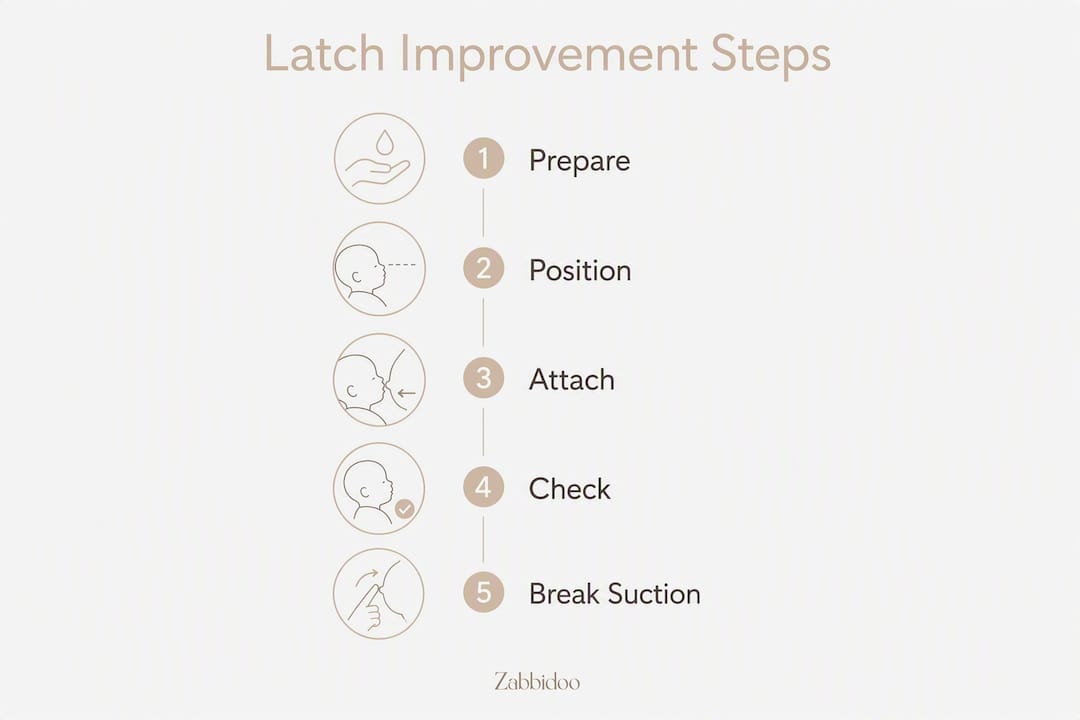
Getting the latch right is a sequence, not a single action. Work through these steps each time until the routine becomes second nature.
- Get comfortable first. Sit upright with your back supported, feet flat on the floor or a footstool. Tension in your shoulders travels straight to your arms and affects how you hold your baby.
- Align ear, shoulder, hip. Hold your baby so their body faces yours completely, with no twisting at the neck. Their ear, shoulder, and hip should form a straight line.
- Position nose to nipple. Bring your baby in so their nose is level with your nipple, not their mouth. This angle encourages them to tilt their head back slightly and open wide.
- Tickle the lower lip. Brush your nipple gently against your baby’s lower lip and wait for a wide, yawn-like gape. Don’t rush this step.
- Bring baby to breast, chin first. Move your baby toward you (not your breast toward them) so their chin touches the breast first and their mouth scoops up more areola below the nipple than above.
- Hold the position for 20 seconds. Keep your hand supporting your baby’s shoulder blades while the latch settles. Releasing support too early lets the baby slip.
- Check the latch. Run through the quick checklist below before you relax.
Quick alignment checklist:
- Nose is clear of the breast (not buried)
- Chin is pressed firmly into the breast
- Lower lip is flanged outward, not tucked in
- Cheeks look rounded, not dimpled
- You can hear or see swallowing within a minute or two
Pro Tip: To break suction safely, slide the tip of your clean little finger into the corner of your baby’s mouth and gently press toward their gum. You’ll feel the seal release. Never pull the baby straight off the breast — that’s how nipple damage happens.

Which breastfeeding hold works best for you?
There’s no single correct hold. The right one depends on your body, your birth recovery, and what your baby is doing on any given day. Laid-back or biological nurturing positioning lets gravity and your baby’s natural rooting reflexes do much of the work, which is why many parents find it easiest in the early days.

| Hold | Best for | Quick setup note |
|---|---|---|
| Cradle | Babies with a strong latch, later weeks | Baby’s head rests in the crook of your elbow; body runs along your forearm |
| Cross-cradle | Newborns, learning phase | Opposite hand supports baby’s head, giving more control over positioning |
| Clutch/football | C-section recovery, large breasts, twins | Baby tucked under your arm like a footy, legs pointing behind you |
| Laid-back/biological nurturing | Early days, fast let-down, sleepy feeders | Recline at roughly 45 degrees; baby lies tummy-down on your chest |
| Side-lying | Night feeds, perineal recovery | Both lying down facing each other; use a rolled towel behind baby’s back |
A few practical notes worth knowing:
- Always bring your baby to the breast, not the breast to the baby. Leaning forward to meet them is one of the most common causes of neck and back pain.
- A firm pillow under your arm in the cross-cradle or cradle hold removes the need to hold your baby’s weight with your wrist alone.
- For the clutch hold after a C-section, place a folded blanket over the incision site before positioning the pillow.
Pro Tip: For side-lying feeds, place a firm pillow behind your baby’s back to prevent them rolling away from the breast. Never fall asleep with your baby on a soft surface — follow the safe sleep guidelines from Red Nose Australia.
What does a good latch look and feel like?
A good latch is mostly something you feel before you see it. The first few seconds may feel like strong pressure, but that pressure should not be sharp or pinching.
Signs the latch is working:
- Mouth is open wide, covering more areola below the nipple than above
- Chin is pressed into the breast, nose is clear
- Lower lip is flanged (turned out), not curled in
- Cheeks are full and rounded during sucking
- You can hear rhythmic swallowing, especially after let-down
- No pain after the first 10–15 seconds of attachment
When these signs are present, milk transfer is happening efficiently and your nipple is protected from friction damage, as the Cleveland Clinic notes in its guidance on deep latch and milk removal.
Watch for these red flags during a feed: clicking sounds (air entering the mouth), dimpled cheeks, pinching or burning pain that doesn’t ease, continuous rapid sucking with no swallowing pauses, or your nipple coming out lipstick-shaped. Any of these signals a shallow latch. Break suction, reposition, and try again. If the same signs keep appearing across multiple feeds, contact an IBCLC.
Common latch problems and how to fix them quickly
Most latch problems have a fast fix you can try during the same feed. The key is identifying what you’re seeing before reaching for a solution.
- Shallow latch: Baby has only the nipple, not the areola. Break suction, reposition so the nose is at nipple height, and aim the nipple toward the roof of the mouth as you bring baby in chin-first.
- Pain that doesn’t ease: Almost always a shallow latch. Pain during breastfeeding is a signal to correct the latch immediately, not something to push through. Break suction and re-latch.
- Baby slipping off mid-feed: Usually means the chin isn’t close enough or the body isn’t well supported. Try adjusting the baby’s hips closer and pressing the chin deeper into the breast without detaching.
- Biting: Remove your baby gently but immediately, pause the feed for a moment, and re-latch. Biting often happens at the end of a feed when the baby is no longer actively swallowing.
- Engorgement making latch difficult: Hand-express a small amount of milk or use reverse pressure softening before the feed to soften the areola. A hard, engorged breast is difficult for a small mouth to grip.
- Nipple cracks or blisters: Apply a small amount of expressed breastmilk after each feed and allow to air dry. Lanolin cream is widely used and safe. If cracking is deep or bleeding, see a lactation consultant before the next feed.
Nipple shields are sometimes suggested for inverted nipples or transitioning from bottle to breast. They can help in specific situations, but health providers recommend short-term use only with a clear plan to wean from the shield, as prolonged use can reduce milk transfer.
If pain persists beyond two weeks, your baby isn’t gaining weight, or you’re not hearing swallowing, stop troubleshooting at home. Tongue-tie (ankyloglossia) can limit tongue extension and prevent a deep latch and requires professional assessment.
Statistic to know: The Australian Breastfeeding Association and NHS both frame breastfeeding as a learned skill for both parent and baby. Early difficulty is normal, not a sign of failure.
How long does it take to get a good latch?
The honest answer: most parents and babies find their rhythm somewhere between two and six weeks. The NHS advises patience and incremental adjustments rather than expecting immediate perfection, and that framing is worth holding onto in the early days.
A rough timeline:
- Hours 1–72: Skin-to-skin contact is your best tool. It triggers rooting reflexes and helps your baby find the breast instinctively. Feeds may be short and frequent.
- Days 3–7: Your milk comes in, which can cause engorgement. This is when latch problems often spike. Soften the breast before feeding if needed.
- Weeks 2–6: Most dyads see steady improvement with consistent technique. Each feed is practice.
- Beyond 6 weeks: As your baby grows, their mouth gets bigger and latch often deepens naturally. Positions that felt awkward early on become easier.
What to monitor to know feeding is working:
- Six or more wet nappies per day from day 5 onward
- Regular dirty nappies in the first weeks
- Audible swallowing during feeds
- Steady weight gain after the initial newborn dip (most babies regain birth weight by two weeks)
- A settled, content baby between most feeds
Short practice sessions are better than long, stressful ones. If a feed is going badly, it’s fine to stop, comfort your baby, and try again in 20 minutes.
Who can help you in Australia, and what to ask them
Knowing who to call saves time when you’re exhausted and in pain. Each service has a different role.
- Australian Breastfeeding Association (ABA): Call the National Breastfeeding Helpline on 1800 686 268, available 24 hours. Best for immediate peer support, triage, and guidance on whether to escalate. See types of feeding support for mums for a full breakdown of what each service offers.
- IBCLC (International Board Certified Lactation Consultant): The specialist for persistent pain, poor weight gain, tongue-tie assessment, or any complex latch issue. Find one via the Lactation Consultants of Australia and New Zealand (LCANZ) directory.
- Maternal and child health nurse: Your first port of call for routine weight checks and nappy output monitoring. They can refer you to an IBCLC if needed.
- GP: Useful for assessing nipple infections (mastitis, thrush) and for tongue-tie referrals.
- Hospital lactation services: If you’re still in hospital or recently discharged, ask for the lactation midwife or nurse before you leave.
Questions to bring to any appointment:
- “Can you watch a full feed and tell me what you see?”
- “How can we improve the latch right now, during this feed?”
- “Could tongue-tie or lip-tie be affecting the way my baby sucks?”
- “What should my baby’s wet nappies and weight gain look like this week?”
- “When should I call you again if things don’t improve?”
The flipple technique and how a nursing pillow helps
Once you’ve got the basics, the flipple (also called the nipple-tilt technique) is worth learning. It consistently deepens the latch by landing the nipple further back toward the soft palate.
How to do the flipple:
- Form a C-hold on your breast with your thumb on top and fingers below, well back from the areola.
- Press gently inward and tilt the nipple slightly upward toward your baby’s nose.
- Bring your baby in with their chin leading, mouth wide open.
- At the last moment, release the tilt so the nipple drops down onto the back of the tongue as the mouth closes.
- Check that more areola is visible above the lip than below.
The La Leche League International guidance on the flipple describes this as using a C-hold and inward press to tilt the nipple, then releasing at the last moment so it falls deeper into the baby’s mouth.
How a nursing pillow changes the equation:
A well-designed nursing pillow raises your baby to breast height so you don’t have to lean forward. Bringing the baby to breast height rather than leaning forward reduces shoulder, neck, and lower-back strain and supports a deeper latch by keeping the baby stable. A pillow that compresses under weight defeats this purpose entirely.
Pro Tip: Check your posture mid-feed: shoulders relaxed and level, lower back supported, wrists straight. If you’re hunching, the pillow isn’t high enough or firm enough.
When to check with a lactation consultant regardless of technique: if you’re using nipple shields, if pain persists after trying the flipple, or if you suspect tongue-tie.
How to prepare your nipples and breasts for feeding
Nipple preparation during pregnancy is largely unnecessary, but once feeding begins, a simple care routine prevents most problems.
After each feed, express a few drops of breastmilk and rub it gently over the nipple. Breastmilk has natural antibacterial properties and supports skin healing. Let the nipple air dry before covering up. Avoid soap directly on the nipple, which strips natural oils and increases the risk of cracking.
Lanolin-based nipple creams (such as Lansinoh or Medela Purelan) are widely used and safe for the baby, so there’s no need to wipe them off before feeding. If you’re prone to dryness, applying a small amount after every feed from day one is a reasonable habit.
For engorgement, which peaks around days 3–5 when milk comes in, hand expression or reverse pressure softening before a feed makes the areola pliable enough for the baby to latch. Reverse pressure softening means pressing gently inward around the base of the nipple for 60 seconds to push fluid back into the breast tissue.
Breast shells (not nipple shields) worn between feeds can protect sore nipples from friction against fabric. If nipple pain is severe or you notice white patches in your baby’s mouth or on your nipple, see your GP to rule out thrush.
How milk supply and let-down affect latch quality
Your milk supply and let-down reflex have a direct effect on how your baby behaves at the breast, and understanding this connection helps you troubleshoot faster.
Let-down (the milk ejection reflex) is triggered by your baby’s sucking and by oxytocin. When let-down happens, milk flows quickly. Some babies pull back or slip off the breast at this point because the flow is too fast. If your baby unlatches, splutters, or seems frustrated in the first minute of a feed, a fast let-down is a likely cause. Try laid-back positioning, which uses gravity to slow the flow, or briefly hand-express before latching to take the edge off the initial rush.
A slow or delayed let-down can cause a different problem: a baby who sucks frantically, pulls at the breast, or falls asleep before getting enough milk. Warmth, skin-to-skin contact, and relaxation all support let-down. A warm compress on the breast for a few minutes before feeding can help.
Low milk supply and latch problems often create a cycle. A shallow latch removes milk less efficiently, which signals the body to produce less. Frequent feeding (8–12 times in 24 hours in the early weeks), ergonomic positioning that keeps the parent comfortable, and effective latch all work together to protect supply. If you’re concerned about supply, an IBCLC can assess milk transfer directly using a pre- and post-feed weighted feed.
Key takeaways
A good latch requires your baby to take a large mouthful of areola, chin pressed into the breast, with no lasting pain for you and audible swallowing within the first minute.
| Point | Details |
|---|---|
| Chin-first attachment | Bring baby in chin-first with the nipple aimed at the roof of the mouth for a deeper latch. |
| Break suction safely | Slide a clean finger into the corner of the mouth to release the seal before removing baby. |
| Monitor nappies and weight | Six or more wet nappies daily from day 5 and steady weight gain confirm feeding is working. |
| Get help early | Contact the ABA (1800 686 268) or an IBCLC if pain persists or weight gain is poor. |
| Zabbidoo nursing pillow | The lift brings baby to breast height, reducing the need to lean and supporting a deeper latch. |
The thing most new parents aren’t told about latch
Latch difficulty is genuinely hard, and the advice to “just keep trying” can feel hollow at 3 AM when you’re in pain and your baby is screaming. What I think gets missed in most guides is this: the latch doesn’t have to be perfect every single time to be good enough. What matters is the trend. Are feeds getting a little less painful? Is your baby swallowing more? Are the nappies adding up?
The parents who struggle most are often the ones who wait too long to ask for help, partly because they’ve been told it should come naturally. It doesn’t always. Breastfeeding is a skill, and skills take practice, feedback, and sometimes a professional watching you do it once to spot what no article can see.
If something feels wrong, it probably is. Pain is information. A clicking sound is information. A baby who feeds for 45 minutes and still seems hungry is information. Trust those signals and act on them early rather than waiting to see if things improve on their own.
The Zabbidoo nursing pillow came out of exactly this kind of thinking: that the physical setup matters, that a pillow that collapses under your baby’s weight is working against you, and that removing one source of strain frees you up to focus on the latch itself.
The Zabbidoo nursing pillow supports better latch from the first feed
Most nursing pillows flatten under a baby’s weight within weeks. The Zabbidoo nursing pillow holds its shape because of its high compression resistance and brings your baby to breast height rather than forcing you to hunch down to meet them.

That height difference is the practical point. When your baby is already at the right level, you spend less time repositioning and more time focusing on the latch itself. The stability-focused design means the baby stays where you put them, which matters most when you’re learning the cross-cradle hold or trying the flipple for the first time.
Who benefits most:
- Parents recovering from a C-section (no pressure on the incision)
- Large-breasted parents who need consistent lift and support
- Partners helping position the baby during early feeds
- Anyone dealing with back, neck, or wrist strain from leaning
The hypoallergenic French flax linen cover is breathable for long feeds and machine washable. A built-in pocket keeps lanolin cream or a muslin within reach, and the portable handle means it moves with you between rooms.
The pillow is an aid, not a substitute for assessment. If latch problems persist, see an IBCLC. For parents who want the full picture on positioning and ergonomic support, the Zabbidoo latch support pillow guide covers the technical detail.
Shop the Zabbidoo nursing pillow and set up your first feed with the right support from day one.
Useful sources to read next
These are the resources worth bookmarking, printing, or bringing to your next appointment.
- Australian Breastfeeding Association — Attaching your baby to the breast: The most relevant Australian-specific guidance on latch technique, with step-by-step photos. Call their helpline on 1800 686 268 any time.
- Cleveland Clinic — Getting a good breastfeeding latch — Clinical overview of what a deep latch looks like and why it matters for milk transfer and nipple health.
- La Leche League International — Breastfeeding positions, latch and positioning: Covers the flipple technique and a range of holds with practical setup notes.
- U.S. Office on Women’s Health — Getting a good latch: Accessible overview of laid-back positioning and tongue-tie assessment; well-suited to parents who want a quick reference.
- LCANZ — Find a lactation consultant: Directory of IBCLCs practising in Australia. Search by postcode to find local support.
Print the ABA attachment page and the NHS latch diagrams and keep them somewhere visible during early feeds. Bringing them to your first IBCLC appointment gives the consultant a clear starting point for what you’ve already tried.
This article provides general information only and is not a substitute for professional medical or lactation advice. Always confirm current guidance with the Australian Breastfeeding Association, a registered IBCLC, or your healthcare provider.